Irishtown, Knock and Castlebar1879 CE
In 1879, poor harvests, falling agricultural prices and insecure small tenancies caused distress in Connacht, reviving fears of hunger, debt and eviction. On 20 April, tenants meeting at Irishtown, County Mayo, transformed a local rent dispute into agitation. Further meetings led to the Mayo Land League at Castlebar in August and the Irish National Land League in Dublin in October, connecting rural protest with Parnell’s parliamentary nationalism. Isaac Butt died, while Home Rule leadership was contested. In August, Knock villagers reported a Marian apparition, investigated by church authorities. Relief efforts began, and university reform created the Royal University of Ireland.
Dateline
In 1879, Ireland’s most consequential events sprang from the vulnerability of rural life. A poor agricultural year, following earlier disappointments, caused severe distress in districts where small tenants depended heavily on the potato and had little cash in reserve. The crisis was most acute in the west, especially Connacht, but its political meaning travelled far beyond the afflicted places. Tenant meetings in County Mayo gave practical form to anger at rents and insecurity; by October, activists and parliamentarians had created a national organisation to press the land question. In the same county, a reported religious vision at Knock became an intensely local response to fear, hardship and faith. Ireland did not yet experience the full confrontation later called the Land War. But 1879 made its conditions visible and supplied its institutions, language and leaders.
A Harvest of Anxiety
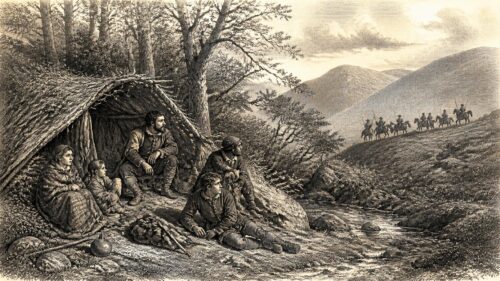
The immediate setting was an agricultural depression rather than a return of the Great Famine on its earlier scale. Rural Ireland had changed greatly since the 1840s: population had fallen, the cottier system had contracted and emigration had become an enduring outlet. Yet these changes had not abolished precarity. Across much of the west, farms were small, holdings were commonly rented rather than owned, and families balanced potatoes, small livestock, seasonal earnings and credit from local shops. A weak potato harvest could therefore threaten both food and the ability to meet rent.
The harvest of 1879 was especially damaging after poor seasons in 1877 and 1878. Bad weather and crop loss reduced the resources of tenants already affected by falling prices for agricultural produce in an increasingly competitive international market. The effects were regional and unequal. Commercial cattle and tillage districts were not identical to the congested, poorer districts of Connacht, but the crisis was serious enough to revive memories of the catastrophe of 1845–52. Hunger, indebtedness and the prospect of eviction again became subjects of public alarm.
It is important not to turn every difficulty in 1879 into famine mortality. Contemporary and later accounts differ in emphasis, and the principal organised relief funds reached their greatest activity in 1880. Still, the distress visible by the autumn of 1879 was real: food stocks and seed supplies were endangered, credit was strained, and tenants faced demands for rent despite the failure of crops. The crisis made the terms of landholding—who bore the risk of a bad year, who controlled the farm, and who could remain on it—an urgent political question.
Irishtown’s Tenant Meeting
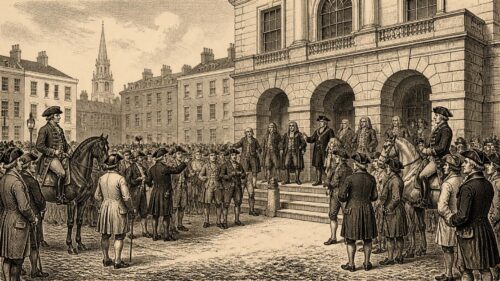
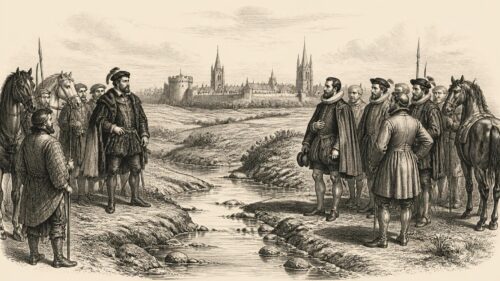
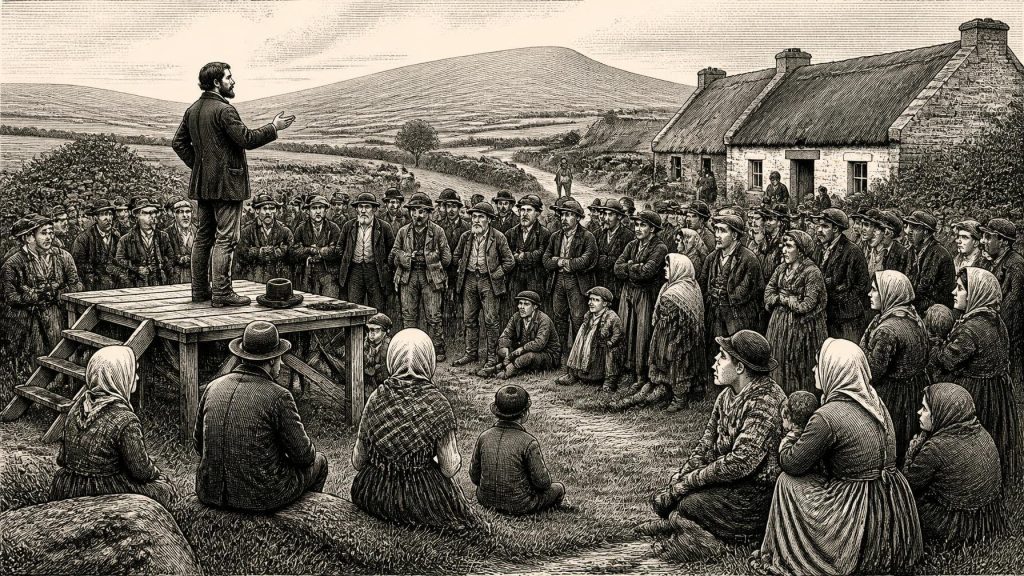
A firmly dated turning point came on 20 April, when a large tenant-right meeting assembled at Irishtown, near Claremorris in County Mayo. It arose from a local dispute involving tenants on the estate of Canon Ulick Burke, but it was organised as a wider demonstration against excessive rents and insecurity. Michael Davitt, recently active again in Irish politics after years in Britain, was closely involved in the emerging movement; James Daly, proprietor of the Connaught Telegraph, used his paper and local connections to help convene opinion. Speakers included tenant-right advocates such as John O’Connor Power and Thomas Brennan.
The meeting mattered because it joined a concrete rent dispute to a national claim: the land of Ireland should sustain its people. It was not an armed rising, nor did it immediately create a countrywide organisation. Its strength lay in public assembly, newspaper publicity and the demonstration that tenants could act collectively. The success of the protest encouraged further gatherings in Mayo. At Westport on 8 June, Davitt and Charles Stewart Parnell addressed a major meeting, linking local grievance with a parliamentary nationalist of growing influence.
By the summer, the agitation had acquired a more durable county structure. The Mayo Land League was established at Castlebar on 16 August. Its formation marked a transition from episodic protest to organisation: branches, meetings, resolutions and funds could connect tenants in separate parishes, defend those threatened with eviction and make rent reduction a collective demand rather than an isolated plea to a landlord. The language of “fair rent”, security of tenure and the chance to acquire ownership drew upon long-standing tenant-right arguments, but the mobilisation gave those arguments new force.
The distinction between the Mayo body and the later national organisation matters. On 21 October, the Irish National Land League was established in Dublin, with Parnell as president and Davitt, Thomas Brennan and Andrew Kettle among its central organisers. Its published rules envisaged branches in every parish or group of parishes. The League brought together people with overlapping but not identical purposes: small farmers seeking lower rents, larger tenants anxious about falling returns, shopkeepers owed money, constitutional nationalists, Fenians and advocates of peasant ownership. That breadth was a source of energy, but also meant that the movement’s ultimate aims could be expressed differently by different supporters.
Parliamentary Nationalism in Transition
The land agitation developed during a change in Irish parliamentary politics. Isaac Butt, the barrister and founder of the Home Rule movement, died near Dundrum, County Dublin, on 5 May. Butt had made an Irish parliament for domestic affairs a respectable constitutional demand and had gathered a substantial Home Rule parliamentary party. By 1879, however, his leadership had been weakened by divisions over tactics and by the more confrontational parliamentary obstruction associated with Parnell and Joseph Biggar.
Butt’s death did not hand Parnell an uncontested leadership of Irish nationalism. The Home Rule party remained divided, and William Shaw became its chairman. Yet Parnell’s presidency of the Land League gave him a different platform: he could connect Westminster politics with rural organisation. This was the political innovation of the year. The campaign for an Irish legislature and the campaign over land were not identical, but in 1879 they began to reinforce one another. The result was a sharper challenge to landlord power and to the limited remedies offered by the Land Act of 1870.
Knock in a Troubled County
County Mayo also witnessed the year’s most enduring religious event. On the wet evening of 21 August, villagers at Knock reported seeing silent figures at the south gable of the parish church: the Virgin Mary, St Joseph, St John the Evangelist, an altar, cross and lamb. Fifteen witnesses later gave testimony. Their accounts described a vision observed through heavy rain, rather than a spoken message or a demand for action.
For historians, the event must be described carefully. What can be firmly dated is the reported occurrence, the named witnesses and the church investigation that followed; the supernatural character of the vision lies within religious belief, not historical proof. Archbishop John MacHale of Tuam established an ecclesiastical commission of inquiry on 8 October. Its members took witness statements during the following weeks and reported that the testimony was trustworthy and satisfactory. MacHale did not issue a public pronouncement at that time.
Knock’s setting gives the reports particular resonance. The parish lay in a region affected by agricultural distress, while the daily work recalled in witness material—saving turf for fuel, tending fodder and managing small farms—belongs to the same strained rural world that produced the Land League. It would be misleading to claim that the apparition caused the land agitation, or that its later international pilgrimage status already existed in 1879. At year’s end it was a new and intensely significant local devotion under investigation, whose larger development still lay ahead.
Relief, Government and Education
The worsening autumn prompted charitable as well as political responses. The duchess of Marlborough, wife of the lord lieutenant, began a relief fund in December; its major distribution belongs chiefly to the following year. The approach itself revealed a continuing dependence on philanthropy, local committees, clergy, boards of guardians and private credit when harvest failure hit. It also exposed a basic argument about responsibility. Tenants and their advocates asked why people who had lost crops should pay unreduced rents; landlords and government officials feared that exceptional concessions could reshape the whole land system.
One quieter development occurred in higher education. The University Education (Ireland) Act of 1879 created the Royal University of Ireland, an examining and degree-awarding body that began operating in 1880. It replaced the Queen’s University framework while leaving the colleges at Belfast, Cork and Galway in place. The measure did not settle the demand for a publicly endowed Catholic university, but it widened the route by which students from different institutions could sit examinations and obtain recognised degrees. In a year dominated by rural emergency, it was a reminder that disputes about opportunity, denomination and authority also ran through urban and middle-class Ireland.
The Year’s Inheritance
By December 1879, no single settlement had been reached. Distress had not disappeared, land legislation had not been remade, and the new League had only begun to test its national reach. Nevertheless, Ireland had changed. Irishtown showed that a local grievance could become a public movement; Castlebar and Dublin supplied that movement with organisation; Knock gave a poor Mayo community a religious event of exceptional power. Together, these developments made 1879 a threshold year: the crisis of the countryside had become impossible for Irish and British politics alike to ignore.
Primary Sources
- The Irish National Land League: Rules for the Guidance of Branches
- Oireachtas L&RS Display Case – October 2019
- Hunger and Poverty after the Famine
- The Right to Life, the Right to Nature, and the Impact of Irish Land on Political Thought in the 1880s
- The West's Awake! The Early Months of the Land War
- Irish-American Anti-Imperialism in Patrick Ford's The Criminal History of the British Empire
- Butt, Isaac
- Isaac Butt and the Founding of the Home Rule Movement
- History
- The Apparition at Knock 1879
- About Knock Shrine
- History of the National University of Ireland
- University Education (Ireland) – Second Reading, 24 July 1879
- Second Reading: Adjourned Debate on Amendment on Second Reading, 29 June 1880
- Agricultural Statistics, 1847–1926: Report and Tables, Appendices
- Churchill, John Winston Spencer
- Relief Fund
- Mansion House Fund for Relief of Distress in Ireland, 1880
- The Irish Crisis of 1879–80: Proceedings of the Dublin Mansion House Relief Committee, 1880
- Rural Ireland, 1850–1950: Timeline of Events
- Ireland in the Nineteenth Century: Document Pack
- The Irish Land Question, the International Monetary Problem, and Archbishop William Walsh, 1881–1896
- Power, Politics and Poor Relief during the Irish Land War, 1879–82
- Landowner Associations, Land Committee and Property Defence Association Records