Parliament Street’s Fenian Press1863 CE
In 1863, post-Famine Ireland remained marked by poverty, precarious employment, local distress and continued emigration, linking communities with Britain and North America. Parliamentary debates addressed relief, destitution and insecure tenant tenure, while drainage legislation promoted estate improvement without resolving tenant rights. The Poor Removal Act addressed welfare disputes arising from migration. Against this background, James Stephens and Irish Republican Brotherhood associates established The Irish People in Dublin on 28 November, funded partly by American Fenians. Edited and managed by organisers, the newspaper provided public republican platform, encouraging recruitment and fundraising. Belleek Pottery’s Parian production also indicated uneven national industrial development.
Dateline
In 1863 Ireland was not the scene of a rebellion, nor did Westminster enact the decisive land or church measures that later generations would associate with the decade. Yet it was a consequential year. The country’s persistent poverty, continued emigration and unresolved land question formed the setting for a more forceful kind of separatist politics. Most visibly, a new weekly newspaper, The Irish People, began publication in Dublin on 28 November. Its appearance gave the Irish Republican Brotherhood (IRB) a public voice, a means of raising money and recruits, and a way of linking local discontents to a transatlantic republican movement.
The newspaper was not Ireland in miniature. Much of the population was concerned above all with harvests, employment, rents, family migration and access to relief. Protestant unionists, Catholic constitutional nationalists, landlords, merchants and industrial workers did not share one political programme. Still, the events and arguments of 1863 show why Fenianism could acquire an audience: the social effects of the Great Famine had not ended with the famine years, and many Irish people saw little security in the arrangements that had replaced them.
Distress, Migration and Argument
The demographic transformation of post-Famine Ireland remained starkly visible. The 1861 census had confirmed that the island’s population had fallen enormously since 1841 through death and migration. In 1863 the outward movement continued on a large scale. Later official figures put emigration from Ireland during that calendar year at 119,788 people, including men, women and children. Departure was not simply an economic statistic: it altered households, removed young adults from villages and towns, and created dense networks of family correspondence, remittances and political contact across the Atlantic.
Contemporary discussion shows both the reality of hardship and the difficulty of treating Ireland as a single, uniformly desperate country. On 5 February, Irish MPs spoke at Westminster of crop failures, indebted small farmers, under-employed labourers and artisans, and the continuing loss of people even while war made travel to America hazardous. On 24 February the Chief Secretary for Ireland was questioned about whether Poor Law Commissioners should direct outdoor relief to distressed agricultural labourers, unemployed mechanics and other destitute people. Such questions did not prove that every district faced starvation; they demonstrate, rather, that relief and employment had become urgent public issues.
The debate sharpened during the summer. On 12 June, MPs considered a motion for a select committee on the condition of Ireland. Advocates for inquiry described severe want in places including Galway and connected hardship to a declining agricultural population, while ministers and their supporters pointed to Poor Law evidence of cheaper food, more available fuel and a comparatively mild spring. On 2 July, Parliament again heard reports alleging destitution in parts of Ireland. The disagreement matters. It would be irresponsible to describe 1863 as a renewed nationwide famine. But neither can the calmer official reading erase local deprivation, precarious seasonal work and the fragility of small farming after the catastrophe of the late 1840s.
Land and the Limits of Reform
The most persistent political grievance concerned the relationship between landlord and tenant. Irish occupiers commonly lacked the security to assume that improvements to a holding would remain theirs to enjoy. Rent, tenure, eviction and the division or consolidation of farms shaped whether a household could make plans beyond the next season. On 23 June, Westminster debated a proposed royal commission on landlord and tenant in Ireland. Speakers made the case that insecure tenure discouraged improvement and helped drive emigration; others resisted the premise or remedy. No settlement of the larger tenant-right question emerged in 1863.
Legislation nevertheless showed that the state continued to approach rural development principally through improvement schemes rather than a redistribution of bargaining power. The Drainage and Improvement of Lands Act (Ireland) 1863 created procedures through which interested proprietors could petition for a drainage district. Proposed works required plans, estimates, notice to affected parties and an assessment of the increase in land value expected from drainage. The measure could assist the reclamation or better management of land and waterways. Its structure, however, also reveals the priorities of the period: improvement was conceived through property, capital, engineering and the anticipated value of estates, not through a statutory guarantee of tenant security.
Another measure, the Poor Removal Act 1863, dealt with a less conspicuous consequence of migration. It allowed Irish Poor Law authorities to challenge certain removals of poor people from England to Ireland and set out an appeal procedure. The act did not solve poverty on either side of the Irish Sea. It did acknowledge a practical problem created by mobility: people who had crossed the channel in search of work could become the subject of disputes over legal settlement and the cost of relief.
A Republican Paper in Dublin
Against this background James Stephens sought to consolidate the clandestine IRB, founded in 1858, by establishing a newspaper. The decision was both political and practical. A secret oath-bound organisation needed funds, communications and sympathisers, but it could not advertise its full internal arrangements. A newspaper could circulate a nationalist interpretation of current affairs in public while helping to support the movement that stood behind it.
Its creation was also transatlantic. Financial assistance came from John O’Mahony and the Fenian Brotherhood in the United States. The American Civil War was still being fought in 1863, and Irish migration had made North America an essential arena for Irish politics as well as family life. The connection did not mean that Ireland was directed from abroad; it meant that money, people, news and political expectations travelled in both directions. The Fenian project imagined an Irish republic, but its organisers understood that the diaspora could supply resources unavailable at home.
Personnel gathered in Dublin during the year. Jeremiah O’Donovan Rossa visited New York on IRB business in June and, after returning in July, moved permanently to Dublin to manage the paper’s business and promote it around the country. In August Stephens recalled John O’Leary from London to edit the projected journal. Thomas Clarke Luby became its registered proprietor and sub-editor. Charles Kickham, already a notable nationalist writer, was drawn into its editorial work, while Denis Dowling Mulcahy and James O’Connor also served the enterprise. These were not merely celebrated names added later to a national story: they were working journalists, organisers, bookkeepers and distributors undertaking the routine labour required to turn political conviction into a weekly printed object.
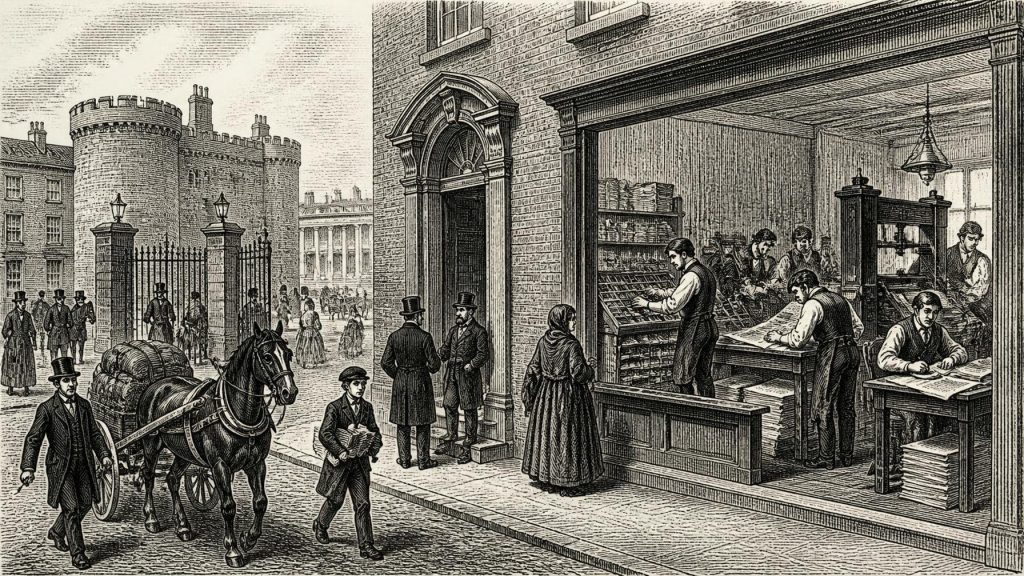
The offices were established at 12 Parliament Street, close to Dublin Castle, the centre of British administration in Ireland. The location was pointed. In an age of close surveillance, the Fenian press operated in the capital and near the machinery of government, rather than in some imagined rural redoubt. Printing required type, paper, premises, skilled labour, capital and a distribution network. It was at once a political challenge and a small urban business.
28 November: The First Issue
The first number of The Irish People appeared on Saturday, 28 November 1863. This is the year’s clearest dated political development. Its opening rhetoric placed Ireland’s predicament within a long history of English domination and revived the uncompromising language of earlier Young Ireland journalism. The paper advocated a national rather than parliamentary solution and treated independence as a matter of right, not a concession to be patiently requested from Westminster.
That language distinguished the paper from constitutional nationalism, but it did not instantly convert Ireland to Fenianism. Its readers encountered competing loyalties: attachment to the Union, local patronage, constitutional reform, denominational institutions and simple caution. The Catholic hierarchy’s hostility to secret oath-bound societies was an important constraint on Fenian organisers, though the scale and character of that conflict developed over the following years rather than in one single event of 1863. The paper’s importance lay in creating a durable public platform from which its writers could argue with rivals, recruit sympathisers and sustain a political community larger than a secret circle.
Work, Craft and Uneven Recovery
Political Dublin was not the whole country. In Belleek, County Fermanagh, a different development connected Ireland to industrial skill, natural resources and external markets. Belleek Pottery produced a small amount of Parian ware in 1863 after earlier attempts had failed. The factory had been established partly to provide employment on an estate affected by the post-Famine crisis, using local materials and water power. Earthenware remained its principal output for many years, so 1863 should not be treated as the moment of a fully mature porcelain industry. Nevertheless, successful Parian production marked a technical step towards the firm’s later international reputation.
This small industrial advance is a useful counterpoint to the parliamentary arguments over rural hardship. Ireland contained commercial towns, printing houses, workshops, mills, ports and developing manufacturers, but opportunity was very unevenly distributed. A skilled pottery in Fermanagh could not answer the immediate needs of landless labourers in Connacht or indebted tenants elsewhere. Nor did emigration cease because a new enterprise opened. Yet the work at Belleek demonstrates that post-Famine Ireland was not defined only by retreat: it also contained experiments in employment, design and manufacture.
A Year of Preparation
By December 1863 no Fenian rising had taken place, no comprehensive tenant-right settlement had been won, and the country’s social divisions remained intact. The significance of the year lies in preparation and connection. Parliamentary exchanges exposed the contested evidence of distress. Migration continued to bind Irish communities to Britain and North America. Drainage law offered one official model of rural improvement while leaving the central question of tenure unresolved. At 12 Parliament Street, meanwhile, the first issue of The Irish People transformed a clandestine republican organisation’s capacity to speak publicly.
The paper’s later suppression belongs to 1865, and the Fenian rising to 1867; neither should be read back as an event of 1863. What can responsibly be said is that the press launched in November made those later confrontations more conceivable. In a year marked by uncertainty about work, land and departure, it offered an assertive explanation of Ireland’s condition and an alternative political future. That was its immediate achievement, and its enduring historical importance.
Primary Sources
- Stephens, James | Dictionary of Irish Biography
- Luby, Thomas Clarke | Dictionary of Irish Biography
- O'Donovan Rossa, Jeremiah | Dictionary of Irish Biography
- Kickham, Charles Joseph | Dictionary of Irish Biography
- O'Leary, John | Dictionary of Irish Biography
- Mulcahy, Denis Dowling | Dictionary of Irish Biography
- O'Connor, James | Dictionary of Irish Biography
- O'Leary, Patrick ('Pagan') | Dictionary of Irish Biography
- Foundation of the IRB Newspaper, the “Irish People”
- Address to Her Majesty on the Lords Commissioners' Speech, 5 February 1863
- Question, 24 February 1863
- Condition of Ireland: Select Committee Moved For, 12 June 1863
- Landlord and Tenant (Ireland): Royal Commission Moved For, 23 June 1863
- Destitution in Ireland: Question, 2 July 1863
- The Budget—Financial Statement, Ways and Means, 16 April 1863
- English, 11 March 1864
- Drainage and Improvement of Lands Act (Ireland) 1863
- Poor Removal Act 1863
- Marriage Law (Ireland) Amendment Act 1863
- Company History | Belleek Pottery
- Museum | Belleek Pottery
- Belleek Pottery | National Museum of Ireland
- The Fenians, Parnell and the Land War | Ask About Ireland
- A Timeline of Ireland and the British Army | National Army Museum