Archived: 10 October 2026
Abstract
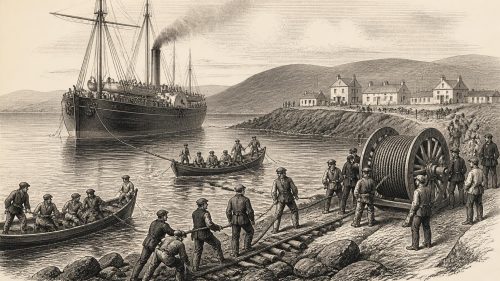
In 1858, Ireland experienced political, technological and social change. James Stephens founded the secret Irish Republican Brotherhood in Dublin, supported by Irish-American networks and committed to republican revolution. Valentia Island became the Irish terminus of the first transatlantic telegraph cable, briefly linking Britain and North America before failure. Post-Famine society continued to be reshaped by emigration, altered farming, poverty administration and Griffith’s Valuation. Infrastructure included Ballinacourty lighthouse, while Edward James Harland acquired Belfast’s Queen’s Island shipyard. Dundalk opened a free public library. These developments revealed uneven modernisation, connecting Ireland more closely with Atlantic migration, imperial commerce, industry and revolutionary politics.
Read Article

Archived: 10 October 2026
Abstract
In 1849, the Great Famine continued as blight, hunger, eviction, overcrowded workhouses and disease devastated Ireland. Cholera killed 772 of 1,077 recorded cases at Ballinasloe Union Workhouse, illustrating inmates’ vulnerability. Relief depended heavily on inadequate local rates; the May rate-in-aid redistributed Irish, rather than British, resources. The Incumbered Estates Act signalled restructuring of landownership, while emigration, consolidation and evictions altered rural life. Young Ireland leaders were transported, and unrest persisted; Dolly’s Brae exposed sectarian tensions. Victoria’s tour, new Queen’s Colleges and the Dublin–Cork railway projected progress, yet famine, political conflict and social upheaval still continued across the island’s fractured communities.
Read Article

Archived: 10 October 2026
Abstract
In 1848, renewed potato blight shattered hopes of Irish recovery after the catastrophic famine year of 1847, deepening hunger, disease and regional inequality. With soup kitchens closed, Poor Law unions, overcrowded workhouses and restricted outdoor relief became central, often forcing destitute tenants to surrender land. Cholera’s arrival foreshadowed mortality. Meanwhile, European revolutions inspired Young Ireland militants. John Mitchel’s United Irishman prompted the Treason Felony Act and his transportation; The Irish Felon briefly continued radical journalism. After habeas corpus was suspended, Smith O’Brien’s poorly supplied rising collapsed at Ballingarry. Subsequent trials created nationalist martyrs, while emigration, eviction and death devastated communities.
Read Article
Archived: 11 October 2026
Abstract
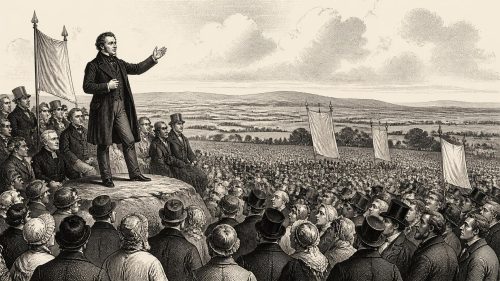
In 1843 Daniel O’Connell’s Repeal campaign sought restoration of an Irish parliament while retaining the Crown. Organised by the Repeal Association, enormous peaceful monster meetings at Trim, Tara and Mullaghmast mobilised supporters and linked self-government to Ireland’s nationhood, poverty, land insecurity and development. Thomas Davis and The Nation broadened its cultural nationalism, while clergy played organisational roles. Beneath pageantry, agricultural dependence, insecure tenancies and harsh Poor Law relief revealed social vulnerability. The prohibited Clontarf meeting marked the campaign’s defeat: O’Connell cancelled it to avert violence, after which government prosecutions began. Repeal failed, but 1843 shaped nationalism and highlighted Ireland’s crisis.
Read Article
Archived: 11 October 2026
Abstract
In 1840 Daniel O’Connell relaunched the constitutional campaign to repeal the Act of Union through the National, later Loyal National, Repeal Association, seeking an Irish legislature within the Crown rather than separation. Though initially modest, it established subscriptions, committees and local mobilisation. Parliament’s Municipal Corporations (Ireland) Act replaced most old corporations and reformed ten boroughs, but retained restricted franchises and limited powers. The Poor Law entered operation, with Cork’s temporary workhouse admitting inmates, signalling a restrictive institutional response to poverty. Rural inequality, population pressure and regional contrasts persisted, alongside railway plans, church reforms and Father Mathew’s temperance movement across Ireland.
Read Article




