Deasy’s Contract Law1860 CE
In 1860, Ireland remained shaped by post-Famine population loss, insecure rural tenancies and religious division. Deasy’s Act recast landlord–tenant relations as contractual, consolidating rules while failing to secure customary tenant-right or resolve ownership of improvements. Census legislation prepared a detailed 1861 enumeration, though household returns were later destroyed. Education expanded but attendance and progression remained limited, amid denominational conflict. Sectarian disturbances in Ulster prompted restrictions on party emblems and renewal of coercive policing. Railways, coaches, ports and emigration strengthened internal and Atlantic links, while the Irish Republican Brotherhood stayed clandestine. Boucicault’s The Colleen Bawn popularised a commercial theatrical Ireland abroad.
Dateline
In 1860 Ireland was neither at peace with its past nor yet in open political crisis. The Great Famine lay little more than a decade behind it; population was still falling through death, migration and the long after-effects of destitution; and the relationship between landowner and tenant remained the central fact of rural life. Yet the year’s most consequential Irish development was legislative rather than dramatic. On 28 August, Westminster enacted the Landlord and Tenant Law Amendment (Ireland) Act, soon known as Deasy’s Act. It attempted to state the law of tenancy in clear, contractual terms. In doing so, it exposed rather than settled the tension between formal law and the customary expectations of tenants.
That tension ran through much else in 1860. Parliament prepared to count the people in the census of the following April; public debate revealed deep dissatisfaction with education; summer disturbances in Ulster prompted further law on flags and party emblems; and a secret republican movement survived in the background, though it had not yet become a mass public force. Meanwhile, trains and coaches altered the experience of distance, emigrant routes bound Ireland ever more closely to the Atlantic world, and a new melodrama carried a stylised vision of rural Ireland to audiences in New York and London.
Land as Contract
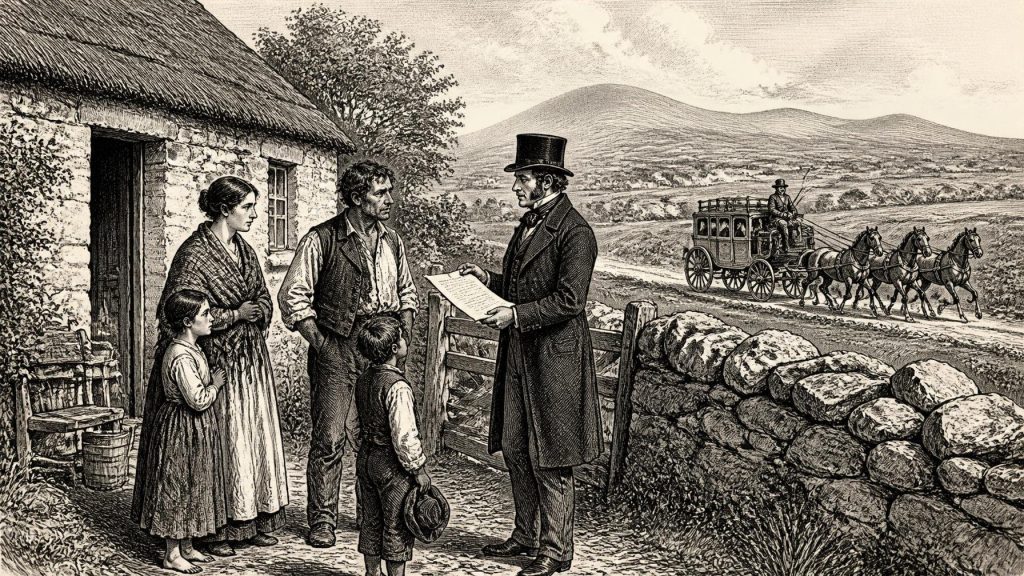
Deasy’s Act was firmly dated: it received royal assent on 28 August 1860. Its central declaration was that landlord and tenant were connected by the express or implied contract between them, rather than by the older language of tenure and service. The Act consolidated a dispersed body of rules governing leases, rents, assignments, notices to quit, ejectment and civil-bill proceedings. It also provided that leases for fixed terms longer than year-to-year tenancies should be made by deed or signed written note. To lawyers and administrators, such regularisation seemed a practical improvement. To many tenants, however, land was not merely a commodity hired at a rent.
In Ulster especially, but not exclusively there, tenant-right custom could mean that a sitting tenant expected some security, a right to sell the interest he had built up, and recognition of his improvements. Those expectations varied greatly from estate to estate. They were not equivalent to a universal statutory right, and no simple formula can describe all Irish tenancies. Nonetheless, the Act’s language of contract mattered because it gave priority to terms that proprietors were generally better placed to define and enforce. It did not establish the later principles remembered as the ‘three Fs’: fair rent, fixity of tenure and free sale.
Another measure of the same date, the Landed Property (Ireland) Improvement Act, permitted limited compensation for certain improvements made with the landlord’s consent. This was an acknowledgement that labour, drainage, buildings and reclamation could add value to a holding. But consent was crucial. The paired statutes therefore did not resolve the question of who owned the value created by a tenant’s work. They marked a stage in a long argument that would return with growing urgency in the 1860s and 1870s. For 1860 itself, it is safer to call them a legal reorganisation and a limited concession than a settlement of the land question.
Preparing to Count Ireland
Earlier that month, on 6 August, the Census (Ireland) Act had authorised an enumeration for 8 April 1861 and subsequent days. Its provisions show what the administration wished to know about the country. Dublin Metropolitan Police and the constabulary, supplemented by other appointees, were to visit every house. They were to record inhabitants’ sex, age, religious profession, occupation and birthplace, as well as inhabited and uninhabited houses and houses under construction. The keepers of workhouses, prisons, hospitals, lunatic asylums, barracks and specified institutions were to enumerate those in their charge.
This was not merely a neutral exercise in arithmetic. The planned count mapped a society through the institutions that governed it: the police district, the poor-law workhouse, the barrack, the parish and the borough. It also anticipated the practical difficulties of a dispersed rural population, seasonal movement and poverty. The Act imposed penalties for refusal, obstruction or knowingly false answers, and required those taking the accounts to certify their work. The surviving published census volumes became indispensable evidence for later historians, although the original household returns of 1861 were later destroyed. Thus a major administrative undertaking begun in 1860 would preserve aggregate knowledge of the island while losing innumerable individual household stories.
The preparatory legislation came at a moment when post-Famine restructuring was still visible across the countryside. Official agricultural series record 428,900 holdings in 1860, compared with 419,500 in 1855. The increase should not be mistaken for a return to the pre-Famine world of dense cottier settlement: small farms had already been drastically reduced after the catastrophe, and the broad movement of the nineteenth century remained towards fewer very small holdings, changing patterns of labour and greater dependence on livestock and market production. Families still lived with the insecurity of rent, harvest, employment and the possibility of departure.
Flags, Processions and Public Order
The summer brought a sharper reminder that Ireland’s divisions were not solely economic. On 20 July, MPs questioned the government about reports that Orange flags had been displayed from numerous churches and public buildings in the North between 1 and 12 July, amid serious local tension. Parliamentary exchanges were fiercely partisan. Some speakers maintained that existing law and policing were adequate; others argued that recurring demonstrations, songs and symbols had become predictable provocations in particular places. The disagreement itself is revealing: contemporaries differed not only over responsibility for violence but over whether state intervention protected public peace or improperly restricted expression.
Parliament’s answer was the Party Emblems (Ireland) Act, passed on 28 August. It amended existing law on party processions and addressed emblems displayed in circumstances calculated to provoke animosity and breach of the peace. Debate made clear that the measure emerged from sectarian conflict concentrated especially in Ulster, rather than from an undifferentiated condition across the entire island. The same late-August legislation renewed the Peace Preservation (Ireland) Act. Government speakers cited unrest in the North and the continuing existence of Ribbonism in parts of the midlands; opponents denounced the renewal as exceptional coercion imposed on Ireland. Neither description alone captures the year. Ordinary life continued across most districts, but recurring local confrontations and fears of agrarian conspiracy ensured that police powers remained a live constitutional question.
Schooling and the Churches
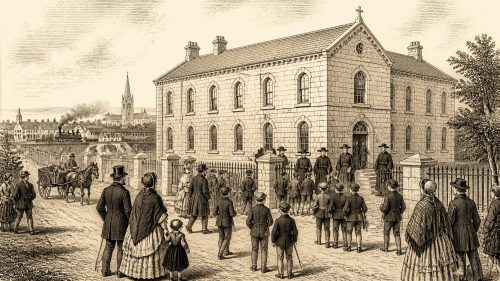
Education supplied another arena in which official policy and religious allegiance overlapped. On 30 April 1860, the House of Lords debated national education in Ireland. The discussion drew on census material to underline the limited reach of schooling among children aged five to sixteen. It also demonstrated how contested the supposedly non-denominational national system had become. Catholic clergy, Protestant church interests, religious teaching orders, local patrons, teachers and parents all had stakes in the character of the schoolhouse.
The annual figures associated with 1860 show both expansion and limitation. There were 519,000 names on national-school rolls, but the reported average daily attendance was only 363,000. Most pupils were reading the earliest books in the series: 214,709 used the primer and 249,999 the second book, while far fewer reached the later readers. Such figures do not measure intelligence or aspiration; they do indicate interrupted attendance, short school careers and the pull of household and seasonal work. A child might enter school, acquire some basic literacy and numeracy, and leave before reaching advanced lessons. The national system was important, but it did not yet deliver long, uniform schooling.
Religion also remained central to public life beyond the classroom. The Church of Ireland retained establishment and endowments despite representing a minority of the population, while the Catholic Church was increasingly organised through parishes, schools, convents and devotional institutions. The Church Temporalities Act of 1860 adjusted aspects of Church of Ireland property administration, but it was not disestablishment. That larger controversy belonged to the political future. In 1860, questions of school control, ecclesiastical resources and public authority were already teaching Irish people that religious identity could carry practical consequences in education, local influence and political debate.
Roads, Railways and Atlantic Connections
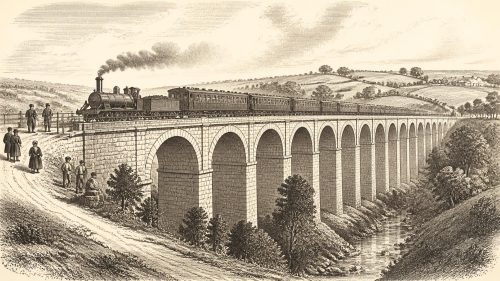
Modern movement was transforming the country unevenly. By 1861, Ireland had 1,423 miles of railway open, more than twice the 1851 mileage. The Railways Act (Ireland) 1860 and the Tramways (Ireland) Act 1860 belonged to a year of continuing attention to internal communication, even though the light-railway networks associated with later decades had not yet appeared. Railways concentrated traffic on principal routes and towns, but did not make older forms of transport redundant.
Charles Bianconi’s coaching enterprise illustrates the overlap. Railways had ended his former near-monopoly of road passenger transport, yet he adapted by running feeder services to stations and retaining routes beyond the rail network. In 1861 his business still employed more than 900 horses and covered roughly 4,000 miles of road. For passengers, traders and letter-writers, the new Ireland was therefore not simply rail replacing road; it was a connected system of trains, coaches, ports and walking journeys, whose benefits varied radically by region and income.
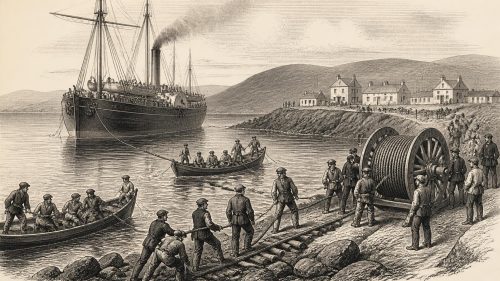
Emigration formed another connection. Irish ports recorded outward movement, while much larger streams of Irish people also left through British ports, particularly Liverpool and Glasgow. American official figures for 1860 counted 52,103 Irish emigrants arriving in the United States, a reminder that the Irish population and its political imagination increasingly stretched across the Atlantic. James Stephens’s Irish Republican Brotherhood, founded in 1858, remained a secret and still relatively limited organisation in 1860; Stephens was in Paris and Thomas Clarke Luby managed affairs in Ireland. It would be misleading to project the Fenian mobilisation of the mid-1860s backwards onto this year. Yet the movement’s transatlantic framework had already been established, connecting Irish radicalism to emigrant money, networks and expectations abroad.
An Ireland on the Stage
Culture supplied a different kind of international connection. Dion Boucicault’s The Colleen Bawn, adapted from Gerald Griffin’s The Collegians, premiered at Laura Keene’s Theatre in New York on 29 March 1860. Its title drew on the Irish phrase cailín bán, and its plot offered audiences a melodramatic rural Ireland of lakes, boats, secret marriage, class anxiety and comic local character. The play opened at London’s Adelphi Theatre on 10 September and became a conspicuous success.
The drama should not be treated as a transparent picture of everyday Ireland. It was a commercial theatrical construction, shaped for audiences in America and Britain as much as for any Irish public. Still, its rapid success is historically revealing. Ireland in 1860 was being measured, legislated for, policed and connected to external markets; it was also being imagined abroad through scenes of Killarney-like landscape and recognisable Irish types. Deasy’s Act dealt in contracts and rents, the census in categories and households, and Boucicault in emotion and spectacle. Together they show a country whose material realities and public images were both being remade.
Primary Sources
- Landlord and Tenant Law Amendment Act, Ireland 1860
- An Act for Taking the Census of Ireland
- Landed Property (Ireland) Improvement Act 1860
- Party Emblems (Ireland) Bill, House of Commons Debate, 20 August 1860
- Question: Party Banners in Ireland, House of Commons Debate, 20 July 1860
- Commons Chamber Debate, 10 August 1860
- National Education (Ireland), House of Lords Debate, 30 April 1860
- National Education in Ireland, House of Commons Debate, 17 May 1861
- Irish Statute Book: Public Acts of 1860
- Census Through History
- Life in 1916 Ireland: Stories from Statistics – Agriculture
- Education Records
- Bianconi, Charles
- Stephens, James
- The Irish Republican Brotherhood
- Return of the Emigration to the United States During the Years 1859–1863
- The Colleen Bawn
- The Colleen Bawn, 1860 Edition
- The Adelphi Theatre Project: Calendar for 1860–1861
- The Colleen Bawn and Tourism in Killarney
- The Tenant-Right Custom
- The Irish Land Question
- Railways
- Proceedings of the Royal Irish Academy, Volumes 1–7