
Blackwater Bank and Belfast Revival1859 CE
In 1859, post-Famine Ireland displayed religious revival, political restriction, migration and uneven modernisation. The Ulster Evangelical revival, rooted in earlier prayer meetings, reached peak visibility through mass gatherings, conversions and controversy, strengthening Protestant culture while provoking clerical criticism. Westminster elections operated under a narrow property franchise, leaving most people excluded. Dublin saw the launch of The Irish Times and the National Gallery’s foundation stone. The Pomona’s wreck off Wexford killed 424, highlighting emigrants’ perils. Railways reached Enniskillen and linked Tralee with Killarney, yet rural hardship deepened. Meanwhile, Fenian reorganisation abroad connected secret republicanism with Ireland’s diaspora and future political conflict.
Dateline
In Ireland, 1859 was neither a single turning point nor a quiet interval between larger dramas. It was a year in which the altered post-Famine country could be seen from several angles at once: in a religious movement that filled Ulster’s meeting-houses and open spaces; in a shipwreck off Wexford that exposed the continuing hazards of emigration; in a Westminster election conducted through a narrow franchise; and in new institutions and rail connections that expressed confidence in urban and commercial improvement. The evidence is strongest for particular events and dates, but these events belonged to a wider society still living with the demographic, economic and emotional consequences of the Great Famine.
A Revival Across Ulster
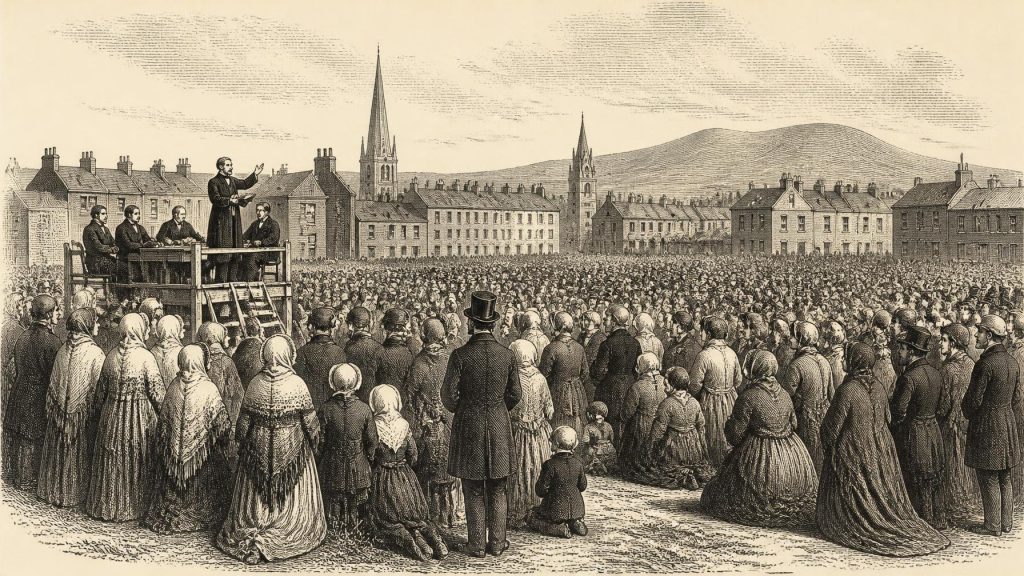
The most conspicuous development within Ireland during 1859 was the Evangelical Protestant revival in Ulster. Its immediate roots lay before the calendar year. Prayer meetings involving young converts had begun at Kells, County Antrim, in late 1857, encouraged by the Presbyterian minister John Hamilton Moore. During 1858 and, especially, 1859, reports of conversions, intense religious feeling, prayer gatherings and crowded services travelled rapidly through Presbyterian networks, newspapers and personal testimony. It was therefore not an event that can responsibly be assigned to one day, but 1859 was unmistakably its year of greatest public visibility.
Presbyterian ministers, laypeople and visiting preachers helped carry the movement from rural Antrim into Belfast and across much of Ulster. A major Belfast gathering on 29 June was later remembered as a high point. The revival crossed denominational boundaries in places, drawing support from Anglicans and other Evangelicals as well as Presbyterians, though its institutional centre of gravity remained Presbyterian. Services could be emotionally charged: contemporary accounts described weeping, confession, prayer and bodily agitation. Such accounts must be read with care, since supporters often presented them as evidence of divine intervention while critics suspected excitement, imitation or disorder.
That disagreement is historically important. The revival did not simply unite Protestant Ulster. Some Presbyterian clergy and educated observers objected to its methods and questioned whether dramatic conversion narratives encouraged religious instability. Others defended it as an overdue awakening in a society they believed had become spiritually complacent. Its lasting effects included additions to congregations, fresh energy in missions and philanthropy, and a stronger popular Evangelical culture. It also helped consolidate a broadly Protestant public identity in Ulster. That later political consequence should not be projected too neatly backwards, however: in 1859 the immediate language was principally one of salvation, moral reform and Christian fellowship, rather than a programme for constitutional politics.
Politics Under a Restricted Franchise
Political life was nonetheless active. The United Kingdom general election ran in Ireland from 28 April to 18 May. Ireland remained represented at Westminster under the Union, but elections did not provide a democratic portrait of the population. The vote was limited by property qualifications, and many contests were settled without a poll. Landlords, clergy, local notables, family influence and the cost of campaigning all mattered greatly. Conservatives secured a majority of Irish seats, although the pattern of returns did not amount to a simple measure of popular opinion. At the United Kingdom level, Lord Derby’s Conservative ministry fell and Viscount Palmerston formed a Liberal administration in June.
The result showed how fractured Irish parliamentary politics had become after Daniel O’Connell’s death and the weakening of the old Repeal movement. MPs might combine Catholic, tenant, local or constitutional concerns with affiliations that did not map neatly onto British party labels. There was no strong, disciplined nationalist parliamentary party capable of speaking for the island. The narrow electorate reinforced this political distance: labourers, most small occupiers and all women were excluded. For many people, politics was experienced less at the polling place than through rent, employment, church, relief administration, newspaper commentary and the authority of local elites.
Print, Art and the Capital
Dublin gained an enduring new voice on 29 March, when the first issue of The Irish Times appeared from Lower Abbey Street. Founded by Lawrence E. Knox, it began as a conservative paper and initially came out three times a week; on 8 June it became a daily. Its launch did not create Ireland’s vigorous press culture, which was already crowded and politically divided, but it added a newspaper that would survive when many contemporaries did not. The first issue’s attention to parliamentary and international affairs also illustrates how Irish readers encountered local concerns within the wider political world of the United Kingdom and empire.
Another Dublin event carried a different kind of national ambition. On 29 January, the Earl of Eglinton, then Lord Lieutenant, laid the first stone of the purpose-built National Gallery of Ireland on Leinster Lawn. The gallery had already been established in law in 1854, following campaigns associated with the Irish Institution and with the legacy of William Dargan’s 1853 industrial exhibition. The 1859 ceremony did not mean that the gallery was ready: the building would open to the public only in 1864. But the stone-laying made visible a serious investment in public art, learning and civic architecture beside Leinster House. It also demonstrated the importance of voluntary subscription, parliamentary grant and elite patronage in creating cultural institutions.
Sea Routes and a Wexford Catastrophe
On 28 April, the American packet ship Pomona, outward bound from Liverpool to New York, grounded on Blackwater Bank near Ballyconigar, County Wexford, and foundered. The number of deaths is generally given as 424, with only 24 survivors. Many aboard were Irish emigrants. This was not an Irish departure port disaster in the narrow sense, yet it was directly bound up with Irish migration: Liverpool was a principal embarkation point for people who had crossed from Ireland seeking passage to North America. The wreck brought a transatlantic route of hope and remittance into tragic proximity with the Irish coast.
The Pomona should not be made to stand for every emigrant experience. Thousands completed the journey, made homes abroad and sustained relatives through letters and money sent back. Yet the disaster is a sharp reminder that emigration remained a risky physical process as well as a vast social transformation. The post-Famine exodus had changed villages, households and labour markets, and continued departures in 1859 meant that family decisions were still tied to shipping agents, ports, weather, credit and overseas opportunity. News of a wreck could move through coastal communities with particular force because so many families had a direct connection to a ship, a port or a distant relative.
Rails and a Difficult Rural Year
Railway development offered another measure of connection and uneven change. On 15 February, the Dundalk and Enniskillen Railway reached Enniskillen, linking the town into a line running through Monaghan and Fermanagh towards Dundalk. On 18 July, the Tralee and Killarney Railway opened, completing a connection between two important Kerry towns. Railways made movement quicker for passengers, livestock, goods, newspapers and visitors, but they did not distribute opportunity evenly. Lines followed capital, anticipated traffic and political authorisation; many poorer districts remained distant from stations and markets.
For rural households, 1859 also began a run of difficult agricultural years conventionally described by historians as the depression of 1859–64. This was not a return of the Great Famine, and it would be misleading to treat all regions alike. Post-Famine agriculture had been shifting towards larger holdings, pasture and livestock, while many families had been reduced or removed from the land altogether. But poor harvest conditions and insecure incomes exposed continuing vulnerability, especially where holdings were small, employment seasonal and alternatives scarce. A modest farmer, labourer or cottier could experience the language of national improvement very differently from investors in railways or institutions in Dublin.
Secret Republicanism and Public Religion
Two contrasting currents of 1859 point towards future Ireland. One was conspicuously public: the Ulster revival mobilised prayer, preaching and voluntary religious association. The other was deliberately hidden. In New York during April, John O’Mahony reorganised the Emmet Monument Association as the Fenian Brotherhood. Its Irish counterpart, the Irish Republican Brotherhood, had been founded in Dublin in 1858 by James Stephens and associates. Stephens was seeking support among Irish-American nationalists during this period. In 1859 the movement remained small, secretive and far from an insurrectionary challenge in Ireland; it should not be inflated into a national force before its time.
Even so, the Fenian reorganisation connected Irish political discontent to the diaspora, to funds raised abroad and to a republican vision that rejected parliamentary compromise. It existed beside, rather than instead of, constitutional politics, religious renewal and economic migration. Ireland in 1859 was thus not moving along one straight path. A prayer meeting in Belfast, a poll in a county constituency, a newspaper office in Dublin, a foundation stone on Leinster Lawn, a train arriving at Enniskillen and the wreckage of an emigrant ship off Wexford all belonged to the same year, but revealed markedly different hopes, institutions and dangers.
Primary Sources
- Stephens, James | Dictionary of Irish Biography
- O'Leary, John | Dictionary of Irish Biography
- A Timeline of Ireland and the British Army | National Army Museum
- The Ulster Revival of 1859: Causes, Controversies and Consequences | The Journal of Ecclesiastical History
- The 1859 Revival and Its Enemies: Opposition to Religious Revivalism within Ulster Presbyterianism | Irish Historical Studies
- The ‘1859’ Revival in Ireland: Episodes and Evaluations | Irish Journal of Applied Social Studies
- The Burning Bush | Presbyterian Historical Society of Ireland
- Presbyterian Magazines | Presbyterian Historical Society of Ireland
- The Irish Times Trust | Safeguarding Independent Journalism
- Holdings: The Irish Times | National Library of Ireland Catalogue
- 1859 General Election – Parties | UK Parliament
- General Election – April 1859 | UK Elections Info
- Loss of Emigrant Ship Pomona 1859 | University of Liverpool
- Local Happenings – The Wreck of the Pomona | Dúchas.ie
- History of the Gallery | National Gallery of Ireland
- National Gallery of Ireland Act, 1854 | Irish Statute Book
- Catalogue of Pictures and Other Works of Art in the National Gallery of Ireland, and the National Portrait Gallery
- Dublin, Merrion Square, National Gallery of Ireland | Dictionary of Irish Architects
- An Industrial Heritage Survey of Railways in Louth and Monaghan | Louth County Council
- Table Showing Dates of Railway Construction in Kerry | O'Donohoe Archive
- Hunger and Poverty after the Famine | RTÉ History
- Famine and Land, 1845–80 | The Oxford Handbook of Modern Irish History
- Agricultural Change | After the Famine: Irish Agriculture, 1850–1914
- Historical Documents: Emigration to the United States, 1859–1863 | Office of the Historian