Hevey Institute and St Mel’s1856 CE
In 1856, post-Famine Ireland remained marked by depopulation, emigration, poverty and institutional reform. Poor Law debates addressed electoral fraud and the removal of destitute migrants from Britain, while estate sales and legislation on public works, drainage and valuation reshaped land, waterways and local taxation. St Mel’s Cathedral opened for worship in Longford, symbolising renewed Catholic confidence after construction halted during the Famine. Mullingar’s Hevey Institute combined charitable elementary schooling with classical education. In Dublin, Michael Henry Gill acquired McGlashan’s publishing business, while the murder of a railway cashier at Broadstone highlighted railway commerce. Reconstruction proceeded alongside continuing displacement and insecurity.
Dateline
In 1856 Ireland was no longer in the emergency years of the Great Famine, but it was far from restored. The population loss revealed by the 1851 census—following death, emigration and the collapse of many tiny holdings—remained the defining condition of the decade. There was no single national turning point in this calendar year. Instead, 1856 can be seen through particular openings, laws and public incidents: a cathedral opened in Longford, a charitable school began teaching in Mullingar, Dublin’s book trade changed hands, and the state continued to recast the machinery of local government, public works and rural property. These were signs of reconstruction, but also reminders that recovery was uneven and often governed by institutions rather than by those who had suffered most.
A Post-Famine Landscape
The year must be placed carefully in its wider setting. The Famine’s acute crisis had passed, yet its demographic and social effects were ongoing. The 1851 census recorded an Ireland dramatically reduced from the population counted in 1841; emigration did not stop once hunger receded, but became an enduring feature of Irish life. The great departures of the previous decade had altered households, labour markets and expectations. Young adults, particularly from poorer rural communities, increasingly looked across the Irish Sea or Atlantic rather than towards subdivision of a family holding at home.
For many people, everyday life in 1856 was shaped by the difficult adjustment to that new reality. Workhouses and Poor Law unions remained central to relief and local administration. Parliamentary debate in June exposed how consequential their governance was: a proposed Irish Poor Law measure addressed fraudulent guardian elections, after allegations that 800 votes had been forged in one Dublin union during 1855. The dispute was not a minor technicality. Poor Law rating also helped determine other local electoral rights, so control of the union affected both welfare decisions and political influence.
Mobility could be harshly policed as well as chosen. In April, Westminster debated reform of the law by which impoverished Irish people seeking aid in Britain could be removed to Ireland if they lacked the required local residence. The discussion makes plain that post-Famine migration created a connected system of Irish, British and Scottish poor relief, in which destitution could mean expulsion as well as assistance. Such debates should not be mistaken for proof that every emigrant was destitute; rather, they illuminate the precarious position of those who arrived in British towns without work, kin or settlement rights.
Land, Water and Local Charges
Land continued to be remade through finance and law. The Encumbered Estates Court, established in 1849 to facilitate sales of debt-ridden Irish estates, was still actively processing property in 1856. Its business arose from a structure exposed by the Famine: rental income had failed, landlords faced debts and creditors sought sale. For tenants, a change of owner could bring uncertainty rather than automatic improvement. Rentals and sale particulars recorded farms, tenants, acreage and rents with striking precision, while the larger human outcome depended on what a purchaser chose to do with an estate. A documented November 1856 sale offering at Carrowcrin, County Sligo, is one small indication of a nationwide process still under way.
Parliament also legislated directly for material improvement. The Public Works (Ireland) Act received royal assent on 29 April, continuing authority for loans for public works in Ireland. On 21 July the Drainage (Ireland) Act dealt with the aftermath and maintenance of major schemes. It divided the Lough Neagh navigation into Lower Bann and Upper Bann navigations, made provision for the Ballynamore and Ballyconnell district and for Lough Corrib, Mask and Carra, and vested works in trustees. The Act allowed tolls and, where income proved inadequate, charges on counties, baronies and townlands. It also provided that maintenance rates and instalments could be recovered from proprietors through civil bill proceedings.
These measures embodied a Victorian faith in drainage, navigation and credit as engines of improvement. They also show the distribution of costs. Works intended to make land and waterways more productive required boards of trustees, public loans, local taxation and legal enforcement. In the same July legislation, grand-jury assessments in counties where the general valuation had been completed were to be apportioned according to the valuation list. Richard Griffith’s nationwide valuation was in progress during the 1850s, making the state’s increasingly detailed assessment of Irish property a practical part of local government.
St Mel’s Opens for Worship
A more visible expression of post-Famine rebuilding came in Longford. On 29 September 1856 St Mel’s Cathedral opened for worship under Bishop John Kilduff. The date is firmly recorded, but the building must not be imagined as wholly complete in its later form: its campanile and entrance portico belonged to subsequent phases, and the cathedral was not consecrated until 1893. What opened in 1856 was nevertheless an imposing Roman Catholic cathedral, planned in a confident neoclassical idiom and built on a prominent site in the county town.
The cathedral’s interrupted construction gave the occasion its particular meaning. Begun in 1840 for Bishop William O’Higgins, the project was suspended in 1846 as the Famine began and resumed in 1853. Its opening therefore marked the resumption of an ambitious undertaking after a decade in which money, labour and attention had been drawn towards survival. Its local limestone, including columns quarried at nearby Newtowncashel, linked an international architectural language to a regional landscape and workforce. The scale of the church did not cancel Longford’s recent suffering; it demonstrated instead the institutional resilience and growing public confidence of the Catholic Church in mid-century Ireland.
Learning at Mullingar
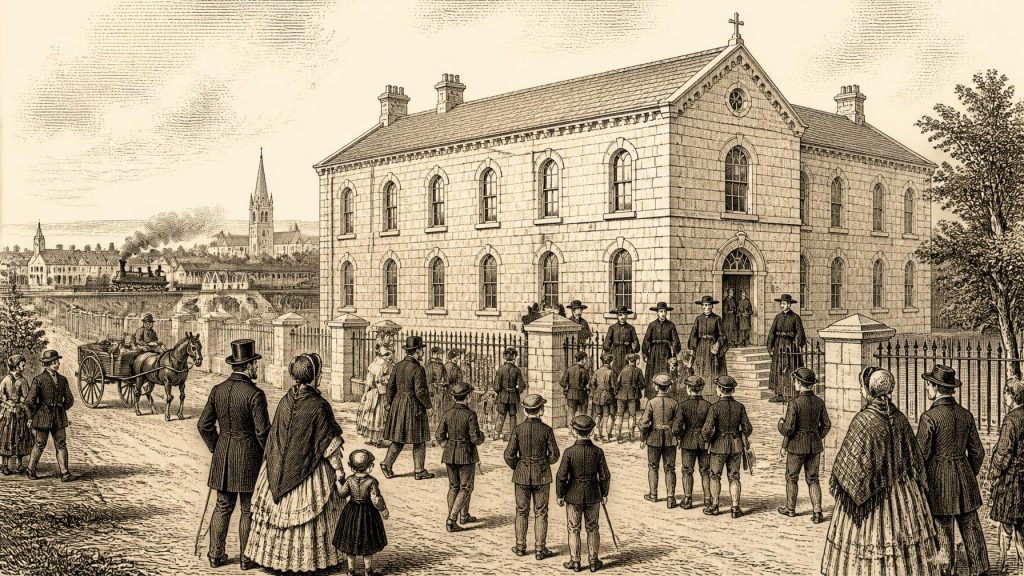
Less monumental but equally revealing was the opening of the Hevey Institute in Mullingar on 20 October. James Hevey, a local brewer and landowner, had left property for the education of poor children in the parish; after his death, trustees carried that intention through to the new institution. The school contained two distinct departments. A general school, entrusted to the Christian Brothers, served poor boys of the parish. A collegiate or classical school taught Latin and Greek, preparing pupils for places such as St Patrick’s College, Maynooth.
This dual structure conveys much about education and social aspiration. The general school offered literacy, numeracy, geography, history, bookkeeping, drawing, geometry and mechanics—subjects useful in a commercial and technically changing society. The classical side offered a route towards clerical education and the learned professions. Its foundations were charitable, but its curriculum reached beyond bare charity. In a town connected to Dublin by rail since 1848 and to Galway from 1851, the institute joined improved transport, Catholic educational organisation and local philanthropy. It represented opportunity, although one must not generalise its resources to all Irish children, many of whom still encountered irregular schooling, early work and poverty.
Dublin’s Printed and Railway City
Dublin supplied two sharply contrasting indications of urban modernity. On 1 January, Michael Henry Gill bought James McGlashan’s stock, copyrights and premises, establishing McGlashan & Gill at Upper Sackville Street. Gill had long been connected with Dublin University Press and had printed important Irish scholarly work, including John O’Donovan’s edition of the Annals of the Four Masters. The transaction did not create a national literary revival by itself, but it established the firm that became M. H. Gill & Son and, later, part of the lineage of Gill publishing. It is a modest but definite landmark in the infrastructure through which Irish books, school texts and religious publications circulated.
At Broadstone, headquarters and terminus of the Midland Great Western Railway, a far darker event occurred on the night of 13–14 November. George Samuel Little, the railway’s cashier, was murdered. The surviving archival catalogue records the inquest and statements gathered in 1856–57, while the later published trial of James Spollen demonstrates the case’s exceptional public afterlife. It should be described with restraint: the murder belongs securely to 1856, but the trial belongs to August 1857. Even so, the crime revealed how railways had created new concentrations of cash, clerical work and public attention within the capital.
By year’s end, Ireland in 1856 was neither simply recovering nor merely waiting for later political upheavals. Church building, charitable education, publishing, drainage administration and railway commerce all showed institutions investing in a changed country. Yet emigration, estate sales, Poor Law administration and the burden of rates made clear that the social settlement emerging from the Famine remained unsettled. The year’s most durable story lies in that tension: visible construction alongside continuing displacement.
Primary Sources
- Census 1851
- Census through History
- The panicked flood: emigration and the Great Famine
- POOR LAW (IRELAND) BILL. (Hansard, 18 June 1856)
- SCOTCH AND IRISH PAUPER REMOVAL BILL. (Hansard, 1 April 1856)
- SETTLEMENT AND REMOVAL OF PAUPERS. (Hansard, 5 February 1856)
- The Public Works (Ireland) Act 1856
- The Drainage (Ireland) Act 1856
- The Transfer of Works (Ireland) Act 1856
- Office of the Chief Secretary of Ireland: Chronology
- The Landed Estates Court, Ireland
- Reference Source | Landed Estates | University of Galway
- Incumbered Estates Court (Ireland): Return of Petitions and Sales
- Saint Mel’s Cathedral, Cathedral Square, Longford
- Saint Mel's Catholic Cathedral, Longford
- Longford Parish – Parish History
- History | Coláiste Mhuire
- Blessing of the Restored Hevey Institute, Mullingar
- Gill, Michael Henry | Dictionary of Irish Biography
- Alice Stopford Green Navigates the Publishing Process
- Family of Flanagan/Woulfe Flanagan
- Trial of James Spollen, for the murder of Mr. George Samuel Little
- Trial of James Spollen, for the murder of Mr. George Samuel Little, at the Broadstone terminus of the Midland Great Western Railway, Ireland
- Newman, John Henry | Dictionary of Irish Biography
- Stephens, James | Dictionary of Irish Biography