Octennial Act1768 CE
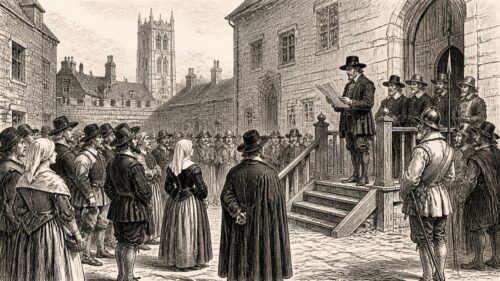
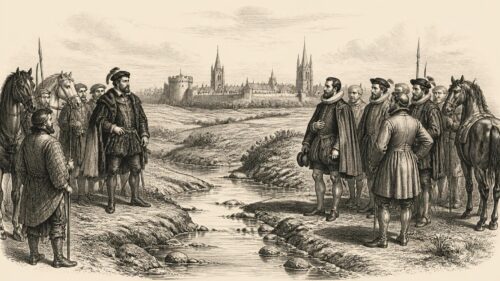
In 1768, Ireland’s Octennial Act received royal assent, limiting parliaments to eight years and prompting dissolution of the 1761 parliament and summer elections. Championed by Charles Lucas, it established regular electoral expectations but preserved Poynings’ Law, Protestant dominance and Catholic exclusion. Lord Lieutenant George Townshend’s proposed expansion of the Irish army was narrowly rejected, exposing conflict between Dublin Castle and parliamentary undertakers and encouraging his later patronage strategy. The new parliament did not sit until 1769. Elsewhere, Frederick Hervey became bishop of Derry, John O’Brien’s Irish-English dictionary appeared in Paris, and Poolbeg’s maritime works advanced Dublin’s commercial access and navigation.
Dateline
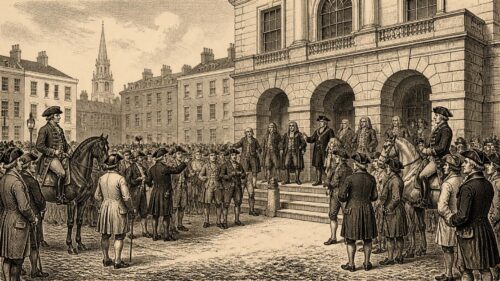
In 1768 the most consequential Irish development was not a battle, a harvest or a change of monarch, but a change to the rhythm of politics. The Octennial Act received royal assent on 16 February, placing an eight-year maximum on the life of an Irish parliament. It was a limited reform within a deeply restricted constitution, yet it required the dissolution of the exceptionally long parliament elected in 1761 and brought a new election that summer. Within weeks, Lord Lieutenant George Townshend’s attempt to secure a larger Irish-funded army was defeated in the House of Commons. Together, the two episodes exposed a central question: would Irish government continue to be managed through a small circle of powerful parliamentary brokers, or more directly from Dublin Castle in the name of the Crown?
An Eight-Year Limit
The Act was the outcome of a campaign for shorter parliaments associated especially with the Dublin radical and MP Charles Lucas, and supported in the later stages by Henry Flood. Before 1768, an Irish parliament could in practice endure for the lifetime of a monarch. The sitting parliament had begun in 1761, on George III’s accession, and had no automatic terminal date. Its members therefore faced electors only rarely. The new statute did not create democracy in a modern sense, nor did it guarantee that every parliament would last eight years. It imposed a maximum term. Nevertheless, it made recurring general elections a constitutional expectation.
The path of the measure reveals the constrained character of Irish law-making. Under Poynings’ Law, proposed legislation had to pass through the Irish and British privy councils before it could be considered by the Irish parliament. A measure sought in Ireland as a septennial, or seven-year, bill returned with important alterations: it prescribed eight years and brought the next election forward to 1768. The Crown’s assent on 16 February was widely welcomed as a concession. It also suited the British ministry, which hoped that a popular constitutional measure would make Irish MPs more willing to accept an unpopular military one.
The reform mattered because elections were a rare point at which public opinion, local influence and parliamentary patronage visibly met. It did not make the House of Commons representative of the whole country. The franchise was governed by property qualifications and varied between counties and boroughs. Catholics, who formed the great majority in much of Ireland, remained excluded from parliamentary voting, while the established Church of Ireland supplied bishops to the House of Lords and much of the political elite of the Commons. Presbyterians could possess votes where qualified, but the sacramental test still excluded them from many offices. The electorate was thus narrow, male and Protestant-dominated, though its members could now expect to be consulted more often.
The Army Division
Townshend had arrived as lord lieutenant in 1767 determined to reside in Ireland rather than leave routine government to the great local interests known as the ‘undertakers’. These magnates, notably Speaker John Ponsonby and the earl of Shannon, helped administrations conduct business in parliament in return for influence and patronage. Townshend’s immediate instruction from London was to obtain consent for an augmentation of the Irish military establishment, from 12,000 to 15,325 men. The proposal was connected with the wider British Empire: a regular rotation of regiments required greater uniformity in military establishments, and London wished Ireland to bear more of the expense of imperial defence.
On 19 April the Irish House of Commons rejected the augmentation by 105 votes to 101. The narrow division was politically loud. Some members objected to the cost to Irish revenue; others suspected that additional troops in Ireland would allow soldiers already stationed there to be sent elsewhere in the empire, including to a North America already troubled by resistance to British taxation. Protestant anxieties about security in a country with a Catholic majority were also part of the argument. The ministry had promised that the garrison would not fall below 12,000 men, but that assurance did not carry the proposal.
The defeat should not be mistaken for an assertion of national self-government by a representative assembly. It was, rather, a clash of interests within a legislature whose authority remained limited by constitutional dependence on Britain and by its own restricted electorate. Yet it showed that Townshend could not simply command the Commons. For him and for ministers in London, the vote demonstrated the weakness of an administration dependent on undertakers who could withhold support. It became an important step towards Townshend’s later effort to build a more obedient ‘Castle’ interest through offices, pensions and control of patronage.
Dissolution and Election
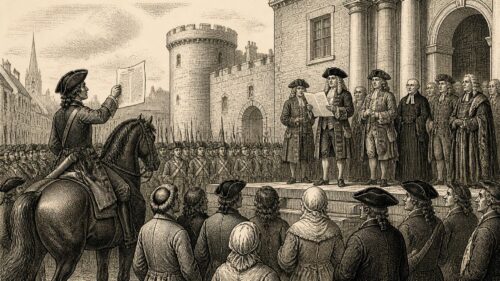
Events moved quickly after the military reverse. Townshend dissolved the old parliament on 28 May 1768. A proclamation called a new parliament, and elections followed during the summer. Charles Lucas was again returned for the city of Dublin; George Macartney secured the borough seat of Armagh in July. Such examples also indicate the uneven nature of electoral politics. County contests could mobilise substantial numbers of qualified freeholders and entail intense local expenditure, while many borough seats lay effectively in the gift of proprietors or corporations.
The new electoral timetable gave political arguments a practical local life. Candidates and their supporters had to court voters, bargain with local interests, provide hospitality and defend their reputations in print and conversation. But the election did not immediately produce a working new legislature. The new parliament was repeatedly prorogued and did not meet for business until October 1769. Thus 1768 established the cycle of octennial parliaments, but did not yet settle the struggle between Townshend, the undertakers and the Commons.
For most inhabitants, political change was observed rather than directly exercised. The religious survey authorised two years earlier had attempted to list households parish by parish as Protestant or Roman Catholic, illustrating the official importance attached to confessional allegiance. Its surviving and copied returns show the value of local parishes as units through which the state and established church sought knowledge of society. They also remind us that the parliamentary world of College Green rested upon a far larger population of tenant farmers, labourers, artisans, small traders and servants whose experience of government was often shaped by rent, tithe, local magistracy, militia and the price of food rather than voting.
Church, Language and Learning
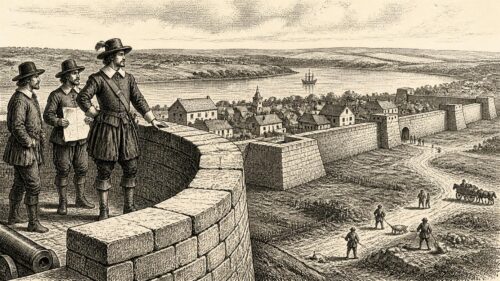
Two ecclesiastical developments illuminate the unequal religious landscape of the year. On 18 February Frederick Augustus Hervey was translated from Cloyne to the wealthy Church of Ireland bishopric of Derry. He would later become celebrated, and notorious, as the ‘Earl-Bishop’, but in 1768 the appointment was principally a conspicuous piece of establishment patronage. It placed an energetic and cultivated Anglican prelate in a diocese that included the important walled and commercial city of Londonderry.
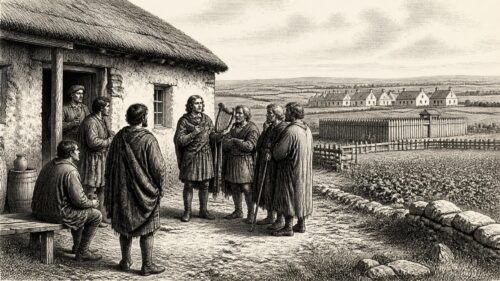
A very different religious and cultural network was represented by Focalóir Gaoidhilge-Sacs-Bhéarla, the Irish–English dictionary compiled by the Catholic bishop John O’Brien and published anonymously in Paris in 1768. O’Brien had drawn on earlier vocabularies and Irish manuscripts, and had sought support for publication as a resource useful to clergy serving Irish-speaking districts. The book’s Paris publication is significant. Catholic learning in eighteenth-century Ireland was not absent, but it operated under legal disabilities, incomplete institutional security and enduring connections with continental Europe. The dictionary preserved and ordered a learned Irish vocabulary at a time when English was expanding in administration, commerce and education. Its appearance was a firmly dated cultural event, even though it cannot by itself measure the daily use of Irish across the island.
Poolbeg and the Working Coast
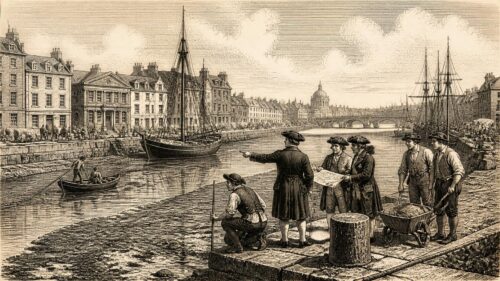
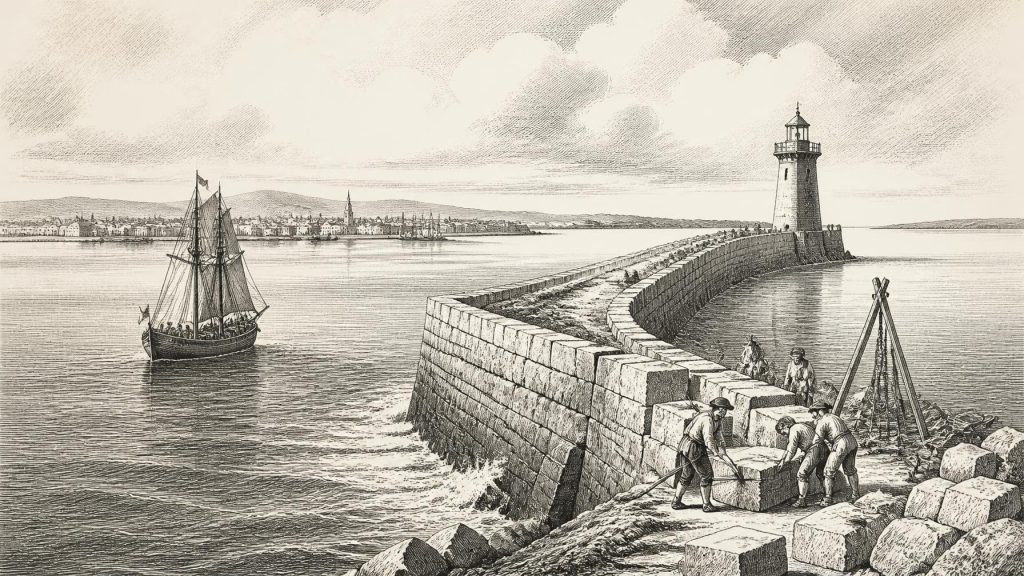
Dublin’s outward-facing economy was also being reshaped by long-running engineering at the mouth of the Liffey. The Great South Wall, projected from Ringsend into Dublin Bay to improve the channel and reduce the danger posed by shifting sand and silt, was still an unfinished work in the 1760s. Poolbeg Lighthouse became associated with this phase of construction. The dating requires care: Dublin Port’s history places its first lighting on 29 September 1767, while other later accounts date its completion or candle-lit operation to 1768. It is therefore safest not to claim a falsely precise first lighting in 1768.
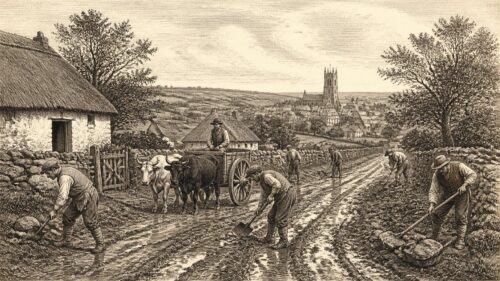
What can securely be said is that the lighthouse and wall were part of Dublin’s active maritime transformation in this year. The small light at the seaward end of the works served vessels approaching a city dependent on coastal and overseas exchange. The wall was intended to direct the Liffey’s flow, scour a navigable passage and make the port less vulnerable to the Dublin Bar. Its practical significance lay in safer access for merchant shipping, packets and passengers, as well as in the labour required to quarry, transport and set stone. Political conflict at College Green attracted attention, but the slower remaking of Dublin Bay was another durable feature of Ireland in 1768.
A Reform with Limits
The year left no settled victory. The Octennial Act was a genuine constitutional gain for those who wanted more frequent elections; the defeat of the army augmentation was a sharp embarrassment for Townshend; and the dissolution opened a new electoral era. None removed the exclusion of Catholics from the franchise, altered Poynings’ Law, or ended elite control of constituencies and offices. Still, 1768 changed the political calendar and sharpened the contest over who would direct Irish affairs. In the same year, O’Brien’s dictionary connected Irish scholarship to continental printing, while the continuing works at Poolbeg linked Dublin’s future to the sea. The country’s politics, culture and infrastructure were each moving, but on markedly unequal terms.
Primary Sources
- Townshend, George | Dictionary of Irish Biography
- Lucas, Charles | Dictionary of Irish Biography
- Macartney, George | Dictionary of Irish Biography
- Hervey, Frederick Augustus | Dictionary of Irish Biography
- O'Brien, John (Ó Briain, Seán) | Dictionary of Irish Biography
- Focalóir Gaoidhilge-Sax-Bhéarla or An Irish-English Dictionary | National Library of Ireland Catalogue
- Religious Census 1766 | National Archives of Ireland
- The Dublin Gazette, Number 1862: Saturday, 28 May 1768 to Tuesday, 31 May 1768 | Virtual Record Treasury of Ireland
- George III, 8th to 9th Year: Proclamations of 1768 | National Library of Scotland
- George III: King and Politicians
- Irish Legislation Database: Limiting Duration of Parliaments
- Central Aspects of the Eighteenth-Century Constitutional Framework in Ireland: The Government Supply Bill and Biennial Parliamentary Sessions, 1715–82
- Monitoring the Constitution: The Operation of Poynings' Law in the 1760s
- The Irish House of Commons in 1769 | Irish Historical Studies
- Public Building and Colonial Policy in Dublin, 1760–1800 | Architectural History
- ‘Reasonable Inconveniences’: The Theory and Practice of the Penal Laws | Oxford Academic
- Irish Penal Laws: Introduction | University of Minnesota Human Rights Library
- History of Parliament in Ireland | Houses of the Oireachtas
- Statute Law Revision Act 1879
- History of Port | Dublin Port
- Dublin Port Yearbook 2025
- Great South Wall Roundhead Reopens to Public, as Remedial Works Completed | Dublin Port
- A Century of Recovery – and Beyond: 1766 Religious Census of Ireland | Virtual Record Treasury of Ireland
- Statute Law Revision Bill 1981: Explanatory Memorandum