
Denny’s Leeson Street Refuge1765 CE
In 1765, Ireland’s contrasting institutions exposed mid-Georgian inequalities and efforts at control. Francis Seymour-Conway, earl of Hertford, became lord lieutenant as ministers sought resident rule, while parliamentary debates over septennial parliaments and grain exports revealed Ireland’s restricted autonomy under Poynings’ Law. The Whiteboy movement’s aftermath prompted coercive legislation, though the Whiteboy Act received assent only in 1766, reflecting conflicts over land, tithes and subsistence. In Dublin, Lady Arabella Denny founded the Magdalen Asylum for unmarried mothers and other stigmatised women, combining relief with discipline. In County Antrim, Gracehill’s Moravian church and Sisters’ House embodied ordered, transnational religious community in Ireland.
Dateline
In 1765, Ireland’s public life was marked less by a single dramatic national turning-point than by a revealing conjunction of events: a new lord lieutenant arrived to manage an unreformed political system; the long first outbreak of Whiteboy agrarian resistance reached its closing phase; a Dublin philanthropist opened a novel refuge for women judged to have fallen outside respectable society; and a Moravian community gave a distinctive physical form to religious settlement in County Antrim. These developments belonged to very different Irelands, but together they show the strain, invention and inequality of the mid-Georgian island.
The calendar must be handled carefully. Some measures commonly labelled “1765” were enacted only during the parliamentary session that began in October 1765 and ended in June 1766. They illuminate the year, but should not be treated as laws already in force in 1765. By contrast, the appointment of Francis Seymour-Conway, earl of Hertford, the opening of parliament on 22 October, the foundation of Lady Arabella Denny’s Magdalen Asylum, and building at Gracehill can securely be placed in this year.
A New Viceroy at Dublin Castle
Francis Seymour-Conway became lord lieutenant in August 1765. His arrival followed a decision by the British ministry, taken earlier that year, that future viceroys ought to reside continuously in Ireland. The intention was administrative as well as political. For decades, the lord lieutenant had generally come over for a parliamentary session and then departed, leaving government to lords justices and to powerful Irish figures who could “undertake” to manage votes in parliament in return for offices, pensions and influence. A resident representative of the Crown, ministers hoped, would restore authority to Dublin Castle and curb this expensive arrangement.
Hertford did not fulfil that expectation. He was in Ireland for the parliamentary session which opened on 22 October 1765, with his eldest son, Viscount Beauchamp, as chief secretary, but his was not a sustained resident viceroyalty. Even so, the appointment mattered because it placed the question of how Ireland should be governed at the centre of political calculation. The kingdom had its own parliament in College Green, but that parliament was neither representative in a modern sense nor fully autonomous. Roman Catholics were excluded from parliamentary politics; borough patronage heavily shaped the Commons; and, under Poynings’ Law, proposed legislation passed through Irish and British privy councils before it could become law.
That constitutional machinery made reform frustratingly indirect. During the 1765–66 session Henry Flood and other Patriot politicians again pressed for a bill to limit the duration of Irish parliaments. In Ireland, a parliament could otherwise last for the life of a monarch: the parliament elected after George III’s accession in 1760 had no automatic fixed end. Reformers sought a septennial limit, believing that elections at regular intervals would make MPs less secure in their seats and somewhat more accountable to electors. The proposal was carried through the Irish parliamentary process but was not allowed through in Britain. Its immediate failure belongs to the politics of the session; its importance lies in showing how a demand voiced in Dublin could be checked elsewhere.
Grain, Authority and Legislative Control
Another controversy exposed the same imbalance. In December 1765 Charles Lucas, Dublin MP, published against an alteration made to proposed legislation concerning the export of grain during scarcity. Lucas did not simply oppose precautions against export. His objection was constitutional: a power first contemplated for the Irish lord lieutenant and privy council to suspend the measure had been recast so that the power lay with the king and council in Britain. The technical wording of a grain bill therefore became an argument about where authority over Irish economic life resided.
For ordinary households, grain was not an abstract constitutional subject. Bread, meal and oats were staples, while market prices, harvest conditions and the movement of food to ports could quickly become matters of anxiety. Ireland exported agricultural produce and fed an expanding commercial economy, but many labouring and small-farming families remained vulnerable to local shortages and to the demands of rent, tithe and dues. Lucas’s pamphlet cannot tell us what every household experienced in 1765; it does, however, locate food supply and export policy among the year’s live public questions.
The Whiteboys’ Bitter Aftermath
In Munster and parts of south Leinster, the first major Whiteboy movement had begun in late 1761 and was still a defining recent experience in 1765. Whiteboys were oath-bound rural protesters, often operating at night in white shirts worn over their clothes. Their actions varied by locality, but the movement grew from acute disputes over enclosure and common rights, rents, tithes and the exactions associated with tithe collection. It was not a single centrally directed organisation, nor should every rural grievance be attributed to it. Yet its methods of nocturnal assembly, threats, levelling and attacks on property gave it a powerful and lasting name.
The state’s response became increasingly severe. A statute usually called the Whiteboy Act is conventionally dated 1765 because it was introduced in the parliamentary session of the fifth and sixth years of George III. Strictly speaking, its royal assent came in June 1766, so it should not be described as an act passed during calendar year 1765. Its terms nevertheless reveal the climate produced by the disturbances: collective attacks on persons or property, the administering of oaths under threat, and the rescue of prisoners were treated as capital offences. The law answered coercion with exemplary coercion, rather than addressing the rural pressures from which the movement had emerged.
This was a grim reminder of the limits of the celebrated stability of eighteenth-century Ireland. The political nation at College Green was overwhelmingly Protestant and propertied; beyond it were numerous Catholic tenants, labourers and cottiers with little formal leverage. Whiteboy activity did not amount to a national rebellion, and its participants had differing motives, but it made plain that apparently local contests over land, clerical payments and subsistence could threaten the social order.
Lady Arabella Denny’s Experiment
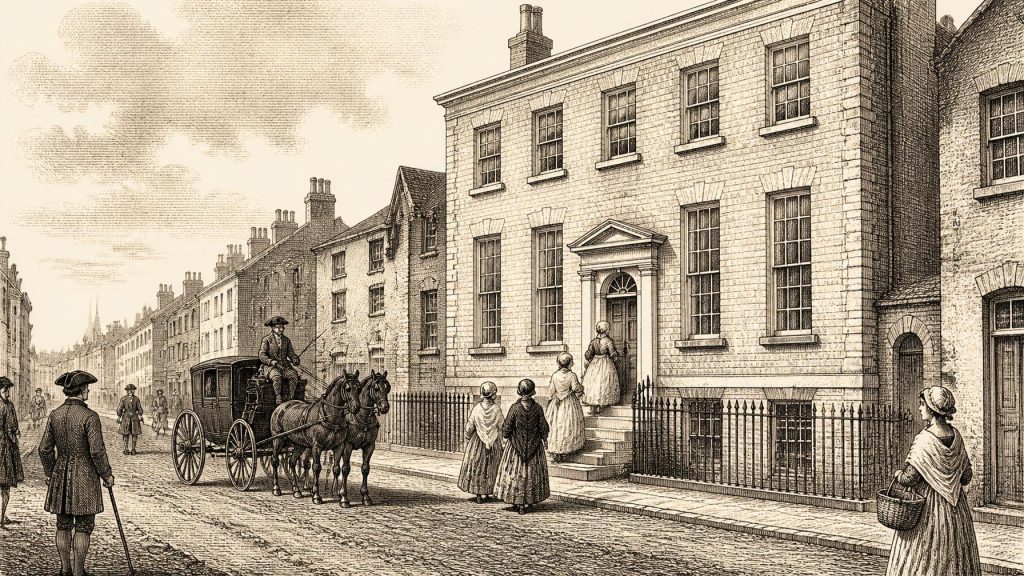
Against that background of coercion and exclusion, Lady Arabella Denny founded the Magdalen Asylum in Lower Leeson Street, Dublin, in 1765. It was the first institution of its kind in Ireland. Denny had already worked with the Foundling Hospital and other charitable causes, and the new asylum was intended as a refuge for unmarried mothers and women described in the language of the time as penitents or “fallen” women. Its purpose combined material relief, moral reform and preparation for a return to respectable employment.
That combination deserves neither sentimental treatment nor anachronism. The institution was founded long before the later network of Magdalene laundries with which the name is often associated, and its earliest surviving admission registers begin in 1767 rather than at the moment of foundation. Yet the asylum sprang from assumptions that were already deeply restrictive: women’s sexual reputations could determine their economic security, family acceptance and public standing. Rescue was offered through supervision, religious instruction and work, not through an assertion of female independence. Later records show that the early asylum admitted women of more than one denomination, even though it increasingly acquired a Protestant character.
Denny’s initiative is therefore significant for two reasons. It indicates the growing place of organised female philanthropy in Dublin’s urban world, where elite women could mobilise patronage, subscriptions and practical oversight. At the same time, it shows how charity could regulate those it helped. Leeson Street’s refuge was an innovation, but its very existence testifies to poverty, stigma and precarious work among women whose lives were otherwise rarely preserved in public records.
Gracehill’s Ordered Landscape
Far from Dublin, County Antrim offered a different institutional experiment. Gracehill had been planned by the Moravian Church from 1759, but 1765 was important in the making of its built environment: its church and Sisters’ House date to that year. The settlement near Ballymena was arranged on a continental Moravian model, with a central square, communal institutions, work spaces, gardens and the burial ground known as God’s Acre. Its layout embodied a disciplined religious community rather than the more irregular growth of an ordinary village.
Gracehill was intended to be self-supporting and closely ordered, serving both its congregation and the surrounding district. Its architecture and plan demonstrate that eighteenth-century Ireland was connected to transnational Protestant networks as well as to the political world of Dublin Castle and Westminster. Moravian ideas, personnel and building practices travelled from central Europe through Britain to Antrim, while local basalt, farming country and Irish Georgian influences gave the place its own character. The church constructed in 1765 remains the clearest annual marker within a settlement whose origins stretch across several preceding years.
A Year of Institutions
Viewed together, 1765 was a year in which institutions tried to order difficult realities. Dublin Castle sought firmer control over Irish administration. Patriots tested the limits imposed on Ireland’s parliament. Coercive legislation was prepared in the wake of rural protest. Denny’s asylum attempted to make female poverty and stigma manageable through charity and discipline. Gracehill made religious ideals visible in stone, streets and communal rules. None of these developments resolved Ireland’s underlying inequalities. But each left traces that make 1765 more than a pause between better-known crises: it was a year in which authority, improvement and social control were being actively remade.
Primary Sources
- Denny (Fitzmaurice), Lady Arabella
- Records of the Magdalen Asylum, Leeson Street, Dublin, 1767–1986
- Chapter 23: Denny House
- ‘Wild, Ideal, Romantic and Absurd’: Lady Arbella Denny and the Establishment of Dublin’s First Magdalen Asylum (continued/1)
- ‘Wild, Ideal, Romantic and Absurd’: Lady Arbella Denny and the Establishment of Dublin’s First Magdalen Asylum (continued/3)
- A Sermon Preached on the Opening the Chapel of the Magdalen Asylum for Female Penitents, in Leeson-Street
- Origin and Development: Gracehill
- Nomination Document: Moravian Church Settlements
- Gracehill
- Moravian Church Settlements: Gracehill Local Management Plan
- The Whiteboy Movement, 1761–5
- Whiteboys
- Tumultuous Risings Act 1775
- Pre-Union Irish Statutes: 1765 Acts
- Conway, Francis Seymour
- Townshend, George
- Flood, Henry
- The Constitutional Position: Background to Irish Statutes
- Published Records of the Irish Houses of Parliament
- Irish Legislation Database: Sources
- A Forgotten Patriot Doctor: Charles Lucas 1713–1771
- Statute Law Revision Act 2015: Chronological Dublin Gazette References
- A Chronology of Ireland
- Ireland in the Age of Revolution, 1760–1805