
Sheehy and the Household Roll1766 CE
In 1766, Ireland’s Protestant authorities ordered a religious return distinguishing Protestant and Catholic householders and listing Catholic clergy. Conducted unevenly by Church of Ireland ministers, it revealed confessional inequality but survives only fragmentarily. In south Tipperary, Father Nicholas Sheehy, sympathetic to agrarian grievances associated with the Whiteboys, became a target of anxious magistrates and gentry. Acquitted of rebellion charges, he was convicted of murder despite disputed evidence and executed at Clonmel. Further executions followed. These events exposed a state classifying an excluded Catholic majority while repressing rural resistance amid commercialising agriculture, constitutional constraints, Protestant dominance, and fears of Catholic disloyalty.
Dateline
In Ireland, 1766 brought two sharply contrasting exercises of authority into view. In March, the Irish House of Lords ordered a countrywide religious return intended to distinguish Protestant from Roman Catholic householders and to identify Catholic clergy. In the same month, at Clonmel in County Tipperary, the Catholic priest Nicholas Sheehy was convicted of murder and executed. Neither event can be reduced to a simple national turning point: the census was incomplete and uneven, while Sheehy’s prosecution grew from a particular south-Tipperary conflict. Together, however, they show a Protestant state attempting to classify a predominantly Catholic society while confronting rural resistance with exceptional severity.
Religion Entered in the Ledger
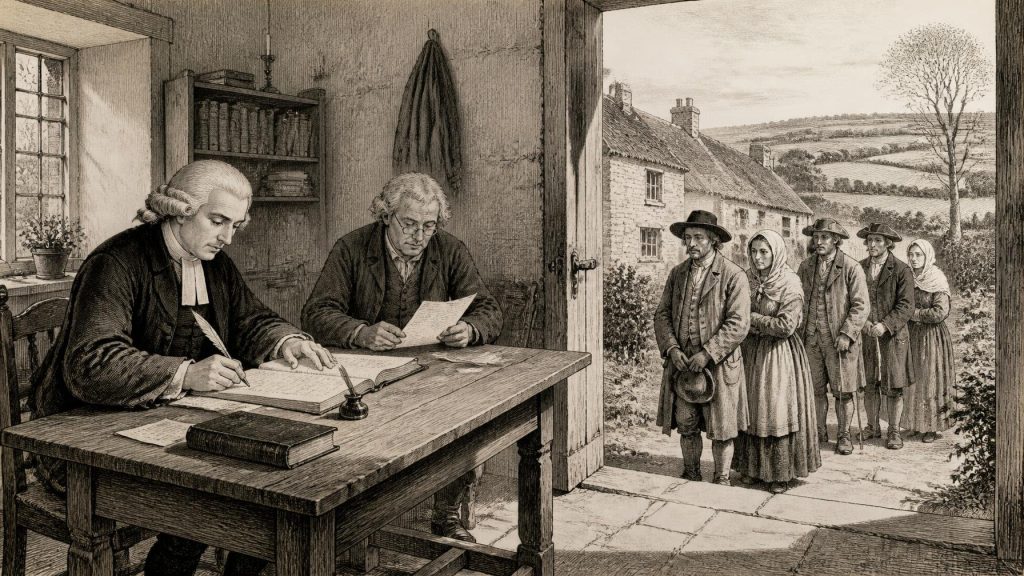
On 5 March 1766 the House of Lords resolved that the kingdom’s archbishops and bishops should direct parish ministers to return lists of families, distinguishing ‘Protestants’ from ‘Papists’, together with lists of reputed Catholic priests and friars. The instruction did not create a modern census. It sought householders rather than every individual; it prescribed no standard form; and it relied upon Church of Ireland clergymen to gather information about communities that were often overwhelmingly Catholic. Most returns were made during March and April. Some named householders, some supplied townland totals, and some gave only broad parish figures.
The surviving evidence makes the scale of confessional imbalance vivid without permitting a precise total for all Ireland. In the Union of Thurles, within the Church of Ireland diocese of Cashel and Emly, the Revd Michael Obins returned figures on 10 April: 89 Protestant householders and 1,103 Catholic householders. He also reported a Catholic archbishop, four secular priests and four friars. This was one clerical union, not a miniature of the entire island, and the figures count householders rather than population. Yet it gives a firm contemporary glimpse of the religious landscape of inland Tipperary.
The order’s language is revealing. Catholic clergy and householders were not invisible; indeed, the state wanted them recorded. But they were recorded through categories devised by a legislature and established church from which Catholics were excluded. The penal code still constrained Catholic political participation, public office and professional advancement. Its enforcement varied by place and period, and Catholic worship and clerical organisation plainly endured. The 1766 return therefore records both inequality and resilience: an official Protestant parish structure collecting information about a far larger Catholic neighbour.
It is also a fragile historical survival. Most original returns later perished in the destruction of the Public Record Office of Ireland on 30 June 1922. Fifty-nine original items survived, alongside copies and abstracts made before the fire. More than 50,000 names can now be recovered across surviving and reconstructed material, but the surviving record must not be mistaken for a complete national enumeration. What 1766 produced was an ambitious, partial survey rather than a settled statistical portrait of Ireland.
A Priest in South Tipperary
The year’s most consequential individual case unfolded farther south, around Clogheen, Newcastle and Clonmel. Nicholas Sheehy, born near Fethard about 1728, had studied at Louvain and was ordained in Rome in 1752. By the early 1760s he served the united parishes of Shanrahan, Ballysheehan and Templetenny, later associated with Clogheen and Burncourt. He was no detached cleric: his ministry lay in a countryside where enclosure of commons, pressure on potato ground, rent, church rates and tithes could all sharpen conflict between tenants, middlemen, tithe collectors and local gentry.
That setting had helped produce the Whiteboys, or Buachaillí Bána, a secretive agrarian movement that first emerged near the Tipperary side of the Knockmealdown Mountains in late 1761. Whiteboy actions included intimidating those associated with enclosures, high rents and tithe collection. The movement was neither a modern political party nor simply an undirected criminal outbreak; its participants could articulate grievances about customary access to land and the burdens imposed on poor cultivators. Authorities, meanwhile, saw nocturnal organisation, oaths and attacks on property as a grave threat to order.
Sheehy sympathised with these grievances and publicly opposed claims for tithes and church rates in his district. Whether he actively directed Whiteboy activity remains uncertain. The best modern account does not treat active participation as proven. What is clear is that the inability of Tipperary grand juries to secure convictions for Whiteboy offences alarmed local magistrates and gentry, who came to regard Sheehy as a dangerous Catholic influence and, in some imaginations, as a possible channel for French or Jacobite subversion. The distance between local agrarian protest and such fears was considerable, but it decisively shaped the official pursuit of him.
By February 1765 a reward of £300 had been offered for his capture, an unusually large sum. Sheehy eventually surrendered. After a long delay he stood trial in February 1766 on allegations of incitement to riot and rebellion and was acquitted. He was immediately indicted over the disappearance in late 1764 of John Bridge, an informer hostile to him. The sequence matters: the murder case was not the first charge brought against a priest already caught in a campaign against Whiteboyism.
Clonmel, March and May
At Clonmel, Sheehy was convicted of Bridge’s murder on 12 March 1766 and executed three days later, on 15 March. The case has long been remembered as a notorious miscarriage of justice. The body of Bridge had never been found; the defence advanced an alibi; and the prosecution relied upon witnesses whose credibility had been challenged. Thomas P. Power’s Dictionary of Irish Biography account concludes that the conviction displayed partial justice, while also cautioning that Sheehy’s sympathy with Whiteboy aims was real. This distinction is essential. It is responsible to connect him to the social conflict of his parish; it is not responsible to treat the murder charge as securely established.
The repression continued after Sheehy’s death. On 3 May, James Buxton, Edmund Sheehy and James Farrell were taken under strong guard from Clonmel gaol to Clogheen and executed after conviction in the Bridge case and for aiding the Whiteboys. Buxton, described in contemporary accounts as a prosperous grazier, was presented to the crowd as a Whiteboy captain. A reported version of his final speech defended the movement’s opposition to arbitrary tithe valuation, although such scaffold speeches survive in competing forms and should be handled carefully. A contemporary newspaper reported that the crowd of more than 1,000 caused no disturbance.
These executions did not extinguish rural grievance. They did, however, demonstrate the reach of county power: magistrates, gaol, assize, military escort, gallows and the public crowd were all brought together in a small market town. Later Catholic memory made Sheehy a martyr. The expression ‘Sheehy’s jury’ entered usage for an arbitrary or prejudiced jury, and laments preserved his name. That later reputation should not overwrite the complexities of 1766, but it confirms how deeply the Clonmel trial entered popular historical memory.
Government Without Representation
At the constitutional level, Ireland remained a separate kingdom under George III with its own parliament, executive and law courts, but its legislative freedom was limited by Poynings’ Law and by oversight through Irish and British privy councils. The political nation represented at Dublin was narrow and Protestant. Catholic householders counted in the Lords’ religious survey had no corresponding place in parliament.
1766 itself was not a year of dramatic parliamentary legislation. An official order prorogued the parliament in Dublin to 19 July, while the supply arrangements then in force continued on their two-year cycle. Yet the decade was politically unsettled. Disputes over government supply, patronage and the right of the Irish Commons to influence money bills had intensified during the early 1760s; ‘Patriot’ opposition was becoming more active. These were predominantly contests within the Protestant political elite, but they formed the constitutional background to a government increasingly conscious of its authority and vulnerabilities.
An international religious development also belonged to the year. James Francis Edward Stuart, the exiled Jacobite claimant recognised by the papacy as James III, died on 1 January 1766. Pope Clement XIII declined to recognise his son Charles Edward as king. This withdrawal of papal recognition weakened one long-standing source of suspicion surrounding Irish Catholic loyalty, although it brought no immediate relief to Catholics in Ireland. The Sheehy prosecution, occurring only weeks later, is a useful warning against imagining that old fears disappeared as soon as the diplomatic setting changed.
Land, Trade and Uneven Prosperity
The conflict in Tipperary belonged to an economy capable of producing export wealth without distributing security evenly. Eighteenth-century Ireland exported beef, dairy produce, hides, tallow and an increasing volume of linen; after 1758 the English market again became especially important for Irish pastoral produce. Dublin and Cork were the principal commercial gateways, while Belfast was growing. Beyond the ports, however, urban development remained limited and much of the population depended directly on land, seasonal labour and fragile local arrangements for food and fuel.
For a grazier such as Buxton, cattle farming could bring substantial means. For cottiers and small tenants dependent on tillage, potato plots and access to commons, conversion of land, rent demands or tithe assessments could be existential matters. The year’s evidence does not justify describing all Ireland as being in a single crisis. It does show, particularly in south Tipperary, how the pressures of a commercialising rural economy could generate organised resistance and how readily confessional prejudice could intensify the official response.
Thus 1766 left unusually revealing records. The religious return attempted to make households legible to the state; the Sheehy proceedings exposed the dangers faced by a Catholic priest identified with the grievances of those households. One document reduced people to denominational categories, while the other turned a contested local struggle into a capital prosecution. Read together, they make the year an important window onto authority, faith and rural society in eighteenth-century Ireland.
Primary Sources
- Religious Census 1766
- Religious Census, 1766
- Thurles, Union of (Athnid, Ballycahill, Ballymurreen, Kilclonagh, Loughmoe, Moyne, Rahelty, Shyane and Thurles parishes)
- Cashel & Emly Diocese Religious Census, 1766
- Sheehy, Nicholas
- Buxton, James
- Hamilton, William Gerard
- The Whiteboy Movement, 1761–5
- The Penal Laws
- ‘Reasonable Inconveniences’: The Theory and Practice of the Penal Laws
- Breakthrough: The First Phase of Catholic Relief in Britain and Ireland, 1766–1789
- The Origins and Purpose of the Penal Laws of 1695
- The Operation of Poynings’ Law in the 1760s
- Central Aspects of the Eighteenth-Century Constitutional Framework in Ireland: Government Supply
- Statute Law Revision Act 2015
- State Papers Ireland 1509–1782: Government Papers on Irish Affairs
- Constitutional Differences
- The Constitutional Position
- The Exchange Business of the Irish Banks in the Eighteenth Century
- An Elegy on the Death of Fr Nicholas Sheehy
- The Trial of Father Sheehy
- Darby Brahan: The Most Feared Man in Clonmel
- James Francis Edward Stuart – The Stuart Successions Project
- The British Monarchy and Ireland