Kildare House1748 CE
In 1748, Ireland’s restricted Protestant political order was highlighted by the Newtown Act, which regularised non-resident burgesses and potentially strengthened borough patronage, while excluding Catholics and dissenters from power. Completion of James FitzGerald’s Palladian Kildare House demonstrated aristocratic wealth, influence and Dublin’s southward expansion. Wartime fasts and embargoes gave way to ceasefires and the Treaty of Aix-la-Chapelle, though rural households remained economically insecure within imperial trading constraints. Proclamations against robbery, intimidation and arson reflected official anxieties over order. Catholic organisation persisted despite Penal Laws, marked by Archbishop Ross Roe MacMahon’s death, while early Methodist preaching added to Ireland’s religious landscape.
Dateline
In 1748, Ireland stood at a hinge between war and peace, although neither condition was simple. The kingdom remained governed within the Hanoverian monarchy of George II, its political life dominated by a Protestant elite and its overseas commerce tied closely to British imperial priorities. Yet the year’s most durable Irish developments were not battles. They lay in a statute affecting borough corporations, a striking new aristocratic house on Dublin’s southern edge, the rhythms of ports and markets as European hostilities wound down, and the continuing religious life of communities largely excluded from formal power.
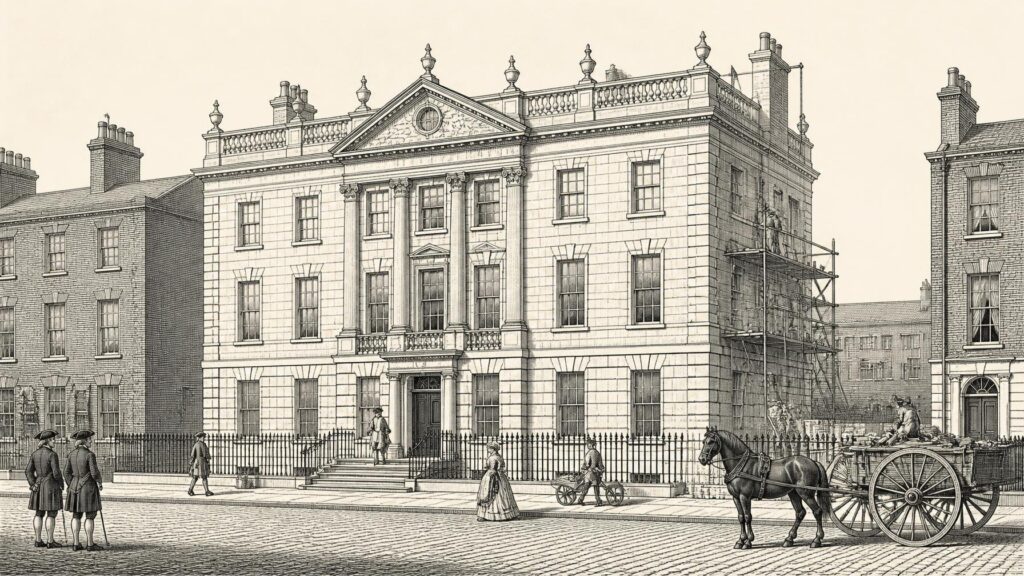
The firmly dated landmarks are revealing. On 9 April the Irish parliament’s Newtown Act received royal assent. During the year, the building now known as Leinster House reached completion as Kildare House, the Dublin residence of James FitzGerald, twentieth earl of Kildare. Official proclamations marked a fast, wartime restrictions on provisions, successive cessations of hostilities, and campaigns against men denounced as tories, robbers and rapparees. On 29 October Ross Roe MacMahon, Roman Catholic archbishop of Armagh, died in County Monaghan. These separate facts illuminate the unequal, commercially connected and administratively anxious Ireland of 1748.
A Borough Statute with Larger Consequences
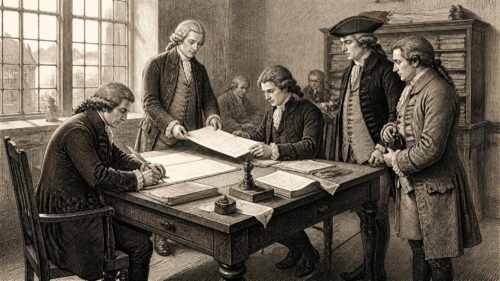
The Newtown Act was an amendment to Irish electoral and municipal law, formally entitled an act for better regulating parliamentary elections and for securing the rights of aldermen and burgesses in corporations. Its name came from Newtownards, County Down, where a dispute over control of the borough had brought wider questions of corporate membership into focus. The provision for which the statute became known dealt with non-resident burgesses: men who held office in a corporation despite not living within its precincts.
Its stated rationale was practical. Some small or decayed corporations claimed too few Protestant inhabitants of sufficient standing to fill the offices attached to municipal government. The act confirmed the position of people already elected, and allowed such appointments in future. But municipal office was far from merely local housekeeping. Many corporations returned members to the Irish House of Commons. Control over the roll of burgesses could therefore influence parliamentary representation, patronage and the balance of power between local interests and great families.
Later critics treated the measure as a decisive device by which borough patrons could pack corporations with dependants from outside, further weakening local independence. That interpretation captures a real danger in the system, but it should not be turned into a claim that the act instantly remade every Irish borough. Detailed historical work has shown that its legal purpose and immediate reach were narrower and more contested than later political memory allowed. What can responsibly be said of 1748 is that the law regularised an existing practice at a moment when borough government, Protestant qualification and parliamentary influence were closely intertwined.
That limitation mattered profoundly. The representative machinery affected by the act did not speak for most of the population. Roman Catholics were excluded from parliament and public office, while Protestant dissenters also faced disabilities. In a kingdom where Catholics formed the great majority, a dispute over which Protestant gentlemen could be burgesses was nevertheless a dispute over access to the state. The Newtown Act therefore offers a precise view of eighteenth-century political Ireland: constitutional language and local corporate procedure operated within a deliberately restricted political nation.
Kildare House on the Southern Edge
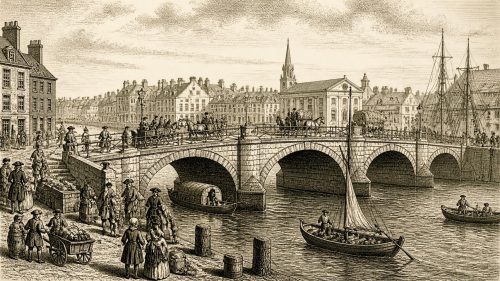
Dublin supplied the year’s most visible statement of elite confidence. Kildare House, built between 1745 and 1748 for James FitzGerald, stood on what is now Kildare Street. Designed by Richard Castle, or Cassels, it was a Palladian townhouse on an unusually ambitious scale, conceived not as a cramped urban lodging but as a great household with courtyards, service ranges, stables and formal rooms. It was later renamed Leinster House after FitzGerald became duke of Leinster, and would eventually acquire an entirely different constitutional role as the home of the Irish parliament after independence. In 1748, however, it was a private aristocratic residence.
Its completion should not be mistaken for the finished form visible today: later owners, architects and public institutions altered both house and setting. Even so, the completed exterior marked a significant urban gesture. Kildare chose a less fashionable southern district rather than the established northern aristocratic quarters. The decision helped advertise his rank while signalling that fashionable Dublin could expand and be reshaped by powerful proprietors. The project also concentrated skilled labour, stone, timber, transport, furnishing and decorative work in the capital. A grand house was a domestic monument, but it was also an economic enterprise and a declaration of political presence.
FitzGerald was not simply an affluent builder. As premier earl of Ireland and a major borough patron, he was one of the kingdom’s most consequential magnates. His new residence thus belonged to the same political world as the Newtown Act, even if neither event caused the other. One concerned the small legal mechanisms through which corporations worked; the other made the scale and resources of aristocratic power visible in stone.
From War Measures to Peace
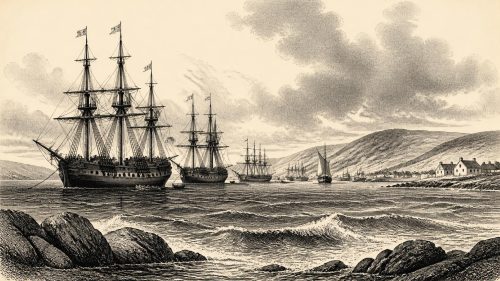
Ireland’s ports and officials were still responding to the War of the Austrian Succession. On 5 January 1748 the Irish administration ordered a public fast for 17 February. On 23 February it instructed revenue officers to enforce strictly an embargo on exporting provisions to France and other specified destinations. Such orders show that Irish foodstuffs and shipping were enmeshed in international conflict. They should not, however, be read as proof that every harbour or merchant obeyed perfectly; proclamations record policy and official concern, not a complete account of trade on the ground.
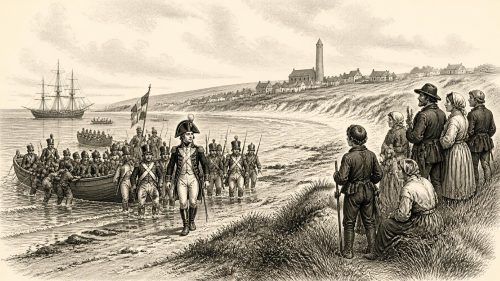
The rhythm altered during the year. A proclamation of 12 May announced a cessation of hostilities with France and the United Provinces; another of 16 August extended cessation to Spain and the Republic of Genoa. The definitive Treaty of Aix-la-Chapelle was signed on 18 October, ending the wider European war. For Ireland, peace promised a less militarised commercial environment, but it did not create commercial freedom. Irish producers remained constrained by the structures of the British Atlantic economy. Linen was the conspicuous encouraged manufacture: state support and export opportunities, especially for plain and coarse linens, underpinned work in Ulster and in other centres. Other branches of production faced much less favourable conditions.
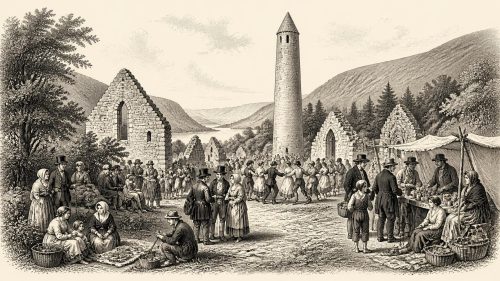
Everyday economic life remained overwhelmingly rural. Tenants, labourers, cottiers, artisans and smallholders experienced the market through rents, wages, crop prices, credit and seasonal employment rather than through treaty clauses. The terrible famine of 1740–41 was already several years past, and the evidence used here does not justify calling 1748 another famine year. Its recent memory nevertheless gave sharp meaning to official controls on provisions and to the vulnerability of households reliant on fragile harvests and irregular earnings. Peace abroad did not remove those insecurities at home.
Order, Worship and New Preaching
Government papers also record persistent concern about order. On 24 June a proclamation required men presented by grand juries as tories, robbers and rapparees in Counties Kilkenny, Tyrone, Wexford and Carlow to surrender. On 31 October another offered a reward for information leading to the apprehension of arsonists in Queen’s County. The terminology was official and accusatory, and it should not be used to suppose a single organised insurgency across those counties. It does show that theft, armed crime, local intimidation and attacks on property were matters serious enough to prompt executive intervention. In a society with weak routine policing, proclamations, rewards, county grand juries and the military were important instruments of authority.
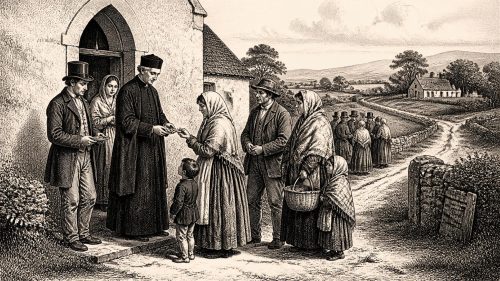
Religious life had its own contrasts. The Church of Ireland was established and bound to political power, while the Penal Laws still imposed extensive civil, political and economic disabilities upon Catholics. Yet Catholic worship and clerical organisation persisted. The death on 29 October of Ross Roe MacMahon, archbishop of Armagh, is a securely dated reminder that a Catholic hierarchy continued to function despite restrictive law and close official attention. MacMahon was buried at Edergole, County Monaghan, in the tomb of his brother; that local burial place points to the family and regional networks through which religious continuity was maintained.
1748 also belonged to the early history of Methodism in Ireland. Charles Wesley’s first extended Irish visit, begun in 1747, concluded in March 1748, while John Wesley was in Dublin during that month. Their correspondence and journals reveal a mobile evangelical movement working through preaching, small societies, lay leadership and personal discipline rather than through possession of the established church’s institutions. It was still modest in scale, and later hostility in Cork should not be projected backwards as though it had already defined 1748. Nonetheless, Methodist activity added another strand to an Irish religious landscape that was already Anglican, Catholic, Presbyterian, Quaker and dissenting in many other forms.
A small cultural note belongs to the year as well. Thomas Roberts, later a notable landscape painter, was baptised in Waterford on 22 May 1748. This was not yet an artistic event of public consequence, but his birth in a cathedral city whose architectural life was shaped by his father, John Roberts, suggests the local craft, family and educational settings from which later Irish art could emerge.
Thus 1748 was not a year of one overriding Irish drama. Its importance lies in juxtaposition: a corporation act that exposed the limits of representation; Kildare House, which gave aristocratic ambition a commanding Dublin address; peace proclamations that linked Irish provisions and ports to Europe; official anxiety over rural disorder; and religious communities whose institutional standing differed radically from their social presence. The year’s surviving records do not yield a single national story, but together they show how power was exercised, displayed, negotiated and endured across Ireland.

Primary Sources
- Statute Law Revision Act 2015
- Irish Legislation Database: Browse Regnal Years
- The Newtown Act of 1748: Revision and Reconstruction
- Pre-Union Irish Statutes Affected
- George II, Twenty-Second to Twenty-Third Year: Statutes and Proclamations
- Leinster House, Kildare Street, Dublin
- Dictionary of Irish Architects: Leinster House
- Richard Castle: Leinster House, A House with Three Lives
- Fitzgerald, James
- MacMahon, Ross Roe (Roche Roccho)
- Roberts, Thomas
- Lucas, Charles
- The Wesley Center Online: Wesley's Letters, 1748
- Charles Wesley in Ireland (1747–1748)
- Charles Wesley Manuscript Journal
- Introduction: Irish Penal Laws
- Penal Laws
- Part 8 of History of the Commercial and Financial Relations between England and Ireland from the Period of the Restoration
- The Royal Dublin Society and the Legacies of Empire Project, 1731–1877
- Aix-la-Chapelle: Peace Treaty with Separate Articles
- Treaty of Aix-la-Chapelle (1748)
- Ireland in the Age of Revolution, 1760–1805