Wesley’s Arrival1747 CE
In 1747, Ireland saw no single decisive event, but political, religious, cultural and social tensions were visible. George Stone became Church of Ireland archbishop of Armagh and a lord justice, strengthening Protestant administrative power under a restricted constitution. Catholic leadership changed through episcopal deaths and appointments, sustained by clerical and continental networks despite penal laws. John and Charles Wesley made their first Irish visits, while Edmund Burke helped found a Trinity debating club. Dublin’s Kelly riots exposed disputes over privilege and theatre authority. Proclamations addressed quarantine, rural crime, weavers’ unrest and rioting, reflecting hardship, trade and fragile order after famine.
Dateline
In 1747, Ireland did not experience a single decisive national event. Instead, the year is best understood through a cluster of precisely datable episodes: a Dublin theatre riot, changes at the summit of both established and Catholic church government, the first visits of the Wesley brothers, the appearance of Edmund Burke’s student debating club, and a succession of official proclamations. Taken together, they reveal an island governed from a narrow Protestant political world, but alive with religious resilience, urban sociability, argument and public disorder.
A Capital on Edge
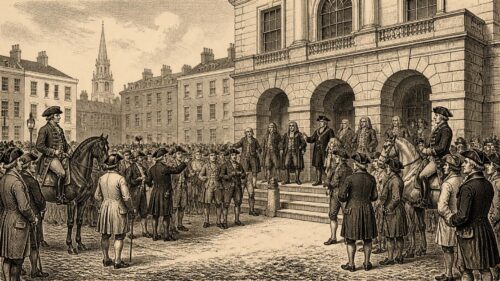
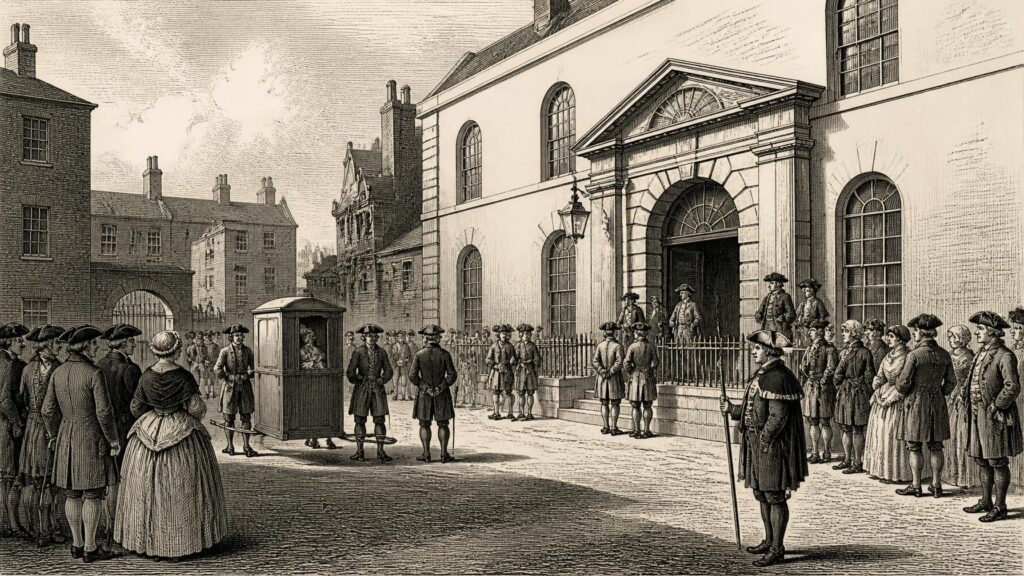
Dublin supplied the year’s most vivid scene. On 19 January, trouble at the Theatre Royal in Smock Alley became the ‘Kelly riots’. Thomas Sheridan, actor-manager and father of the later dramatist Richard Brinsley Sheridan, had become entangled in a confrontation with Edward Kelly, a drunken Trinity College student. The immediate incident occurred during a performance of John Vanbrugh’s Aesop: Kelly entered the backstage area and assaulted an actress. Sheridan intervened and had him expelled. What followed was not merely a private quarrel. Kelly and allies returned, performances were disrupted over successive nights, and the affair generated pamphlets, affidavits and litigation.
The episode exposed a feature of eighteenth-century urban culture that can seem startling now. Some well-connected male spectators assumed a right to occupy the stage and backstage rooms, the so-called ‘freedom of the scenes’. Sheridan’s effort to impose a clearer division between audience, performers and dressing rooms was therefore taken by opponents as an insult to gentlemanly privilege. The riot was about theatre management, but it also concerned class, gender and authority: an actor-manager had challenged the presumptions of young men who thought social rank gave them access to women performers and to the space behind the curtain.
Smock Alley was more than a place of amusement. The playhouse was an arena in which Dublin’s elite, students, soldiers, tradespeople and visitors met. Applause, hissing, thrown objects and organised interruption could carry political as well as theatrical meanings. The Kelly affair should not be inflated into a national rebellion, yet it shows that public order in the capital was fragile and that cultural institutions were places where status could be vigorously contested.
Government by Proclamation
At the political summit, George II remained king, while William Stanhope, first earl of Harrington, held the lord lieutenancy. Like many eighteenth-century viceroys, Harrington did not provide continuous resident government. Much routine authority lay with Irish office-holders, senior judges, bishops and parliamentary managers. George Stone’s promotion to the Church of Ireland primacy consequently had political as well as ecclesiastical importance.
Stone, formerly bishop of Derry, was nominated archbishop of Armagh on 28 February; letters patent followed on 13 March. At only thirty-eight, he became Primate of All Ireland and soon entered the practical machinery of administration. In March he was chosen as one of the lords justices who could govern during the lord lieutenant’s absence, alongside the lord chancellor Robert Jocelyn and the Commons speaker Henry Boyle. On 10 April Stone was sworn to the Irish privy council. His exceptionally rapid rise reflected patronage from powerful British connections, but it also announced the arrival of a churchman who would be central to Irish political management for the next seventeen years.
The constitutional language of a separate Irish kingdom should not conceal the restricted character of political participation. Parliament existed in Dublin, but the franchise and public office were overwhelmingly confined to Protestant property-holders, while the executive operated within a system shaped by Westminster, the crown and Poynings’ Law. Proclamations offer a particularly useful measure of what government regarded as urgent in 1747. Parliament was repeatedly prorogued: on 16 February its meeting was deferred until 25 August, and on 7 August it was put off again until 6 October.
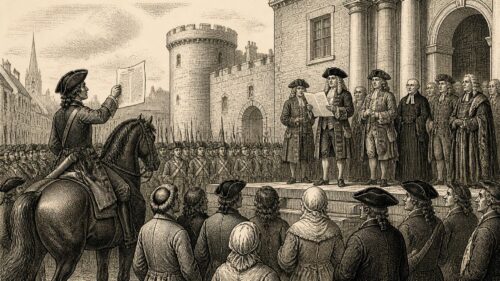
Administration also responded to threats moving along commercial routes. A proclamation of 26 June imposed quarantine on vessels arriving from Santa Cruz and the Barbary coast. Such measures show how a maritime island was connected to Atlantic and Mediterranean worlds, and how fear of contagion could translate into controls at Irish ports. Other proclamations reveal more local anxieties. On 12 September, named ‘tories, robbers and rapparees’ in Tipperary, Limerick, Antrim, Donegal and Wexford were ordered to surrender. The terminology was capacious and politically charged, but the order records official concern about organised rural crime or armed fugitives across several regions.
Urban labour conflict entered the official record in November, when rewards were offered for the apprehension of Dublin journeymen broad weavers. A further reward for rioters in Dublin followed on 26 December. These notices cannot by themselves tell us the full causes, scale or social composition of the disturbances. They do, however, show that late-year disorder was serious enough to require public intervention. For skilled textile workers, employment, wages, apprenticeship and control of work were matters of livelihood; the government’s response treated collective action principally as a policing problem.
Two Churches, Unequal Conditions
Stone’s accession represented the authority of the established Church of Ireland, endowed with tithes and interwoven with the governing class. Yet the Catholic majority maintained its own clergy, congregations and overseas links despite the penal-law regime. The laws restricted Catholics’ access to political power, property, professions and education, and they constrained bishops and religious orders especially sharply. Enforcement was uneven, however, and institutional Catholic life endured through local practice, clerical networks and continental colleges.
Several developments in 1747 make that endurance unusually visible. Bernard MacMahon, Catholic archbishop of Armagh, died on 27 May and was buried at Edergole in County Monaghan. His brother Ross MacMahon, then bishop of Clogher, succeeded him as Catholic archbishop of Armagh on 3 August. On 11 September Daniel O’Reilly was appointed bishop of Clogher. O’Reilly had served as president of the Irish College at Antwerp, a reminder that Irish Catholic organisation depended in part on European educational and ecclesiastical connections which the state had long tried to restrict.
In the south, Thaddeus MacCarthy, Catholic bishop of Cork and Cloyne and apostolic administrator of Ross, died on 14 August. The combined arrangement did not simply continue: Cork became a separate bishopric, while Cloyne was joined with Ross. These were not dramatic changes visible to every parishioner, but they mattered. They concerned who could ordain priests, administer a far-flung diocese and sustain sacramental life under a legal order designed to privilege another church.
New Preachers, New Arguments
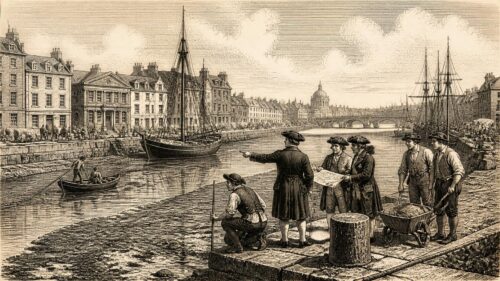
Religious energy also arrived in a different Protestant form. John Wesley landed at George’s Quay, Dublin, on 9 August for his first visit to Ireland, following an invitation from Thomas Williams, who had been preaching in Dublin. Wesley stayed with the banker William Lunell and preached during a brief visit lasting until 14 August. His published correspondence conveyed a warmly favourable, though highly selective, impression of people he met. More important historically was the beginning of a sustained connection: Wesley would return many times, and Methodism would become a significant force in Irish religious life.
Charles Wesley’s first Irish visit began in September. His journal records him in and around Dublin, including a house near Dolphin’s Barn acquired for Methodist purposes. The brothers’ arrival should not be mistaken for the instant creation of a mass movement. In 1747 their congregations were small, their work precarious and their preaching could meet resistance. Nonetheless, their itinerancy brought a revivalist style of worship, discipline and lay participation into an Irish setting already marked by established Anglicanism, Catholic survival and a substantial Presbyterian presence in Ulster.
Another small beginning occurred on 21 April, when Edmund Burke, then a young student at Trinity College Dublin, helped establish a debating association commonly known as Burke’s Club. Its surviving 1747 minute book, including a speech by Burke, is firmer evidence than later celebratory legend. The club was not identical with the College Historical Society, formally founded in 1770, but it was an important predecessor and a sign of the intellectual habits developing among students: formal speaking, disputation, historical inquiry and political discussion. Burke himself would leave Ireland for London within a few years, but the club belongs to his Irish formation.
After Crisis, Under Constraint
The year also unfolded in the shadow of recent hardship. The catastrophic famine of 1740–41, remembered in Irish as Bliain an Áir, had been followed by further scarcity and disease in the mid-1740s. It is not responsible to assign a single national harvest result or mortality figure to 1747 from the evidence available. But the surviving official record indicates continued official sensitivity to food, livestock and disease. A public fast ordered for 7 January 1747, and later references to an order of 14 March concerning disease among horned cattle, place divine providence and animal health within the year’s administrative concerns.
For most people, life remained rooted in small farms, seasonal labour, household production, local markets and the obligations of rent and tithe. Ireland’s exports and ports linked producers to British and overseas markets, while wartime restrictions and quarantine could abruptly alter those connections. The Dublin weavers’ disturbance gives one glimpse of the urban side of this economy; the pursuit of alleged rapparees gives another, rural and coercive one. Neither should stand for the whole island, but together they caution against treating 1747 as a placid interval between larger crises.
Its importance lies precisely in its scale. No great battle remade Ireland in 1747. Instead, institutions adjusted: a powerful primate took office; Catholic diocesan leadership changed hands; new Methodist visitors found a foothold; students organised debate; officials regulated disease, commerce and disorder; and Dublin audiences fought over who had the right to command a public stage. These were modest events in isolation, but they illuminate an Ireland in which authority was narrow, society was restless, and religious and cultural life remained more varied than the formal constitution allowed.

Primary Sources
- Stone, George | Dictionary of Irish Biography
- Sheridan, Thomas | Dictionary of Irish Biography
- Stanhope, William | Dictionary of Irish Biography
- MacMahon (Ennis), Bernard | Dictionary of Irish Biography
- Statute Law Revision Act 2015
- GEORGE II. 23rd to 24th Year
- Trinity College Dublin Historical Society: First minute book of the Historical Club (afterwards the Historical Society) with speech of Edmund Burke, 1747
- Report on Trinity’s Student Societies and Clubs Launched
- Hist250 Exhibition Celebrates the ‘Greatest of all Schools of Oratory’
- The Wesley Center Online: Wesley’s Letters: 1747
- John Wesley in Dublin
- The Journal of Charles Wesley: September 1 – December 28, 1747
- Charles Wesley in Ireland (1747–1748)
- History of the Diocese of Clogher
- The Ancient and Present State of the County and City of Cork: Appendix to Volume 1
- Clearing the Stage: Gender, Class, and the Freedom of the Scenes in Eighteenth-Century Dublin
- The Right to Person in Eighteenth-Century Britain
- The Irish Famine of 1740–1741: Famine Vulnerability and ‘Climate Migration’
- History of the Commercial and Financial Relations between England and Ireland from the Period of the Restoration
- The Penal Laws: Origins, Purpose, Enforcement and Impact
- The Penal Laws | Ulster Historical Foundation
- Central Aspects of the Eighteenth-Century Constitutional Framework in Ireland
- The Office of the Chief Secretary of Ireland: Context and Chronology