Limerick Articles1691 CE
In 1691, Williamite forces broke Jacobite power in Ireland, ending the war begun after James II’s overthrow. Ginkel captured Athlone, then defeated Saint-Ruth’s army at Aughrim, where the French commander’s death precipitated rout and Galway’s surrender. Limerick, divided after Tyrconnell’s death and deprived of resources, endured siege, bombardment and a Williamite crossing of the Shannon. Articles signed on 3 October ended organised resistance, offering protections for Catholic property, trade and worship, though their wording and enforcement remained disputed. Military terms enabled departure, Williamite service or homecoming. Thousands entered French service, while William and Mary secured sovereignty amid unsettled political consequences.
Dateline
In 1691 the struggle for Ireland that had begun with the overthrow of James II in 1688 reached its military conclusion. The year was not simply a sequence of famous engagements. It brought the collapse of Jacobite field power, the surrender of the last major strongholds, a fraught negotiation over land, religion and allegiance, and the departure of a large part of the defeated army for France. Its consequences were enormous, but they should not be read backwards as though every later development was already settled. In 1691 Ireland’s future was still being argued over in camps, fortified towns, council rooms and crowded ports.
The Shannon Line Breaks
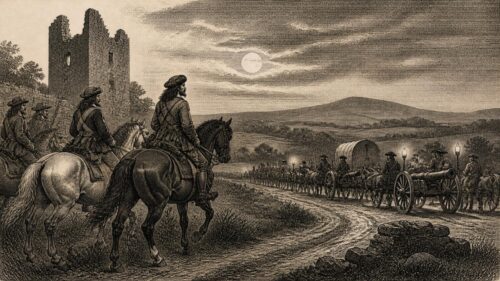
The campaigning season opened with the Jacobites holding the principal crossings and towns west of the Shannon. Their cause remained part of the wider Nine Years’ War: William III’s coalition was fighting Louis XIV across Europe, while French officers, equipment and hopes of relief linked the Irish theatre to continental strategy. The arrival at Limerick in May of the French lieutenant-general Charles Chalmont, marquis de Saint-Ruth, brought weapons and supplies but neither the money nor the additional troops that the hard-pressed Jacobites wanted. He found an army whose morale and material condition were poor after the previous winter.
Godert de Ginkel, William’s Dutch-born commander in Ireland, had spent that winter preparing an army large enough to force the Shannon. Athlone was its immediate objective. The town’s capture on 30 June was a decisive operational success: it opened a route into Connacht and showed that the river barrier could not indefinitely preserve Jacobite territory. It also made clear that the war would be settled by more than the celebrated encounter at the Boyne of the previous year. The crucial fighting of 1691 lay further west.
Aughrim’s Catastrophe
On 12 July, in the contemporary English and Irish calendar then in use (22 July in the Gregorian calendar), the opposing armies fought at Aughrim in County Galway. Saint-Ruth chose ground around Kilcommadan Hill, protected in front by boggy, difficult terrain and approached by narrow routes. The position gave the Jacobites a real defensive advantage. Both armies were roughly 20,000 strong, though Ginkel had stronger artillery and substantial English, Scottish, Dutch, Danish and other continental contingents. Ireland’s war was therefore at once a civil conflict over kingship and religion, and a multinational European campaign.
For much of the day the Jacobite line resisted fiercely. Attacks across the wet ground in the centre and against the Irish right were beaten back. Yet the battle turned abruptly late in the fighting. Saint-Ruth was killed by cannon fire while moving behind his line, at a moment when command and the deployment of reserves mattered greatly. Accounts differ in their detail and in their allocation of blame, but the practical result is clear: the Jacobite army lost cohesion, Williamite troops gained the crucial ground, and a retreat became a rout. Many men were killed, wounded or captured; others scattered. Aughrim was the decisive field battle of the war in Ireland.
Its immediate political effect was devastating. Galway, one of the last important Jacobite-held towns, capitulated within days, on 20 July in Ginkel’s account. The negotiated articles there reflected the importance of legal and commercial interests as well as military necessity. Denis Daly, a Galway Catholic lawyer who had favoured an earlier accommodation, helped persuade the garrison to submit. That detail is a useful corrective to simple pictures of two uniform communities: Jacobite Ireland contained competing priorities among soldiers, officeholders, landowners, merchants and lawyers, just as the Williamite side was a coalition rather than a single national force.
A Government in Crisis
After Aughrim, Limerick was the only major Jacobite position left. Richard Talbot, earl of Tyrconnell and James II’s lord lieutenant, worked to strengthen its defence and sustain morale. He had long differed with Patrick Sarsfield and other advocates of continued war over whether terms should be sought. Those disputes had not disappeared with the defeat. Tyrconnell died in Limerick on 14 August after a sudden illness, leaving a divided leadership at the moment of greatest danger. Sir Richard Nagle and other Jacobite figures became lords justices, while Sarsfield emerged as the most prominent Irish military negotiator.
The tension within the garrison was serious. Henry Luttrell, a senior officer, was accused during the siege of corresponding with Ginkel; the evidence was contested, and he was imprisoned rather than executed. Whatever the merits of the accusation, it demonstrates the fear of betrayal and the strain imposed by defeat. Hugh Balldearg O’Donnell, another important Gaelic leader, had already reached terms with the Williamites near Sligo in August. The remaining Jacobite war effort was increasingly localised, short of resources and uncertain of French relief.
The Second Siege
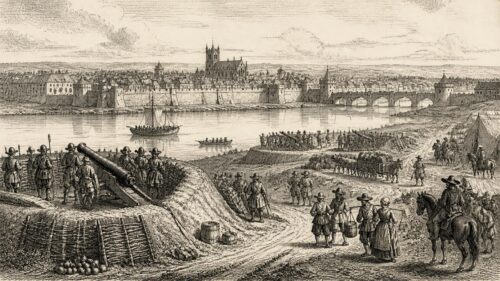
Ginkel invested Limerick on 25 August. He did not repeat William III’s costly attempt to storm the city in 1690. Instead, he used artillery, manoeuvre and pressure on the defenders’ communications. A contemporary Williamite siege diary records the difficulty of moving heavy guns and mortars from Athlone for want of draught horses: logistics, animals, carts, fodder, roads and boats were as important as battlefield courage. The same record describes cannon, bombs and incendiary shells damaging the town, burning stores of biscuit and brandy, and reducing the defenders’ food margin.
These reports should be treated with the care due to partisan wartime testimony, but they convey the character of urban warfare. Limerick’s inhabitants faced bombardment, overcrowding, requisitioning and the displacement that came with a garrisoned city. One report claimed that civilians had withdrawn and that no house remained whole; it is safer to say that the bombardment caused grave destruction and that civilian life was profoundly disrupted than to turn that report into a precise census. Earlier Jacobite testimony from the winter of 1690–91 also describes soldiers in empty houses with inadequate bedding, clothing and rations. By late summer 1691, the prospect of another winter under arms was a powerful argument for settlement.
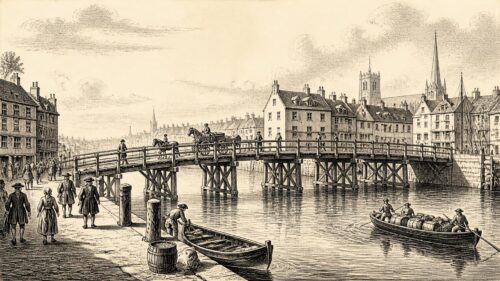
Ginkel’s most consequential manoeuvre came on 16 September, when Williamite forces crossed the Shannon above Limerick and threatened the city from the Clare side. The move narrowed the defenders’ options and cut them more fully from the countryside that supplied them. Fighting at Thomond Bridge inflicted severe losses on Jacobite infantry. A cessation of hostilities was agreed on 24 September. It was a negotiated end, not the taking of a city by assault, and that distinction shaped the terms that followed.
Terms at Limerick
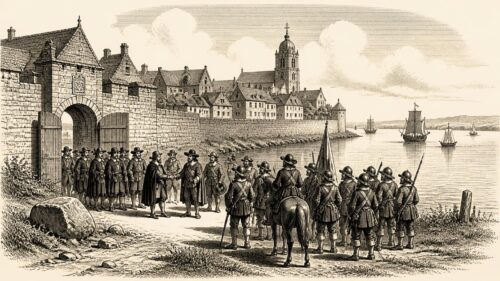
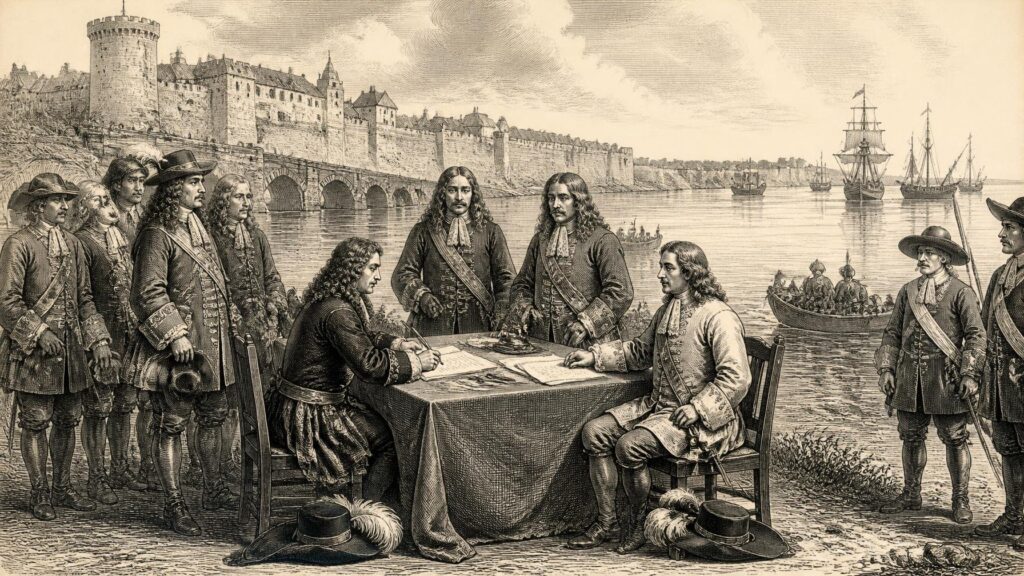
On 3 October, civil and military articles were signed at Limerick by Ginkel and the Williamite lords justices, Charles Porter and Thomas Coningsby, and by Sarsfield, Viscount Galmoy, Sir Toby Butler and other Jacobite representatives. The treaty ended organised Jacobite resistance in Ireland. Its civil articles sought to define the position of Catholics who submitted to William and Mary. They promised those covered by the agreement possession of qualifying estates and the exercise of their trades, subject to an oath of allegiance. They also stated that Roman Catholics would enjoy the religious practice they had had in the reign of Charles II, while holding out the prospect of further security from parliament.
That language mattered because it connected constitutional allegiance, property and worship. It did not create an equal civic settlement, and it imposed conditions, but it was substantially more protective than unconditional conquest. Its scope was immediately contentious. The formal copy omitted words that had appeared in the negotiated second article, concerning people under the Jacobite army’s protection in named western counties. The omission was discovered soon afterwards and became a central issue in the treaty’s later history. In 1691 itself, it exposed how much depended upon exact drafting, official copies and the willingness of the new regime to honour commitments.
The military articles offered an alternative to submission. Officers, soldiers and others who chose to leave could go overseas with their families, personal effects and, in specified cases, arms and horses. Ginkel undertook to provide passports, escorts, shipping and provisions. The agreement also allowed Jacobite troops to declare whether they would enter French service, accept Williamite employment or return home. Thus the settlement was not merely a diplomatic document; it set thousands of households moving through Limerick, the Shannon estuary and the ports of Cork and Kinsale.
Departure and a Changed Island
The term ‘Flight of the Wild Geese’ is commonly applied to the subsequent departure for France, though it can obscure the practical, staged nature of the movement. Some men went home, some entered Williamite service, and large numbers chose France. Contemporary correspondence shows that Irish officers had reached Brest by 27 November, when James II thanked them for their decision to continue in his service. Embarkations continued during the autumn and winter. Later estimates commonly place the number entering French service at about 14,000 officers and men, but totals vary according to whether dependants and later departures are included.
For those who stayed, peace meant neither a return to the world of 1688 nor an immediate, settled new order. Farms, roads, towns and households had been disturbed by years of marching, quartering and destruction. Catholic landowners and professionals now had to establish whether they fell within the treaty’s protections; Protestant supporters of William expected security after a war fought partly in the name of their safety. The political and religious exclusions often associated with the eighteenth-century Protestant order were not yet a finished programme in 1691. What the year did settle was military sovereignty: William and Mary were acknowledged in Ireland, and Jacobite government had ended.
Limerick’s articles therefore deserve to be remembered as both an ending and an unsettled beginning. Aughrim had broken an army; the siege had forced a decision; the treaty turned defeat into a contested legal settlement and opened an enduring Irish military connection with France. In a single year, the centre of gravity moved from the Shannon battlefield and city wall to oaths, patents, estates, ships and the uncertain enforcement of a peace.

Primary Sources
- The Treaty of Limerick, 1691
- Contemporary Diary of Siege of Limerick, 1691
- Letters from Patrick Sarsfield, Earl of Lucan, 1691
- James II. to Officers of Irish Forces on Arrival at Brest, 1691
- The Journal of John Stevens, Containing a Brief Account of the War in Ireland, 1689–1691
- A Jacobite Narrative of the War in Ireland
- Ginkel, Godard van Reede van
- Sarsfield, Patrick
- Talbot, Richard
- Saint-Ruth (Saint-Ruhe), Charles Chalmont
- Daly, Denis
- Nagle, Sir Richard
- William III
- Luttrell, Henry
- O'Donnell, Hugh Balldearg (Balderick, Balderock)
- MacCarthy, Justin
- Williamite Peace Tactics, 1690–1
- Jacobite Ireland 1685–91: Studies in Irish History
- The Sieges of Limerick Synopsis
- The Danish Force in Ireland 1690–1691