

Dunboy’s Last Guns1602 CE
In 1602, the Nine Years’ War moved towards crown victory after Kinsale’s surrender removed Spain’s main force, though resistance persisted. Hugh Roe O’Donnell sailed to Spain seeking aid, but died there in August, weakening the Irish confederacy. In Munster, Sir George Carew besieged, captured and demolished Dunboy Castle, ending its role as a potential Spanish foothold and O’Sullivan Beare stronghold. In Ulster, Mountjoy used garrisons, allied forces and systematic destruction of crops and livestock to impose famine. Royal advances shattered Gaelic lordships; Ruaidhrí O’Donnell submitted in December, while Hugh O’Neill continued fighting until 1603. The conflict remained unresolved that winter.
Dateline
In 1602, the Nine Years’ War entered its last, devastating Irish phase. The previous winter’s crisis at Kinsale had not ended neatly with a single battle: its consequences travelled from the harbour towns of west Cork to the grainlands of Ulster, through Gaelic lordships already strained by campaigning, and across the sea to the court of Philip III of Spain. This was a year in which forts, ships, cattle, crops and routes through difficult country mattered as much as grand declarations. It was also a year in which the crown’s victory was secured not simply by battlefield success but by siege, garrison warfare, alliance-building and the deliberate destruction of civilian sustenance.
Kinsale’s January Reckoning
The fighting outside Kinsale is conventionally dated 24 December 1601 in English records, equivalent to 3 January 1602 in the Gregorian calendar used by many continental and Irish writers. The failure of the relieving Irish army under Hugh O’Neill, earl of Tyrone, and Hugh Roe O’Donnell to break the royal siege left the Spanish garrison in Kinsale isolated. Its commander, Don Juan del Águila, negotiated terms with Lord Deputy Charles Blount, Lord Mountjoy. The surrender itself is normally dated 2 January 1602 in English-style dating. Spanish troops were to be conveyed home, while the surviving Spanish-held posts in west Munster, including Dunboy, were to be yielded up.
For the Dublin government and its English commanders, this was a strategic and diplomatic success. It removed the most substantial Spanish force sent to Ireland during the war and demonstrated that the crown could concentrate troops and supplies at a southern port even while much of Ulster remained resistant. Yet the settlement did not pacify Ireland. Spanish intervention had made clear that Ireland was part of a wider conflict between the English crown and Catholic Spain, while the war’s local causes – sovereignty, land, lordship, religion and the growing reach of royal government – remained intensely immediate to those who had fought it.
Hugh Roe’s Spanish Mission
Hugh Roe O’Donnell responded to the reverse at Kinsale by seeking a new expedition from Spain. The Annals of the Four Masters, written from an Irish Catholic perspective later in the seventeenth century, presents his departure as a moment of grief in the camp and records that he sailed on 6 January, reaching the Coruña area on 14 January. Its chronology should be read with care alongside English and Spanish dating conventions, but the broad sequence is firm: in the opening weeks of 1602 O’Donnell left Ireland for Spain, entrusting the leadership of Tír Chonaill to his brother Ruaidhrí.
O’Donnell’s mission shows that the war still possessed an international horizon. Philip III received him at Zamora in February and promises of assistance were made. The hopes attached to those promises, however, were greater than the practical help that arrived. O’Donnell remained in Spain while the military position in Ireland deteriorated. He died at Simancas while travelling to seek another audience with the king. Modern biographical scholarship dates his death to 30 August 1602 in English or Julian reckoning; the Four Masters gives 10 September, the corresponding Gregorian date. The difference is calendrical rather than evidence of two deaths. His passing deprived the Irish confederacy of one of its most forceful leaders, even though the war itself continued.
Religion was inseparable from this diplomacy. O’Donnell and many of his supporters cast resistance to Elizabeth’s government in explicitly Catholic terms, while Spanish support was framed as aid to fellow Catholics. The Four Masters’ account of his final illness, confession, anointing and Franciscan companions preserves the religious language through which his death was understood. It also reminds us that friars, clerics and learned writers moved within the political world of Gaelic lordship, serving as confessors, envoys, counsellors and preservers of memory.
Dunboy and the Beare Peninsula
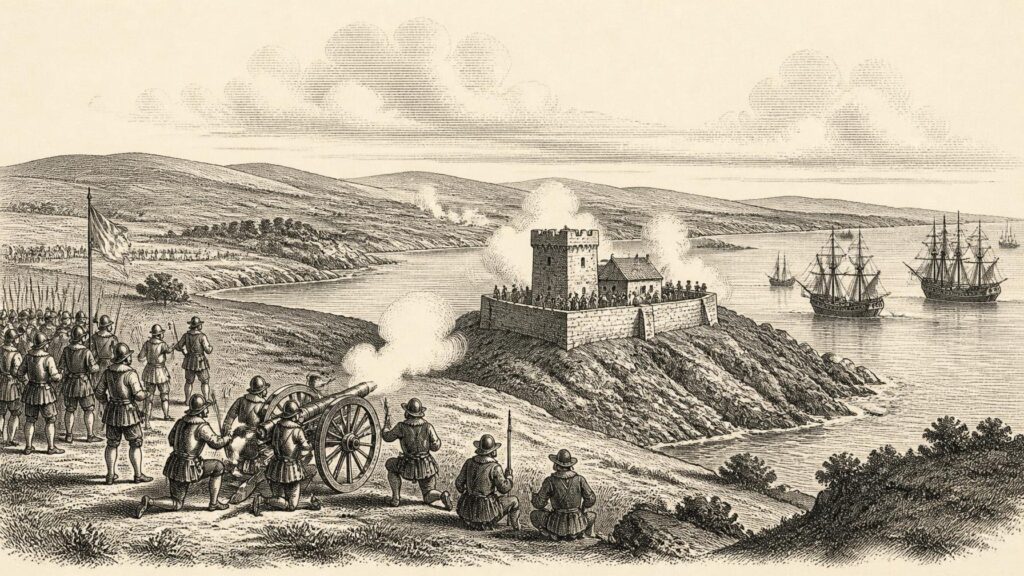
The most dramatic fighting of the year occurred in the far south-west. Domhnall O’Sullivan Beare, commonly called Donal Cam, had placed a Spanish garrison in Dunboy Castle on the Beare peninsula. The castle stood beside a sheltered maritime zone of great importance: Bantry Bay, Berehaven and nearby islands offered potential anchorages through which men, arms, news and supplies might pass between Ireland and Spain. Dunboy’s position made it more than a local fortress. So long as it held, it offered a possible foothold for renewed Spanish intervention and a rallying point for Munster resistance.
O’Sullivan Beare did not comply with the Kinsale surrender terms. He commanded resistance from the difficult terrain around Glengarriff and Beare, drawing on local followers and hired fighting men, while awaiting the possibility of help by sea. Sir George Carew, the lord president of Munster, therefore mounted a full-scale operation. The siege is usually dated from 6 June 1602. Carew’s government force, supported by ships and artillery, brought overwhelming firepower against a relatively small garrison. Archaeological research has confirmed the importance of the castle’s late sixteenth-century defensive works and the scale of the artillery assault described in narrative sources.
Dunboy fell after a short but ferocious siege, generally dated to 18 June. The defenders had endured bombardment, breaches and an assault; many were killed during the fighting, and surviving members of the garrison were executed. The castle was then demolished. It was a brutal conclusion to the last important Munster stronghold still resisting the crown. It also exposed a central reality of the war: castles and promontory forts could protect a lordship’s people and communications, but could not indefinitely withstand siege artillery, ships and the logistical resources of the expanding royal state.
The human consequences reached beyond those inside the walls. Households in the peninsula faced raids, requisitioning, flight and the danger of being caught between rival forces. Coastal commerce was transformed into wartime traffic: merchant vessels could be seized, while small craft and foreign ships became vital instruments of communication and survival. Cattle, stored food and access to landing places were political assets. In an economy where livestock, grain and maritime connections underpinned lordship, the loss of Dunboy weakened O’Sullivan Beare’s ability to sustain both his followers and armed resistance.
War on Food and Landscape
While Carew completed the reduction of south-west Munster, Mountjoy intensified pressure in Ulster. His policy was calculated rather than incidental. In a letter of 5 June 1602, Mountjoy argued that famine was the only means by which the remaining resistance could be overcome. Royal troops and allied Irish forces destroyed corn, seized livestock, burned dwellings and maintained garrisons that narrowed the space in which O’Neill and his adherents could operate. This was warfare directed at the productive landscape: fields, herds, mills, farmsteads and stores were as strategically significant as castles.
The contemporary evidence records appalling suffering. On 11 September Mountjoy reported bodies unburied in the country between Tullyhogue and Toome, and repeated an estimate that more than 3,000 had starved in Tyrone since the army’s advance to the Blackwater that year. Such figures must not be treated as a complete demographic count, but the report is compelling evidence of acute famine. Fynes Moryson, Mountjoy’s secretary, wrote of widespread starvation and did not conceal the harshness of the policy, even while defending it as militarily necessary. Ordinary people – tenants, labourers, herders, camp followers and displaced families – bore its principal burden.
The campaign also remade political geography. In September Mountjoy broke the inauguration stone of the O’Neills at Tullyhogue, a deliberately symbolic act. The stone was associated with the traditional installation of the O’Neill, and its destruction proclaimed that royal power intended to dismantle not only a military enemy but the ceremonial foundations of Gaelic lordship. The gesture was not the end of O’Neill’s authority, nor did it instantly settle Ulster, but it marked the confidence of a government advancing through territory once difficult for crown forces to penetrate.
Fracturing Lordships
In Tír Chonaill and neighbouring regions, the war continued as a struggle within and between lordly networks as well as against the crown. Niall Garbh O’Donnell and English forces captured Ballyshannon in the spring, using heavy artillery; they later took Enniskillen and occupied the monastic sites of Devenish and Lisgoole. These operations mattered because river crossings, islands and monastic precincts could become defensible positions, supply points and symbols of possession. The seizure of them demonstrated the expanding reach of royal allies into areas previously governed through O’Donnell and Maguire authority.
Ruaidhrí O’Donnell attempted to hold his people together after his brother’s departure. The annals depict the movement of men, cattle and household property through Connacht and along vulnerable passes, an image that captures the practical reality of lordship in wartime. Protection meant finding pasture, preventing the recovery of seized animals, guarding routes and keeping armed retainers supplied. During the summer and autumn, clashes and truces around Sligo and Boyle showed that resistance had not disappeared. But it was increasingly local, mobile and defensive rather than a confederacy capable of coordinating a national campaign.
By the beginning of winter, news of Hugh Roe’s death strengthened Mountjoy’s hand. Ruaidhrí entered negotiations and submitted at Athlone in December 1602. That submission did not end the Nine Years’ War: Hugh O’Neill remained in the field until 1603. Nevertheless, the year closed with the principal northern alliance badly fractured, Spanish hopes unrealised, Munster’s final major resistance centre destroyed, and famine undermining the society from which Gaelic armies drew food, labour and allegiance. Ireland in 1602 was not yet at peace, but the shape of the coming settlement had been made through siege guns, scorched fields and the collapse of alternatives.
Primary Sources
- Annals of the Four Masters: Annal M1602
- Beatha Aodha Ruaidh Uí Dhomhnaill (The Life of Red Hugh O'Donnell)
- Chapters towards a History of Ireland in the Reign of Elizabeth, chapter 109
- Pacata Hibernia: Or, A History of the Wars in Ireland During the Reign of Queen Elizabeth
- An Itinerary Written by Fynes Moryson, Gent.
- The Description of Ireland
- Calendar of the State Papers Relating to Ireland, Volume 11: 1601–1603
- A Copy of the Articles Between the Lord Deputy and Don Juan del Águila for the Surrender of Kinsale
- Particulars of a Levy of 200 Foot for Ireland, 1602; Articles Between Lord Deputy Mountjoy and Don Juan del Águila
- Three Letters from Mountjoy to Sir George Carew Concerning Tyrone, the Spaniards and Dunboy, 1602
- Letter of Sir William Monson to Sir Robert Cecil, 4 October 1602
- Prose Miscellany: The Camp and Siege of Kinsale, Followed by an Account of Events in 1602 and 1603
- O'Donnell, ‘Red’ Hugh (Ó Domhnaill, Aodh Ruadh)
- O'Donnell (Ó Domhnaill), Ruaidhrí
- O'Sullivan Beare, Domhnall
- Carew, Sir George
- Blount, Charles Brooke
- Moryson, Fynes
- The Renaissance Fortifications at Dunboy Castle, 1602: A Report on the 1989 Excavations
- The Genealogy of Corca Laidhe, Note 395