Kinsale Siege1601 CE
In 1601, Spain’s landing at Kinsale internationalised the Nine Years’ War, offering Hugh O’Neill and Hugh Roe O’Donnell support but far from their Ulster bases. Don Juan del Águila’s 3,300 troops fortified Kinsale and Rinncorran, while Mountjoy and Carew imposed a land and naval siege. Elsewhere, crown garrisons, allied Irish lords, arrests and campaigning weakened resistance, while civilians endured plunder, requisitioning and famine. O’Donnell and O’Neill marched south to relieve the town, threatening besiegers’ supplies. A poorly coordinated Christmas Eve attack collapsed in disorder on 24 December, routing the confederates. O’Donnell sailed for Spain; Mountjoy regained initiative, although war continued.
Dateline
In 1601, the Nine Years’ War was transformed by a landing at Kinsale. What had begun as a struggle in Ulster and spread through much of Ireland became, in its closing months, an international siege on the south-coast harbour of Cork. The arrival of Spanish troops gave Hugh O’Neill, earl of Tyrone, and Hugh Roe O’Donnell of Tyrconnell the foreign assistance for which they had long appealed. Yet the location was awkwardly distant from their northern power bases, while the English crown’s army under Lord Deputy Charles Blount, Lord Mountjoy, moved rapidly to contain the newcomers. By year’s end, the armies faced one another in a cold, hungry and unstable encirclement. The decisive field action is often called the Battle of Kinsale, but its date requires care: it was fought on 24 December 1601 in the Julian calendar then used in Ireland and England, equivalent to 3 January 1602 in the Gregorian calendar used in Spain and now internationally.
A War Still Spread Across Ireland
Kinsale did not erase the wider war. In the north-west, Red Hugh O’Donnell was already under intense pressure. Crown forces based at Derry, assisted by the rival O’Donnell claimant Niall Garbh, had worked to divide Tyrconnell and disrupt the confederate war effort. The Annals of the Four Masters, a later seventeenth-century compilation drawing on Irish records, places Niall Garbh and English troops at Donegal in 1601 and describes Red Hugh’s unsuccessful attempt to dislodge them. The attack brought fighting around Donegal friary and monastery, which the annals say was burned on Michaelmas Day, 29 September. The episode made plain that a religious house could be a military position as well as a place of worship, learning and burial.
Mountjoy, meanwhile, pressed into Ulster during the summer. The annals record his advance in June through the Moyry Pass, then a formidable route between the northern and southern parts of Ulster. A stone-and-lime castle was erected there and garrisoned, while Portmore, Armagh and other positions were reinforced or occupied. Such works did not mean that Tyrone had been conquered: the deputy’s men could not range freely through the country, and fighting occurred near Benburb. But they represented the crown’s increasingly effective method—linked garrisons, fortified passes, supply routes and mobile forces—which narrowed the room in which O’Neill and his allies could operate.
The disruption was felt far beyond formal campaigns. In Connacht, armed bands moved through territories contested by Burke factions; camps consumed stored meat, herds were taken, and local communities endured plundering by both allies and enemies. The Four Masters describes rival forces watching one another for weeks in the Clanrickard region until provisions failed. Such notices are important reminders that war was not confined to famous commanders. Farmers, herders, tenants, town dwellers and religious communities bore its most continuous costs: requisitioning, the destruction of crops and stores, displacement, insecurity on roads, and the burden of feeding soldiers.
Munster Under Pressure
Munster had been a principal theatre of rebellion in 1600, but its political landscape was changing during 1601. Sir George Carew, the crown’s president of Munster, combined military operations with arrests, protections, pardons and intelligence-gathering. James FitzThomas Fitzgerald, the so-called Sugan Earl of Desmond, was captured and sent to England; Fineen MacCarthy Mór was also arrested after coming under protection. These actions were harsh and politically consequential. They removed figures who might have rallied substantial support for a Spanish landing, while demonstrating that a safe-conduct offered by crown officials could be narrowly interpreted or simply overridden in the name of security.
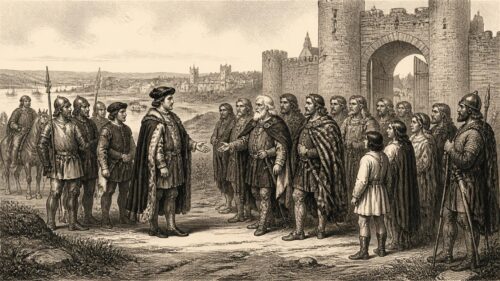
Not every Irish lord stood in the same relation to the crown or to the northern confederacy. Ulick Burke, earl of Clanrickard, died at Loughrea in May and was succeeded by his son Richard. Clanrickard’s lordship supplied forces to the crown, as did Donough O’Brien, earl of Thomond. Their participation shows why the conflict cannot responsibly be described as a straightforward contest of English Protestants against Irish Catholics. Religion mattered profoundly: the Spanish intervention presented itself as Catholic support, and Irish writers could describe the defence of religion and patrimony together. But allegiance also rested on family rivalry, land, security, local authority and calculations of survival. English government armies themselves included many Irish soldiers and lords.
The Spanish at Kinsale
On 21 September 1601, a Spanish expedition entered Kinsale harbour. Contemporary figures vary, but the force under Don Juan del Águila numbered roughly 3,300 men. It was a substantial overseas deployment, though much smaller and less well supplied than Irish hopes required. Its choice of Kinsale was strategically dramatic but deeply problematic. The town lay at the far southern end of the island from Ulster; its harbour could receive ships, but its defences and hinterland were not prepared for a long siege, and the expedition lacked secure command of the sea.
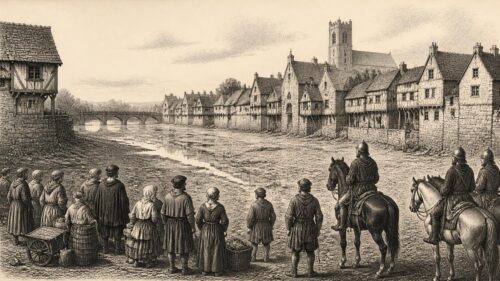
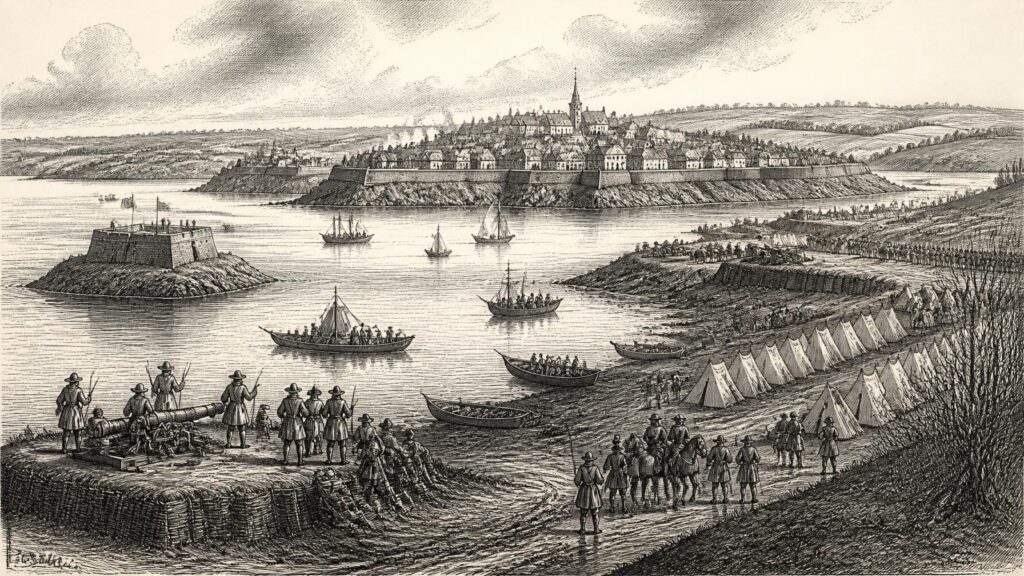
For Kinsale’s inhabitants, occupation immediately altered daily life. The Four Masters says that Spanish officers and soldiers were quartered in the town’s timber and stone dwellings, and that provisions, drink, ordnance, powder and lead were landed from the ships. The Spaniards strengthened points of approach, mounted guns and organised regular sentries. They also garrisoned Rinncorran, the fort on the eastern side of the harbour. This was a practical military landscape of walls, artillery, watches, food stores and access to water—not simply the setting for a heroic battle.
Mountjoy and Carew had been meeting at Kilkenny when news arrived. Their reconciliation, encouraged from London, was timely. Mountjoy reached Cork quickly and concentrated troops from the crown’s garrisons and allied lordships. By early October he had begun the investment of Kinsale. Rinncorran fell after sustained pressure, depriving Águila of an important harbour defence. English naval power was essential: ships brought men, artillery and supplies, blockaded Kinsale, and later contested the arrival of Spanish reinforcements at Castlehaven. The siege was therefore amphibious as well as terrestrial, dependent on harbours, tides, weather, transport vessels and naval guns.
Winter Camps and Southern Marches
The siege was dangerous for Mountjoy’s army as well as for those inside the town. Soldiers suffered exposure, sickness, desertion and inadequate food; horses also deteriorated. Spanish sorties and artillery fire prevented the besiegers from settling into safety. Reinforcements under the earl of Thomond arrived by sea during the winter, but the crown army remained vulnerable. It could not easily storm a town held by professional Spanish infantry, yet a long blockade consumed provisions and exposed thousands of men to a wet, bitter season.
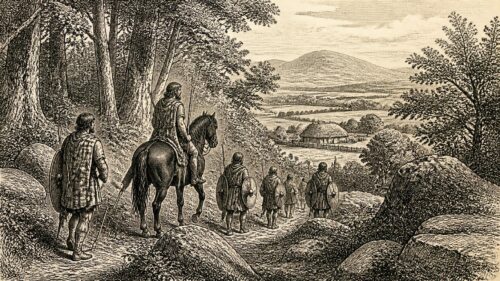
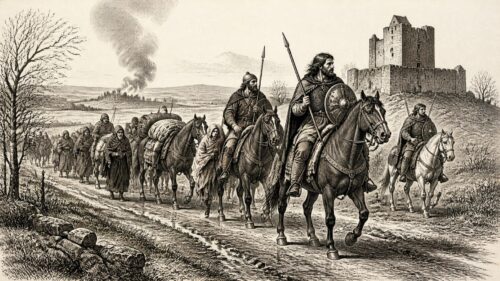
O’Donnell moved first to relieve Kinsale. He departed Ballymote in late October, brought allies from Tyrconnell and Connacht, crossed the Shannon, and outmanoeuvred Carew’s blocking force by a hard march through the interior. The route was a logistical achievement but its passage was destructive: the annals explicitly record burning and plundering around camps, and the seizure of castles in Kerry. O’Neill left Tyrone a week after All Hallows, early in November, and marched south more slowly. He raided through the Pale and the midlands on the way, both sustaining his force and signalling that Mountjoy’s redeployment to Cork had opened danger elsewhere.
By mid-December, O’Neill and O’Donnell had joined near the Bandon. Their combined army camped north of the crown position. This changed the military geometry. Mountjoy’s troops faced the Spanish garrison in Kinsale, while the Irish confederates threatened their communications and restricted access to hay, grain, water, straw and fuel. Each side tried to make scarcity a weapon. The Irish leaders could see the besiegers weakening; Águila’s soldiers could see relief near at hand, yet remained trapped behind the English lines.
The Christmas Eve Rout
Strategy now divided the allied camp. O’Neill preferred to maintain the pressure of blockade and winter hardship. O’Donnell, acutely conscious of Spanish distress, favoured a co-ordinated attack. Their disagreement should not be exaggerated into a simple personal feud: both faced daunting practical choices, and the evidence for some later stories of betrayal is weak. What is clear is that a night operation was agreed in which Irish forces would strike the crown camps while Águila’s men sallied from Kinsale.
In darkness the attacking columns lost time and direction. At daybreak on 24 December, Mountjoy’s troops encountered O’Neill’s division before the wider plan had properly cohered. Crown cavalry and infantry exploited the disorder. The Spanish sortie that might have supported the Irish did not arrive in effective strength, and the three Irish divisions could not turn their numerical presence into a unified assault. O’Neill’s men broke first; O’Donnell attempted to rally the retreating force, but the other formations also withdrew. Contemporary accounts disagree sharply over casualties, and later narratives often inflate them. The secure conclusion is not a precise body count but a rout that destroyed the relief effort.
That night the Irish leaders withdrew from the Kinsale area. O’Neill returned towards Ulster to defend his remaining base. O’Donnell chose a different course, sailing for Spain on 27 December to seek further assistance. The Spanish garrison was not yet surrendered in 1601, and the wider war was not over. But the year ended with the international intervention contained, the northern alliance scattered, and Mountjoy once more holding the initiative. Kinsale’s winter siege had exposed the extraordinary reach of Irish and Spanish resistance, but also the fatal difficulty of joining forces across a country already fractured by garrisons, rival lordships, hunger and war.

Primary Sources
- Annals of the Four Masters: Annal M1601
- Annals of the Four Masters
- O'Neill, Hugh
- O'Donnell, ‘Red’ Hugh (Ó Domhnaill, Aodh Ruadh)
- Águila, Don Juan del
- Carew, Sir George
- MacCarthy, Dermod Moyle (Diarmaid Maol)
- Collins, Dominic
- St Lawrence, Sir Christopher
- O'Byrne, Feilim
- Moryson (Morrison), Richard
- Oviedo, Mateo (Matthew)
- Newce, William
- The Battle of Kinsale, 1601
- The Battle of Kinsale
- Don Juan del Aguila's promises to the people of Kinsale and exhortation to Roman Catholics. Composition of Mountjoy with the same for the surrender of Kinsale, 1601. Note of captains and companies of Spaniards shipped from Kinsale after the surrender, 1601.
- Draft of a letter of Sir R. Cecil to Mr Nicholson, telling of the arrival of 50 Spanish ships with may be some 5,000 men at Kinsale and arrangements to meet this force. Oct. 3, 1601.
- A discourse of the fleet of Don Juan Aquila, sent into Spain, 9 days after his landing at Kinsale, Sept., 1601.
- Several papers relating to the siege of Kinsale and the victory gained there, 1601.
- Cecil to Mr Nicholson, telling of the arrival of 50 Spanish ships with may be some 5,000 men at Kinsale and arrangements to meet this force.
- The Spaniards and Kinsale 1601.