

Brabazon’s Limerick Court1549 CE
In 1549, Tudor authority in Ireland rested on negotiation, military pressure and limited resources. William Brabazon replaced Edward Bellingham as lord justice and held a major court at Limerick, where regional lords accepted a contingent peace secured by civic and aristocratic guarantees. Conflict continued across the midlands and west through castle seizures, raids, killings and disputed successions within Gaelic kindreds. Gunpowder caused Dermot O’Sullivan’s death, illustrating changing warfare. French envoys explored an Ulster alliance through Lough Foyle but found Gaelic divisions. Religious reform remained uneven, while local lordship, kinship and control of land shaped daily political realities beyond royal centres.
Dateline
In 1549, Ireland’s political map was not redrawn by a single decisive battle or statute. Instead, the year is best understood through a series of linked episodes: a change at the head of the Dublin administration, a conspicuous peace meeting in Limerick, local killings and recoveries of strongholds in the midlands and west, and renewed continental interest in the island’s northern coast. Together they show how little control the Tudor crown actually possessed beyond its centres of power, and how much depended on bargains with regional lords.
The most securely dated Irish events come from the annals, which are especially valuable for recording deaths, raids, local successions and political encounters outside the official English record. They do not provide a complete national narrative, and their entries must not be treated as proof that every event occurred on a precisely known day. Yet their notices for 1549 offer a vivid cross-section of Ireland: a kingdom claimed by Edward VI, but governed in practice through a shifting mixture of royal officers, Gaelic lordships, old English towns, ecclesiastical networks and armed households.
A Change in Dublin Government
Sir Edward Bellingham, the forceful English soldier who had been lord deputy since 1548, left Ireland for England during 1549. The Annals of the Four Masters calls him lord justice, reflecting the language through which Gaelic chroniclers described the chief representative of royal power. In his place, William Brabazon, the vice-treasurer, acted as lord justice. Brabazon was no neutral caretaker. Long established in Dublin government, he combined financial office, extensive landed interests and a reputation for advocating a hard military advance into Gaelic territories.
The transition mattered because Bellingham’s administration had intensified the crown’s intervention in the midlands. In the preceding two years, royal forces had fought the O’Connors of Offaly and the O’Mores of Laois, while forts were established at Daingean and what became Portlaoise. These were developments of 1547–48, not events newly founded in 1549; nevertheless, they formed the immediate setting for the year. Garrison building, military provisioning and the collection of revenue placed heavy demands on the Pale and sharpened fears among neighbouring communities that agreement with the crown might lead not to security but to permanent occupation.
The cost of this policy was a continuing problem. The Dublin administration depended on English subsidies, local revenues and the exaction known as cess, by which communities were expected to supply soldiers and officials. Forts were not simply symbols on a map: they required food, wages, transport, horses, weapons and repair. For people living near contested frontiers, the practical consequences included billeting, requisitioning and the danger that crops, cattle and houses might be destroyed in raids or counter-raids. The state’s reach was therefore experienced less through abstract law than through armed men and demands for sustenance.
A Court at Limerick
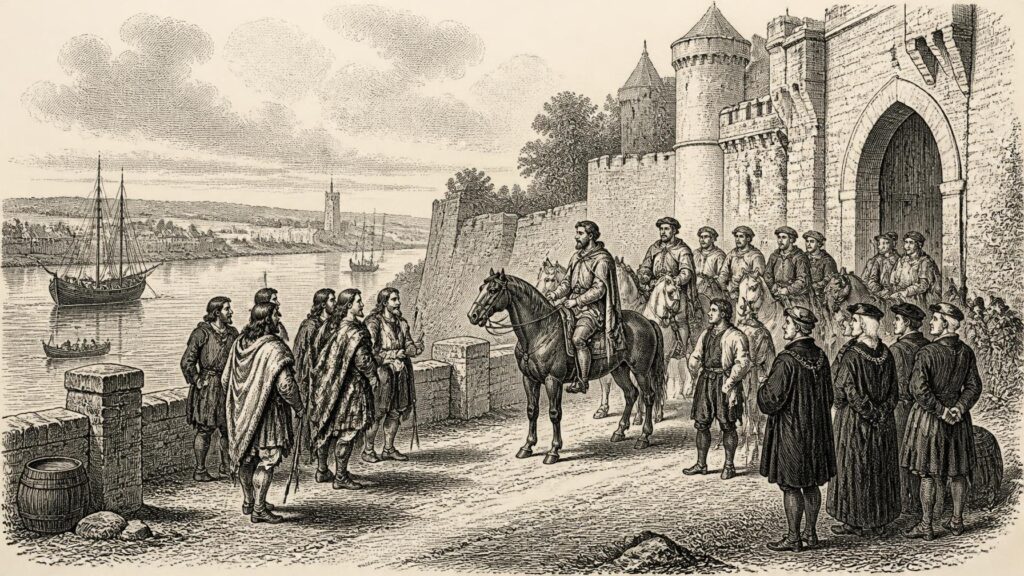
Brabazon’s most striking recorded action as lord justice was the holding of a “great court” at Limerick. The annals do not date the gathering more closely, so it should not be assigned to a particular month. Its place, however, is significant. Limerick was a walled port and a major urban centre on the Shannon, positioned between the crown’s more secure eastern sphere and the lordships of Munster and the midlands. Holding court there projected royal authority through a town whose mayor and civic elite were themselves important political actors.
Tadhg Caoch O’Carroll, lord of Éile, attended under safe protection. The guarantee came from the earl of Desmond, the mayor of Limerick, and the English and Irish chiefs present at the court. This detail is revealing. Protection was not supplied by the crown alone; it was collectively underwritten by magnates and municipal government. In a society accustomed to feud, retaliation and the seizure of persons, safe-conduct was a serious political instrument. It enabled an adversary or uncertain ally to appear without immediately risking capture or killing.
O’Carroll returned home safely with peace terms for himself and associated Irish leaders, named as MacMurrough, O’Kelly and O’Melaghlin, alongside others whom the annalist did not list. The agreement should not be mistaken for the pacification of a broad region. Such settlements were personal and contingent, resting on the honour, interest and military capacity of those involved. Still, the gathering shows Brabazon seeking to deal with power as it existed: not by direct administration of every district, but by negotiating with lords able to command followers, collect tribute and make war.
For O’Carroll, the occasion came amid intense pressure in Éile, the territory straddling parts of modern counties Offaly and Tipperary. He had faced both rival branches of his own kindred and the expanding reach of crown officers. The crown’s new forts in Laois and Offaly threatened to alter the balance across the midlands, while local captains sought opportunities in the disorder. The Limerick peace gave O’Carroll a measure of recognition, but it did not remove the underlying contest over castles, cattle, land and political allegiance.
Éile and the Midland Frontier
The annals record that Baile Mic Adam was taken from “Edmond a Faii” and that the O’Carrolls returned there, provoking great rejoicing in Éile. The entry does not state the full military sequence or precisely locate the emotions it reports, but its language matters. Control of a settlement or fortified site represented more than possession of stone and timber. It signified who could shelter followers, dominate roads and river crossings, store supplies, and claim lordship. The rejoicing suggests that the O’Carroll recovery was understood locally as a reversal of outside intrusion.
Elsewhere in the midlands, violence remained intimate as well as political. At Newcastle in Clonlonan, in modern County Westmeath, Niall O’Melaghlin attacked a house containing Tadhg Ruadh O’Melaghlin and his kinsman Murchadh. The house was burnt over them. The annals says that more than twenty people were killed or wounded, nine dying at once; the two principal targets escaped, though Murchadh was wounded. The episode is a reminder that fortified or substantial houses could become lethal traps when attacked with fire, and that a conflict described under one leading surname could engulf dependants and household members.
In Sil Anmchadha, around the east Galway–south Roscommon borderland, Máel Sechlainn God O’Madden, tanist of his lineage, was killed by Máel Sechlainn Modardha O’Madden and his kinsmen in revenge for the killer’s father and brother. “Tanist” identified a recognised successor within a ruling kindred, not necessarily the eldest son of the current lord. His death thus had constitutional as well as personal significance. Succession in Gaelic Ireland was negotiated among eligible male relatives and could be settled by alliance, force or assassination. Kinship supplied both the language of obligation and the motive for revenge.
The same pattern appears in the killing of Donnchadh O’Farrell, tanist of the O’Farrells, by his own brother. These brief annalistic notices cannot tell us every cause behind the murders, and it would be irresponsible to invent them. They do demonstrate, however, that political authority in many lordships was inseparable from family rivalry. A crown official arriving with a treaty could influence such conflicts, but could not simply replace the local structures through which land, military followings and status were organised.
Gunpowder and Lordship
One of 1549’s most striking notices comes from the south-west. Dermot O’Sullivan was burned by gunpowder in his own castle. His brother Auliffe succeeded him, only to be killed soon afterwards. The annals does not explain whether the first death resulted from accident, attack or an act within the household; certainty would go beyond the evidence. What is clear is that gunpowder had become a dangerous element in Irish lordly warfare and castle life. Firearms and powder did not eliminate older forms of conflict, but they altered the risks attached to defending a residence, maintaining a garrison and storing munitions.
This was a world in which a castle was both home and political resource. Its destruction, seizure or accidental explosion could suddenly transform a local succession. The O’Sullivan episode should therefore be read not as an isolated curiosity but as evidence of the growing integration of gunpowder into the material politics of sixteenth-century Ireland. Older weapons, cattle-raiding and kin-based retinues endured, while artillery, handguns and fortified positions increasingly shaped what a lord could hold.
Ulster and Continental Diplomacy
Ireland’s vulnerability also had an international dimension. During the autumn of 1549, after war resumed between England and France, the Irish intermediary George Paris accompanied two French envoys from Scotland to Lough Foyle. They explored the possibility of alliance with Ulster lords. Their presence did not produce a French landing or an Irish coalition: they departed in January 1550, and French observers found the divisions among the Gaelic leadership discouraging. Nonetheless, the episode was important. It showed that northern Ireland could be approached through the Scottish–Hebridean world, and that rival European powers recognised the island’s potential strategic value.
For the Dublin government, such contacts made local rebellion appear inseparable from foreign danger. For Gaelic leaders, foreign correspondence offered a possible counterweight to Tudor pressure, even if promises from abroad often failed to become effective aid. The discussions at Lough Foyle belong firmly to the later months of 1549, but their consequences belong to a longer history: English governments would repeatedly fear that France, Scotland or Spain might use Irish alliances to threaten the western approaches to England.
Religion, Language and Limits
Religious change formed part of the year’s wider political atmosphere, though the evidence does not permit a simple claim that the new English prayer book was already used throughout Ireland in 1549. Edward VI’s first Book of Common Prayer was mandated in England that year, and the English crown increasingly described ecclesiastical reform as applying to its dominions. In Ireland, however, practice remained uneven. The first securely attested public use of the 1549 prayer book in Ireland belongs to Easter 1551, not to 1549. Latin worship, Irish-speaking clergy and the inherited religious life of parishes and religious communities remained overwhelmingly important beyond a limited circle of official reformers.
The year therefore cautions against imagining a uniform “Tudor Ireland”. In Dublin, government officers sought revenue, obedience and religious conformity. In Limerick, a royal court depended on the guarantees of an earl, a mayor and regional chiefs. In Éile, Westmeath, Sil Anmchadha and the O’Farrell country, lordship was fought over within and between kin-groups. At Lough Foyle, French envoys tested the possibilities of diplomacy but found no united force to enlist. Ireland in 1549 was connected to the politics of Edward VI’s monarchy and to European war, yet its everyday realities were still determined above all by local power, protection, household survival and the uncertain control of land.
Primary Sources
- Annals of the Four Masters: Annal M1549 (English translation)
- Annals of the Four Masters: Annal M1549 (Irish text)
- Bellingham, Sir Edward
- Brabazon, Sir William
- St Leger, Sir Anthony
- O'Carroll (Ó Cearbhaill), Sir Tadhg Caoch
- Paris, George
- MacMurrough Kavanagh, Domhnall
- Burke (de Burgo), Roland
- O'Hurley, Dermot
- Francis Cosby (1510–80), Stradbally, Queen’s County and the Tudor conquest of Leinster
- Printing of Ireland’s First Book to Be Commemorated
- The 1549 Book of Common Prayer: Preface
- The 1549 Book of Common Prayer: Morning Prayer
- Edward VI’s Letter to the Bishops, 1549
- State Papers Ireland 1509–1782: Government Papers on Irish Affairs
- State Papers Domestic 1547–1649: Tudor and Stuart Government Papers
- State Papers Foreign 1509–1782: Government Papers on Foreign Affairs
- State Papers of Ireland: Calendar, 1509–1573
- Statute Law Revision (Pre-1922) Act 2005