

Knockavoe’s Night Assault1522 CE
In 1522, Aodh Dubh Ó Domhnaill defeated Conn Bacach Ó Néill’s extensive coalition at a surprise night attack at Cnoc Buidhe, or Knockavoe, near Strabane. Conn’s allies included Ulster lords, Connacht and Munster contingents, men from Meath and Leinster, and Scottish mercenaries. Earlier raids captured Ballyshannon, burned settlements and seized livestock, damaging Tír Chonaill’s communities and resources. Ó Domhnaill’s victory disrupted the coalition’s planned advance from Sligo and preserved his lordship, though warfare continued into 1523. The campaign demonstrated Ireland’s interconnected political and maritime world, while annalistic notices also recorded churchmen, scholars and the wartime deaths of learned household members.
Dateline
In 1522, the gravest conflict in Ireland was fought not between the Tudor government and an Irish lord, but within the shifting political world of Gaelic and Gaelicised lordships. Aodh Dubh Ó Domhnaill of Tír Chonaill faced Conn Bacach Ó Néill of Tír Eoghain in a campaign that drew in chiefs and fighting men from Ulster, Connacht, Munster, Meath and Leinster, as well as Scottish mercenaries. Its decisive encounter, a surprise night attack at Cnoc Buidhe, usually identified with Knockavoe near Strabane, ended a formidable coalition offensive and demonstrated both the reach of Ó Domhnaill power and the limits of a large but loosely connected alliance.
A Northern War of Unusual Scale
The annals agree that a major war broke out in 1522 between Ó Domhnaill and Ó Néill. Their rivalry was not new. The two dynasties competed for predominance in Ulster, for influence over border lordships and for leverage in Connacht. What made this year exceptional was the scale of Conn Bacach’s combination. He had become lord of Tír Eoghain in 1519 and was closely connected to the FitzGerald earls of Kildare through his mother, a daughter of the seventh earl. That connection helped place him within political networks extending well beyond his own lordship.
Conn’s host was a coalition rather than a national army. The annals name men of Tír Eoghain, Magennis of Iveagh, the MacMahons and other lords of Oriel, Maguire’s people of Fermanagh, Ó Catháin interests, contingents from Meath and Leinster, and Scottish fighting men under Alasdair, son of Mac Domhnaill. From the west came Richard Burke, Mac William of Clanricarde, with both Gaelic and English-speaking followers in Connacht; branches of the Ó Briain family, the Ó Cerbaill and the Ó Cinnéide also associated themselves with the enterprise. Several Connacht lords who had formerly recognised Ó Domhnaill’s superiority were now counted among the coalition.
This catalogue of allies should not be mistaken for a settled constitutional bloc. Lords joined campaigns for immediate advantage: disputed land, old obligations, opportunities for booty, kinship and marriage ties, or a calculation about which neighbour was becoming too strong. Yet the breadth of the gathering shows that the contest was consequential. Aodh Dubh was not merely defending Donegal. His authority and tributary relationships reached south towards Sligo and Lower Connacht, while Conn Bacach hoped to turn a great muster into regional supremacy.
Raids on the Erne Frontier
The campaign immediately affected communities along the south-western approaches to Tír Chonaill. The Annals of the Four Masters place Conn Bacach’s capture of Ballyshannon on 11 June. The fortress controlled an important crossing and route near the Erne estuary. Its defence was entrusted to Brian ‘of the Fleet’ Mac Suibhne of Tír Boghaine, who was killed with many of his people when the place fell. The same account records the deaths of two learned men attached to Ó Domhnaill: Diarmaid, son of Tadhg Cam Ó Cléirigh, described as historian and poet, and a son of the Mac an Bhaird learned family.
Ballyshannon’s fall was followed by the burning of Belleek and Bundrowes. Another annal records raids and the taking of prey in Tír Chonaill. Such language is easily read too quickly. A ‘prey’ chiefly meant seized livestock, but its consequences extended far beyond the armed men who drove cattle away. Animals represented food, ploughing power, manure, rents and movable wealth. Burning settlements and carrying off stock disrupted cultivation, compelled dependants to move animals and provisions to safety, and imposed losses that could be felt long after an army had withdrawn.
Ó Domhnaill replied with speed but not by seeking a conventional set-piece battle at once. His son Manus led a force into Tír Eoghain, burning and taking prey. Aodh Dubh himself moved to protect Tír Hugha and pursue Conn. This division of effort reveals a practical feature of lordly warfare: an army had to defend its own lands while threatening the enemy’s. Campaigning was therefore a contest over routes, stores, livestock, fortified places and the confidence of subordinate communities as much as over battlefield victory.
The Camp at Cnoc Buidhe
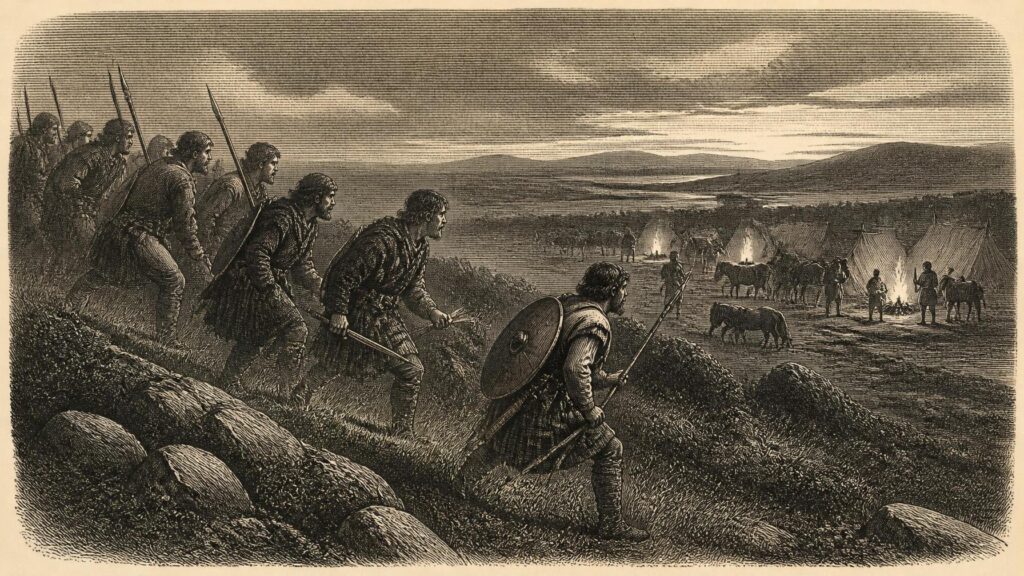
Conn Bacach later encamped at Cnoc Buidhe, beside Loch Monann in the wording of the Four Masters. The precise topography and some details differ between narrative traditions, but the central sequence is secure: Ó Domhnaill faced Conn’s large northern host while a second allied army waited around Sligo, threatening Tír Chonaill from the south. The Ó Domhnaill force was too small to engage both armies separately in daylight. Its leaders therefore chose the dangerous alternative of a night assault on Conn before the two wings could unite.
The annalists present the decision as a council of men facing defeat or subjection. Ó Domhnaill’s troops dismounted their horsemen and added them to the infantry formations. The move was tactical as well as symbolic. In darkness, on broken ground and against an encamped enemy, cohesion on foot mattered more than the mobility of mounted men. The attackers advanced without the help of neighbouring allies. Sentinels detected them only at the last moment; the alarm and assault reached Conn’s camp almost together.
The result was a confused nocturnal fight in which, as the Four Masters stressed, combatants could barely distinguish faces. That imagery may reflect the literary conventions of annalistic battle narrative, but it conveys a credible military reality. A camp surprised at night could be broken by noise, panic, the loss of leaders and the inability to deploy separate contingents in order. Conn’s force included Scots, Leinster gallowglass companies and men from Meath as well as Ulster followers: exactly the sort of large composite host whose parts might struggle to act together under sudden pressure.
Ó Domhnaill won. The Annals of Ulster and Annála Connacht, independently preserving the broad story, report Conn’s defeat and heavy losses among Scottish and Irish allies. The Four Masters gives a figure of more than 900 dead, supposedly calculated from local recognition and burial; that dramatic total cannot be independently verified and should be treated as the annalists’ estimate, not a modern casualty count. Named dead included men of Clann Domhnaill, Clann Síthigh, the Bissetts and other Scottish associates, while the victors took horses, weapons, armour, food, drink and valuable vessels from the abandoned camp.
Victory Beyond the Battlefield
The immediate strategic consequence was almost as important as the fighting. Ó Domhnaill marched rapidly westward towards Benbulben, where the Connacht and Munster allies had reached the Sligo area. Their original plan had depended upon the strength of Conn Bacach’s northern army. Once news of Knockavoe arrived, they withdrew across the Curlew Mountains. The Four Masters calls this a ‘bloodless defeat’; Annála Connacht similarly remarks that, despite their resources and numbers, the allies retired without carrying out their covenants against Tír Chonaill.
This retreat did not make Aodh Dubh undisputed master of Ireland, nor did it end the Ó Néill–Ó Domhnaill struggle. The conflict continued into 1523, when the annals record further Ó Domhnaill raids in Tír Eoghain before a peace at the end of harvest. But 1522 checked Conn Bacach’s attempt to assemble overwhelming regional power. It also enhanced Manus Ó Domhnaill’s reputation. Still his father’s lieutenant rather than lord in his own right, Manus had participated in the counter-raids and later acted in dealings with the southern lords. His political and cultural prominence would grow markedly in the following decades.
Scotland, Leinster and the Irish Sea
The Scottish presence on both sides of Irish politics was no anomaly. The North Channel was a corridor of kinship, shipping, mercenary service and information. Gallowglass families of Hebridean origin had long held lands in Ireland and served Irish lords as professional heavy infantry, while Scottish captains could bring fresh companies across the sea. Their participation at Knockavoe makes the battle a reminder that sixteenth-century Irish politics cannot be contained within the island alone.
The year’s annals make this wider outlook unusually visible. Their opening notices discuss the European war involving the French king, the English, imperial and Italian powers, and the Scots. The reports were said to come from people who carried news and frequented ports. Annalists were not neutral international correspondents, and their summary of events abroad was imperfect. Nevertheless, it shows that those recording Irish affairs understood overseas war through maritime movement, visitors and commercial contact. News from ports belonged in the same historical record as raids on the Erne and a battle in Ulster.
Lordship, Church and Learning
Other notices placed in 1522 offer smaller but revealing glimpses of authority and learning. The Annales Breves Hiberniae records the death and burial at Leighlin of Gerald Mac Murchadha Caomhánach, who, in its pointed Latin phrasing, had caused himself to be called king of Leinster and duke of the Leinstermen. The wording is a reminder that the old provincial title endured as a claim to status, even where practical power rested in a narrower Kavanagh lordship amid the competing interests of the Kildares, Butlers, towns and Crown administration.
The year also saw the death of Redmond Roe Maguire, prior of Lisgoole, and that of Master Felim Ó Corcráin, identified as a learned doctor of canon law. Such brief obituaries matter. They show religious houses, church law and trained scholarship continuing as recognised parts of Irish society before the Henrician religious changes of the 1530s and 1540s. The killing of the Ó Cléirigh historian-poet at Ballyshannon shows the vulnerability of learned households in war; the respectful notice of his hospitality shows their social value. In 1522, arms and lordship dominated the annals, but warfare unfolded in a world sustained also by monasteries, lawyers, poets, fosterage and obligations of patronage.
Knockavoe was therefore more than a local clash between two northern dynasties. It exposed the connected political geography of early sixteenth-century Ireland: a northern struggle could call men from the Isles, Meath, Leinster, Connacht and Thomond; a burned frontier town could cost a lord learned servants as well as soldiers; and a sudden night attack could undo months of alliance-building. For Aodh Dubh Ó Domhnaill, the victory preserved Tír Chonaill at a moment of acute danger. For Conn Bacach Ó Néill, it was a serious reverse, though not the end of his long political career. For many households in Ulster and along the north-western routes, the enduring fact of 1522 was simpler: armies had come, livestock and provisions had been seized, and the balance of power had violently changed.
Primary Sources
- Annála Connacht: Annal 1522
- The Annals of Ulster: Year U1522
- The Annals of Ulster: Year U1523
- Annals of the Four Masters: Annal M1522
- CELT Project: Annals of the Four Masters
- Annales Breves Hiberniae
- O'Neill (Ó Néill), Conn ‘Bacach’
- O'Donnell (Ó Domhnaill), Sir Aodh Dubh
- O'Donnell (Ó Domhnaill, Maghnas): Manus O'Donnell
- Mág Uidhir (Maguire), Cú Chonnacht Óg (‘an Comharba’)
- O'Neill, Niall Mór
- ‘Irish’ Ireland and ‘English’ Ireland
- English Lordship of Ireland and the Irish Sea World: Re-assessing the Origins of the Kildare Ascendancy, c.1390–c.1513
- Richard II and the Wider Gaelic World: A Reassessment
- The Rise and Fall of the Clann Éinrí Aimhreidh Uí Néill: Dynastic Feuding and Geopolitics in the Late-Medieval Irish Sea World
- Some Medieval Seals Out of the Ormond Archives, Including That of Donal Reagh Mac Murrough Kavanagh, King of Leinster
- Letters and Papers of Henry VIII
- State Papers Ireland 1509–1782: Government Papers on Irish Affairs
- Letters and Papers, Foreign and Domestic, Henry VIII
- Calendar of State Papers Ireland: Tudor Period, 1509–1547