Dungannon’s Great Guns1498 CE
In 1498, Gerald FitzGerald, earl of Kildare and royal deputy, led Gaelic and Anglo-Irish allies to capture Dungannon Castle with artillery, intervening in the violent O’Neill succession struggle. The campaign displayed military capacity but reinforced a factional settlement rather than extending durable Dublin control. Kildare’s restored administration also summoned parliament, pursuing taxation, customs and measures promoting English elite practice. Ireland endured famine and recorded smallpox deaths, including scholar Cathal Óg Mac Maghnusa, compiler of the Annals of Ulster. Conflict in Munster, religious patronage by Margaret Maguire, and scattered annalistic reports reveal interconnected yet locally experienced political, social and cultural life.
Dateline
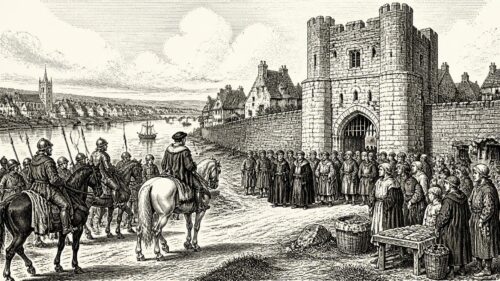
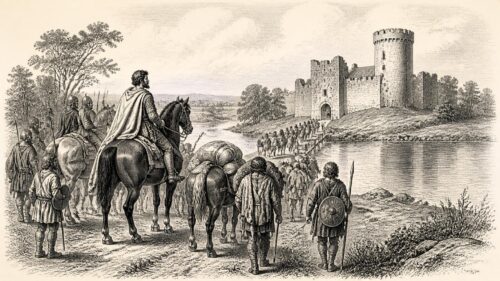
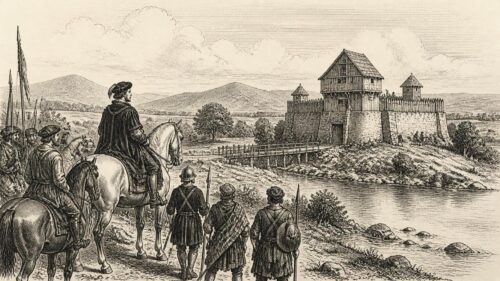
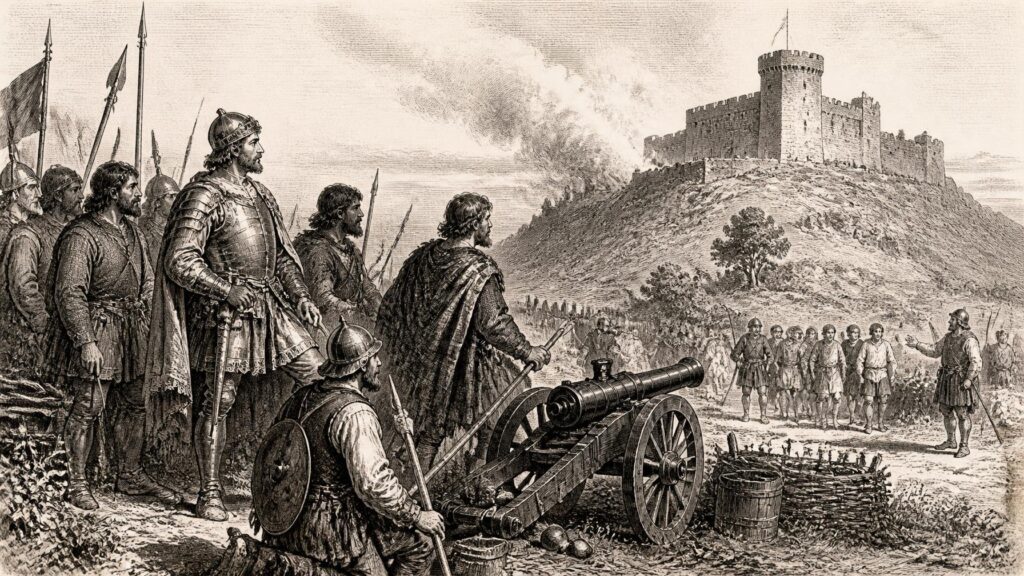
In 1498, the taking of Dungannon Castle made a local Tyrone succession struggle into an island-wide demonstration of political power. Gerald FitzGerald, eighth earl of Kildare and the king’s deputy in Ireland, led an expedition north with a coalition that included Aodh Ruadh O’Donnell of Tír Chonaill, John Maguire of Fermanagh and Turlough O’Neill. The castle fell to artillery. That fact matters: the guns were not merely instruments of destruction, but a visible statement that the deputy could bring costly, organised force into the heartland of the O’Neills. Yet the campaign also shows the limits of any simple picture of English conquest. Kildare’s army depended upon alliances with leading Gaelic lords, and its result was to strengthen one O’Neill faction against another, rather than to impose a durable government from Dublin.
A Tyrone Succession Crisis
The immediate background was a violent contest within Cenél nEógain, the northern lordship commonly called Tyrone. Henry Óg O’Neill, lord of Cenél nEógain, was killed early in 1498 by Turlough and Conn, sons of Conn Mór O’Neill. The Annals of Ulster place the killing on 21 July and describe it as revenge for the death of their father five years earlier. Annála Connacht likewise records Henry Óg’s death at Doire an Fhiadha. Such accounts should not be read as neutral court reports: they are concise annalistic notices, shaped by the interests and information networks of their compilers. But together they leave no doubt that a long-running family feud had reached a decisive and bloody point.
Retaliation followed swiftly. Domnall O’Neill, who had previously been proclaimed O’Neill, gathered his followers and allies among the Mac Mahons and moved against Dungannon. His party was surprised at Cross Cavanagh by forces called out by Féilim, son of the slain Henry Óg. The annals describe men found sleeping and given a “cold-awaking” by their enemies. A number of prominent men of Ulster fell; horses and armour were lost, and Féilim himself received a head wound from a spear and died after several days. The episode conveys the character of lordship in the region: kinship, fosterage, marriage connection, hostage-taking, fighting bands and the possession of fortified places all mattered at once.
Another clash of the same year brought Aodh Ruadh O’Donnell directly into the dispute. He raided the sons of Art O’Neill, defeated them, seized Caisleán Maol and took armour, hostages and prisoners. The tally of seventeen suits of armour and fifteen hostages is unusually concrete. Armour was valuable movable wealth as well as military equipment; hostages were political securities, usually drawn from leading families to guarantee submission or agreement. The capture of a castle, therefore, was inseparable from the capture of people and the transfer of obligations.
Kildare’s Northern Coalition
It was in this unsettled setting that Kildare entered Tyrone. The Four Masters and the Annals of Ulster agree on the essential event: the deputy marched upon Dungannon at the urging of O’Donnell, Turlough O’Neill and Maguire, joined by many Gaelic allies from the south as well as Ulster. This was not an expedition of an isolated colonial administration confronting a united Irish opposition. Kildare was an immensely powerful Anglo-Irish magnate whose authority rested upon his offices, estates and armed following, but also upon an ability to make himself useful to Gaelic rulers.
Family connection helped explain his intervention. Turlough and Conn, the sons of Conn Mór, were sons of a daughter of Kildare. The expedition could be represented both as the king’s deputy enforcing order and as an earl assisting his nephews’ cause. Such overlapping loyalties were typical of late-medieval Ireland. The political map was not divided cleanly between an English Pale and an Irish exterior. There were jurisdictions, languages and legal traditions with real consequences, but aristocratic marriage, military service, church connections, trade and personal alliance crossed their borders.
The castle was taken “with great guns”, according to the Four Masters, on the day after the main host arrived. The Annals of Ulster similarly says that it was taken with guns. Neither source permits a reconstruction of the siege’s duration, the exact size of the artillery pieces or the number of casualties. It is safer not to imagine a prolonged bombardment in modern terms. What can responsibly be said is that artillery had become important enough for contemporaries to make it the defining feature of the capture. Stone or timber defences, even on a commanding hill, were vulnerable when attackers could transport and employ cannon.
The victors released prisoners, including Domnall, a son of O’Donnell who had reportedly been held for a year, and Art O’Neill with two sons. They seized horses, military equipment and other goods; Conn, son of Turlough Ruadh O’Neill, was killed in the castle. Kildare’s coalition then placed Dungannon in Domnall O’Neill’s hands. This outcome was no straightforward settlement. It rewarded an ally while leaving rival claimants alive and armed. The year’s events instead reveal how castles were bargaining counters: their control could decide who collected tribute, sheltered retainers, detained captives and spoke with authority for a lordship.
Deputyship and Parliament
The Dungannon campaign came only two years after Kildare had been restored to royal favour and returned as deputy. Henry VII’s government had attempted to curb his power through the administration of Sir Edward Poynings and the statute later known as Poynings’ Law. But royal policy also required a workable governor in Ireland, and Kildare’s restoration acknowledged the practical reach of his influence. In 1498 he received authority to summon a parliament, the first held under the new procedure requiring English approval for proposed legislation.
The surviving statutory record associates the parliamentary session of 1498–99 with measures restoring Kildare, raising customs and land taxation, and regulating elite display. One act required lords to ride in saddles in the English manner; another concerned robes worn in parliament. These enactments belonged to a wider official ambition to uphold “English” order and custom within the lordship. They should not be mistaken for evidence that social practice changed overnight, still less that such rules reached most of the island. Their value lies in showing what officials considered difficult to control: clothing, riding, weapons, revenue and the conduct of magnates.
For communities within the Pale and in towns connected to its economy, customs duties and land subsidies could be felt in practical ways. Merchants, landholders, port officials and consumers all had an interest in how poundage and taxation were assessed. Yet the records do not allow a confident calculation of their effect in 1498. The year is better understood as one in which Kildare’s government sought both military authority in Ulster and a renewed legal and fiscal basis in the Dublin-centred lordship.
Famine, Smallpox and Household Loss
Politics unfolded amid grave human insecurity. The Four Masters state that a great famine prevailed throughout Ireland in 1497 and the following year, reporting that hunger drove people to foods too dreadful for the compiler to specify. The statement applies directly to 1498, though it offers neither harvest figures nor regional detail. It should therefore be treated as evidence of a severe, widespread crisis rather than as a precise measure of mortality. For ordinary households dependent on grain, cattle, dairy produce and local exchange, scarcity would have intensified the risks of displacement, raiding, debt and disease.
Smallpox is explicitly named in two 1498 notices. Niall, son of Aodh Ruadh O’Donnell, died in captivity before St Brigid’s Day; Domnall, son of Nechtain O’Donnell, also died of the disease. Most notably, smallpox carried off Cathal Óg Mac Maghnusa on 23 March. His death was an intellectual loss as well as a personal one. Based at Seanadh, now Belle Isle on Lough Erne, he was a churchman with offices linking him to Armagh, Clogher, Inis Caoin and Lough Erne. His obituary calls him a host to travellers and the poor, a learned man of law, theology, medicine, philosophy and Irish scholarship, and the compiler of the book that became known as the Annals of Ulster.
The lavish praise must be recognised as an obituary convention, but it still illuminates the learned world that sustained Irish historical writing. Annals were not accidental lists. They were assembled from earlier books, kept within ecclesiastical and hereditary learned networks, and continued by scribes after a compiler’s death. In 1498, amid war, hunger and epidemic illness, the passing of Mac Maghnusa marked the end of one scholar-patron’s work while the manuscript tradition he fostered endured.
Munster and Religious Patronage
Conflict was not confined to Ulster. The Annals of Ulster record that Thomas Óg FitzGerald, son of Thomas, earl of Desmond, and Cormac Óg Mac Carthaigh pursued Eógan Mac Carthaigh after a cattle raid. Eógan, two sons, Philip O’Sullivan Beare and his son, members of the Mac Suibhne family and others were killed. The notice is brief, and its location is not securely identified in the translation; it should not be expanded into a general war in Munster. It does, however, show that pursuit after cattle-taking could mobilise aristocratic parties and exact a high human cost.
The year also preserves quieter signs of devotion and status. Margaret Maguire, wife of Gilbert O’Flanagan of Tuath Rátha, died and was buried at Donegal. The annals note that the couple had built a chapel in honour of God and the Virgin Mary at Achadh Mór, their settlement. Her commemoration demonstrates that women of ruling families could be remembered not merely through marriage ties but through acts of religious patronage. Such chapels bound family memory, local worship and lordly reputation together.
Thus 1498 was not one national story with a single centre. It was a year in which Dungannon’s artillery captured the most dramatic encounter between the deputy and Gaelic politics; in which parliament attempted to define the order of the lordship; and in which famine, disease, household grief and the work of scholars and patrons continued across Ireland. The annals’ scattered entries are themselves revealing. They show a country connected by alliances and learning, but experienced day by day through local lordships, vulnerable communities and contested strongholds.
Primary Sources
- The Annals of Ulster: Year U1498
- Annals of the Four Masters: Annal M1498
- Annála Connacht: Annal 1498
- The Annals of Ulster
- Annals of the Four Masters, Volume 4 English Translation
- Annála Connacht
- Mac Maghnusa (MacManus), Cathal Óg
- FitzGerald, Gerald (Gearóid Mór)
- English Lordship of Ireland and the Irish Sea World: Re-assessing the Origins of the Kildare Ascendancy, c.1390–c.1513
- Statute Law Revision Act 2007
- Statute Law Revision Bill 2007: Schedule
- Ireland under the Tudors; with a Succinct Account of the Earlier History
- Ireland, 1494–1603
- Ireland under the Tudors, Volume I
- Medieval Dungannon
- Hill of The O’Neill Heritage Guide
- The Annals of Ulster, in Irish, 431–1541
- Exploring the Irish Annals
- Tudor Re-Conquest in County Kildare
- The Kildare Ascendancy (1470–1541)
- The Language of the Annals of Ulster
- The Annals of Ulster: Bibliography and Publication Details