

Simnel’s Dublin Crown1487 CE
In 1487 Dublin became the base for a Yorkist challenge to Henry VII. Lambert Simnel, presented as Edward, earl of Warwick, was crowned Edward VI at Christ Church, backed by Kildare and elements of the Anglo-Irish clergy and administration. With Lincoln, German mercenaries and approximately 4,000 Irish kerns, the coalition invaded England, but was defeated at Stoke, where many Irishmen, including Thomas FitzGerald, died. Meanwhile, Gaelic lordships endured warfare, killings and contested successions. Severe storms and summer rain damaged buildings and crops. Churches suffered in raids, while poet, historian and legal scholar died. Desmond’s earl was murdered, highlighting FitzGerald instability.
Dateline
In 1487 Ireland became the launching ground for one of the most serious early challenges to the new Tudor monarchy in England. At Dublin, a boy presented as Edward, earl of Warwick – but now known as Lambert Simnel – was accepted by leading figures of the English lordship, ceremonially crowned, supplied with an army and sent across the Irish Sea. The enterprise ended in defeat at Stoke in England on 16 June, with grave losses among the Irish troops who had crossed with it. Yet this was not a year whose significance can be reduced to Dublin and the Wars of the Roses. Irish annals also record destructive weather, damaged harvests, regional wars, political killings, a disputed succession and the deaths of poets, lawyers and churchmen. The island’s history unfolded through several overlapping political worlds, not one national government.
A Yorkist Claim in Dublin
The immediate background was the unsettled succession in England after Henry Tudor defeated Richard III at Bosworth in August 1485. The principal magnates of the English lordship of Ireland, especially Gerald FitzGerald, eighth earl of Kildare, had deep Yorkist connections. Kildare had been Richard III’s deputy governor, and his authority in Ireland depended greatly on a network of family, offices, landed retainers and alliances among the lords of the Pale. A Tudor king with little prior connection to Irish affairs could appear both politically uncertain and potentially threatening to this established order.
Lambert Simnel arrived in Ireland during the winter of 1486–87, trained to claim the identity of Edward Plantagenet, earl of Warwick, nephew of Edward IV and a Yorkist heir with a stronger dynastic pedigree than Henry VII. The real Warwick was alive and held in the Tower of London; Henry had him displayed publicly in London in February 1487 to rebut the story. That did not prevent prominent Anglo-Irish supporters from treating the claimant as genuine, or at least finding his claim useful. Thomas FitzGerald of Lackagh, Kildare’s brother and chancellor of Ireland, was especially active in advancing Simnel’s cause.
Support was important but not unanimous. Walter FitzSimons, archbishop of Dublin, and John Payne, bishop of Meath, backed the movement, while Octavian de Palatio, archbishop of Armagh, together with senior churchmen in Tuam, Cashel and Ossory, did not. That division is a useful warning against imagining either the Irish church or the English lordship as politically uniform. The venture was an Anglo-Irish and international Yorkist coalition centred on Dublin, rather than an enterprise supported by all Ireland.
The Coronation at Christ Church
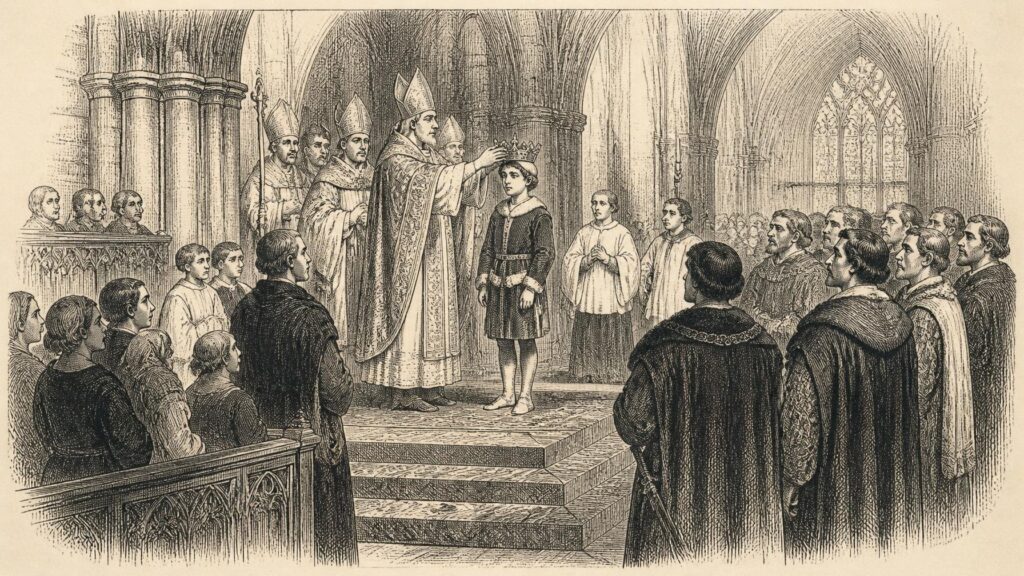
The most firmly dated event of the year occurred on 24 May, when Simnel was crowned in Christ Church Cathedral, Dublin, as “Edward VI”. The choice of regnal number made sense within the Yorkist fiction: he was presented as an Edward succeeding Edward V. It was nevertheless an extraordinary act. The boy was crowned as claimant to the English crown outside England, in the principal cathedral of the lordship’s capital, with the participation of its archbishop and leading secular officials.
The Annals of Ulster, preserving a Gaelic perspective, describe a great fleet of “Saxons” arriving to meet the alleged son of the duke of York, then living with Kildare. The annalist states that he was proclaimed king at Áth Cliath, Dublin, on the Sunday of the Holy Ghost, and records that many Irishmen sailed east with him. The annal’s identification of the boy reflects the claim current among his adherents, not his true identity; it is valuable precisely because it shows how the episode was represented and understood in Ireland at the time.
A government was organised in the new king’s name. Kildare became lieutenant of Ireland under “Edward VI”, and a parliament was summoned which affirmed the claimant’s title and attainted Thomas Butler, seventh earl of Ormond, for loyalty to Henry VII. Surviving evidence also associates coinage struck at Waterford with the new royal style, suggesting that initial resistance there had weakened or been overcome. Such measures were more than ceremonial decoration. They appropriated the machinery, language and symbols of government in an attempt to make a disputed child into a functioning king.
An Army Goes East
The Dublin court was strengthened by the arrival on 5 May of John de la Pole, earl of Lincoln, a nephew of Edward IV and a far more plausible Yorkist leader than Simnel himself. He came with German mercenaries, raised with the help of Margaret of Burgundy, Edward IV’s sister, and commanded by Martin Schwartz. Their presence reveals the European dimensions of the crisis: Burgundian money, German soldiers, English dynastic exiles and Irish political interests converged in Dublin.
On 4 June the expedition departed for England. Modern estimates commonly give the Irish contingent as about 4,000 Gaelic foot soldiers, or kerns, under Thomas FitzGerald, who had given up the Irish chancellorship to command them; Edward Plunket also led men. The number should be treated as an estimate reported by later historical reconstruction rather than a modern muster roll. What is beyond doubt is that a substantial body of men from Ireland crossed the sea in support of the Yorkist invasion.
The campaign ended at Stoke on 16 June. Henry VII’s army defeated the invaders; Lincoln and Thomas FitzGerald were killed, and Simnel was captured. The Annals of Ulster says that the battle went against the young man proclaimed king in Dublin and that the greater part of those who had gone east from Ireland were killed, including Thomas and many noble “Foreign” youths. Its language conveys the human scale of the reverse better than the constitutional drama alone can do. The defeat removed Kildare’s brother, damaged the military resources of his affinity and exposed the lordship’s governing elite to Tudor suspicion.
War and Lordship Beyond the Pale
Even while Dublin prepared an invasion, violence and political manoeuvre continued across Gaelic Ireland. In March Brian Ruadh Ó Ruairc, an important leader in lower north Connacht, was wounded by an arrow and died on 10 March. The killing triggered intervention by Aodh Ruadh Ó Domhnaill of Tír Chonaill. Ó Domhnaill attacked Feidhlimidh Ó Ruairc’s castle, took it and had it demolished shortly afterwards. The annalist specifically notes that Brian Ó Ruairc was killed by a gunshot during the assault. Firearms had not displaced older weapons or modes of war, but their appearance in this local struggle is a clear sign of changing military practice.
Feidhlimidh Ó Ruairc was driven into Fermanagh, though later in the year he returned and made peace with Ó Domhnaill. The sequence demonstrates both the instability of lordship and the practical limits of victory. Castle-taking, exile and negotiated reconciliation were all instruments in the contest for control of Breifne and its neighbours. Elsewhere, rival branches of the Maguires fought in Fermanagh; the Ó Neills, MacMahons and Ó hAnluains raided and counter-raided in Ulster and Oriel; and conflicts among the Ó Conchobairs, Mac Diarmadas and Ó Ceallaighs disturbed Connacht and Uí Maine.
Succession remained a dangerous business. Toirdelbach Ó Raghallaigh died at his castle of Tullymongan on 1 September, and his son John was made Ó Raghallaigh on 13 September. In Uí Maine, William Ó Ceallaigh died in captivity after rival kinsmen had established competing claims. These were not peripheral incidents: the authority of regional rulers rested on kinship, land, clientage, hostages and military followings, all of which could be rapidly unsettled by a death or capture.
Storm, Rain and Food
The annals give unusually direct glimpses of environmental hardship. On 24 February a great wind unroofed houses and churches, broke trees and damaged cottages and gardens. This was the kind of event that struck ordinary households as well as ecclesiastical institutions: roofs, stored materials, garden plots and small craft were essential assets, difficult to replace in a society where transport and cash were limited.
More consequential still was the summer. The Annals of Ulster describes rain so severe that the season resembled an inclement winter and says that much of Ireland’s crops were destroyed. The entry does not allow us to calculate harvest losses, prices or mortality, and it should not be converted into a documented nationwide famine. It does, however, firmly place widespread agricultural damage in 1487. For cultivators already facing raids, billeting, livestock seizures and local warfare, a poor harvest could make the difference between precarious sufficiency and acute shortage.
Church, Learning and Cultural Loss
Religion was woven into political and social life, not separate from it. The fighting around Achadh Beithe on 23 September ended with the burning of its stone church, despite the stated wishes of the Maguire leader. In Magh Luirg, raids burned houses and crops, and the church of Druim Conaille was burned by an Ó Ruairc follower. Aodh Ruadh Ó Domhnaill sought restitution for property removed from another violated church, and when the church-burner could not be produced, a hostage was delivered to the clergy as security for reparation. These episodes show churches as protected places in principle, yet vulnerable in practice, and clergy as parties able to demand compensation.
The year also saw the death of Philip “the Poor” Ó hUiginn, a Franciscan friar of the Strict Observance whom the annalist praised as the most prolific and finest devotional versifier of recent times. Sigraidh Ó Maolconaire, learned historian and ollamh to the Ó Conchobairs of Connacht, also died, as did John Mac Aodhagáin, legal scholar to MacWilliam of Clanricarde. Their deaths remind us that late medieval Irish lordships supported specialist hereditary and religious learning: poets, historians, jurists and clerics helped preserve memory, law, devotion and political legitimacy.
Desmond’s Violent Year-End
At the end of the year, probably around Christmas, James FitzThomas FitzGerald, ninth earl of Desmond, was killed by treachery. The Annals of Ulster names John “the Toothless” as responsible and says that James’s brother Maurice was made earl; Maurice promptly killed John in retaliation. The murder was part of the recurrent strain within the great Desmond lordship, where family rivalry could become armed succession politics. It also forms a grim counterpart to the disaster suffered by the Kildare affinity at Stoke: two branches of the wider FitzGerald world ended 1487 diminished by death.
Thus 1487 was both an exceptional year and a revealing one. Dublin’s coronation and the crossing to England made Ireland central to an international dynastic gamble. But storms, ruined crops, local warfare, churches under pressure and disputed lordship shaped life just as immediately. The defeat at Stoke did not end Kildare’s power, nor did it bring English royal control suddenly to the whole island. It did, however, show the Tudor regime that political authority in Ireland could be organised independently, mobilised militarily and projected across the Irish Sea.
Primary Sources
- The Annals of Ulster, Year U1487
- Annála Connacht
- Simnel, Lambert | Dictionary of Irish Biography
- FitzGerald, Gerald (Gearóid Mór) | Dictionary of Irish Biography
- FitzGerald, Thomas fitz Thomas | Dictionary of Irish Biography
- Fitzgerald, Maurice fitz Thomas | Dictionary of Irish Biography
- FitzGerald, Gerald (Gearóid Óg, Garrett McAlison) | Dictionary of Irish Biography
- O'Donnell (Ó Domhnaill), Aodh Ruadh | Dictionary of Irish Biography
- O'Rourke (Ó Ruairc), Donnchadh | Dictionary of Irish Biography
- O'Reilly (Ó Raghallaigh), Eóghan | Dictionary of Irish Biography
- Butler, Piers (‘Piers Ruadh’) | Dictionary of Irish Biography
- St Lawrence, Sir Nicholas | Dictionary of Irish Biography
- Preston, Robert | Dictionary of Irish Biography
- MacMahon (Mac Mathghamhna), Aodh Ruadh | Dictionary of Irish Biography
- Factions, Feuds and Noble Power in the Lordship of Ireland, c. 1356–1496
- English Lordship of Ireland and the Irish Sea World: Re-assessing the Origins of the Kildare Ascendancy, c.1390–c.1513
- Aristocratic Autonomy, 1460–94 | A New History of Ireland: Volume II
- Trinity Historians Reconstruct Thousands of Medieval Documents Bombed in the Four Courts in the Civil War
- Account of the Crowning of Lambert Simnel in Dublin, May 27, 1487; Account of the Silver, Copper and Iron Mines in Ireland, etc.
- Medieval Dublin XVII
- The Italian Connection: The Great Earl & Archbishop Octavian
- The Coronation of Lambert Simnel