Kildare Return1496 CE
In 1496 Henry VII restored Gerald FitzGerald, eighth earl of Kildare, as lord deputy, ending the immediate crisis of direct Tudor rule. Landing at Howth with royal favour and a new marriage, Kildare accepted conditions including Poynings’ Law, while his heir remained in England. Efforts to dig defensive boundaries around the Pale reflected insecure frontier government. Elsewhere, MacMahon feuds in Oriel, O’Donnell conflicts and regional successions demonstrated fragmented authority. Severe weather destroyed crops and cattle, causing widespread dearth and disrupting husbandry. Annals nevertheless recorded musicians, learned families and religious patrons, revealing cultural prestige amid warfare, political competition and agricultural hardship.
Dateline
In 1496 the most conspicuous political change in Ireland was the return of Gerald FitzGerald, eighth earl of Kildare, to royal office. Yet the year cannot responsibly be reduced to a Dublin-centred restoration. The Irish annals record a country in which lordship was contested in many places, harvests failed, cattle perished, fortresses changed hands and learned people, musicians and patrons still mattered enough to be remembered by name. Kildare’s arrival at Howth was significant because it settled a crisis in the English lordship; it did not make Ireland politically uniform, peaceful or secure.
A Deputy Returns
The firmly dated turning point came on 6 August, when Henry VII reappointed Kildare as his lord deputy in Ireland. This was a striking reversal. Kildare had been arrested in February 1495 during Sir Edward Poynings’s intervention, accused of disloyal dealings with Gaelic lords and enemies of the Tudor regime. He had then been attainted by the Irish parliament. By 1496, however, evidence from Magennis and O’Hanlon had helped clear the most serious allegation against him, while the expense and limited effectiveness of direct English government had become obvious. Poynings had left Ireland late in 1495. Henry VII again chose the far cheaper and more practical course of governing through the most powerful resident magnate in the English lordship.
Kildare’s commission was both generous and conditional. He swore to observe Poynings’ Law, govern impartially, defend the lordship, deliver English rebels who sought refuge in Ireland, and remain at peace with the Butler interest and Archbishop Walter FitzSimons of Dublin. He was appointed for ten years and thereafter at the king’s pleasure, received wide authority over offices, and could reclaim crown lands held by Gaelic Irish lords. His eldest son and heir, Gerald, was retained at the English court: a reminder that royal favour rested on security as well as trust. Henry also permitted Kildare to marry Elizabeth St John, a royal cousin. This marriage bound the Geraldine more closely to the Tudor court without diminishing his local power.
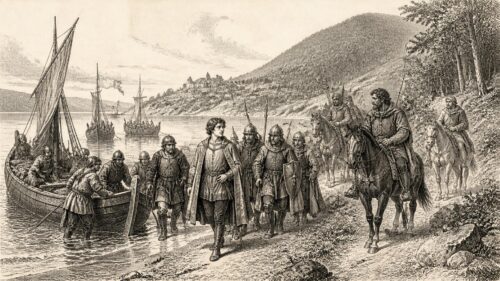
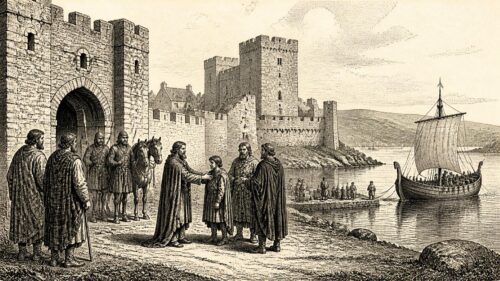
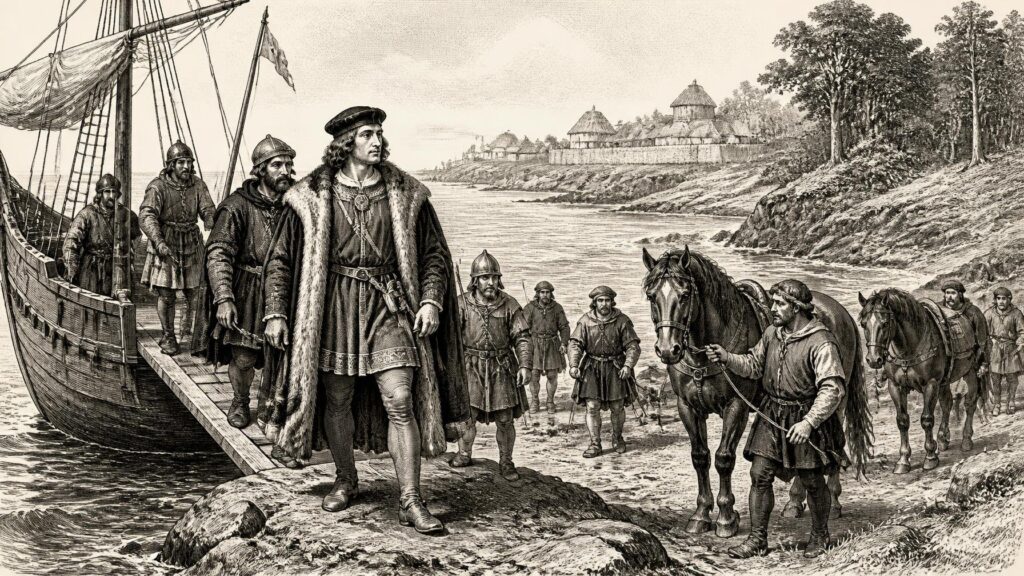
The Annals of Ulster place Kildare’s arrival in Ireland a week before Michaelmas, while a modern study identifies 17 September as the day he landed at Howth after a difficult crossing. The annalist styled him justiciar over the “Foreigners of Ireland”, a term used in Gaelic writing for the English-descended political community rather than for strangers in the modern sense. He arrived, the annal says, with great honour from the English king and with his new wife. The wording captured the intended message: Kildare was returning not as a released suspect but as a publicly restored royal governor.
The Pale’s Unfinished Border
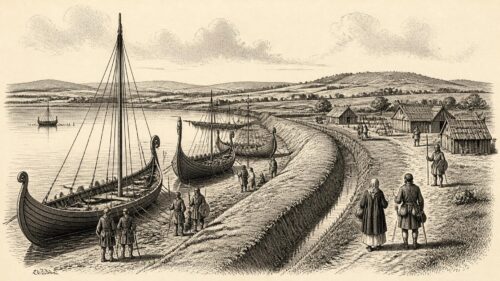
His restoration did not undo Poynings’s legislation. The parliament of 1494–95 had tightened English control over the summoning and business of Irish parliaments, while its acts also sought to regulate offices, military power and relations across the frontier. Of immediate practical importance in 1496 was the statute ordering ditches around the “English Pale”, the first recorded use of that term for the defended area of the obedient shires. Early that year, leading Kildare landholders were commissioned to proclaim the measure and supervise its execution.
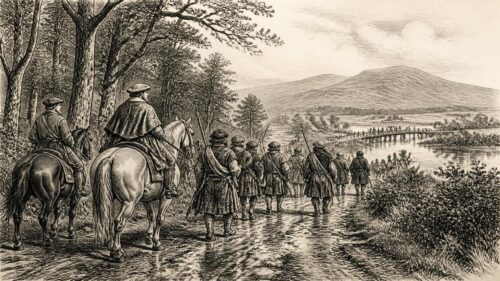
This was not merely a line on a map. A ditch and earthen bank required carts, spades, timber, labour and armed protection in a landscape of roads, fords, pasture and cultivated fields. The work represented an attempt to turn fluctuating marcher zones into a harder boundary around the core of the lordship. It also shows why Kildare was useful to Henry VII. His estates, tenants and followers supplied resources which an imported deputy and a short-lived English army could not easily command. The measures should not be mistaken for a completed wall enclosing all of Leinster: they were a continuing programme of defence and local obligation.
Violence in Oriel
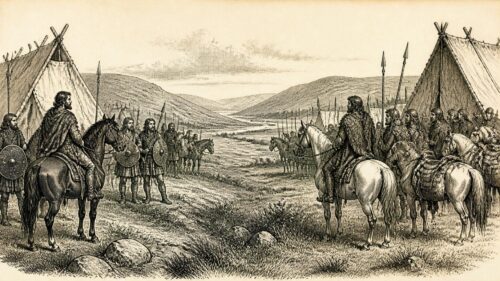
While Kildare’s return concerned the English lordship, the most closely dated violence of 1496 occurred farther north in the MacMahon country of Oriel. On the night of 11 January, Glaisne MacMahon was killed in his own house at Monaghan by Gilla-Pádraig and Ruaidrí, sons of Aedh Óg MacMahon. The Annals of Ulster give the unusually vivid detail that only sixteen farmers took part, and record the seizure of another MacMahon kinsman in the same attack. A week later, Glaisne’s sons and Brian, son of Redmond MacMahon, retaliated with a cattle raid. Several mounted men died.
The feud widened rather than ended. Brian’s party burnt the town of Aedh Óg MacMahon in early summer. On 27 May, Gilla-Pádraig MacMahon was himself killed by Máel Sechlainn O’Hanlon and his kin; his brother Éimer was captured. Herds and dependants moved in response to danger: one MacMahon grouping went with its cattle towards the O’Reillys and the English, while its opponents took cattle into Fernmagh. Such movements reveal the material substance of lordship. Cattle were food, wealth, a means of payment and a visible measure of a leader’s capacity to protect followers.
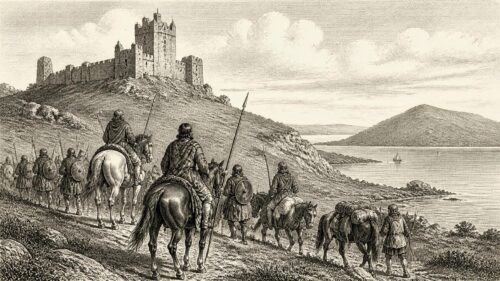
Aodh Ruadh O’Donnell of Tír Chonaill entered the conflict in support of Brian MacMahon. His forces crossed Oriel into O’Reilly’s Breifne, burning territory as far as Cavan and raiding the English settlement of Machaire Oirghialla in present-day County Louth. The annals’ account is an explicit warning against imagining a simple opposition between “English” and “Irish”: Gaelic lords made tactical alliances with one another, while MacMahon factions could seek support from O’Reilly and English neighbours. A meeting later produced peace among the Oriel parties, though pursuit and killing continued. By the feast of Molaisse, Brian had been made MacMahon in place of the blinded Aedh Óg, who died near the year’s end.
Bad Weather, Dearth and Husbandry
The annals also preserve an island-wide condition of exceptional importance. They report “great inclemency” in 1496, causing enormous losses among cattle, followed by great dearth in the greater part of Ireland and serious hindrance to husbandry. A further notice says that harvest weather ruined crops generally, especially in Fermanagh. These entries are firm evidence for severe stress, but not a licence to assign precise death totals or describe a fully documented famine where the sources do not do so.
Even so, the consequences would have been grave. In a predominantly agrarian society, a lost crop reduced food for households and seed for the next sowing; losses of cattle weakened dairying, traction, rents, hospitality and the ability to sustain fighting men. The year’s raids, burnings and forced removals therefore fell upon communities already facing scarcity. The combination explains why livestock appears so insistently in political narratives. Raiding a herd was not peripheral plunder: it struck directly at the productive and social foundations of a rival lordship.
Castles, Churches and Successions
Other annalistic notices show the breadth of political change. In the north-west, Aodh, son of O’Donnell, seized Ballyshannon castle from his father’s warders after Christmas, an episode in the mounting rivalry within the O’Donnell family. Later John Maguire, acting with Aodh, drove Conn O’Donnell from Ath Seanaigh and pursued him to Donegal, where the town was burnt. The counterattack reached the sanctuary of St Dáibhí’s termon. Its coarb, Ruaidrí Mag Craith, invoked the protection of the church, but the pursuers ignored it; Maguire’s men were defeated in difficult boggy ground, losing horses and men. The account shows both the authority claimed by ecclesiastical sanctuary and its limits during war.
Succession also reshaped regions without necessarily producing a single decisive battle. Conchobhar O’Brien, king of Thomond, died and his brother Toirdelbach, called Gilla Dubh, was inaugurated in his stead. Brian O’Doherty died, after which Aodh Ruadh O’Donnell installed John O’Doherty. William O’Dowd was succeeded by Brian Óg O’Dowd. These notices matter because a lordship was not an abstract territory: continuity depended upon agreement, force and recognised inauguration within a ruling kindred.
What the Annals Valued
Amid warfare and scarcity, 1496 also records cultural life. Florence O’Corcráin, praised as a harper, singer and player of other stringed instruments, died with his wife in O’Reilly’s castle. The deaths of Ruaidrí O’Cuinnín and Eógan Ó Dálaigh mark the passing of members of learned hereditary families. In Munster, Fineen O’Mahony was remembered as hospitable, wise and learned in Latin and English; another O’Mahony was praised as erudite in world history. Roland Eustace, credited with building the monastery of Kilcullen, died between Christmas and Epiphany. Such obituary language is selective and formal, but it demonstrates that musical accomplishment, multilingual learning, hospitality, historical knowledge and religious patronage retained public prestige even in a difficult year.
Thus 1496 closed with Kildare restored, the Pale being more deliberately bounded, and Henry VII once again governing through an Irish magnate. Beyond that lordship, no comparable central settlement existed. The year’s evidence instead reveals overlapping political worlds: Tudor commissions at court, Geraldine authority around Dublin, Gaelic successions, alliances and feuds in the north and west, and communities confronting failed crops and dying cattle. Kildare’s landing was the year’s great constitutional moment; hardship and local power made up much of its lived reality.
Source References
Hover over a number to see the source. Select it to open the source.

- [1] The Annals of Ulster: Year U1496
- [2] Annals of the Four Masters: Annal M1496
- [3] CELT Project: The Annals of Ulster
- [4] CELT Project: Annals of the Four Masters
- [5] FitzGerald, Gerald (Gearóid Mór)
- [6] Poynings, Sir Edward
- [7] O'Donnell (Ó Domhnaill), Aodh Ruadh
- [8] O'Donnell (Ó Domhnaill), Sir Aodh Dubh
- [9] O'Brien (Ó Briain), Tadhg an Chomhaid
- [10] Factions, Feuds and Noble Power in the Lordship of Ireland, c. 1356–1496
- [11] VIII. The Vindication of the Earl of Kildare from Treason, 1496
- [12] Extending the English Pale: Berminghams’ Country, and the Rise of Sir William Bermingham, Baron of Carbury (c.1485–1548)
- [13] The Hegemony of the Earls of Kildare, 1494–1520
- [14] Kildare Renaissance, 1496–1522
- [15] Tudor Policy and the Kildare Ascendancy in the Lordship of Ireland, 1496–1534
- [16] James IV, the O’Donnells of Tyrconnell and the Road to Flodden
- [17] The English Pale: A ‘Failed Entity’?
- [18] 'Ireland Corporate of Itself'
- [19] Statute Law Revision Act 2007, Schedule 2
- [20] Royal MS 18 C XIV: Accompts of William Hatteclyffe, Under-Treasurer of Ireland, 1495–1496
- [21] The Struggle for Control of the Irish Mint, 1460–c.1506
- [22] English Lordship of Ireland and the Irish Sea World: Re-assessing the Origins of the Kildare Ascendancy, c.1390–c.1513
- [23] Poynings’ Law
Primary Sources
- The Annals of Ulster: Year U1496
- Annals of the Four Masters: Annal M1496
- CELT Project: The Annals of Ulster
- CELT Project: Annals of the Four Masters
- FitzGerald, Gerald (Gearóid Mór)
- Poynings, Sir Edward
- O'Donnell (Ó Domhnaill), Aodh Ruadh
- O'Donnell (Ó Domhnaill), Sir Aodh Dubh
- O'Brien (Ó Briain), Tadhg an Chomhaid
- Factions, Feuds and Noble Power in the Lordship of Ireland, c. 1356–1496
- VIII. The Vindication of the Earl of Kildare from Treason, 1496
- Extending the English Pale: Berminghams’ Country, and the Rise of Sir William Bermingham, Baron of Carbury (c.1485–1548)
- The Hegemony of the Earls of Kildare, 1494–1520
- Kildare Renaissance, 1496–1522
- Tudor Policy and the Kildare Ascendancy in the Lordship of Ireland, 1496–1534
- James IV, the O’Donnells of Tyrconnell and the Road to Flodden
- The English Pale: A ‘Failed Entity’?
- 'Ireland Corporate of Itself'
- Statute Law Revision Act 2007, Schedule 2
- Royal MS 18 C XIV: Accompts of William Hatteclyffe, Under-Treasurer of Ireland, 1495–1496
- The Struggle for Control of the Irish Mint, 1460–c.1506
- English Lordship of Ireland and the Irish Sea World: Re-assessing the Origins of the Kildare Ascendancy, c.1390–c.1513
- Poynings’ Law