Conn O’Donnell1497 CE
In 1497, Ireland remained divided among competing Gaelic and Anglo-Irish lordships despite Henry VII’s nominal authority and Kildare’s Dublin administration. Perkin Warbeck briefly landed at Cork but gained no support before departing for Cornwall. In the south-east, Piers Ruadh Butler killed Sir James Ormond, strengthening his territorial position. Conn Ó Domhnaill succeeded in Tír Chonaill in May, yet succession conflict, defeat and invasion brought his death in October. Local peace-making and raiding continued elsewhere. A severe island-wide famine caused hunger, mortality and extraordinary food prices for communities. Religious developments included regulation of Lough Derg pilgrimage and Franciscan reform at Carrickfergus.
Dateline
In 1497, Ireland’s political map was not governed from any single centre. Henry VII was lord of Ireland, and the Dublin administration had recently returned to the hands of Gerald FitzGerald, eighth earl of Kildare, but royal authority was strongest in and around the English lordship. Beyond it, great Gaelic and Anglo-Irish dynasties defended, extended and disputed their own lordships. The year’s records therefore do not describe one national story. They reveal several connected worlds: a failed Yorkist claimant at Cork, a lethal Butler rivalry in the south-east, a dramatic succession crisis in Tír Chonaill, reforming friars in Ulster, and a famine whose effects were felt throughout the island.
A Brief Return to Cork
Perkin Warbeck, the pretender who claimed to be Richard, duke of York, returned to Irish waters in July. His earlier appearances had made Ireland an important stage in the wider European struggle over the English crown. In the mid-1490s he had won support at Cork and from Maurice FitzGerald, tenth earl of Desmond, while Waterford had stood firmly for Henry VII. That earlier alignment had helped make Munster politically dangerous for the Tudor king.
The visit of 1497 was markedly different. Warbeck had sailed from Scotland with his wife, Catherine Gordon, after James IV ceased to be a useful protector. The Irish Dictionary of Biography records that he reached Cork but found no support there. This was not simply a personal disappointment. It showed that the alliances of 1495 could not be summoned at will. Desmond had made his peace with the crown in 1496; Cork’s political calculations had changed; and Waterford remained alert to any new threat. Warbeck soon left for Cornwall, where he joined a rising that also failed. A letter of Henry VII dated 12 September confirms that Warbeck and his wife had come from Ireland to Cornwall.
His fleeting landing nevertheless mattered to Ireland. Sea routes linked Cork, Waterford and the south-western lordships to the politics of England, Scotland, Burgundy and France. Merchant ships, messengers, refugees and armed followers could carry a dynastic crisis across the Irish Sea with striking speed. Yet 1497 also demonstrated the limits of foreign-backed adventure. Warbeck’s claim had once attracted important local backers; in this year it found no comparable foothold.
Butler Rivalry Settled by Violence
On 17 July, James Butler, usually known as Sir James Ormond or Black James, was killed by Piers Ruadh Butler. The Annals of Ulster supplies the date and identifies the killer, while later accounts describe the encounter as the climax of a bitter contest for authority in the Ormond lordship. Sir James had been sent to Ireland by Henry VII and the absentee earl of Ormond as a royal and dynastic counterweight to both Kildare and Piers Butler. He had held high office, including the treasurership and a joint governorship, but his position depended heavily on support from England.
Piers, fostered in Kildare’s household and married to Kildare’s daughter Margaret, regarded the Butler leadership in Ireland as his proper inheritance. The death of Sir James removed his most formidable rival. It did not instantly make Piers earl of Ormond—the title remained with the absentee Thomas Butler in England—but it greatly strengthened Piers’s practical hold over the lordship’s Irish lands and affinities. The episode illustrates a central feature of late medieval Irish politics: offices, kinship, fosterage, marriage and armed followings mattered at least as much as formal titles. Royal intervention could disrupt local balances, but it could not easily command lasting obedience where a powerful territorial network opposed it.
Succession in Tír Chonaill
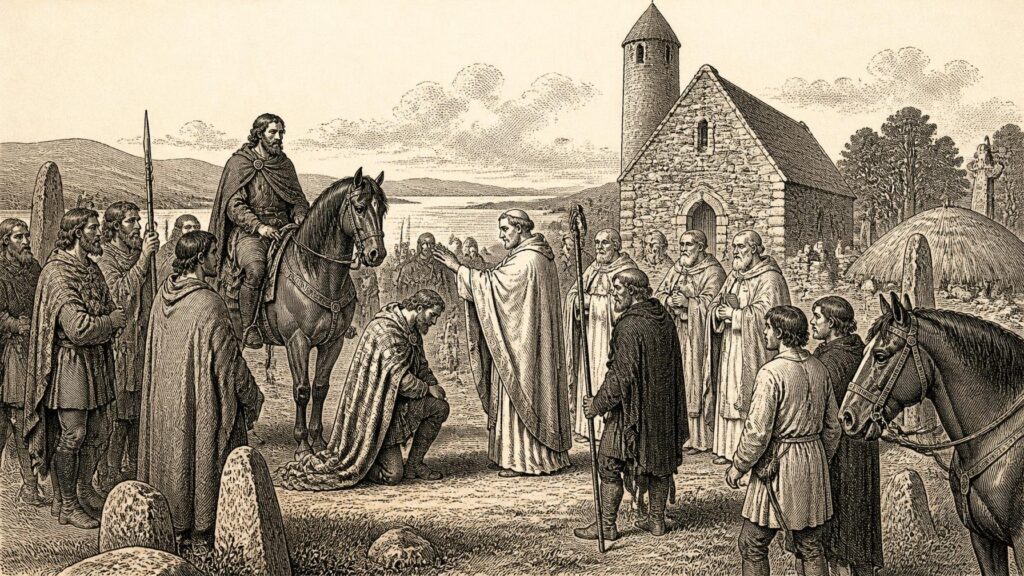
The year’s most closely dated upheaval unfolded in north-west Ulster. On Friday 26 May, Aodh Ruadh Ó Domhnaill relinquished the lordship of Tír Chonaill at Carna in the termon of the Mac Craith ecclesiastical family. The following Tuesday, his son Conn was inaugurated as Ó Domhnaill. Aodh Ruadh had ruled for decades and had built Tír Chonaill into a major regional power, but rivalry among his sons made the succession precarious. The choice of Conn was clearly contested rather than accepted as an automatic inheritance.
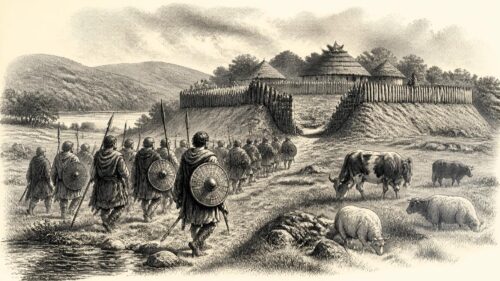
Conflict came rapidly. After Lammas, Walter son of Richard de Burgh sailed with a fleet to assist Conn against his brother Aodh. The annalist reports that Aodh met the force and seized much of its arms, clothing and provisions. Soon afterwards, however, Conn captured Aodh and had him held in Connacht under Walter de Burgh’s custody. Conn then led a large host against Tadhg Mac Diarmata of Magh Luirg. On 23 September his army suffered a severe defeat. Numerous leading men and hostages were taken, and the Cathach of Colum Cille—an exceptionally prestigious relic associated with the founder-saint of the Cenél Conaill—was seized along with its keeper, who was killed.
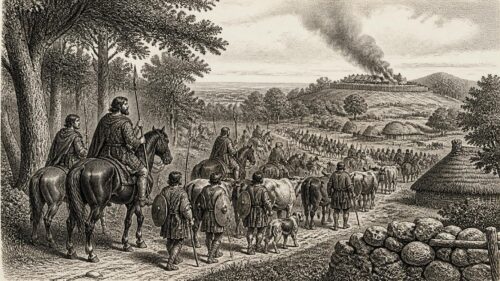
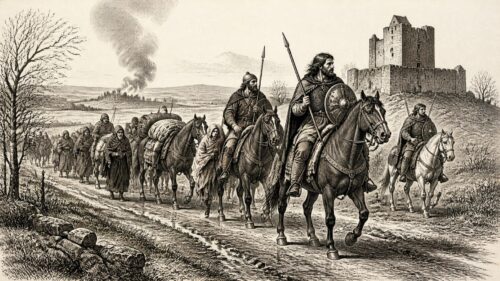
The crisis ended catastrophically on 19 October. Henry Ó Néill junior invaded Tír Chonaill, devastated Fanad, and met Conn’s force at Bel-atha-daire. Conn was killed, together with his brothers Niall Garbh and Domnall, and the annalist says that more than eight score men died with them. Henry Ó Néill captured Castlederg on his return march. Conn’s lordship had lasted less than five months. The speed of its collapse shows how vulnerable a ruler could be when succession disputes combined with external enemies and shifting alliances. Aodh Ruadh was compelled back into the forefront of Tír Chonaill politics after his chosen heir’s death.
Peace, Raids and Local Lordship
Elsewhere, the annals show neither a settled island nor continuous general war, but a landscape of negotiated authority and local violence. At the end of spring, Domnall Ó Néill and Henry Ó Néill junior made peace. Domnall’s son Aodh was released without ransom, and gifts of horses, clothing and other valuables were made in return for Domnall relinquishing the title of lord. Such arrangements were political settlements expressed in the valuable currency of livestock, apparel, captives and honour.
In July, Brian Mag Mathgamna died in an unsuccessful assault on the castle of the erenagh, an ecclesiastical office-holder. Men were slain or drowned, while Sifin White and others, described as both Foreigners and Gaels, were captured. The phrasing is revealing. Lordship and warfare did not follow a simple ethnic division between ‘English’ and ‘Irish’: people of varied backgrounds could be allies, captives and combatants in contests over a castle, church land or local precedence. Deaths among the Uí Ruairc, Uí Fhearghail and Mac Jordan kindreds similarly record the continuing hazards of feud and internal rivalry.
Famine Across Ireland
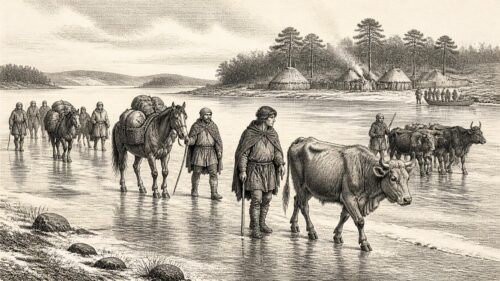
Amid these struggles came the year’s gravest shared experience. The Annals of Ulster calls 1497 a very great and grievous famine throughout Ireland, without equal in the memory of those then living. It says that many died of hunger in every corner of the country. The annalist provides unusually stark price comparisons: in Meath, a peck of wheat supposedly cost five ounces, while among Gaelic communities a small bundle of oats might cost an in-calf cow. Beef, milk-cows and oats were likewise valued at extraordinary rates.
Those figures should not be treated as a modern national price index. They are an annalist’s evidence of extreme scarcity, and their force lies in the inversion of ordinary value: grain and fodder had become dear enough to be exchanged for productive livestock. The record does not responsibly permit a precise explanation of the famine’s causes. It does, however, establish widespread hunger and mortality in this calendar year. In a society dependent on grain, oats, cattle, dairying and seasonal stores, dearth could weaken households, reduce the capacity to pay rents or maintain followers, and make political conflict still more destructive.
Reform and Pilgrimage
Religious life was also reshaped in 1497. Around the feast of St Patrick, the cave identified with St Patrick’s Purgatory at Lough Derg was broken by the guardian of Donegal and representatives of the bishop in the deanery of Lough Erne, acting, the annals say, with papal authorisation. The stated reason was that writings about the knight Owein and other old books showed that this was not the actual purgatory granted to Patrick, although people had been visiting it. The action was therefore not an attack on pilgrimage as such, but an attempt to regulate a celebrated devotional site by challenging the authenticity of a particular sacred space.
Later that year, on 14 August, sixteen friars from the Donegal community took possession of the Franciscan house at Carrickfergus after it had been transferred from Rome to the Friars Minor of the Strict Observance. Together, these notices show the reach of reforming religious networks across Gaelic and urban Ulster. They also show that late medieval Irish Christianity was connected to Rome while remaining rooted in local monasteries, termon families, saints’ cults and pilgrimage landscapes.
Thus 1497 was a year in which a claimant’s failure at Cork, a killing within the Butler world, Conn Ó Domhnaill’s short and fatal rule, religious reform, and island-wide hunger all exposed the fragility of power. Ireland was divided among many lordships, but famine and maritime politics could cross those divisions with terrible ease.
Source References
Hover over a number to see the source. Select it to open the source.

- [1] Annals of Ulster: U1497
- [2] Annals of Ulster otherwise Annala Senait, Annals of Senat: U1497
- [3] Warbeck, Perkin
- [4] Fitzgerald, Maurice fitz Thomas
- [5] Butler, James (‘Sir James Ormond’; ‘Black James’)
- [6] Butler, Piers (‘Piers Ruadh’)
- [7] O'Donnell (Ó Domhnaill), Aodh Ruadh
- [8] Mac Maghnusa (MacManus), Cathal Óg
- [9] Documents Relating to Perkin Warbeck, with Remarks on His History
- [10] Letter of Henry VII to Sir G. Talbot saying that Warbek and his wife have come from Ireland to Cornwall, 12 September 1497
- [11] Ireland under the Tudors, Volume I
- [12] Famine in Ireland, 1300–1900
- [13] The Legend of the Purgatory of Saint Patrick: From Ireland to Dante and Beyond
- [14] Henry VII's Relations with Scotland and Ireland 1485–1498
- [15] The Perkin Warbeck Conspiracy: 1491–1499
- [16] Henry VII
- [17] Certified Copies of Letters of Henry VII to the Mayor of Waterford Concerning Perkin Warbeck's Arrival at Cork
- [18] Letter from Henry VII to the Earl of Kildare Regarding the Liberties of Waterford
- [19] Waterford City in Lewis's Topographical Dictionary
- [20] The Irish Annals and Climate, Fifth–Seventeenth Centuries CE
- [21] The Dating of the Irish Annals
- [22] CELT: Annals of the Four Masters
Primary Sources
- Annals of Ulster: U1497
- Annals of Ulster otherwise Annala Senait, Annals of Senat: U1497
- Warbeck, Perkin
- Fitzgerald, Maurice fitz Thomas
- Butler, James (‘Sir James Ormond’; ‘Black James’)
- Butler, Piers (‘Piers Ruadh’)
- O'Donnell (Ó Domhnaill), Aodh Ruadh
- Mac Maghnusa (MacManus), Cathal Óg
- Documents Relating to Perkin Warbeck, with Remarks on His History
- Letter of Henry VII to Sir G. Talbot saying that Warbek and his wife have come from Ireland to Cornwall, 12 September 1497
- Ireland under the Tudors, Volume I
- Famine in Ireland, 1300–1900
- The Legend of the Purgatory of Saint Patrick: From Ireland to Dante and Beyond
- Henry VII's Relations with Scotland and Ireland 1485–1498
- The Perkin Warbeck Conspiracy: 1491–1499
- Henry VII
- Certified Copies of Letters of Henry VII to the Mayor of Waterford Concerning Perkin Warbeck's Arrival at Cork
- Letter from Henry VII to the Earl of Kildare Regarding the Liberties of Waterford
- Waterford City in Lewis's Topographical Dictionary
- The Irish Annals and Climate, Fifth–Seventeenth Centuries CE
- The Dating of the Irish Annals
- CELT: Annals of the Four Masters