Kildare’s Harvest Plea1491 CE
In 1491 Conn Ó Néill of Tír Eógain and Aodh Ruadh Ó Domhnaill of Tír Chonaill sought Gerald FitzGerald, earl of Kildare, to arbitrate their Ulster conflict, but no peace resulted, demonstrating limits to Kildare’s authority. Warfare continued through raids, killings, captivity and contested castles across Ulster, Breifne and borderlands. In east Breifne, John Ua Raghallaigh died, prompting a disputed succession and Kildare’s destructive intervention. Persistent summer and autumn rain ruined Ireland’s grain, particularly in Fermanagh, worsening pressures created by campaigning. Ecclesiastical offices and monasteries remained significant. A post-Christmas wind concluded a year marked by insecurity, authority and environmental hardship.
Dateline
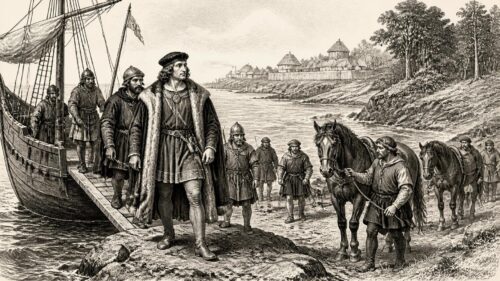
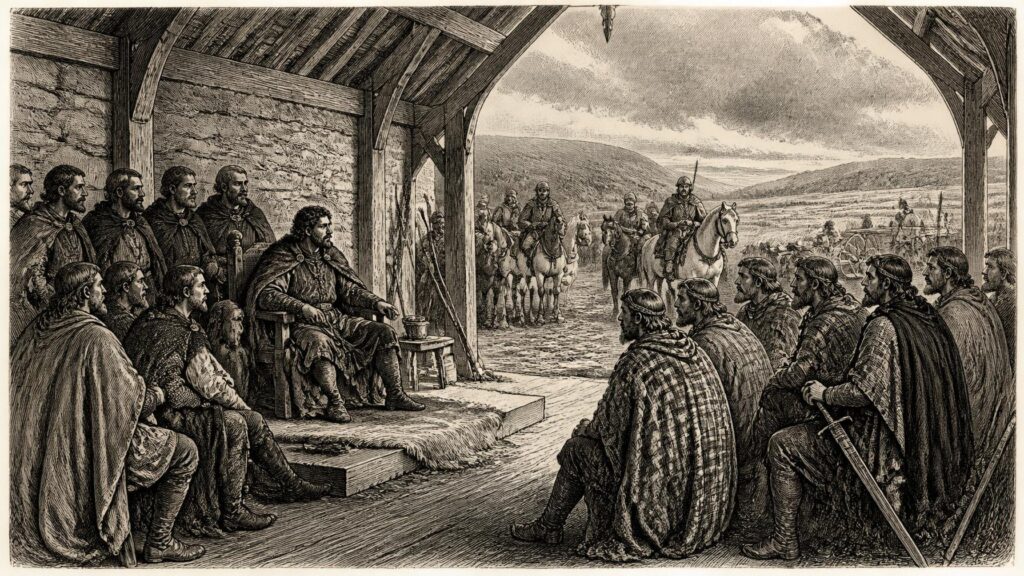
The clearest national event recorded for 1491 was not a battle with a fixed battlefield and date, but an unsuccessful attempt to prevent one. During the harvest season, Conn Ó Néill, lord of Tír Eógain, and Aodh Ruadh Ó Domhnaill of Tír Chonaill brought their dispute before Gerald FitzGerald, eighth earl of Kildare, then governing the English lordship of Ireland as deputy and described in the Irish annals as justiciar. They left without a dependable peace or truce. The failure mattered well beyond the meeting itself. It confirmed that two of Ulster’s greatest lordships were again at war, and that even Kildare’s unusual reach across the political border between the Pale and Gaelic Ireland had limits.
A Dispute Before Kildare
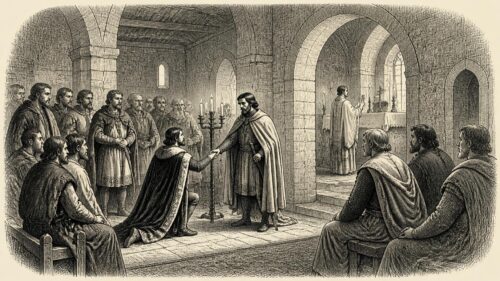
The Annals of Ulster place the approach to Kildare in the harvest of 1491. Its wording is valuable because it shows Irish politics functioning through negotiation as well as force. Conn and Aodh Ruadh did not go to Dublin merely as defeated petitioners: each came to “plead” his case against the other before a magnate who combined royal office, immense private resources and family connections extending into Gaelic lordships. Conn’s marriage to Eleanor FitzGerald, sister of the earl, gave Kildare a direct dynastic interest in Tír Eógain. Yet kinship was not command. The annal’s conclusion is stark: there was no peace and no truce on which either side could rely.
The opponents were formidable. Conn, son of Éinrí Ó Néill, had led Tír Eógain since the early 1480s and was trying to restore and extend Ó Néill authority after periods of internal fracture. Aodh Ruadh, son of Niall Garbh Ó Domhnaill, ruled Tír Chonaill from the north-west and had long experience of both internal dynastic competition and regional war. Their contest was therefore not a simple frontier quarrel. It concerned precedence, tribute, allies, cattle, access through neighbouring territories and the balance of power across Ulster and north Connacht. The annals indicate fighting around the turn of the year 1490–91 and renewed conflict during 1491, but they do not permit a precise reconstruction of every march or engagement.
One named casualty gives the dispute a human scale. Brian, son of Aodh Gallt Ó Domhnaill, was killed by Henry, son of Henry Ó Néill, during the war. The Annals of Ulster add that Henry maintained the country while Conn was away in “the house of the Foreigners”, meaning Kildare’s Anglo-Irish political world. That remark captures an important practical truth. A lord’s journey to seek arbitration did not suspend the needs of defence. Kinsmen and captains had to hold territory, protect dependants and answer raids while their ruler travelled and negotiated.
Violence at Local Scale
The wider Ó Néill–Ó Domhnaill war was accompanied by smaller, destructive conflicts. After the feast of St Brendan, the annals report that Feidhlimidh, son of Aodh Ó Néill, was killed by Brian Mac Mathghamhna, son of Réamonn. Feidhlimidh’s brother Art responded that same night with a raid into Teallach-Gealagain, burning and killing people there. This was not ceremonial warfare at a safe distance from ordinary settlement. Retaliation targeted people, livestock and the stores on which households depended. The place-name is generally associated with the Tullygarvey area of modern County Cavan, an indication of how violence in this period could move through the borderlands between the interests of the Ó Néills, Mac Mahons and Uí Raghallaigh.
Another entry tells of John Ó Catháin’s release from captivity. Before his own people knew he was free, he recovered his creaghts from the sons of Magnus Ó Catháin. A creaght was a mobile body of people and cattle, not simply a herd. The episode therefore involved possession of dependants, animals and productive wealth, all of which could be moved quickly in a society accustomed to raiding and counter-raiding. Its suddenness is striking: release from custody became militarily useful only because John could act before opponents had warning.
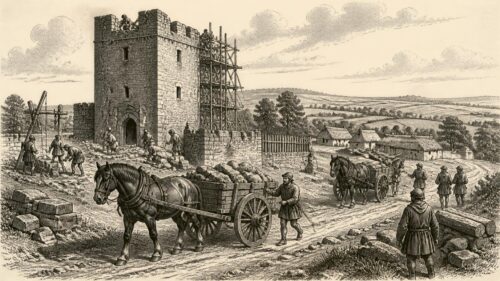
Further south-west, the record of Liathdruim castle, probably in the Breifne region, illustrates the instability of local lordship. The Annals of Ulster assign to 1491 the killing of Cathal Mag Raghnaill within the castle, its seizure by rival members of the same extended kindred and allies from the Mac Diarmata family, and its recovery by Eoghan Ó Ruairc during the harvest. The Annals of the Four Masters place a related sequence under 1490. This disagreement is a useful warning against false precision: the episode certainly belongs to this narrow period of conflict, but its exact chronology cannot be treated as secure. What is secure is that fortified residences could change hands through treachery, purchase and force alike.
Breifne’s Changing Leadership
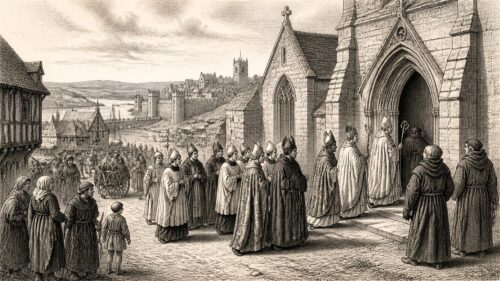
In east Breifne, the death and succession of a ruler can be dated more closely. John, son of Toirdhealbhach Ua Raghallaigh, died and was buried in the monastery at Cavan on 25 November, the feast of St Catherine. The Annals of Loch Cé independently record his death and the elevation of John, son of Cathal, as Ua Raghallaigh. Such notices show that lordship was not automatically inherited by the eldest son according to a fixed rule. Selection within the ruling lineage, military support and acceptance by powerful neighbours were crucial. The burial at Cavan also reveals the continuing political importance of a monastic centre: religious houses preserved prestige, served as burial places for elites and formed part of the landscape through which power was expressed.
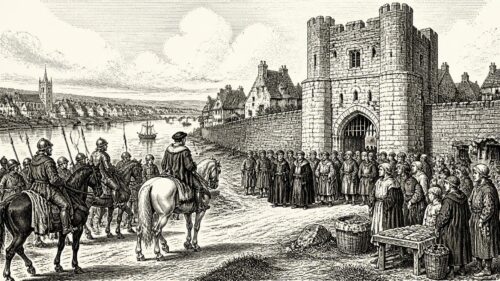
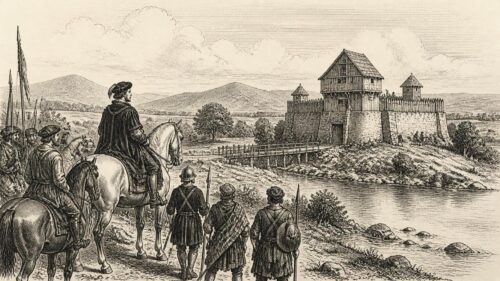
The succession immediately attracted outside pressure. According to the Annals of Ulster, Cathal Ua Raghallaigh brought Kildare against the newly installed, younger Ua Raghallaigh and his kinsmen. Kildare’s host devastated crops and carried off chattels; one opposing captive was taken, two horsemen drowned, and an Ua Raghallaigh was killed. The annal does not explain every motive or identify a lasting settlement, but it makes the economic method of campaigning plain. Armies hurt a rival by destroying standing grain, seizing movable goods and interrupting the ability of a lord to feed followers. James, son of Earl Thomas, also conducted major raids that year against the sons of Glaisne Ua Raghallaigh. Breifne was thus not merely a route between larger powers; it was a contested political arena in its own right.
The Rain That Ruined Corn
For most people, however, the gravest event of 1491 may have been the weather. Both the Annals of Ulster and the Annals of the Four Masters report exceptionally wet, unfavourable conditions through much of the summer and autumn. The Ulster annalist used deliberately biblical language, saying that nothing comparable had been known since the Flood, and stated that almost all Ireland’s corn failed, especially in Fermanagh. The Four Masters likewise recorded that the corn crops of Ireland decayed. The agreement of these independent annalistic traditions makes the broad fact of a seriously damaged harvest unusually firm, even if their rhetoric should not be read as a measured meteorological report.
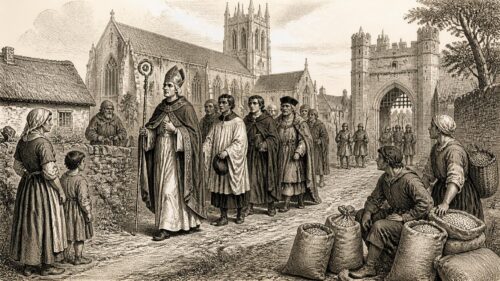
“Corn” meant grain generally: the cereals from which bread, ale, seed and animal fodder might come. Persistent rain could flatten ripening crops, make cutting and drying difficult, spoil grain before storage, and leave carts and roads impassable. Its effects varied by region and household. A tenant or small farmer might lose both food and seed; an urban household faced a tighter market; a lord whose income included food renders and hospitality obligations found his capacity to sustain retainers reduced. In the Pale, contemporary evidence from the later fifteenth century shows a mixed economy of wheat, oats, barley, beans, livestock and brewing. Elsewhere pastoral resources could soften some pressures, but they could not replace a failed cereal harvest without cost.
The sources do not record a nationwide famine mortality for 1491, and it would be irresponsible to invent one. Nor can the surviving notices tell us grain prices, the scale of imports or the exact experience of particular villages. Nevertheless, crop failure and warfare reinforced one another. Kildare’s expedition into Breifne deliberately damaged crops at precisely the point when wet weather had already endangered them. In Fermanagh and the northern lordships, armies depended on provisions drawn from the same landscape that had suffered the rain. Food insecurity was therefore not a separate “social” issue beneath high politics; it shaped the choices available to rulers and households alike.
Church, Chronicle and Winter
Religion appears in the record chiefly through its institutions and calendar. Saints’ feasts dated violent and political events; Cavan monastery received the body of a ruling Ua Raghallaigh; and shortly before Christmas Ruaidhrí Mag Craith was made comarba, or ecclesiastical successor, and head of his kindred group. These brief notices should not be inflated into a claim of religious reform or cultural transformation in 1491. They do, however, show that ecclesiastical office, learned record-keeping and secular standing remained closely interwoven.
The year ended with another environmental shock. The Annals of Ulster record an exceptionally great wind on the day and night after Christmas. In a landscape of thatched dwellings, timber buildings, boats, open grain stores and vulnerable trees, such a storm could be damaging even without a detailed list of losses. Taken together, the failed arbitration, local raids, disputed successions, sodden harvest and winter gale make 1491 a year of insecurity. It was not a year in which Ireland became politically unified or decisively transformed. Rather, it exposed how authority rested on fragile bargains: between rival dynasties, between the deputy’s influence and Gaelic autonomy, and between human plans and an unforgiving climate.
Primary Sources
- The Annals of Ulster: Year U1491
- Annals of the Four Masters: Annal M1491
- Annals of Loch Cé A.D. 1014–1590: Annal LC1491
- FitzGerald, Gerald (Gearóid Mór)
- O'Donnell (Ó Domhnaill), Aodh Ruadh
- O'Neill (Ó Néill), Conn
- O'Neill (Ó Néill), Conn ‘Bacach’
- O'Donnell (Ó Domhnaill), Sir Aodh Dubh
- O'Neill (Ó Néill), Niall Mór
- O'Neill (Ó Néill), Aodh
- MacMahon (Mac Mathghamhna), Aodh Ruadh
- The English Lordship of Ireland and the Irish Sea World: Re-assessing the Origins of the Kildare Ascendancy, c.1390–c.1513
- The English Pale: a ‘failed entity’?
- Ireland’s English Pale, 1470–1550: the making of a Tudor region
- Family and Finances in Fifteenth-Century Dublin
- Extremes of Weather Recorded in the Annals of Connacht, 1224–1562
- Pre-1500
- Castilian–Irish Trade in the Later Middle Ages
- Teallach Dhúnchadha/Tullyhunco
- The Economy of Early Medieval Ireland