Tulsk Castle and Tudor News1485 CE
In 1485, Ireland comprised competing lordships, towns and ecclesiastical jurisdictions, while Kildare dominated the English administration. His Trim parliament defended corporate privileges, funded frontier defence, Castledermot’s construction and plague relief, anticipating England’s uncertain succession. Henry VII’s accession after Bosworth altered calculations without immediately displacing Kildare. In Connacht, Uilleag Burke succeeded violently, with annals differing over his campaign and Tulsk Castle’s destruction. Successions, killings and raids reshaped Connacht and Ulster, where O’Neill and O’Donnell forces fought then made peace. Breifne conflicts involved castles, cattle and Kildare’s intervention. Church appointments, chantries, scholarship, hospitality, disease and hardship reveal communities facing persistent insecurity throughout.

Dateline
In 1485, Ireland was not a single political arena waiting for orders from England. It was a country of overlapping lordships, ecclesiastical jurisdictions, chartered towns and frontier districts, in which the authority of the English crown was strongest around Dublin and weakest where local dynasties and military followings set the terms of power. Yet news from across the Irish Sea mattered profoundly. Richard III’s death and Henry Tudor’s accession altered the political calculations of the lordship of Ireland just as warfare, succession and disease were affecting communities from Connacht to Ulster.
The surviving evidence gives an unusually textured view of the year. Parliamentary records illuminate the concerns of the English lordship; the Irish annals preserve events within Gaelic and Gaelicised lordships; and, crucially, they do not always describe the same events in the same way. What can be firmly placed in 1485 is therefore a landscape of local action rather than a simple national story: legislative activity at Trim, dynastic change in Clanricard and Oriel, raids and counter-raids along several frontiers, and the arrival of a new English king whose Irish consequences were not yet fully visible.
Kildare’s Parliament at Trim
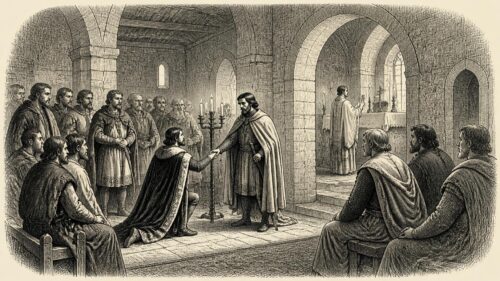
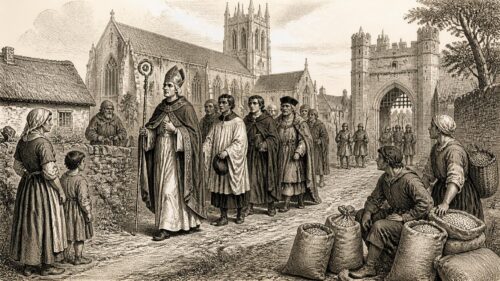
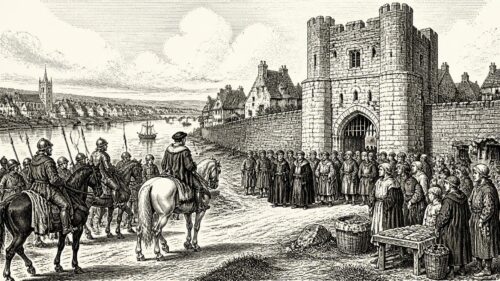
Gerald FitzGerald, eighth earl of Kildare, known later as Gearóid Mór, was the dominant figure in the English lordship. Richard III had confirmed him as deputy governor in 1483, and by 1485 Kildare exercised exceptional influence over the Irish council. A parliament opened at Trim on 6 June, under his authority; a further sitting is recorded on 8 August. The timing is important. Reports that Henry Tudor was preparing to invade England had already made the succession uncertain, and Kildare secured legislation intended to preserve his own position should the regime in England change. This was not a declaration of Irish independence. It was a powerful local governor ensuring that an English dynastic revolution would not remove him from government.
The surviving statutory headings show a government concerned with institutional privilege, defence and the practical burdens of insecurity. They confirmed the liberties of the church, of the land of Ireland, and of cities and towns. They allowed the deputy lieutenant to manage parliament through a deputy during his absence, licensed a chantry foundation at St Nicholas’s church in Dundalk, and temporarily permitted the archbishop of Dublin to provide Irish clergy to benefices in his gift. Such measures reveal a lordship administered through churchmen, magnates, towns and legal forms, not merely through armed force. They also show how the political community of the Pale defended its own corporate rights at a moment of uncertainty.
Other acts point to more immediate pressures. Counties Dublin, Meath, Kildare and Louth were assessed for subsidies to fund defence, including one explicitly granted during a present outbreak of plague. County Louth contributed 43 marks towards tenants held for ransom by Irish kerns. Labourers and carts were to be assessed for building Kildare’s castle at Castledermot, described as necessary for recovering lands in County Carlow. The wording should not be taken as a complete picture of conditions across Ireland, but it firmly demonstrates how military defence, forced transport and labour, ransom, fiscal extraction and epidemic anxiety touched the governed districts of the lordship in 1485.
A New King Across the Sea
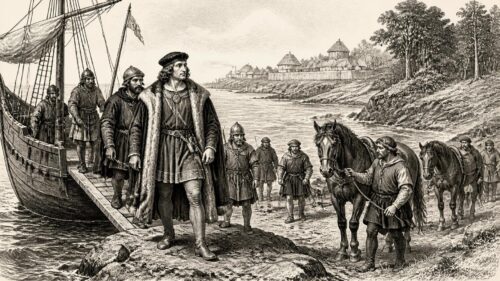
On 22 August, Henry VII became king of England after Richard III was killed at Bosworth. The Annals of the Four Masters gives that precise date; the Annals of Ulster, while describing the battle more generally as occurring at the beginning of harvest, likewise records Richard’s death and the elevation of the victor, “the son of the Welshman”. For Ireland, the event was immediately significant but not instantly transformative. Kildare remained the effective head of the English administration, while the political loyalties of the Irish elite had been shaped by long Yorkist connections. The more open Irish challenge associated with Lambert Simnel belongs to 1487, not 1485, and should not be read back into this year.
Henry’s accession nonetheless created the central political problem of the next few years: could a new Tudor king govern Ireland without the cooperation of the enormously well-connected Kildare? The question was sharpened by the earl’s family alliances across the Pale and with neighbouring Gaelic powers. In 1485, however, Kildare’s response was careful self-preservation through parliament and administration rather than an overt break with the new monarchy.
Clanricard’s Violent Succession
In Connacht, the death of Uilleag Ruadh Burke, lord of Clanricard, brought his son, another Uilleag, to power. The elder Burke had maintained a substantial lordship in south Connacht, one whose ruling family combined Anglo-Norman descent with deep participation in Gaelic political and cultural life. The annals call him a patron of learning, an indication that lordly standing was displayed not only through land and soldiers but also through support for poets, clerics and learned men. His death therefore mattered beyond his own household.
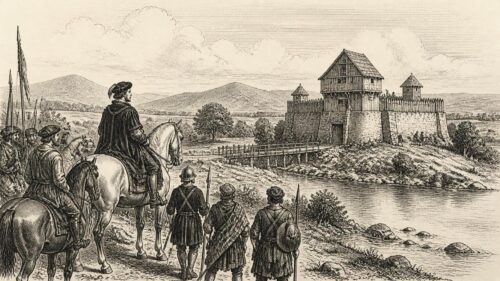
The successor acted quickly, but the record cautions against excessive certainty about the route of his campaign. The Annals of the Four Masters say that he led an army through Machaire Chonnacht and Hy Many, burning crops and settlements, and demolished Tulsk castle and its prison. The Annals of Ulster agrees that the younger Uilleag took the lordship and led a host, but locates burning in part of Roche country in Munster. The agreement confirms an armed assertion of the new lord’s authority; the disagreement warns against treating every geographical detail in a later annalistic account as beyond dispute. Either way, burning corn, towns and a castle was an attack on food stores, habitation, lordship and confinement alike.
Elsewhere in Connacht, Eóghan Caoch Ó Conchobair Donn died after a long illness and Aodh, son of Aodh Ó Conchobair, was nominated in his place. Rory, son of Brian Ballach Ó Conchobair, was killed by kinsmen of the descendants of Tadhg Ó Conchobair. These notices underline a persistent fact of late-medieval Irish politics: succession was neither wholly hereditary in a modern sense nor merely arbitrary. A ruling kindred, its allies and military strength all mattered, and the death of a lord could invite both formal replacement and violent contest.
War, Peace and Lordship in Ulster
Ulster’s annals are especially full for 1485. Aodh Óg Mac Mathghamhna was inaugurated king of Oriel, consolidating his position after the death of a rival. At the same time, conflict ran through lordships and kin-groups. Cú Uladh Ó Néill’s settlement was burned by his uncle Brian na Coille Ó Néill; Cú Uladh, assisted by Mac Mahons, retaliated by burning Brian’s town and lands. Aodh Óg, lord of Trian Conghail, died after a raid into Lecale when he was struck by a javelin. These were not distant clashes between fixed national blocs, but contests over honour, territory, dependants and authority in which family division and alliance could be equally decisive.
A larger war set Conn Ó Néill of Tír Eógain against Aodh Ruadh Ó Domhnaill of Tír Chonaill. The annals name divided branches of both dynasties on opposing sides. Ó Domhnaill entered Muintir Luinigh, took substantial cattle prey and passed close to Ó Néill’s camp without being stopped. After Michaelmas, Conn Ó Néill entered Tír Chonaill with a large host; damage was done in Tír Aodha and Mac an Bhaird’s settlement was burned. Yet peace was made between Ó Néill and Ó Domhnaill during that expedition. The sequence shows both the destructiveness and the limits of campaigning: large forces could devastate an opponent’s dependants and resources, but negotiated peace remained an essential political instrument.
Castles, Cattle and Vulnerable Communities
In Breifne and the marches, control of land was expressed in settlement and fortification. The sons of Glaisne Ó Raghallaigh expelled the descendants of Máel Mórdha from Mullach and built a castle there. Their opponents brought Kildare against them; fifteen herds of cattle were taken and Gilla Íosa, son of Glaisne, was captured. This episode is a particularly clear connection between the deputy’s Pale-centred authority and disputes beyond its core counties. Kildare could intervene, but he did so within a regional world where cattle, prisoners, castles and shifting local alliances remained the immediate currency of power.
The annals occasionally preserve dates that bring this world into sharper focus. On Tuesday 27 September, Toirdelbach Ó Raghallaigh burned the settlements of two Mag Samhradháin brothers in Tullyhaw. Their pursuit next day killed or captured sixteen of his men and recovered 200 horses. Shortly before Christmas, Redmond Mac Mathghamhna attacked the English settlement on the plain of Oriel, where John Taaffe was killed and between eighty and one hundred horses were taken. For farming households and tenants, such raiding threatened animals, crops, labour and personal safety. The records are written from elite viewpoints, but they leave no doubt that non-combatants bore much of the cost.
Church, Learning and Loss
Religious and learned life appears in the annals not as a separate sphere but as part of public society. Edmund Courcey, a Franciscan and doctor of divinity from the Courcey country in Munster, took possession of the bishopric of Clogher, although the Annals of Ulster notes that his letters had not yet come from Rome. The remark is a valuable reminder that an episcopal succession involved local possession and papal documentation, and that these might not coincide neatly. Meanwhile, the licence for Kildare and others to establish a chantry at Dundalk demonstrates continuing investment in intercessory worship within the English lordship.
Obituaries also register the social value of hospitality and scholarship. Nicholas Ó Gráda, abbot of Tuamgraney, and Donnchadh Mac Coille, erenagh of Bearach, were remembered for charitable hospitality. Gilla Pátraic Ó hUiginn, described as a professor of poetry, died around Michaelmas; both major annals praise the guest-house he maintained for rich and poor. Uilleag Ruadh Burke’s reputation as a patron of learning belongs in the same cultural setting. These notices do not prove that provision was plentiful in every locality, especially in a year marked by plague and war, but they show that generosity towards guests, clerics, learned people and the needy was a recognised measure of rank and moral standing.
Plague is directly attested in the statutory grant for Pale defence and in the death of Feidhlimidh, son of Glaisne Ó Raghallaigh, after the feast of the Holy Cross in harvest. The Ulster annalist also reported lethal lightning and snow in the north, though isolated notices cannot establish a nationwide climatic pattern. Taken together, the evidence makes 1485 a year of precariousness rather than uniform crisis: communities negotiated political transition, armed rivalries, disease, seasonal hardship and the obligations of lordship at the same time.
Primary Sources
- Annals of the Four Masters, Annal M1485
- CELT Project: Annals of the Four Masters
- The Annals of Ulster, Year U1485
- CELT Project: The Annals of Ulster
- Annála Connacht, Annal 1485
- CELT Project: Annála Connacht
- Pre-Union Irish Statutes Affected
- Statute Law Revision Act 2007, Schedule 2
- FitzGerald, Gerald (Gearóid Mór)
- Burke (de Burgh), Uilleag (‘Uilleag Ruadh’)
- O'Donnell (Ó Domhnaill), Aodh Ruadh
- O'Neill (Ó Néill), Conn
- MacMahon (Mac Mathghamhna), Aodh Ruadh
- O'Neill (Ó Néill), Aodh
- O'Connor Donn (Ó Conchobair Donn), Aodh Óg
- Appendix 7: Parliaments and Councils Held at Trim, 1392–1542
- CELT Project: Annales Breves Hiberniae
- Translated Texts at CELT
- Ireland under the Tudors, Volume I
- FitzGerald, Gerald (Gearóid Mór), Dictionary of Irish Biography DOI record