

Drogheda’s Northern Synod1486 CE
In 1486 Ireland remained politically fragmented, with Kildare dominating the English lordship around Dublin while Gaelic and Anglo-Irish powers contested local authority. Ulster saw raids, killings, captures and burnings among Maguire, MacMahon, Ó Néill and allied groups, including the capture of a castle at Belfast. Connacht experienced disputed kingship, lordship successions and a significant battle involving Aodh Ruadh Ó Domhnaill and Mac William. Archbishop Octavian de Palatio convened a northern synod at Drogheda, while Roland FitzEustace founded an Observant Franciscan friary near Kilcullen. Abundant apples contrasted with severe salt scarcity and high horse prices, linking conflict, markets and everyday life.
Dateline
In 1486 Ireland was not governed by one settled political rhythm. The lordship claimed by the English crown was strongest in and around Dublin, where Gerald FitzGerald, eighth earl of Kildare, remained the decisive figure in government. Beyond the Pale, Gaelic lordships and old English powers negotiated, raided, succeeded and fell according to their own local balances of kinship, military force and patronage. The annals for this year, especially those compiled in Ulster and Connacht, preserve a crowded record of killings, captures, burnings, church business, lordship transfers and shortages. Their density is itself revealing: Ireland’s political life was intensely local, but no locality was isolated.
A New Tudor King, an Old Irish Administration
The wider setting was unsettled. Henry VII had taken the English throne after Bosworth in August 1485, ending Richard III’s short reign but not the broader dynastic struggle between Yorkist and Lancastrian interests. Kildare, a powerful Yorkist magnate, had been deputy governor under Richard III and retained exceptional influence in Dublin after Henry’s accession. His family connection to Roland FitzEustace, Lord Portlester, lord treasurer and a leading administrator, strengthened a governing partnership that linked the Kildare affinity, the council and the political society of the Pale.
It would be wrong, however, to treat the Dublin administration as the government of all Ireland. The crown’s effective resources were limited, while major Irish and Anglo-Irish lordships exercised authority over their own territories. Kildare’s position depended as much on landed power, marriage alliances and negotiated relationships as on a royal title. In 1486 the new Tudor regime had not yet imposed a decisive change in Irish government. The dramatic public support for the Yorkist pretender Lambert Simnel belongs firmly to 1487, not 1486. Yet the vulnerability of Henry VII’s position, and the depth of Kildare’s Yorkist inheritance, form essential context for a year in which political loyalties remained fluid.
Conflict Across the Northern Marches
The most closely dated events cluster in Ulster and its borderlands. On 15 February, Aodh, Art Carrach and Philip, younger sons of Edmund Maguire, were seized by rival Maguires, the sons of Toirdelbach. Eight days later Brian Mag Mathghamhna led a major raid against another branch of the Maguire family at Cúil na nAirther; Edmund junior was killed at Daire-Cenain. These were not random outbreaks of violence. In Gaelic lordships, succession was competitive, and the standing of a ruling lineage rested on its capacity to protect dependants, command fighting men and prevail over collateral rivals.
Further treacherous captures, killings at assemblies and night attacks followed among the Maguires, Mag Raghnaills, Mac Murchadhas and others. The repeated language of treachery in the annals should be read with care: it records the moral judgement of the chronicler as well as the manner of death. Still, it conveys the insecurity created when kin-groups fought over authority. The consequences reached ordinary households through lost livestock, disrupted cultivation, burnt settlements and demands for food, labour and military service.
In early summer Redmond Mag Mathghamhna attacked the ‘Foreign settlement’ on the plain of Oriel, the mixed and predominantly English-descended settlement zone in what is now south Monaghan and neighbouring districts. His force lost horses and men; on 6 June, Brian Mag Mathghamhna, lord of Dartry, was killed by men of that settlement. During the same summer Aodh Óg Mag Mathghamhna burnt twenty-eight townlands there. Before 1 November Conn Ó Néill also led a host onto the plain, causing extensive burning and devastation. The designation ‘Foreign’ did not describe a distant colonial outpost: these communities had long been embedded in Irish politics, and their lands lay amid competing Gaelic powers.
A castle at Bél Feirste, later Belfast, was taken in the summer by Féidhlimidh, grandson of Aodh Buidhe Ó Néill, alongside Robert Savage and allies descended from Brian Faghartach. The episode demonstrates the mixed character of politics in east Ulster. An Ó Néill claimant, a member of the long-established Savage family and other local interests could combine against a common garrison. Castles were military sites, storehouses and symbols of lordship; changing hands at one could alter who controlled river crossings, rents and the surrounding countryside.
Connacht: Kingship and a September Battle
Connacht supplied one of the year’s sharpest illustrations of contested rule. Aodh, son of Aodh, was made Ó Conchobair in Connacht by Mac William de Burgh and his own supporters. The wording matters. Kingship was not simply inherited by automatic primogeniture: installation required backing, and rival branches could remain dangerous after a nominee had been chosen.
On 5 September Aodh Ruadh Ó Domhnaill of Tír Chonaill fought Lower Mac William at the mouth of the ford of Áth na Riagh. The Annals of Ulster calls it a courageous skirmish, but reports more than one hundred of Mac William’s people killed and several prominent prisoners taken, including John Mac Jordan and Ulick Burke. This was a substantial encounter rather than a minor affray. It also shows that political boundaries were permeable. The lord of Tír Chonaill could intervene far into Connacht, while the Burkes, though descended from Anglo-Norman settlers, were central participants in the region’s Gaelic-style lordship politics.
Loss and succession were equally important. Ruaidhrí Mac Diarmata, lord of Magh Luirg in north Roscommon, died in 1486. The Connacht annals praise him as a supporter of poets, exiles, needy people, entertainers and learned culture. Tadhg Mag Raghnaill of Muintir Eolais likewise died, celebrated as generous and powerful. Such commemorations are not neutral biographies, but they identify hospitality as a public political duty. A lord acquired reputation by maintaining guests, rewarding poets and protecting followers; patronage helped turn agricultural surplus into authority. Conchobur Mag Raghnaill was proclaimed successor later in the year, an example of lordship being renewed through the approval of a leading descent group rather than by a single fixed rule.
Drogheda and Religious Renewal
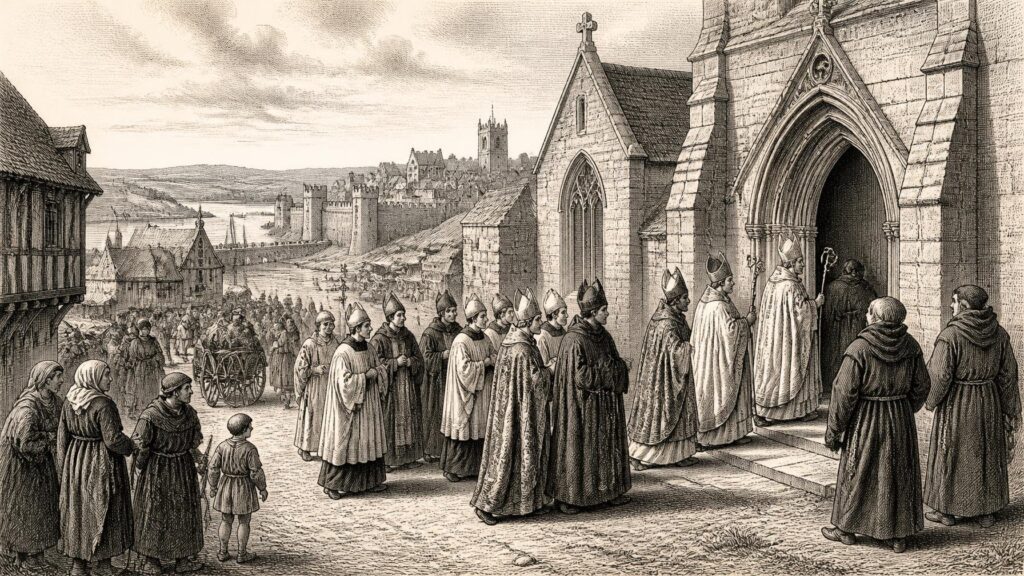
A firmly dated ecclesiastical event occurred at Drogheda on 11 July. Octavian de Palatio, the Italian-born archbishop of Armagh, held a general synod with bishops and clergy of northern Ireland. The surviving notice does not preserve its decrees, so it would be unsafe to claim a detailed programme. Its very assembly nevertheless shows the continuing capacity of the late-medieval church to convene regional clergy across political divisions.
Domnall Ó Fallamhain, an Observant Franciscan, attended while seeking to secure his papal letters for the bishopric of Derry, granted from Rome. The annalist’s extraordinary praise of him as the preacher who had done most service for Irish people since Patrick is rhetoric, not a measurable fact. It does, however, register the standing of a preacher associated with the stricter Franciscan reform. The episode joins local church politics to wider Catholic networks: an Irish see, a synod at a major port town, an Italian archbishop and papal provision were all connected.
Religious building also advanced in Leinster. In 1486 Roland FitzEustace began a house of the Friars Minor of the Strict Observance on the bank of the Liffey at New Abbey near Kilcullen. This was a concrete investment in reform-minded Franciscan life, funded by one of the Pale’s greatest office-holders. A friary was more than a church: it offered preaching, burial, intercession, learning and a visible expression of a patron’s standing. Its foundation in a year of political uncertainty suggests that elite competition and religious patronage could reinforce one another.
Salt, Horses and an Uneven Year
The annals also record conditions that bring daily life into view. Apples were abundant in gardens and woods, suggesting a favourable yield of that crop. Yet abundance was uneven. There was a great scarcity of salt in 1486 and the preceding year; in Meath, a quart could cost a groat, and satirists composed an elegy for salt because it was so hard to buy. Salt was indispensable for preserving meat and fish, especially through winter and for provisioning travelling households and armed bands. A shortage therefore affected kitchens, markets and the security of stored food, not merely taste.
Horses were also unusually dear in Ulster, where a colt could reportedly command a milch cow and a heifer. The annalist gives no cause, so neither war nor disease should be asserted as the explanation. But the price comparison makes clear how valuable horses were: they enabled travel, raiding, herding, ploughing in some settings and aristocratic display. Taken together with burnings, raids and contested lordships, the note on prices reveals an Ireland in which political disorder and material life were closely connected.
Thus 1486 was not a quiet prelude to the more famous events of the following year. It was a year in its own right: a northern synod met at Drogheda; an Observant friary began beside the Liffey; lordships changed hands; a major Connacht encounter was fought; the plain of Oriel was repeatedly ravaged; and people confronted a costly shortage of salt. The record is fragmented, but its fragments show a society whose religious institutions, markets, settlements and political allegiances were continually shaped by the contest for local power.
Primary Sources
- The Annals of Ulster: Year U1486
- The Annals of Ulster
- Annála Connacht: Annal 1486
- Annals of Loch Cé
- Annals of the Four Masters
- FitzGerald, Gerald (Gearóid Mór)
- FitzEustace, Roland
- Darcy, Sir William
- O'Donnell (Ó Domhnaill), Aodh Ruadh
- MacMahon (Mac Mathghamhna), Aodh Ruadh
- FitzGerald, Thomas ‘fitz Maurice’
- New Abbey
- K3D – The Portlester Effigy
- Religious house – Franciscan friars, Nicholastown (Kilcullen ED), County Kildare
- Memoranda Rolls 2 Henry VII
- Statute Law Revision Act 2007
- History of Parliament in Ireland
- The Later Middle Ages
- Early Tudor Ireland
- Irish Script on Screen – MS 23 P 6 (The Annals of the Four Masters)
- Exploring the Irish Annals
- Annals of Ulster Manuscript Records