Lough Oughter’s Broken Peace1390 CE
In 1390, rivalry between Tighearnán Mór Ó Ruairc of West Breifne and Tomás Mór Ó Raghallaigh of East Breifne drew allied kindreds into a great war. Maghnus Ó Ruairc escaped captivity at Lough Oughter but was killed near Lough Scur. Peace followed, secured by concessions, hostages and expulsions, though raids, forced movements and cattle losses continued. Tomás’s death brought Seán Ó Raghallaigh to power. Elsewhere, Kilbarron Castle was demolished, while legal, historical and ecclesiastical figures died. The Book of Ballymote’s late fourteenth-century compilation reflected enduring scholarly patronage. Despite English justiciar Sir John Stanley, regional lords managed conflict and settlement independently.
Dateline
The year 1390 is unusually well illuminated for a period often known only through brief annalistic notices. Its centre of gravity lies in Breifne, the broad, lake-studded borderland of modern Cavan, Leitrim and adjoining districts. There, a contest between the Ó Ruaircs of West Breifne and the Ó Raghallaighs (O’Reillys) of East Breifne produced imprisonment, escape, killing, cattle-raiding, a negotiated settlement and a disputed succession. The episodes were local in setting but not trivial: they show how lordship worked in late medieval Ireland, through kin alliances, hostages, control of strongholds and the movement of livestock and armed households.
War Between Breifne’s Kings
The principal conflict was between Tighearnán Mór Ó Ruairc, king of West Breifne, and Tomás Mór Ó Raghallaigh, king of East Breifne. The Annals of Ulster simply call it a “great war”; the Annals of Connacht give a fuller picture of the forces drawn in. Muintir Anghaile in Annaly, Muintir Eolais, Tellach Dunchada—associated with the MacTighearnáin or MacKiernan kindred—and Clann Muircheartaigh, a branch of the Ó Conchobair dynasty, were involved. Domhnall, son of Muirchertach Ó Conchobair, and Tomaltach Mac Donnchada are named as influential figures in the wider coalition.
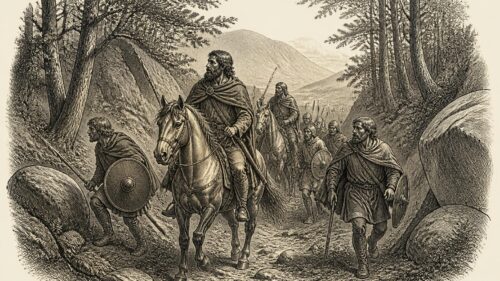
This was not a war between two neatly bounded states. Breifne was a political landscape of overlordships, client kindreds, church lands, lake strongholds and routes used by mounted forces, foot soldiers and cattle-drovers. The Ó Ruaircs and Ó Raghallaighs competed not only for territory but for the obedience of lesser lords. Alliances could therefore bring in people from Annaly, south Leitrim, Tullyhunco and Connacht. The annals’ language of “great war” is significant because it records a conflict whose consequences spread well beyond the immediate households of the two rival kings.
Tomás Mór had been steadily strengthening his position in East Breifne. A later biographical reconstruction, drawing on the annals, suggests that his 1390 combination of allies placed serious pressure on Tighearnán Ó Ruairc. Yet the evidence must be handled carefully. The surviving records give outcomes and named participants, rather than a full campaign narrative. They do not permit a precise map of every raid or a confident day-by-day sequence. What can be said firmly is that armed rivalry and negotiation unfolded within the same year.
Escape at Lough Oughter
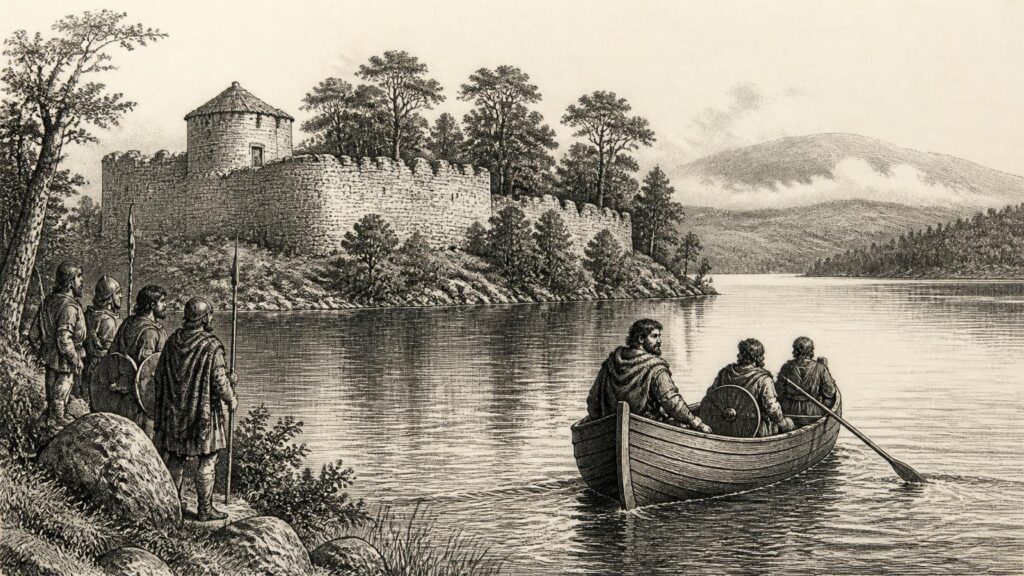
The most vivid event concerns Maghnus Ó Ruairc, who was held captive at the castle or rock of Lough Oughter. The lake, with its islands and narrow waters, was a natural defensive system, and its castles were political instruments as much as buildings. A prisoner in such a place was difficult to rescue and useful to whoever controlled him. Maghnus escaped confinement and made for the castle of Lough Scur. His freedom was brief. The annals say that Clann Muircheartaigh pursued or were alerted to him, and that he was killed as he came ashore from a small boat.
The incident conveys both the possibilities and dangers of travel in this watery country. A skiff could carry a fugitive from one defended site towards another, but landing places, watchers and local knowledge mattered as much as the water itself. It also reveals the human stakes behind the formal language of war. Captivity was a means of containing rival claimants; escape could reopen a succession problem; betrayal might decide it. The chroniclers record Maghnus’s death without explaining every motive, so it would be unsafe to assign responsibility beyond the groups they name. Nonetheless, the killing removed a figure important enough for three major annalistic traditions to notice.
Peace, Hostages and Displacement
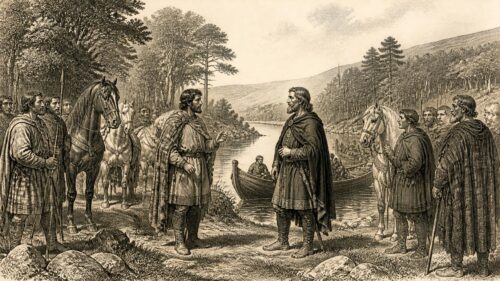
By the end of the struggle, Ó Ruairc and Ó Raghallaigh made peace. It was not a peace of equals in every respect. The Annals of Connacht state that Ó Ruairc made substantial concessions in return for Ó Raghallaigh separating himself from Ó Ruairc’s enemies and expelling them. Eóghan Ó Ruairc and a son of Cathal Riabhach were handed over as securities for the terms. The Annals of the Four Masters likewise record hostages given in connection with payment and agreement.
Hostages were not an incidental detail. In Gaelic and Anglo-Irish politics alike, they turned promises into enforceable obligations by placing members of a ruling family or allied elite in another lord’s custody. Their delivery demonstrated weakness or compromise, but also made a settlement possible without eliminating a rival dynasty. In 1390 the arrangement appears to have checked immediate open warfare while leaving its underlying rivalries intact. The following year’s annalists record a dangerous encounter between Ó Ruairc and forces of Clann Muircheartaigh, a reminder that peace settlements could be fragile.
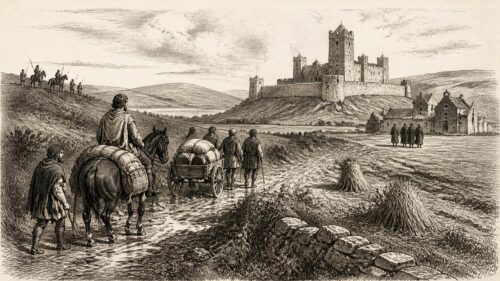
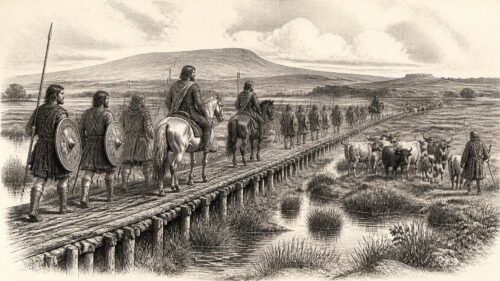
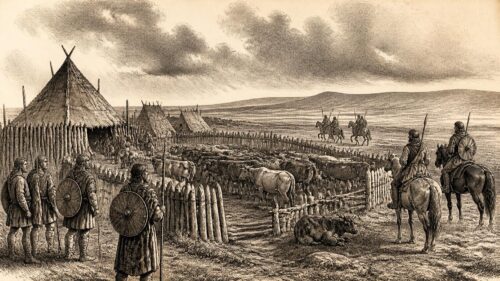
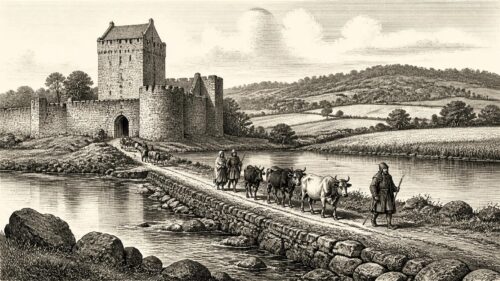
The same year brought a forcible movement of Clann Muircheartaigh and Tellach Dunchada into Ó Ruairc territory, towards Fid Ua Fionnúige, Sliabh Corrain and Cenél Luachain. This should not be imagined as a peaceful migration. The Annals of Connacht describe it as an imposed entry, and Tighearnán responded after receiving news at Glangevlin. He moved his baggage train to the upper end of Cenél Luachain, attacked the allied princes and pursued them from Bel-atha Daire Dubthaig towards the Breifne hills, killing cattle along the route. Cattle were movable wealth, food, labour and a measure of a lord’s ability to reward followers. Their seizure or destruction could punish opponents and damage the households dependent on them.
A Succession in East Breifne
Tomás Mór Ó Raghallaigh died in the autumn of 1390, after the settlement. His death immediately raised the problem that every Gaelic lordship faced: succession was not automatic primogeniture. The annals say that Seán, son of Pilib Ó Raghallaigh, assumed the kingship of Breifne. This succession was consequential because Tomás had just achieved a position strong enough to extract concessions and hostages from his western neighbour. Seán inherited the title, but not necessarily his predecessor’s personal alliances, authority or capacity to command them.
The change in East Breifne underscores why kinship politics could be so volatile. A lord’s death altered the calculations of dependants, rival branches and neighbouring dynasties at once. In the same annal-year, Fearghal Ó hEaghra, king of Luighne, also died, another indication that regional political society was constantly being reshaped by mortality as well as battle. The annals do not allow us to turn every death into a crisis, but they show how frequently lordship depended upon a named individual rather than an impersonal state.
Castles, Law and Memory
Conflict was not confined to Breifne. Domhnall, son of Muirchertach Ó Conchobair, demolished Kilbarron Castle. The notice is brief, and it does not supply an exact date or a full military explanation. Still, it is a useful warning against imagining castles as permanent and unassailable symbols of authority. Their maintenance required labour, supplies, local allies and a political environment in which their garrisons could survive. A demolished castle represented the removal of a rival’s defensive base and claim to command a district.
1390 was also a year of losses among learned and ecclesiastical personnel. Brian Mac Aodhagáin, described as ollamh of jurisprudence in Breifne, died. An ollamh was a recognised master within a learned profession; in Brian’s case, legal expertise was part of the machinery of lordship. Brehons and legal families advised rulers, preserved legal learning and helped articulate rights, obligations and settlements. Seán Mac Aodhagáin, called “the Official”, was killed four nights before Christmas. The same annals record the death of Dubginnán Ó Duibhginnáin, ollamh of the Conmaicne in history. Their notices show that law and historical learning remained valued offices, closely attached to regions and elite households.
Church institutions, too, were present in the record. Niall Ó Taichligh, canon chorister of Clogher and superior or coarb of Devenish, died; so did Peter Ó hEoghain, dean of Lough Erne, and Bartholomew Ó Conghaile, canon and sacristan of Lisgoole. These titles point to a religious landscape sustained not only by bishops and monasteries but by local chapters, custodians and hereditary ecclesiastical offices. The death notices do not tell us how ordinary worshippers experienced 1390, but they confirm the institutional density of church life around Clogher and the Erne.
Writing Near Ballymote
In north-west Connacht, the Book of Ballymote belongs closely to the cultural world of 1390, although it should not be presented as a securely dated event of that single year. It is conventionally associated with 1390–91, while manuscript evidence establishes that important portions were produced in the late fourteenth century under the patronage of Tomaltach Mac Donnchada of Corran, Ballymote. Its principal scribes included Solamh Ó Droma, Robert Mac Síthigh and Maghnus Ó Duibhginnáin.
The manuscript gathered genealogy, history, law, poetry, place-lore, saga material and a copy of Leabhar Gabhála Éireann. Its production depended on vellum, trained scribes, patrons and access to exemplars: a considerable investment in learned culture during a time of military rivalry. The Book of Ballymote therefore offers an essential counterpoint to the year’s raids and hostages. Political power could destroy a castle or drive cattle across a frontier, but it could also support the preservation and reorganisation of inherited knowledge. In 1390, Ireland’s political world was fractured; its scholarly world was nevertheless active, connected and ambitious.
At the level of the English lordship, Sir John Stanley was justiciar of Ireland in 1390, serving Richard II. Yet the Breifne annals do not portray the Dublin administration as directing the settlement between Ó Ruairc and Ó Raghallaigh. That absence matters. Royal government remained an important force in parts of the island, but regional lords retained the capacity to fight, negotiate, exchange hostages, patronise scholarship and settle their own affairs. Lough Oughter’s escape and the peace that followed offer a sharply local view of that wider political reality.
Primary Sources
- The Annals of Ulster: Volume 3 English Translation
- Annals of the Four Masters: Volume 4 English Translation
- Annála Connacht: English Translation
- Annála Connacht: Irish Text
- The Annals of Ulster: Irish Text
- List of Published Texts at CELT
- Book of Ballymote, RIA MS 23 P 12
- Codices Hibernenses Eximii II: Book of Ballymote
- The Book of Ballymote and the Irish Book
- O'Reilly (Ó Raghallaigh), Tomás Mór
- O'Reilly (Ó Raghallaigh), Pilib
- O'Reilly (Ó Raghallaigh), Cú Chonnacht
- Stanley, Sir John
- English Lordship of Ireland and the Irish Sea World: Re-assessing the Origins of the Kildare Ascendancy, c.1390–c.1513
- Thomas Holand – Richard II’s King of Ireland?
- In the Footsteps of a King
- Irish Lords and English Rulers
- One World: The Communities of the Southern Dublin Marches
- Book of Ballymote
- Extracts from the Urban Archaeology Survey of County Mayo
- County Mayo Urban Archaeology Survey 1989: Ballinrobe
- Ballinrobe Greenway Archaeological Assessment
- Mac Aodhagáin, Giolla na Naomh
- CELT Frequently Asked Questions