Cenn-eitigh’s Cattle Camp1397 CE
In 1397, Irish politics centred on rival lordships, notably Connacht’s struggle between Ó Conchobhair Donn and Ó Conchobhair Ruadh. Mac Donnchadha’s cattle-bearing camp at Cenn-eitigh was surprised and destroyed in mid-August, prompting retaliatory raids, new alliances and further gallowglass warfare. Conflict devastated crops, houses and herds amid summer food scarcity and a wet, destructive autumn. In Ulster, Niall Mór Ó Néill died and was succeeded by Niall Óg, who inherited continuing struggles. Roger Mortimer sought authority in Leinster and the midlands, building Finnea castle. Ecclesiastical deaths and journeys to Rome reflected enduring religious connections despite widespread instability across the island.
Dateline
In 1397, the most closely recorded Irish events were not the acts of a single national government but the movements of rival lordships: armies converging on pasture, herds being seized, alliances remade after defeat, and rulers whose authority depended upon kin, clients and fighting men. The annals place the year’s sharpest conflict in Connacht and its northern fringes, where the struggle between the Ó Conchobhair Donn and Ó Conchobhair Ruadh branches continued to draw in Burkes, Mac Donnchadhas, Mac Diarmadas, Ó Dubhdas and professional gallowglass companies. Elsewhere, the death of Niall Mór Ó Néill altered the leadership of Tír Eóghain, while Roger Mortimer’s government sought to secure the midlands and Leinster with a new castle.
A Camp on the Curragh
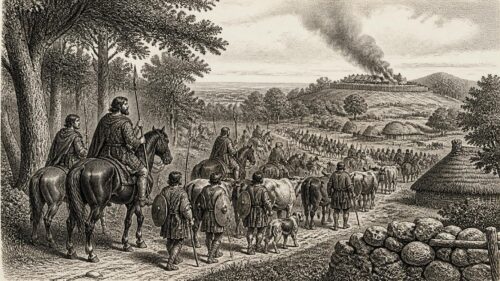
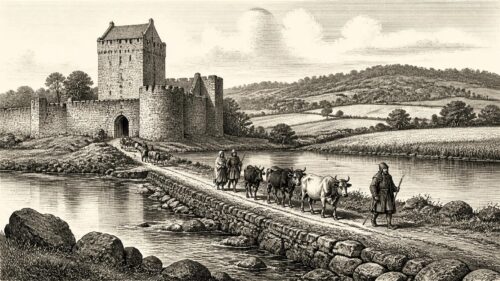
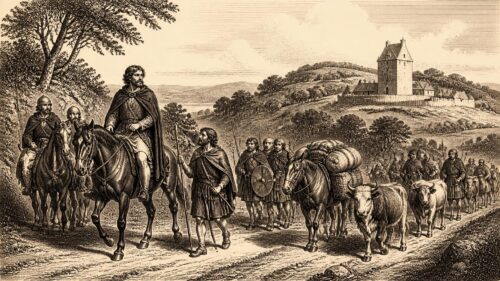
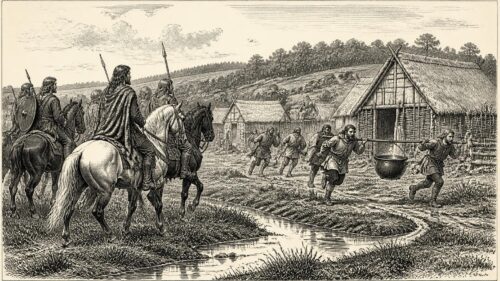
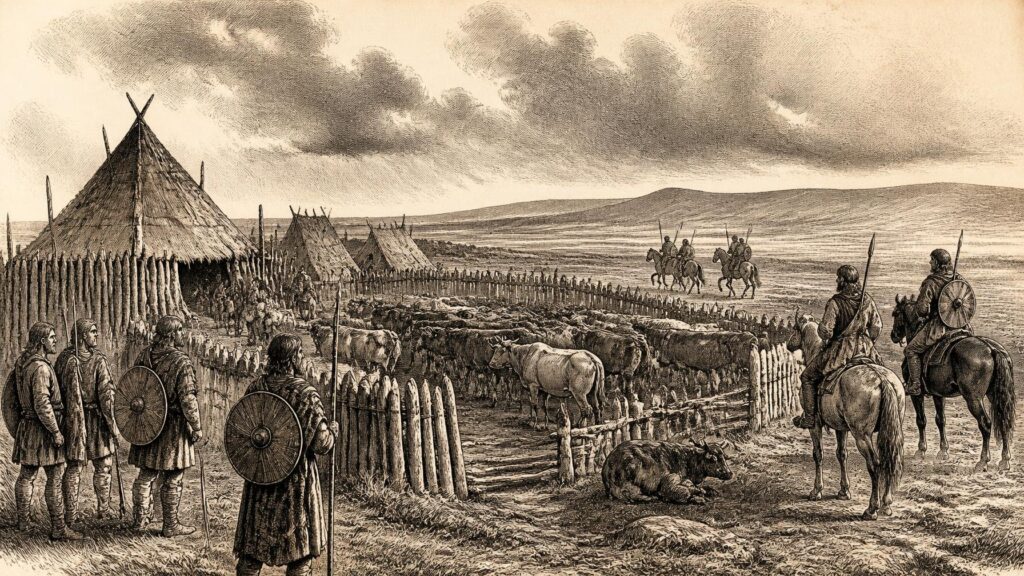
The central episode occurred on the Curragh of Cenn-eitigh, on the plain of Connacht. Mac Donnchadha of Tír Oilella, identified in the annals with the Mac Donnchadha lordship of Tirerrill in modern County Sligo, brought a great hosting to aid Toirdhealbhach Óg Ó Conchobhair Donn. Significantly, the force did not travel as a purely military column. It camped with its herds. Cattle were wealth, food supply, movable capital and the practical means by which a lord sustained followers; their presence made the camp both an assertion of power and an exceptionally tempting target.
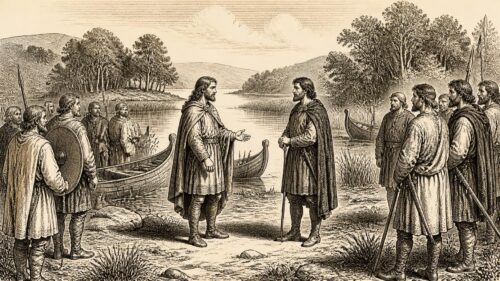
The opposing coalition formed quickly when Toirdhealbhach Ruadh Ó Conchobhair, leader of the Roe branch, and Thomas Mac William Burke learned where the camp lay. The Annals of Ulster name the sons of Cathal Óg Ó Conchobhair, the sons of Aodh Mac Diarmada, and a muster of Connacht gallowglasses among their allies. This was therefore not a simple confrontation between two Ó Conchobhair cousins. It was a conflict in which old Gaelic kindreds, the Burke lordship of Mac William, mounted men and hired heavy infantry all had stakes in the outcome.
The attack achieved surprise. Mac Donnchadha did not realise that the enemy host was upon him until Toirdhealbhach Ruadh arrived with a large body of horsemen at the camp itself. The annals list a grim concentration of losses: Mac Donnchadha; Aodh Caech, a son of the Ó Conchobhair Donn line; Diarmait Mac Donnchadha, described as future lord of Tír Oilella; members of the Mac Suibhne gallowglass leadership; and many others. Their wording stresses that neither the dead nor the captured goods could be counted. That language is conventional, but the agreement of several annalistic accounts leaves no doubt that the rout was a major reverse for the Donn alliance.
A modern biographical study dates the surprise and rout to 11 August, whereas the Annals of Ulster associates the campaign’s first decisive actions with the vigil of the Assumption, 14 August. Rather than impose a false certainty on a difficult annalistic chronology, it is safest to place the disaster in mid-August. What is clear is its immediate consequence: Toirdhealbhach Óg was absent from the camp when it fell, and, once informed, struck back by raiding the herds of his rival in Leitrim. The counter-raid came only a few days later according to the modern reconstruction. Defeat did not end a war; it redirected it towards the herds and households that made renewed war possible.
Alliance After Defeat
The Connacht campaign continued into the weeks that followed. Turlough Ó Domhnaill of Tír Chonaill came south at the request of the sons of Cathal Óg Ó Conchobhair. He moved into northern Tír Oilella, where houses and crops were burned and the son of Cormac, son of Ruaidhrí, was despoiled. The record is important for what it says about war’s reach. Fighting was not confined to a named battlefield: an army moved through cultivated country, burned grain and dwellings, and stripped property from local rulers. Such actions could weaken an opponent’s ability to feed dependants and reward retainers long after armed men had dispersed.
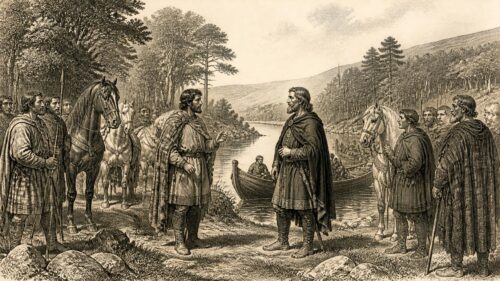
Out of the crisis came a new compact. Maolruanaidh Mac Donnchadha took the lordship of Tír Oilella after the death of Mac Donnchadha. He allied himself with Ó Domhnaill, the sons of Cathal Óg, Ó Dubhda and the eastern Ó hEaghra. Political succession and military alliance were inseparable. A newly installed lord needed allies; allies, in turn, acquired a reason to defend his position. The arrangement drew gallowglass leaders and Muintir Dhuirnín into the fighting in Cairbre, while surviving Mac Suibhne gallowglasses regrouped with Muircheartach Bacach.
At Bun Brennóige, Ó Domhnaill arrived with only a small force to reinforce the sons of Cathal Óg. Their opponents were defeated, and Marcus Mac Domhnaill, constable of the gallowglasses, his son Dubhghall, John Mac Sithigh and many gallowglasses were killed. Further forays pushed the sons of Cathal Óg back across the Erne. The year thus demonstrates how mobile professional soldiers served the politics of regional dynasties. Gallowglasses were not an anonymous military backdrop: their captains appear by name, their losses mattered, and their survival or destruction affected the capacity of rulers to campaign.
Scarcity and a Destructive Autumn
Mac Carthaigh’s Book preserves an unusually direct notice of conditions beyond the battlefield: there was “insufficiency of food” in the summer, followed by an autumn described as wet, windy, destructive and cold. The entry does not allow a measured national harvest estimate, nor should it be treated as proof that every district suffered equally. Nevertheless, it is firm evidence that scarcity and damaging weather were recorded as notable features of this calendar year.
For farming households, such weather could have acute consequences. A poor summer reduced the margin between subsistence and want; a wet autumn hindered the gathering and storage of grain and fodder, while storms damaged houses, fences and boats. In districts affected by raids, the burning of crops and removal of cattle compounded climatic pressure. The annals do not describe ordinary people at length, but their references to herds, crops, food shortage and destroyed settlements reveal the material foundations upon which lordship and warfare rested.
Niall Mór’s Succession
In Ulster, Niall Mór Ó Néill died during 1397 after receiving the rites of unction and penance. The Annals of Ulster calls him “arch-king of Ulster” and a contender for the kingship of Ireland. This should be understood as an annalist’s powerful statement of status, not evidence that he ruled all Ireland as a modern territorial monarch. Niall had nevertheless been one of the most formidable Gaelic rulers of his generation. His authority in Tír Eóghain had been shaped by conflict with English and Anglo-Irish interests, rival Irish lordships and the Mortimer earls of Ulster.
His son Niall Óg was made king in his stead. The succession occurred in a tense setting. Richard II’s settlement of 1394–95 had left unresolved the relationship between the Ó Néills and Roger Mortimer, while Mortimer’s subsequent attack on the Ó Néills had helped unravel the king’s promises of arbitration and protection. During 1397 Niall Óg also entered a struggle with Ó Domhnaill and Domhnall Bog Ó Néill; his forces suffered a setback in Donegal, and Ó Domhnaill went on to plunder Fermanagh and Sligo. Thus the new ruler inherited not peace but an active contest for supremacy in Ulster.
The year’s annals also preserve a precisely dated local killing. On 26 December, St Stephen’s Day, Art of Cúil, son of Philip Mag Uidhir, was killed by an arrow shot by the sons of Mag Shamhradháin. This brief notice from the Fermanagh–Breifne world is a reminder that lordship was contested at many scales. Great dynastic wars, successions and royal strategies unfolded alongside lethal disputes among neighbouring kindreds.
Mortimer’s Midland Castle
Roger Mortimer, earl of March and Ulster, returned to Ireland in 1397 as sole lieutenant after a period in England. He had fewer royal resources than his office demanded and was expected to rely heavily on his own wealth. Mac Carthaigh’s Book records an attack by “the Earl” upon the Leinstermen, and says that he gained sway over this side of Leinster. Its wording is broad and should not be read as a permanent conquest; Mortimer’s authority was precarious. Yet it captures a real attempt to translate military movement into political control.
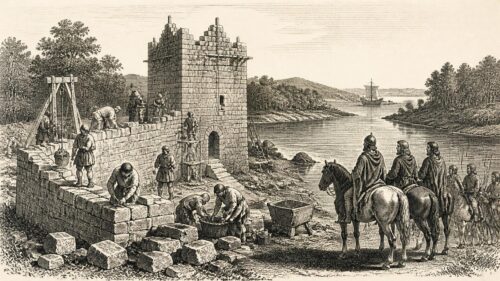
That effort had a durable physical expression at Fiodh an Átha, now Finnea on the River Inny in County Westmeath, where a castle was built in 1397. A fortified crossing could watch movement between the midlands and Breifne, offer a defensible base for troops, and signal a lord’s claim to exact obedience in the surrounding countryside. In the same year, Mac Carthaigh’s Book records Mullingar and Fir Thulach being burned and destroyed by the son of Murchadh Ó Briain and people of south Leinster. Castle-building and destructive raiding belonged to the same frontier politics: one sought to hold routes and territory, the other to deny security and resources.
Religious life, too, remained connected to these political landscapes. Gallchorr, bishop of Clonmacnoise, died in 1397, while clergy from Muintir Anghaile travelled to Rome, including Fearghal, official of Ardagh, and the abbots of Lorrha and Shr rule. Such notices show that Irish ecclesiastical institutions maintained long-distance channels of authority and pilgrimage even as local warfare intensified. The year closes not with a single decisive settlement, but with contested successions, rebuilt alliances, a new castle at a ford, and communities facing the combined burden of violence, scarcity and severe weather.
Primary Sources
- The Annals of Ulster: Year U1397 (English translation)
- Annals of Ulster Otherwise Annala Senait: Year U1397 (Irish text)
- Annals of the Four Masters: Volume 4 English Translation
- Annals of the Four Masters: Irish Text, Volume 4
- Mac Carthaigh’s Book: Annal MCB1397 (English translation)
- Mac Carthaigh’s Book: Fragment III (Irish text)
- MacMurrough Kavanagh (Mac Murchadha Caomhánach), Art Mór
- O’Neill (Ó Néill), Niall Mór
- O’Neill (Ó Néill), Niall Óg
- O’Connor Don (Ó Conchobhair Donn), Toirdhealbhach Óg
- Mortimer, Roger
- Richard II
- Richard II and the Wider Gaelic World: A Reassessment
- Richard II and the Submissions of Gaelic Ireland
- The Rise and Fall of the Clann Éinrí Aimhréidh Uí Néill: Dynastic Feuding and Geopolitics in the Late Medieval Irish Sea World
- Close Roll 21 Richard II (1397–1398), Item 3
- The Bishopric of Clonmacnoise in the Later Middle Ages
- Bailtí Fearainn: Finnea / Fiodh an Átha
- Castle, Finnea, Co. Westmeath
- Fiodh an Átha Townland, County Westmeath
- Finnea Townland: Before Norman Invasion
- King Richard II’s Two Visits to Kilkenny (1393 & 1399)