Carnfree’s Brief King1225 CE
In 1225, Connacht was devastated by a succession war after Cathal Crobderg Ó Conchobair’s death. Toirrdelbach, son of Ruaidrí Ó Conchobair, was inaugurated at Carnfree with support from Áed Ó Néill and Connacht allies, but Áed mac Cathail regained power through Anglo-Norman, Thomond and local assistance. Campaigns centred on cattle, territory and hostages, displacing communities and bringing plunder, killings, drowning, hunger and exposure. Alliances repeatedly shifted, while church and secular lands suffered alike. A second rising failed, forcing Ruaidrí’s sons back to Ulster. Fever, disrupted harvests and ploughing compounded destruction, leaving Áed restored but Connacht socially and economically shattered severely.
Dateline
In 1225 Connacht endured a succession struggle so destructive that its effects reached from the Shannon crossings to the western lake country, through the cattle districts of north Connacht and into the church lands of south Galway. The year’s central event was the short-lived inauguration at Carnfree of Toirrdelbach, son of Ruaidrí Ó Conchobair, followed by the restoration of his rival Áed mac Cathail Chrobdeirg. Yet to call this merely a dynastic quarrel would understate its scale. It became a war of shifting coalitions, in which an Ulster king, the Anglo-Norman administration, magnates from Munster and Leinster, local Connacht lords, paid soldiers and displaced farming communities all had a part.
The fullest account comes from Annála Connacht, whose long narrative should be read carefully: it assigns events to the year but does not provide a modern, day-by-day chronology. The essentials are supported by briefer notices in the Annals of Ulster and the Annals of Inisfallen. Together they show a province shaken by a contested kingship only a year after the death, in May 1224, of Cathal Crobderg Ó Conchobair. Cathal had held Connacht together for decades. His son Áed inherited a formidable position, but not an uncontested one.
A Rival Raised at Carnfree
The challenge came from Toirrdelbach and Áed, sons of Ruaidrí Ó Conchobair, the former king of Connacht and one-time claimant to the high-kingship of Ireland. They were assisted by Áed Ó Néill, king of Cenél nEógain in Ulster. The immediate spark, according to the Connacht annalist, was the resentment of Donn Óc Mac Aireachtach, chief of Síol Muiredaig, who sought revenge after the confiscation of his land and inheritance. His defection was consequential: much of Síol Muiredaig and western Connacht joined the revolt. Cormac Mac Diarmata was singled out as a conspicuous exception.
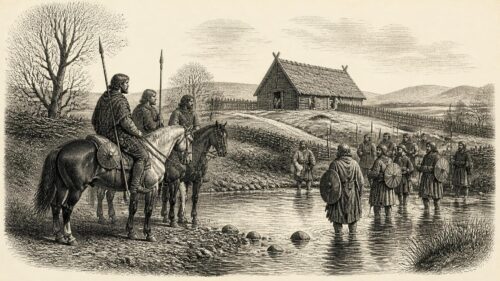
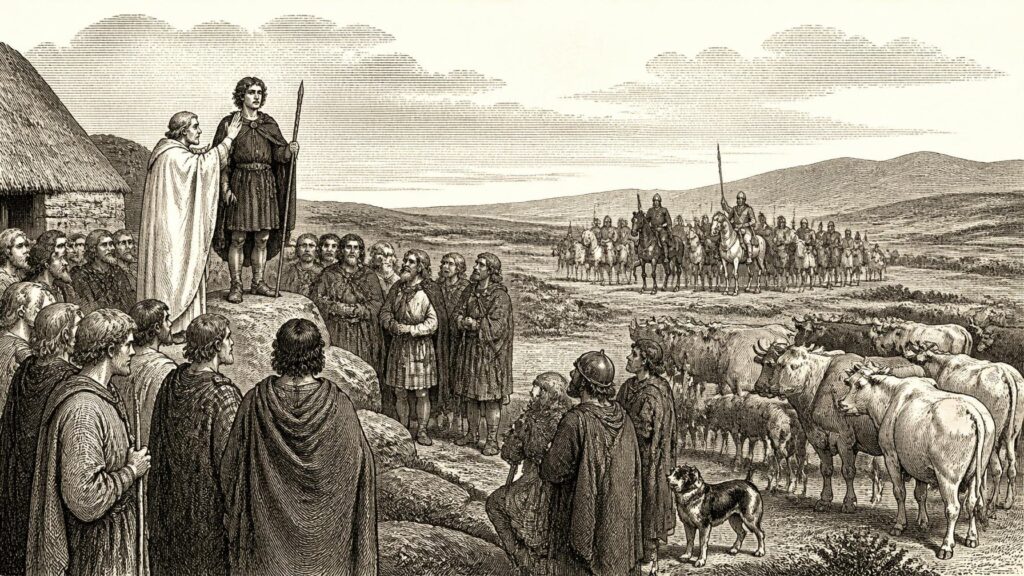
Ó Néill led a hosting south into Connacht. His army moved through Síol Muiredaig towards Athlone, stayed two nights at Mullach Uaine and plundered Loch nÉan, carrying away Ó Conchobair treasure. It then went to Carnfree, the ancient inauguration place of Connacht’s kings, where Toirrdelbach was installed. The choice of site was politically deliberate. An inauguration at Carnfree did not magically settle a disputed succession, but it invoked a deeply established language of provincial legitimacy. Toirrdelbach now possessed a public claim to the kingship, backed by an army from the north and by a substantial Connacht coalition.
That claim immediately exposed its limits. Ó Néill withdrew homewards rather than remain to wage a prolonged Connacht war. Toirrdelbach and his brother were left dependent on local allies whose loyalty was bound up with cattle, territory and the prospects of survival. The year’s campaigning repeatedly reveals that royal authority rested not only on ancestry or ceremonial, but on the ability to defend people, herds and food supplies.
Áed’s Appeal at Athlone
Áed mac Cathail Chrobdeirg reacted by seeking support from the “Galls”: the Anglo-Norman settlers, officials and military men of the lordship. This was not a simple meeting of Irish and English blocs. Áed’s father had maintained relationships with leading colonial powers through gifts, payments and military co-operation, and Áed could draw upon that inherited political capital. Fortuitously for him, a great court of the lordship was meeting at Athlone, on the strategic Shannon frontier.
Áed secured the support of the justiciar, William Marshal, together with a force of settlers and soldiers. Donnchad Cairbrech Ó Briain, king of Thomond, and Ó Máelsechlainn also came to his aid. The arrangement shows Connacht drawn into the political world of the lordship without ceasing to be a Gaelic kingdom. Áed was not surrendering a passive province to an outside army. He was an Irish king employing external allies against Irish rivals, while those allies expected wages, plunder, hostages and influence in return.
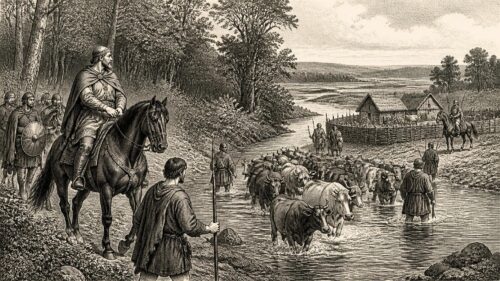
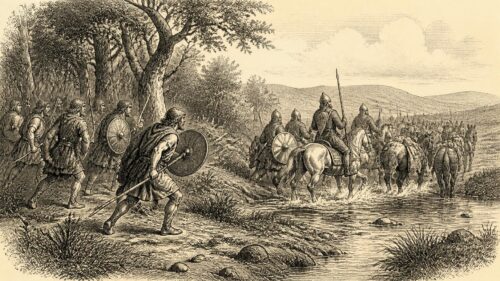
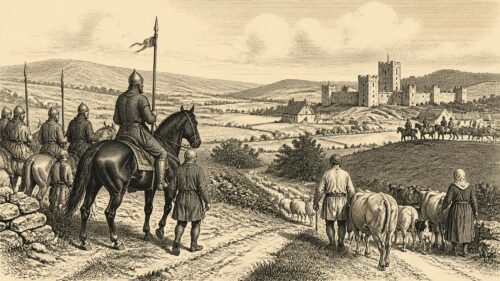
The counter-offensive forced people of Mag Aí and the wider Connacht districts east and north towards Leyney and Tirawley. They drove their cattle with them, leaving Toirrdelbach’s party without the territorial levy on which it depended. Cattle were both portable wealth and essential livelihood: milk, meat, traction, breeding stock and the means of meeting lordly exactions. Protecting a herd was therefore a political and household necessity. The rival sons of Ruaidrí moved towards Kilkelly with a small following to cover the retreat of their livestock and dependants.
War Against People and Property
The annals make clear that the campaign was not confined to clashes between armed retinues. Áed’s forces pursued their enemies through Leyney, plundered for three nights around Meelick and attacked communities attempting to escape with their animals. Echmarcach Mac Branáin died while defending women and cattle in an oak wood. At Attymas and Coolcarney, fleeing inhabitants suffered plunder and killing. The narrative’s most harrowing episode concerns people who tried to cross near Ballycong: many drowned, and fishing weirs were reportedly found full of drowned children. Those refugees from Clann Tomaltaig who reached Tirawley were then attacked by Ó Dubda and stripped of their remaining cattle.
Such details are not incidental colour. They explain why allegiances altered so swiftly. Chiefs made peace to preserve what stock and people remained; rivals sought guarantees from whichever army was strongest nearby. The annalist records men leaving one coalition, guarding the livestock of sworn allies, or accepting submission terms for the sake of their dependants. Even the language of military success is inseparable from cattle seizures, food, clothing and horses.
Violence also spread beyond the force directly commanded by Áed and the justiciar. Men from Leinster and Munster, forces associated with Desmond, and the sheriff of Cork entered southern Connacht in pursuit of profit. Their arrival displeased Áed, who had not summoned them. Four sons of Mac Murchada were killed in one place. The Connacht annalist condemns a war in which young warriors plundered their own companions when able, while women, children, weaker people and the sons of lords endured cold and hunger. This is a rare and valuable glimpse of how the destruction was understood within an elite narrative: not as an abstract contest for a crown, but as a disaster for the province’s social fabric.
Submission, Hostages and a Second Rising
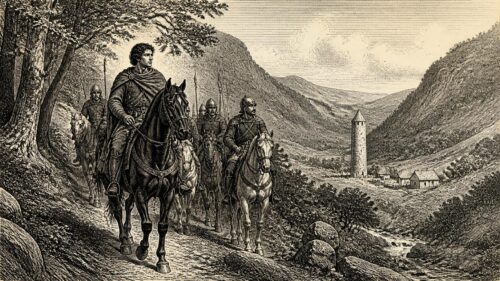
Áed advanced westwards to Mayo and Kilmaine. There, the annals say, the province was almost filled with armies: three bodies of Galls alongside Gaelic forces. Áed Ó Flaithbertaig of western Connacht submitted to Áed and the justiciar under guarantees from prominent settlers and from Donnchad Cairbrech. In return he was permitted to retain his people and cattle, provided that he dismissed the sons of Ruaidrí. Such agreements were practical rather than permanent. Islands, vessels and leading men could be given as pledges; chiefs could be held until soldiers’ wages were paid; captives might have to ransom themselves.
Indeed, the settlement soon unravelled. Once some of the external forces had dispersed, Ó Flaithbertaig and others again joined the sons of Ruaidrí. Áed summoned additional troops from Leinster. At Ardrahan, forces allied to Toirrdelbach launched a dawn attack on the settlement where these soldiers were encamped. The attackers gained an initial success and killed the constable of the Galls, but fighting on the western side of the place went against them. The sons of Ruaidrí were not caught in the defeat, yet the renewed effort did not restore their position.
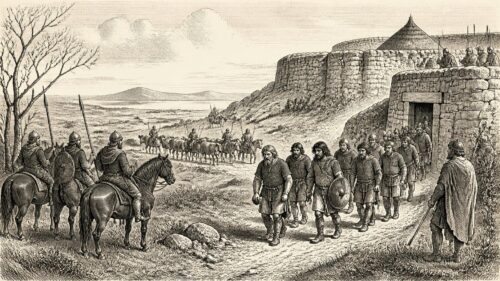
By the end of this phase the brothers abandoned Connacht and sought Ó Néill’s protection once more. Áed mac Cathail Chrobdeirg exacted hostages and assurances, while the sons of Muirchertach Ó Conchobair and other local figures made peace to safeguard their communities. The annalist judged the respite badly needed, declaring that neither church property nor secular property in Connacht had escaped destruction. Áed had regained the kingship, but he ruled a devastated province and had done so with obligations to powerful allies.
Churches, Learning and an Unfinished Harvest
Amid warfare, the annals also preserve quieter notices that reveal the institutions sustaining regional life. Amlaíb Ó Beolláin, erenagh of Drumcliff, died; he was remembered for generosity and for maintaining a guest-house. An erenagh administered church lands and resources, and the praise for hospitality points to the continuing practical role of ecclesiastical households in sheltering travellers and distributing food. The abbot of Boyle died after blood-letting, a reminder that monastic centres were places of prayer, landholding and learning, but also participated in the medical practices available to elite religious communities.
The year’s environmental evidence is stark. The Annals of Ulster record “great destruction of people”, while the Connacht account says that fever followed plunder, slaughter, hunger and exposure, emptying settlements so thoroughly that few recovered. It would be unsafe to diagnose the disease or to claim a nationwide epidemic from these notices alone. It is responsible, however, to see the reported sickness as inseparable from displacement, damaged food supplies and the physical ordeal of war.
Harvesting was still taking place after St Brigid’s Day, 1 February, while ploughing was already under way. The unusual overlap, also attributed to war and poor weather in the annal tradition, suggests serious disruption to the agricultural calendar. For a society dependent on cereals, livestock and seasonal labour, delayed reaping threatened more than inconvenience. In Connacht, 1225 was a year when a contested inauguration at Carnfree helped turn political rivalry into a crisis of subsistence, security and survival.
Primary Sources
- Annála Connacht
- The Annals of Ulster: Year U1225
- Annals of Inisfallen: Annal AI1225
- Annals of the Kingdom of Ireland by the Four Masters
- Annals of Loch Cé A.D. 1014–1590
- Annals of Boyle, an historical compilation in Irish, A.M. 1–A.D. 1270
- Inspeximus of a Patent of Henry III to Geoffrey de Mariscis, Justiciar of Ireland, 30 June 1226
- Marisco, Geoffrey de
- From Kingdom to Colony: Framing the English Conquest of Ireland
- From Boom to Bust: The Lordship of Ireland and the European ‘Commercial Revolution’
- A Community in Competition: The Barons of Leinster in Thirteenth-Century Ireland
- Normans & Natives in Medieval Connacht
- Extremes of Weather Recorded in the Annals of Connacht, 1224–1562
- On the Origins of Medicine in Ireland
- CELT: List of Published Texts
- Annála Connacht: Bibliographic and Editorial Information
- Gazetteer of Ireland / Gasaitéar na hÉireann
- Search: Kilmaine
- An tOrdú Logainmneacha (Contae na Gaillimhe) 2012
- Annals of Connacht (AD 1224–1544)