Tír Briúin and Mael Domnaig1324 CE
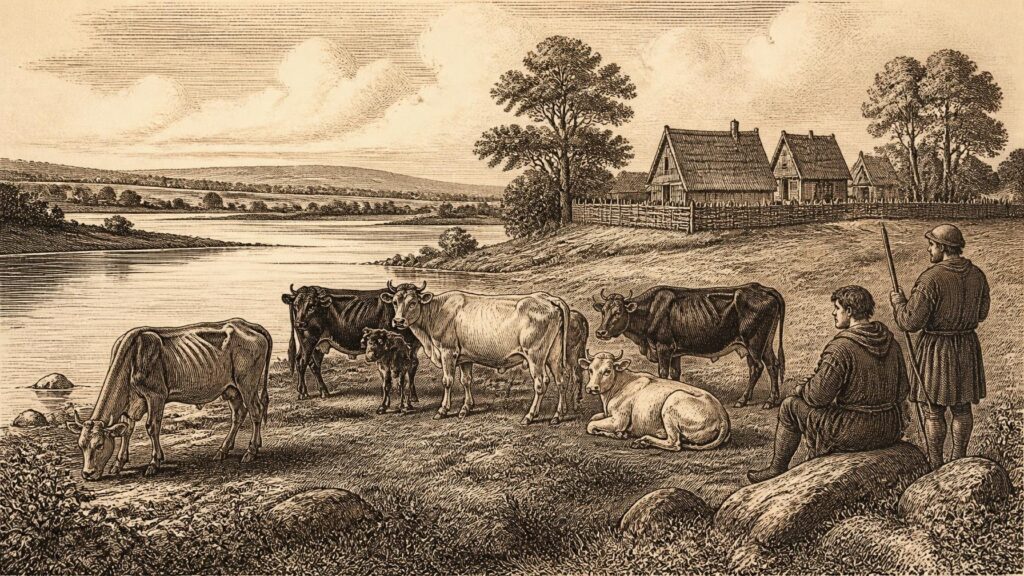
In 1324, Connacht experienced a decisive dynastic reversal when Toirrdelbach Ó Conchobair killed Cathal Ó Conchobair in Tír Briúin na Sinna in autumn and was recognised as king. Cathal, ruler since 1318, had long contested power with his rival amid Gaelic and Anglo-Irish pressures. Annála Connacht also recorded the continuing Mael Domnaig cattle murrain throughout Ireland, a severe but undiagnosed epizootic threatening food, farming, transport, wealth and lordship. John Darcy, newly appointed justiciar, administered English-controlled jurisdictions under Edward II, where common law, Dublin ordinances and local usages coexisted. Sparse annalistic evidence portrays political succession and rural vulnerability as closely intertwined.
Dateline
In 1324, Ireland’s most clearly recorded developments lay in Connacht and in the countryside across the island. One was a violent change of kingship: Cathal Ó Conchobair, ruler of Connacht for about six and a half years, was killed by his dynastic rival Toirrdelbach Ó Conchobair. The other was the continuing cattle mortality known as Mael Domnaig. The surviving annals place both matters firmly within the year. Together they show how political power and daily subsistence could be entwined in fourteenth-century Ireland: a king’s authority rested on followers and military success, but also on the cattle, food, labour and exchange on which lordship depended.
Reading a Thin Record
The year is not richly documented in the manner of a modern chronicle. The fullest contemporary-style notice is in Annála Connacht, a Connacht annalistic compilation whose entry for 1324 records only a handful of events: the death of William Burke, son of William; the killing of Cathal Ó Conchobair and his companions; the accession of Toirrdelbach; a cattle plague said to extend throughout Ireland; and the death of Gilla Críst Ó Birn. Its concision matters. It does not permit a reconstructed calendar of every raid, market, church service or household experience. But its emphasis identifies what its compilers considered consequential: the transfer of provincial kingship and a disease affecting the principal productive animals of the country.
Medieval Irish annals also demand care with dates. Their year-headings were not always synchronised with the modern calendar, and later compilations can preserve material under shifted years. For 1324, Annála Connacht supplies an unusually precise day for Cathal’s death, 25 October. A modern biographical account places the killing in late September instead. The responsible conclusion is that Cathal was killed in autumn 1324; 25 October is the date given by the annal, rather than an independently secure modern dating.
A Connacht Kingship Overturned
Cathal belonged to the Clann Bhriain Luinigh branch of the wider Ó Conchobair dynasty and had established himself as king of Connacht in 1318. His rule had emerged from a long contest within the dynasty, not from a single hereditary succession accepted by all. Connacht’s kingship carried great prestige, but practical authority depended upon securing the obedience, alliance or submission of lesser lords, kin groups and powerful neighbours. The annalist’s statement that Cathal had ruled “in spite of Gael and Gall” captures that reality. His position had to be defended against rival Gaelic claimants and negotiated amid the influence of Anglo-Irish magnates, especially the de Burgh interest in Connacht.
The immediate victor in 1324, Toirrdelbach son of Áed son of Eógan Ó Conchobair, was not an outsider but Cathal’s dynastic adversary. The two men had clashed before. In 1318 Cathal had defeated Toirrdelbach and driven him to seek protection among the Burkes. The reversal in 1324 was therefore the culmination of a rivalry already several years old, rather than a sudden local quarrel. It also demonstrates the resilience of competing Ó Conchobair lines: defeat and exile did not extinguish a credible royal claim.
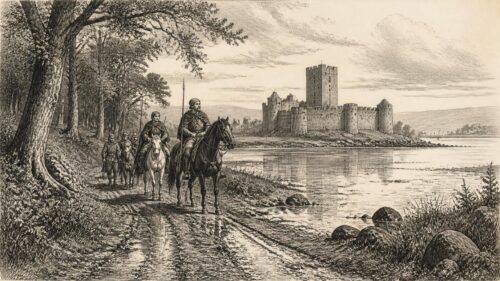
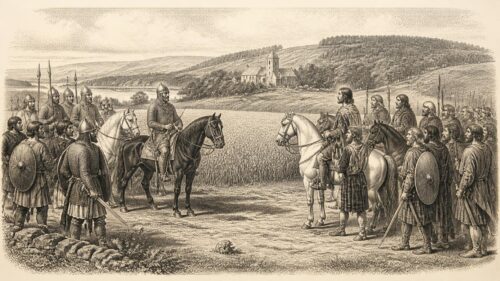
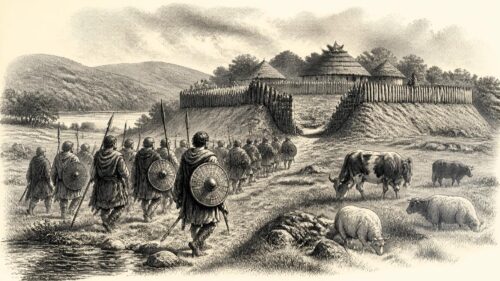
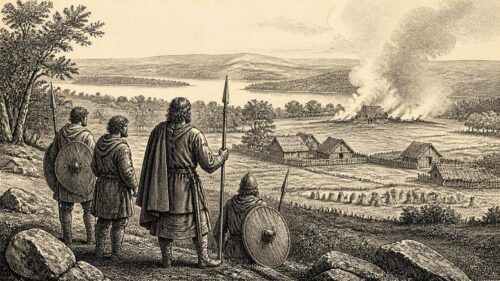
Annála Connacht says that Cathal was killed by Toirrdelbach in Tír Briúin na Sinna, a territory west of the Shannon in what is now north-eastern County Roscommon, between the river corridor and the lands around Elphin and Drumsna. The entry names prominent casualties alongside Cathal: Máel-Sechlainn, son of Toirrdelbach Ó Domnaill, Gilla Críst Óg Mac Donnchada, and “many others”. This was not a private assassination. It was a lethal encounter involving the followings of leading families, whose losses would have affected their local political standing and their capacity to protect dependants.
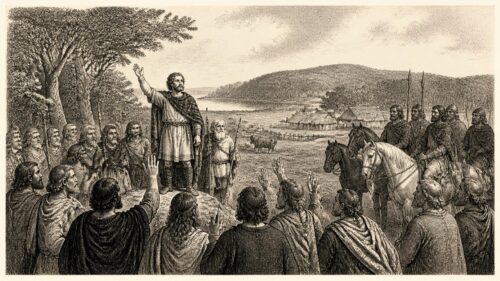
The annalist calls Cathal “the most vigorous and powerful Gael of his time”, high praise that should be read as an assessment of political and martial effectiveness rather than as neutral measurement. Yet the same notice immediately records the settlement that followed: “Toirrdelbach was now made king by all the Connachtmen.” Such unanimity may partly be the language of legitimisation after victory. Still, it indicates the essential next step after a successful challenge. Killing a rival was not enough; Toirrdelbach had to be acknowledged by Connacht’s political community as king. In 1324 he achieved that recognition.
The Cattle Plague
The annal’s other island-wide report is stark: “The same cattle-plague was in all Ireland this year. It was called the Mael Domnaig.” The phrase “the same” is important. This was a recurrence or continuation of a murrain already known in the early 1320s, not an isolated local outbreak. Other annalistic traditions and an Anglo-Irish record associated with St Mary’s Abbey, Dublin, also preserve a 1324 notice of cattle mortality. The corroboration across Gaelic and Anglo-Irish writing makes the broad geographical claim more persuasive, although no source allows a reliable total for animals lost.
Mael Domnaig was a contemporary name, not a diagnosis. Modern historians therefore should not identify it confidently with one particular pathogen. It is safer to call it a severe cattle murrain or epizootic. Research on the wider fourteenth-century bovine panzootic places the Irish recurrence within a sequence of livestock disease affecting parts of western Europe. The evidence supports the seriousness of the outbreak, but not precise claims about infection rates in every Irish district.
Its likely consequences were extensive because cattle were central to Irish rural life. Oxen provided traction for ploughing and haulage; cows supplied milk and calves; cattle functioned as movable wealth, tribute, compensation and the objects of raiding. A diminished herd therefore affected more than meat. It could reduce dairy produce, weaken a household’s ability to furnish renders to a lord, restrict the animals available for breeding, and leave fewer draught beasts to cultivate fields. In pastoral and mixed-farming districts alike, a sustained murrain made ordinary recovery harder.
Those effects should not be turned into unsupported claims of universal famine in 1324. The annals do not record a general human famine for this specific year. Nor do they tell us how equally the burden fell. A wealthy lord with several herds, extensive grazing and dependent tenants might endure losses differently from a modest farming household with a few cattle. Yet the very fact that annalists, who normally concentrated on rulers, warfare and ecclesiastical figures, recorded the murrain as an all-Ireland condition suggests that it was understood as a public calamity.
Government in the Lordship
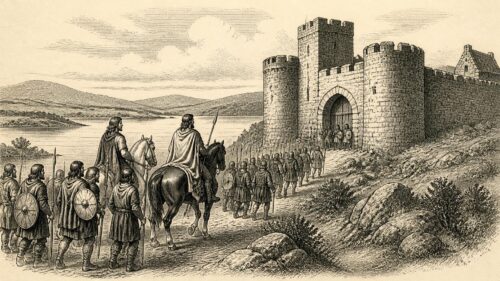
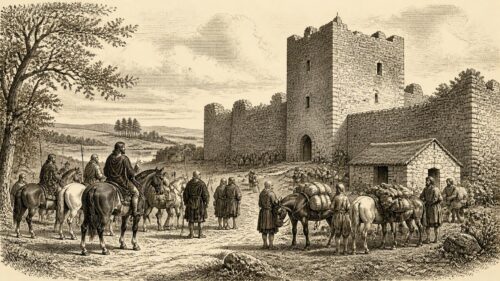
While Connacht underwent this change of kingship, the English lordship of Ireland was also receiving a new chief governor. Sir John Darcy had been appointed justiciar late in 1323 and was in Ireland during 1324. His arrival came at a politically sensitive moment after the escape of Roger Mortimer, whose Irish lands and connections gave the Crown cause to watch the loyalty of Anglo-Irish magnates. Darcy’s administration belonged principally to the English-controlled towns, counties, liberties and castles, rather than to the whole island; nevertheless, its demands for service, revenue and security shaped life within those jurisdictions.
A measure catalogued under the seventeenth regnal year of Edward II and conventionally dated 1324 ordered the maintenance in Ireland of common law, the ordinances of Dublin and the usages of the land. The wording itself reveals a plural legal landscape. Crown government sought continuity in English common law and urban custom, yet it recognised established local usages in framing administration. This was not evidence that one legal system governed all Irish people alike. Gaelic lordships continued to organise authority through their own dynastic, territorial and customary practices, while the lordship’s institutions operated most fully in its colonial heartlands and towns.
Churchmen, religious houses and literate communities provided part of the connective tissue between these political worlds. The annals were copied, continued and preserved in ecclesiastical and learned settings; their terse entries are themselves a cultural achievement. They recorded royal violence and animal disease not as separate spheres but as events requiring remembrance, moral reflection and chronological order. The death notices for William Burke and Gilla Críst Ó Birn similarly remind us that the passing of regional figures could matter even when no fuller biography survives.
An Unsettled Autumn
1324 was therefore not defined by a single national event. Its best-attested story is a convergence of pressures. In Tír Briúin na Sinna, a dynastic contest ended in Cathal Ó Conchobair’s death and Toirrdelbach’s recognition as king of Connacht. Across Ireland, the continuing Mael Domnaig murrain endangered the herds that underpinned food, farming, wealth and lordship. In the English lordship, John Darcy’s new government sought order and loyalty under Edward II. The year’s record is brief, but it preserves a country in which political succession and rural vulnerability were inseparable facts of life.
Primary Sources
- Annála Connacht: Annal 1324
- Annála Connacht: Irish Text
- O'Connor (Ó Conchobhair), Cathal
- O'Connor (Ó Conchobair), Toirrdelbach
- Darcy, Sir John
- Morice (Moriz), John
- Annales Hiberniae
- The Annals of Ulster: Year U1324
- Annals of the Four Masters
- A Fourteenth-Century Cattle Panzootic
- Climate, Disease and Society in Late-Medieval Ireland
- Statute Law Revision Act 2007, Schedule 2
- Literae Com. de Kildare et aliis magnatibus ab Edw. II. ut Johanni Darcy Hiberniae Justiciario constituto obedirent et auxilio essent
- The Gascon Rolls Project: C 61/36 Calendar
- The Place-Names of Co. Roscommon
- Animal Exploitation in Medieval Ireland
- Exploring the Irish Annals
- Annála Connacht: National Library of Ireland Catalogue Record
- Latin Texts: CELT Project
- Close Roll 19 Edward II (1325–1326), Item 9