Cerrán Cnámchaille’s Vengeance991 CE
In 991, Brian son of Cennétig led an armed hosting from Munster into Leinster, where Tadc son of Donnchadh died and Cerrán Cnámchaille was killed in vengeance. The campaign demonstrated Brian’s expanding reach, although no conquest or settlement is recorded. Annals also report the treacherous killing of a prominent Tara-centred heir, but differ over his identity and the perpetrators, reflecting contested midland politics. Domnall Ua Dúngalaig died, as did Scandlán son of Tadc, erenagh of Cell Dá Lua, or Killaloe. These notices reveal power exercised through warfare, kinship, tribute, ecclesiastical offices and regional rivalries, rather than a unified Irish state.
Dateline
The surviving record for 991 is short, but it catches Ireland at a revealing moment: a Munster king was campaigning in Leinster; a politically prominent heir was killed in circumstances that later annalists described differently; and a senior church officer died at Cell Dá Lua, modern Killaloe. These notices do not amount to a continuous narrative. They are carefully selected memorials of armed action, elite death and ecclesiastical succession. Yet taken together, they show how far the reach of rulers, monasteries and rival dynasties extended across the island.
A Hosting into Leinster
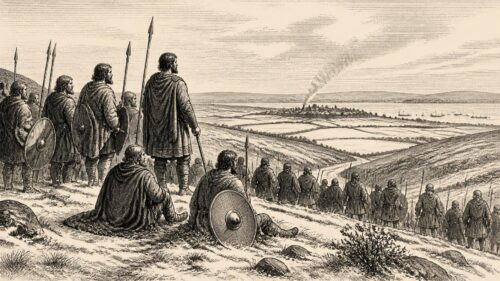
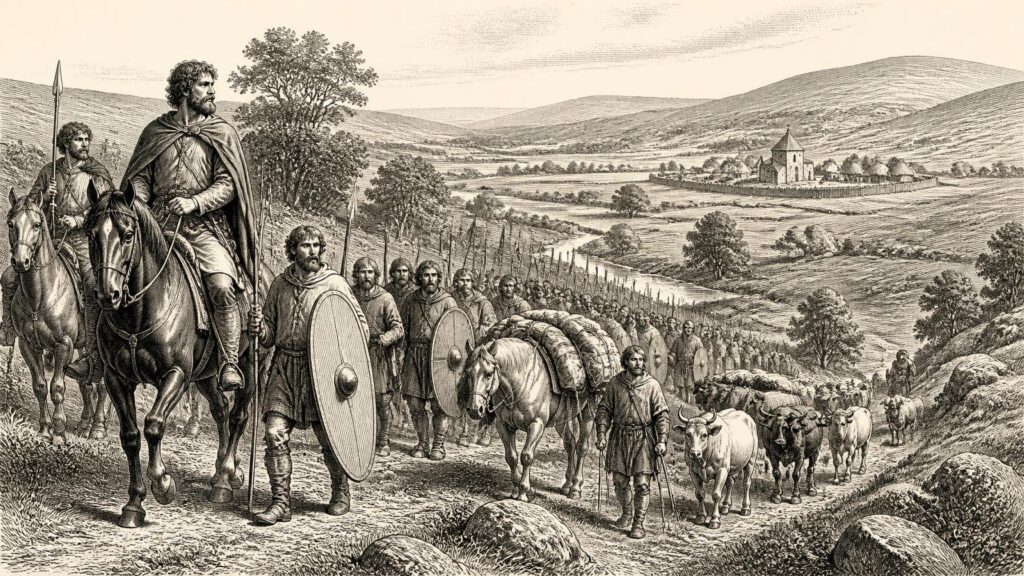
The clearest event placed in 991 comes from the Annals of Inisfallen. Brian son of Cennétig, the Dál Cais ruler later known as Brian Boru, led a hosting into Laigin, or Leinster. A hosting was not simply a battle: it meant the assembling and movement of an armed following, with its provisions, dependants and political purpose. The annal does not give a route, a named battlefield or a precise date within the year. It does, however, preserve the human cost in unusually compressed form. Tadc, son of Donnchadh, fell during the expedition, and Cerrán Cnámchaille was killed in vengeance for him.
That last detail deserves to stand at the centre of the year. The annalist neither explains Tadc’s position nor identifies Cerrán’s allegiance, and it would be unsafe to turn the notice into a fully documented feud. What can responsibly be said is that an expedition undertaken by Brian produced a death important enough to demand remembered retaliation. Warfare was conducted through personal and kindred obligations as well as territorial rivalry. The killing of Cerrán was recorded not as an anonymous casualty but as an act of dígail, vengeance. In an age when authority depended upon the loyalty of kin-groups and fighting men, failure to answer such a death could diminish a leader’s standing.
The campaign also demonstrates that Brian’s sphere of action was not confined to Munster. Leinster was not a single obedient province but a region of competing kingships and local interests, strategically important because it faced the Irish Sea and contained routes towards Dublin and the midlands. Brian’s appearance there in 991 therefore belongs to his developing struggle for wider influence. It should not, however, be presented as a conquest of Leinster. The annal says only that he led a hosting into the province. It does not say that he obtained hostages, tribute or submission, nor does it name a settlement afterwards.
Brian’s Expanding Reach
Even so, the raid or campaign makes sense within the closely connected evidence of the preceding year. In 990, the same Munster annals noted that Marcán, Brian’s brother, took the abbacy of Imlech Ibuir; that the son of Ímar abandoned Port Láirge; and that raiders described as foreigners attacked Ros Ailithir, seizing its lector. Brian ransomed that lector at Inis Cathaig. Those are events of 990, not 991, but they provide immediate context for the political world in which the Leinster hosting took place: ecclesiastical institutions could be attacked, rulers could intervene in ransoms, and the south-east remained entangled with Scandinavian-settled towns and maritime power.
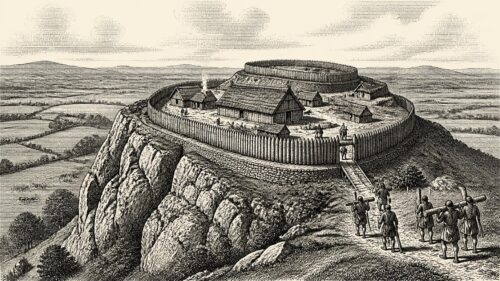
Brian’s authority rested on more than battlefield success. A king required access to food renders, cattle, ships where waterways mattered, and the service of lesser rulers and households. A hosting into Leinster would have placed considerable demands on communities along its path. Men had to be fed; horses and cattle required grazing; weapons, clothing and transport had to be maintained. None of this permits an estimate of the army’s size or a claim that ordinary settlements were devastated in 991. The sources do not provide it. But the very fact that a provincial ruler could take an organised force beyond Munster indicates political resources accumulated through lordship, alliance and obligation.
The title later attached to Brian, Boru or Bórama, is commonly associated with cattle tribute. Whether or not that later reputation precisely describes his position in 991, cattle were plainly central to the political economy in which he operated. They were wealth, food, movable property and a principal form of exaction. Campaigns could seek them, protect them, or deny them to an enemy. The annals’ attention to hostings and vengeance thus points beyond combat itself to the practical foundations of power in a predominantly rural society.
An Heir Killed in Contested Accounts
A second notice for 991 concerns a killing at the heart of midland politics, but the evidence must be handled with particular care. The Annals of Inisfallen state that Donnchadh Ua Congalaig, called “royal heir of Ireland”, was treacherously killed by Máel Sechnaill son of Domnall, apparently through an alliance; the translation itself marks uncertainty in the final phrase. The Annals of Tigernach, by contrast, record that Donnchadh son of Domnall, “crown prince of Tara”, was treacherously slain by Clann Cholmáin, specifying Conchobar son of Cerball.
These reports may preserve differing identifications or traditions concerning one political killing; they cannot simply be fused into a single, fully certain account. The names and titles overlap imperfectly, while the attribution of responsibility is more pointed in one source than the other. What is firm is that the annals place the violent removal of a prominent claimant or heir in the same year, and that they regard it as treacherous rather than an open death in battle. That language matters. It signals a breach of expected political conduct, whether by ambush, deception, collusion or killing outside a recognised encounter.
The titles “royal heir of Ireland” and “crown prince of Tara” should not be read as evidence of a modern, automatic succession. Early medieval Irish kingship was hierarchical, competitive and negotiated. Tara carried immense symbolic weight as a centre of the kingship of the southern Uí Néill, while the effective power of any overking depended on kindred, clients, ecclesiastical alliances and armed support. Máel Sechnaill, ruler of Mide and leading figure of Clann Cholmáin, was one of the foremost kings in Ireland. The death of a rival heir could therefore strengthen a reigning dynasty, but it could also create fresh obligations of vengeance and new instability among the kin-groups of Brega and the midlands.
This is the political setting in which Brian’s Leinster expedition should be understood. Ireland in 991 was neither a collection of isolated petty kingdoms nor a unified realm under a single unquestioned monarch. Powerful rulers were extending authority across provincial boundaries, while older Uí Néill claims centred on Tara remained potent. The simultaneous record of Brian’s movement eastward and a disputed elite killing in the midlands shows several centres of power operating at once. Neither event proves direct coordination between Brian and Máel Sechnaill. The sources offer no such statement, and later developments must not be read backwards as if their contest had already reached its final form.
Cell Dá Lua and Ecclesiastical Continuity
The annal for 991 concludes with quieter, but locally significant, deaths. Domnall Ua Dúngalaig died, without further description. More revealing is the “repose” of Scandlán son of Tadc, erenagh of Cell Dá Lua. Cell Dá Lua is Killaloe, on the Shannon, within the Dál Cais heartland associated with Brian. The word rendered “erenagh” derives from airchinnech, an ecclesiastical office linked to the stewardship of church lands, buildings and community resources. Such figures were not marginal religious attendants. A church settlement was a place of worship, burial, learning, hospitality and landed wealth; its senior officers connected spiritual authority with local society and lordship.
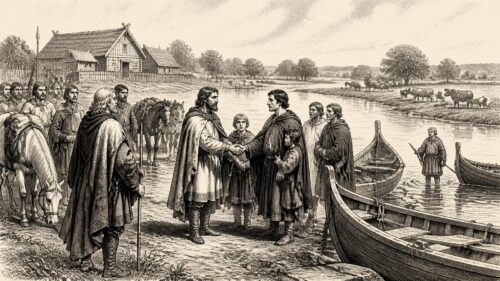
Scandlán’s death does not prove that Brian appointed his successor, nor does it tell us what changed at Killaloe during the year. It does show why the death was worth entering into an annal. Control, protection and continuity at major churches mattered to rulers and local kindreds alike. In the south, Brian’s growing power existed alongside, and partly through, established ecclesiastical landscapes rather than apart from them. The record of Scandlán’s passing is therefore an important corrective to a year otherwise dominated by killing: Ireland’s institutions also endured through offices, property, memory and succession.
What the Silence Allows
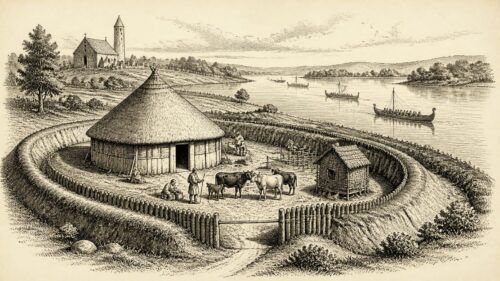
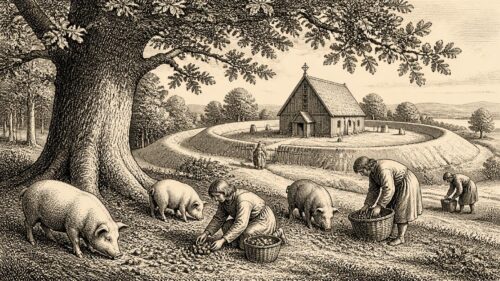
For everyday life in 991, the evidence is necessarily indirect. The annals do not report harvest failure, epidemic disease, unusual weather, market prices or new buildings for this particular year. It would be wrong to invent them merely to fill a calendar. Most people lived in dispersed rural settlements, managing livestock, crops, households and obligations to secular and ecclesiastical superiors. Their work sustained the hostings and churches recorded by the annalists, but their individual voices are not preserved in these entries.
The sources themselves require caution about chronology. The Annals of Inisfallen head 991 with a calendrical notice corresponding to a Thursday at the Kalends of January, but they do not date the campaign or deaths more precisely. The Annals of Tigernach preserve the killing of the Tara heir but not Brian’s Leinster hosting in their entry for 991. The Annals of the Four Masters, compiled much later, carry a chronology explicitly noted by their modern editor as deviating from historical chronology; material under their 991 belongs, in modern reckoning, to the following year. These are not defects to be ignored but part of the evidence: medieval Irish history survives through several annalistic traditions, each shaped by compilation, transmission and regional perspective.
Thus 991 was not a year of one decisive national battle. It was a year in which a Munster king’s armed reach was felt in Leinster, a revenge killing marked the aftermath of that expedition, and the lethal politics of succession touched the Tara-centred order of the midlands. At Killaloe, the death of an erenagh reminds us that religious institutions remained embedded in the same landscapes of power. The year’s few surviving notices reveal an Ireland held together not by a settled central state, but by travel, tribute, churches, kindreds and the dangerous business of maintaining honour.
Primary Sources
- Annals of Inisfallen, Part 54: Annal AI991
- Annals of Inisfallen, Part 6: Irish text for Annal I991
- Annals of Tigernach, Part 15: Annal T991
- Annals of Tigernach
- The Annals of Ulster
- The Annals of Ulster: Irish text
- Annals of the Four Masters
- Annals of the Kingdom of Ireland, Volume 2
- Chronicon Scotorum
- The Leabhar Oiris
- Cogad Gaedel re Gallaib in the Book of Leinster
- The Vikings in Scotland and Ireland in the Ninth Century
- Viking Ireland: Afterthoughts
- Exploring the Irish Annals
- Identity, Exemplarity and the Ideal King in Early Medieval Ireland
- From Kingdom to Colony: Framing the English Conquest of Ireland
- Residence, Ritual and Rulership: A State-of-the-Art for Royal Places in Early Medieval Ireland
- Making Provincial Kingship in Early Ireland: Cashel and the Creation of Munster
- Early Medieval Ireland, AD 400–1100: The Evidence from Archaeological Excavations
- Early Medieval Ireland: Archaeological Excavations 1930–2009
- Settlement Clusters at Parish Churches in Ireland
- The Erenagh in the Monastic Irish Church
- Gazetteer of Ireland / Gasaitéar na hÉireann
- Cill Dalua / Killaloe, Logainm.ie