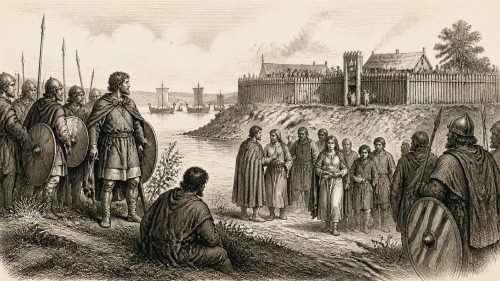
Airbertach’s Scattery Ransom990 CE
In 990, Irish annals recorded dispersed connected conflicts involving kings, churches and maritime raiders. Máel Sechnaill of Mide defeated north Munster forces at Fordroma, where Domnall of Uí Fhorga died, demonstrating contested regional power rather than national unity. A son of Ímar left Waterford, while foreigners raided Ross Carbery and captured its lector, Airbertach mac Cos Dobráin. Brian son of Cennétig ransomed him at Scattery, displaying authority and resources. Brian’s brother Marcán became abbot of Emly, strengthening dynastic church links. Derry was plundered, and notices of a poet’s and a king’s deaths underline learning, ecclesiastical wealth, violence and political fragmentation.
Dateline
The Irish evidence for 990 is unusually concentrated, yet it reaches from Derry to the south-western coast and from the midlands to Munster. Its notices preserve no single national story. Instead, the year appears as a set of connected pressures: a victory by Máel Sechnaill son of Domnall over forces from north Munster; attacks on major ecclesiastical places; a change of abbot at Emly; and the capture and ransom of a learned churchman from Ross Carbery. The annals are terse and were preserved in later manuscripts, so they do not permit a day-by-day reconstruction. Nevertheless, when read alongside one another, they show an Ireland in which military authority, seaborne mobility, monastic wealth and scholarship were inseparable.
The most detailed southern account comes from the Annals of Inisfallen, whose 990 entry places several developments side by side. Marcán, son of Cennétig, took the abbacy of Imlech Ibuir, now Emly; a son of Ímar abandoned Port Láirge, Waterford; ‘foreigners’ invaded Ros Ailithir, Ross Carbery; its lector, Mac Coise Dobráin, was seized; and Brian son of Cennétig ransomed him at Inis Cathaig, Scattery Island. The same annal records the death of Domnall son of Lorcán, king of Uí Fhorga, and the plundering of Daire Calgaig, Derry. These were firmly associated by the annalist with the calendar year, although the season, sequence and local circumstances are mostly unknown.
A Battle With Wider Meaning
Three annalistic traditions add crucial context for Domnall’s death. The Annals of Ulster state that Máel Sechnaill won the battle of Cam Fordroma against Tuadmumu, north Munster, and that Domnall son of Lorcán, king of Uí Fharca or Uí Fhorga, fell there with many others. The Annals of Tigernach and Chronicon Scotorum likewise record the battle—calling it Fordroma or Cairn Fordroma—and a great slaughter. Their agreement makes the fighting secure, even if the sources give only a place-name rather than an identifiable modern battlefield and provide no precise date.
This was not simply a clash between anonymous warbands. Máel Sechnaill was the dominant ruler of Mide and claimant to Ireland-wide supremacy after his victory over the Dublin foreigners at Tara in 980. In 990, however, that supremacy required continual demonstration. His success against Tuadmumu projected midland power into the political world from which Brian son of Cennétig and the Dál Cais were emerging. Brian was not yet the later ‘high king’ of popular memory; that title belongs to the final phase of his career. But he was already a formidable north Munster ruler whose family, church connections and military reach mattered greatly.
The battle should therefore not be turned into a simple contest between two future national rivals. Domnall of Uí Fhorga was the named casualty, while the sources do not say that Brian personally fought at Fordroma, commanded the defeated forces, or made peace afterwards. What can responsibly be said is that the encounter revealed the unsettled balance of power within and around Munster. A king could die in battle, a regional people could suffer a ‘great slaughter’, and an outside overking could win renown and advantage without establishing permanent control. Ireland remained a landscape of overlapping kingships, alliances and obligations rather than a unified realm.
Ports, Coasts and Captivity
The notice that a son of Ímar abandoned Port Láirge is equally revealing, despite its brevity. The annalist does not name him, explain whether he withdrew voluntarily or under pressure, or state who took control of the port thereafter. It would be unsafe to supply those missing details. Yet Port Láirge stood on the Suir estuary within the maritime world of Hiberno-Norse Ireland, a world linked by ships, raiding, exchange and dynastic connections to Dublin, the Isles and western Britain. Archaeology at Woodstown near Waterford has reinforced the importance of the lower Suir as a Viking-Age settlement zone. The 990 entry records political movement at a strategic harbour, not the disappearance of Scandinavian influence from the region.
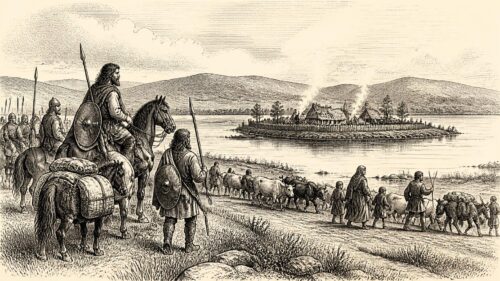
Ross Carbery’s experience shows the human cost of such maritime power. Ros Ailithir was attacked by ‘foreigners’, the flexible annalistic term often used for Scandinavian or Hiberno-Norse groups. Its fer léigind, or lector and chief scholar, Mac Coise Dobráin, was carried off. Modern scholarship identifies him with Airbertach son of Cos Dobráin, later remembered as an ecclesiastical superior and associated with learned works drawing on Latin geographical, biblical and psalmic material. The identification gives the episode unusual clarity: a raid endangered not only land and movable wealth but a school’s most important teacher and intellectual resource.
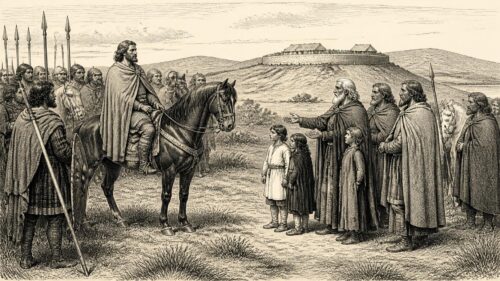
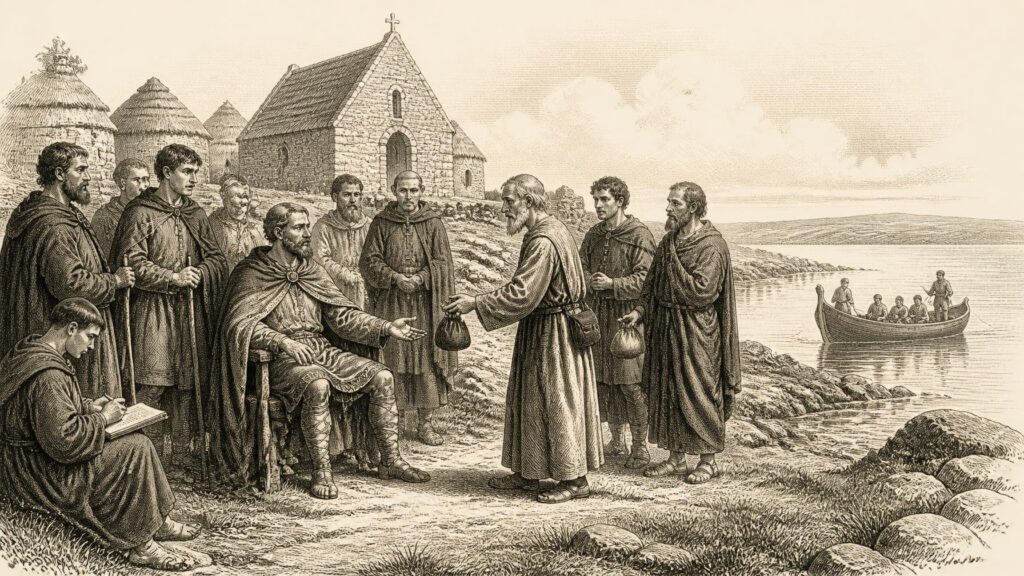
His ransom by Brian at Scattery is one of the year’s most striking facts. Ransom was not an incidental kindness. It required recognised authority, negotiation and resources that could be transferred or promised. Brian’s intervention displayed his capacity to protect or recover a churchman beyond his own immediate heartland. Scattery Island, at the Shannon’s estuary, was an apt setting for such an act: an important ecclesiastical site at a maritime gateway between Munster and the wider Irish Sea world. The annal does not tell us what was paid, to whom, or whether Airbertach had kin involved in the settlement. Its significance lies in what is explicit: the captive was recovered through Brian’s agency.
Emly and Dynastic Churchmanship
In the same year Marcán son of Cennétig acquired the abbacy of Emly. Marcán is generally identified as Brian’s brother, and the appointment mattered because Imlech Ibuir was an old and prestigious church centre closely connected with the religious landscape of Cashel and Munster. In early medieval Ireland, an abbacy was not merely a spiritual office in the modern sense. Major churches possessed land, revenues, dependants, legal standing, sacred prestige and schools. Their leaders could be clerics, members of ruling families, or both. The office at Emly therefore gave the Cennétig kindred a stronger presence within an institution of regional importance.
This does not mean that the church was simply a department of dynastic government. The year’s entries point instead to mutual dependence. Emly’s new abbot belonged to a rising royal family; at Ross Carbery, a learned ecclesiastic required rescue by a powerful ruler; and at Derry, a great church settlement was vulnerable to plunder. Religious communities prayed, taught, copied texts, maintained estates and offered hospitality, but they also had to navigate the ambitions of kings and the dangers of armed visitors. Their wealth and standing made them valuable allies, targets and places where political reputation could be made.
Derry, Learning and the Limits of the Record
Daire Calgaig’s plundering brought the year’s violence to the north-west. The Annals of Ulster specifically attribute the attack to ‘Danes’, while the Annals of Inisfallen merely say that Daire Calgaig was plundered. The difference is worth preserving. It warns against treating every annalistic label as a precise ethnic description, but it also confirms that raiding forces associated with the Scandinavian world remained active far beyond the principal ports. Daire Calgaig was the ecclesiastical settlement from which modern Derry developed, and earlier and later annalistic notices show it as a community with superiors and institutional standing. In 990 it was sufficiently prosperous or strategically exposed to be plundered.
The northern annals also record two deaths which illuminate what their compilers valued. Urard son of Cos, styled chief poet of Ireland, died in penitence at Clonmacnoise according to Chronicon Scotorum; Áed ua Máel Doraid, king of Cenél Conaill, also died. The pairing of a leading poet and a regional king is accidental in one sense, but revealing in another. Learned poets served memory, genealogy, praise and political communication. Their stature was recognised across kingdoms. Clonmacnoise, where Urard died, was itself a major midland centre of learning and commemoration. The annals make no claim that his death altered the course of politics, but they accord it a place beside royal events.
For most people, 990 is harder to see. The surviving record says nothing certain about harvests, weather, prices, household routines or the experience of farmers, craftspeople and traders in this particular year. It would be wrong to invent famine, prosperity or social calm. Yet the recorded events show conditions that shaped everyday security: armed forces could devastate districts; coastal raiders could seize people as well as goods; churches acted as centres of learning and resources; and powerful rulers could turn protection of religious communities into political capital. The year’s fragmentary notices thus offer a disciplined glimpse of an island tied together by roads, rivers, sea-lanes and institutions, but still profoundly divided in power.
By the end of 990, no annalist announced a decisive settlement. Máel Sechnaill had won at Fordroma, but Munster’s political contest endured. A son of Ímar had left Port Láirge, but maritime Scandinavian influence remained embedded in Irish affairs. Ross Carbery had lost and regained its lector, while Marcán’s accession at Emly strengthened a family whose ambitions would transform Irish politics in the next generation. The enduring image of the year is therefore not a coronation or conquest, but a ransom at Scattery: a learned man restored through the intervention of a rising king, at the meeting point of church, coast and power.
Primary Sources
- Annals of Inisfallen, Part 54: Annals AI988–AI991
- The Annals of Ulster
- Annals of Tigernach, Part 15: Annals T988–T994
- Chronicon Scotorum, Part 112: Annals CS990–CS994
- Airbertach
- Brian Bórama (Bóruma, Boru)
- Annals of the Four Masters
- Annals of Inisfallen
- CELT: List of Published Texts
- The Annals of Ulster, Part 539: Year U969
- The Annals of Ulster, Part 491: Year U921
- The Annals of Ulster, Part 478: Year U908
- The Annals of Ulster, Part 520: Year U950
- Annals of Inisfallen, Part 55: Annals AI997–AI1001
- Chronicon Scotorum, Part 118: Annals CS1015–CS1021
- Chronicon Scotorum, Part 119: Annal CS1022
- Viking Activity in Ireland by County in the Annals
- Writing the Past: Tipperary History and Historians
- Viking Woodstown
- ‘Emperor of the Irish’: Brian Boru and the Battle of Clontarf 1014