Anmchad and the Mast981 CE
In 981, Irish annals recorded local political, ecclesiastical and environmental developments rather than a unified national story. Domnall ua hAitid, king of Uí Echach, and Loingsech son of Fogartach of Uí Nialláin killed one another, exposing fragility of regional lordship. Anmchad, elderly bishop of Kildare, died, confirming that church’s wide authority. Deaths also included successors of saints Feichín, Brendan and Comgall, whose communities sustained property, ritual and learning across Ireland. Although Máel Sechnaill’s previous victory had strengthened midland overkingship, regional rivalries endured. An unusual mast-crop highlighted woodland’s economic importance for pigs, provisioning and seasonal resources throughout early medieval Irish society.
Dateline
The surviving notices for 981 are brief, but they are unusually revealing when read together. They record the death of Anmchad, bishop of Kildare; a fatal encounter between two northern rulers; the passing of leading churchmen attached to the cults of Feichín, Brendan and Comgall; and an exceptional mast-crop. None is a grand national set-piece. Together, however, they show an Ireland whose political life remained intensely local, whose churches were major institutions of authority and memory, and whose rural economy was still exposed to the rhythms of woodland as well as field and pasture.
A Carefully Dated Year
Medieval Irish annals must be handled with care. The Annals of Ulster, Annals of Tigernach and Chronicon Scotorum place the principal notices under 981, while the Annals of the Four Masters, compiled much later, puts the same cluster under an entry it explicitly corrects to 981. The agreement is strong enough to connect the events responsibly with this calendar year, but it cannot give days, seasons, motives or locations that the annalists did not preserve.
The year followed a dramatic change at the centre of Irish politics. In 980 Máel Sechnaill mac Domnaill of Clann Cholmáin had succeeded as king of Tara and defeated the Dublin rulers at Temair. The annals present that victory and the subsequent pressure on Dublin as a severe blow to its military power. In 981, however, they do not record a fresh nationwide campaign by Máel Sechnaill, a new submission of provinces, or an expedition by Brian mac Cennétig in Munster. The proper picture is therefore not one of an island suddenly made politically uniform, but of a powerful new overkingship forming in the midlands while older rivalries continued in the regions.
Two Rulers Fall
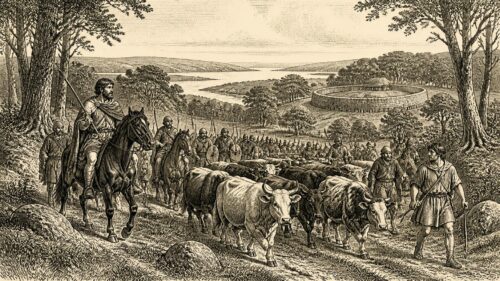
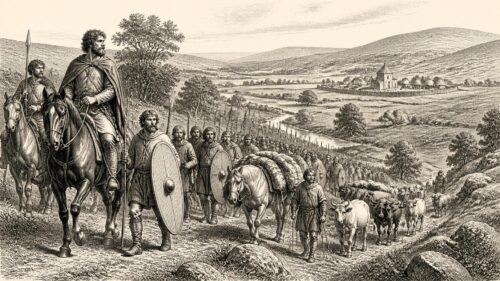
The clearest political event of 981 was the death of Domnall ua hAitid, king of Uí Echach, and Loingsech son of Fogartach, chief or king of Uí Nialláin. The Annals of Tigernach call their encounter a duel; the Annals of Ulster simply say that they fell by one another. Both formulations make the reciprocal killing certain, while leaving its immediate cause unstated.
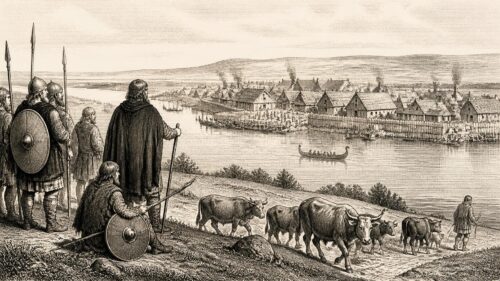
These were not remote figures. Uí Nialláin lay in the Armagh district, remembered in the modern Oneilland name, while Uí Echach was one of the important dynastic territories of Ulster. Their rulers stood within a crowded political landscape of kindreds, client groups, church estates and competing kings. A clash between such men could affect control of tribute, cattle, routes and dependants far beyond the point of fighting. Yet it would be wrong to turn the annal’s compressed line into a fully described battle or to assign it a motive such as a disputed succession. No contemporary record supplied those details.
The vocabulary itself is instructive. Irish political authority worked at several levels. A man styled king might rule a people or territory much smaller than Ireland, while an overking such as Máel Sechnaill claimed superiority over other rulers through alliances, hostages, tribute and military capacity. The deaths of Domnall and Loingsech demonstrate how fragile authority could be at the local level. Their followers now faced a practical question unrecorded in the sources: who could gather the household, retain allies and secure acceptance as successor? In a society where lordship rested on personal relationships as much as fixed institutions, the death of a ruler was a moment of real uncertainty.
Kildare’s Elder Bishop
Far to the south, the annals record that Anmchad, bishop of Kildare, ended his life in a good old age. Another annal calls him bishop of Laigin, a designation that underlines Kildare’s standing beyond its immediate settlement. This was not simply a local church. Kildare was one of the great ecclesiastical centres associated with Brigit, possessing religious prestige, land, personnel and connections across Leinster and further afield.
Anmchad’s death is the only firmly dated event in 981 that places Kildare at the centre of the record. The surviving entry offers no biography, no account of his appointment and no named successor. Its restraint matters. It does not permit a claim that his death caused political upheaval or ecclesiastical reform. But the notice does show that the bishopric was important enough for several annalistic traditions to mark his passing. In early medieval Ireland, a senior churchman could be a spiritual leader, manager of church lands, guardian of relics and patron of clerics, scribes and guests. The orderly phrasing of a death ‘in old age’ evokes an expected, honoured end rather than the violent removal that features so often in the annals.
Kildare’s prominence also helps to explain why an individual bishop could be remembered alongside kings. Major monasteries and churches were not detached from society. Their communities required food, labour, buildings, books, livestock and protection. They dealt with secular dynasties, received gifts and negotiated claims to land and revenue. A bishop’s death therefore mattered to a wide circle: resident clergy, dependent tenants, lay supporters and neighbouring rulers alike. That wider institutional reality is sound historical context; the precise consequences of Anmchad’s death in 981 remain unknown.
Successors of Saints
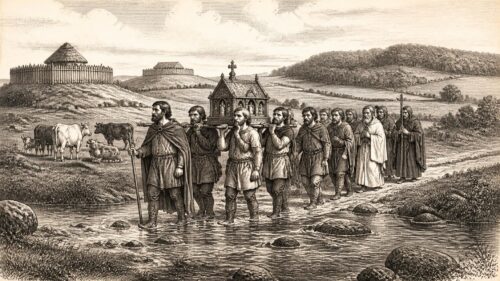
The Annals of Ulster also records the deaths of Cleirchéne son of Donngal, successor of Feichín; Eógan ua Cadáin, successor of Brendan; and Sínach son of Muirthilén, successor of Comgall. The later Annals of the Four Masters identifies Eógan with Clonfert, Brendan’s foundation, and Sínach with Bangor, the church of Comgall. These titles did not mean merely that the men occupied ceremonial seats. A successor, or comarba, headed the institutional inheritance of a saint: its community, property, rights, ritual prestige and historical memory.
The grouping of these notices illuminates the ecclesiastical map of Ireland. Feichín’s cult linked communities in the west and midlands; Brendan’s authority centred on Clonfert beside the Shannon; Comgall’s on Bangor in Ulster. The annals thus connect 981 with church networks spanning much of the island. Each community maintained its own traditions and resources, but saintly affiliations could also create wider bonds of learning, pilgrimage and patronage.
There is no surviving notice of a new book, school or artistic commission in 981. Nonetheless, the deaths of these office-holders are evidence for the continuing institutional framework within which learning was preserved. Monastic and ecclesiastical communities trained clerics, maintained liturgical practice and kept records from which later annalists worked. The annals’ careful preservation of personal names, fathers’ names and saintly successions reflects a culture in which genealogy and ecclesiastical continuity carried public weight.
An Exceptional Woodland Harvest
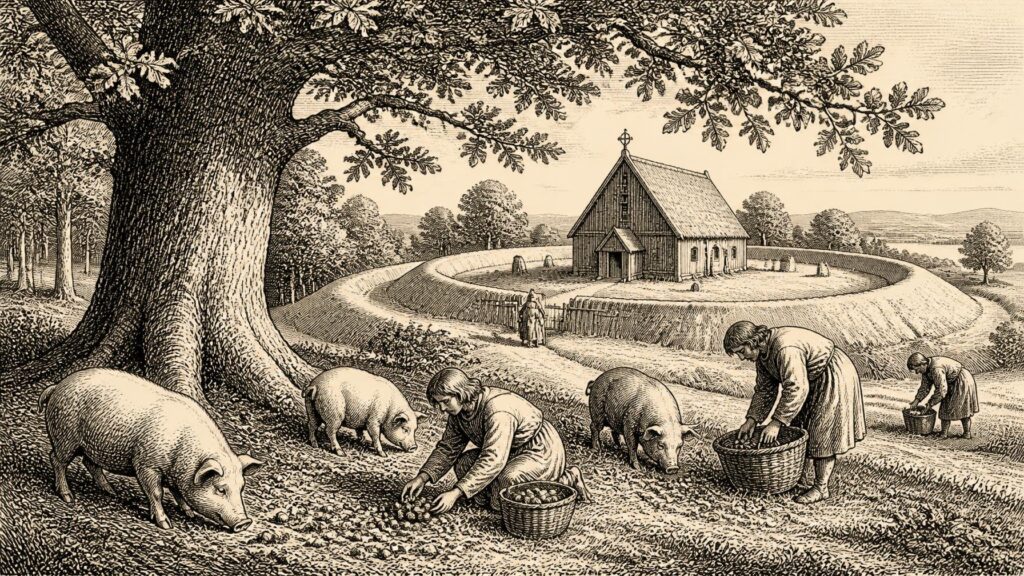
The most evocative entry of the year is environmental rather than political: an ‘abnormal mast-crop’. Mast meant the seasonal crop of tree-fruit and nuts, especially the produce of woodland that could be gathered or used to feed animals. The annalist gives neither region nor explanation, and the word ‘abnormal’ should not be forced into a precise modern measure of abundance. It tells us only that the crop was sufficiently unusual to deserve entry in a chronicle otherwise preoccupied with kings and churchmen.
That attention is understandable. Woodlands remained economically useful in early medieval Ireland even amid expanding pasture and cultivation. Pigs could be turned into wooded places to feed on mast; people could gather foodstuffs and materials there; and woodland supplied timber, fuel, fencing and other resources. Early Irish legal and agricultural traditions treated the relation between pigs and mast as important enough to distinguish animals fed on acorns from those reared on other food. An exceptional mast year could therefore register in household provisioning, livestock management and the value of access to woodland.
It would be reckless to claim that 981 brought plenty everywhere, or that it transformed the price of pigs, because no source says so. Nor can the entry prove a particular weather pattern. Its importance lies elsewhere: it preserves a rare glimpse of what people noticed outside war and succession. The same communities that watched rulers die and bishops be commemorated also watched the productivity of trees. Their economy was not solely a matter of cattle raids and tribute; it depended on closely observed seasonal resources.
What 981 Shows
In 981 Ireland was politically plural. Máel Sechnaill’s victory at Tara in the preceding year had altered the balance around Dublin, but the annals for this year still lead us to a lethal contest between neighbouring northern rulers, not to a settled realm. The death of Anmchad reveals the regional authority of Kildare, while the deaths of the successors of Feichín, Brendan and Comgall show how saints’ communities anchored leadership and learning across the island. Finally, the unusual mast-crop brings the material landscape into view: woodland, pigs, food and seasonal expectation.
It is a modest dossier, and its modesty is part of its value. The sources do not license a dramatic invented narrative for 981. They instead preserve four connected truths about life in Ireland: power could die face to face; religious institutions endured through named offices; major churches reached beyond their enclosures; and the harvest of the woods was important enough to enter history.
Primary Sources
- The Annals of Ulster: Year U981
- The Annals of Tigernach: Annals T977–T985
- Chronicon Scotorum: Annals CS981–CS984
- Annals of the Four Masters: Annals M980–M981
- Annals of Inisfallen: Annals AI978–AI981
- The Annals of Ulster: Year U980
- Chronicon Scotorum: Annal CS980
- The Annals of Ulster: CELT Edition and Bibliographical Information
- The Annals of Tigernach: CELT Edition and Bibliographical Information
- Chronicon Scotorum: CELT Edition
- Annals of the Four Masters: CELT Edition
- Annals of Inisfallen: CELT Edition
- Vikings in Ireland
- Early Monastic Churches
- Changing Human-Cattle Relationships in Ireland: A 6000-Year Isotopic Perspective
- Pigs, Pannage, and the Solstice: Isotopic Insights from Prehistoric Feasting at Newgrange
- Imagining Movement: Past and Present Views of Transhumance in Ireland
- Drummannon: Uí Nialláin Thiar / Oneilland West
- Irish Script on Screen: MS 23 P 2, The Book of Lecan
- Genealogical Tables: Uí Méith