Brian’s Lough Ree Armada988 CE
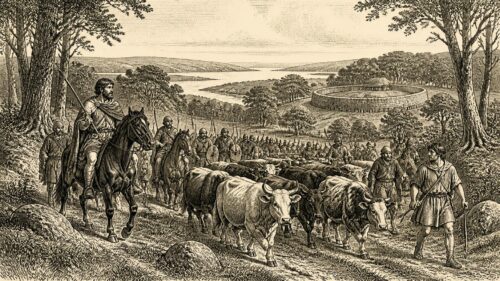
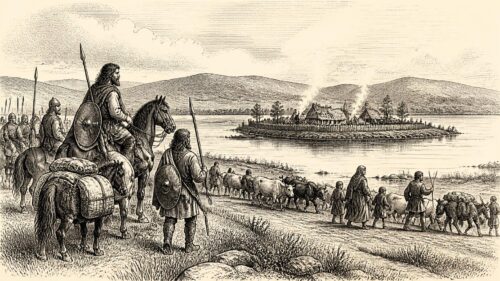
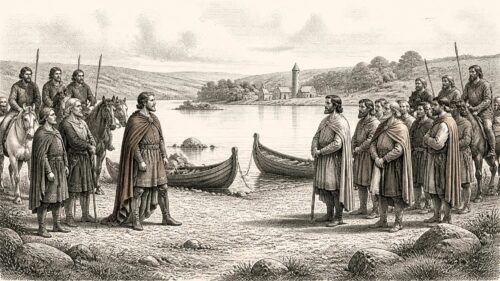
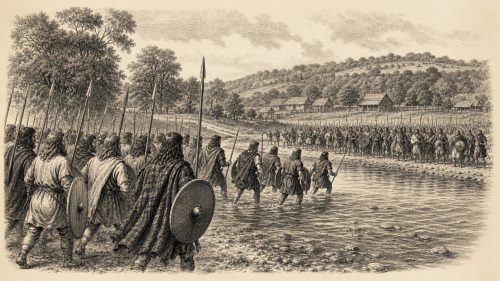
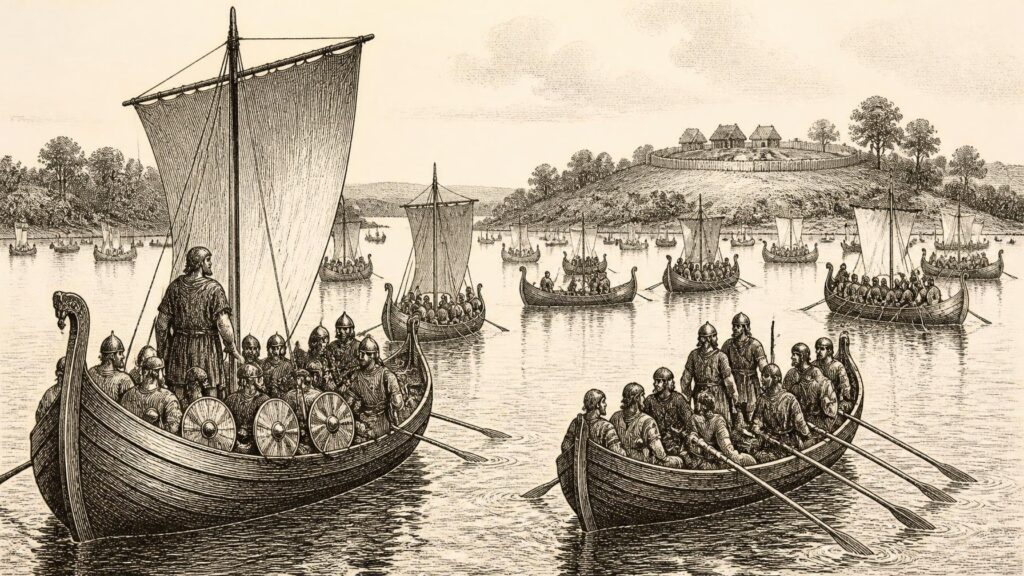
In 988, Brian son of Cennétig, Munster’s dominant ruler, launched a fleet of 300 vessels onto Lough Ree, using the Shannon waterways to raid Mide and reach Uisneach. The expedition demonstrated mobilisation and challenged the political landscape dominated by Máel Sechnaill of Tara, but did not establish Brian’s rule over Ireland. A detachment of twenty-five boats entering Connacht suffered heavy losses, although it killed Muirgius, a Connacht royal heir; Dúnlang, a prominent ally, also died. Differing annalistic year systems complicate dating. The campaign formed part of Brian’s wider waterborne strategy, revealing ambition, logistical capacity, and the resilience of rival kingdoms.
Dateline
The most consequential Irish notice for 988 is striking because it is measured not in spears, hostages or cattle, but in boats. The Annals of Inisfallen, a chronicle compiled in the south of Ireland, records that Brian son of Cennétig placed a fleet of 300 vessels on Loch Rí (Lough Ree). From there it harried Mide and went to Uisneach. Twenty-five boats then entered Connacht, where their crews suffered a heavy defeat, although they killed Muirgius son of Conchobar, described as a royal heir of Connacht. It is an unusually large and vivid notice, revealing both the reach of Brian’s ambitions and the formidable limits he met beyond Munster.
The annal is firmly assigned to 988 in the Inisfallen chronology, but care is needed with medieval dating. The Annals of Ulster place closely matching deaths under a year labelled “987 alias 988”. They state that Dúnlang son of Dub dá Bairenn and Muirgius son of Conchobar fell by one another in Uí Briúin Shinna. The agreement on the central episode is strong; the difference lies in the annals’ systems of year-numbering. No day or season is supplied, so the campaign cannot responsibly be dated more closely within 988.
A Fleet on the Inland Sea
Brian was not yet high king of Ireland. In 988 he was the dominant ruler in Munster, a position acquired through the rise of his Dál gCais kindred in the preceding decade. His northern contemporary Máel Sechnaill son of Domnall, king of Tara, stood at the head of the Southern Uí Néill and was the principal political power in Mide. The Lough Ree expedition should therefore not be imagined as the routine movement of an Irish national army. It was an aggressive intervention by a southern king into territories where other rulers possessed their own rights, clients and armed followings.
The scale of “300 boats” deserves attention without being inflated into certainty. The annalist’s number may be rounded, and the word translated as boat does not specify identical craft, capacity, construction or crew size. Archaeology and documentary evidence show that waterways were central routes through early medieval Ireland, but they do not allow the reconstruction of Brian’s fleet vessel by vessel. Even so, the number signals a major act of mobilisation. A flotilla sufficient to impress an annalist required crews, food, weapons, pilots familiar with river and lake, landing places and the authority to summon them. It made the Shannon system a military road.
Lough Ree lay at a strategic hinge in that road. It linked the upper and lower reaches of the Shannon and brought a force from the Munster heartland towards the midlands and Connacht. The expedition did not need to conquer or occupy every shore it approached in order to be politically meaningful. Its passage advertised Brian’s ability to transfer force far from his own base; its plundering put pressure upon communities whose wealth was held in livestock, stored food, movable goods and people capable of being taken captive or compelled to submit.
Mide and Uisneach
The annal says that Brian’s men harried Mide and went to Uisneach. It does not say that he captured Uisneach, received its submission, fought a battle there or met Máel Sechnaill. Those silences matter. Yet the place-name was itself significant. The Hill of Uisneach, in modern County Westmeath, had long been associated with assemblies, divisions of territory and the imagined centre of Ireland. Its prehistoric monuments and later traditions gave it a status far beyond that of an ordinary hill. To reach it with a powerful fleet and raiding force was, at the least, a pointed demonstration in the political landscape of Mide.
That demonstration should not be mistaken for a simple claim to rule all Ireland. Irish kingship was layered and negotiated. A ruler’s authority was expressed through tribute, military protection, alliances, marriage, church patronage, hostage-taking and the ability to punish opponents. It also varied from place to place. The 988 raid shows Brian testing northern power and communication routes, but the annal records no durable settlement with Máel Sechnaill. Indeed, later events make plain that the contest between the Munster and Tara regimes remained unresolved for years.
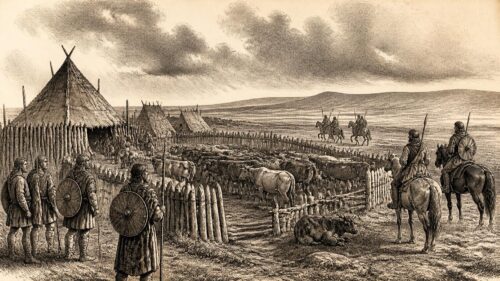
There was also a practical side to the expedition. Early medieval Ireland was overwhelmingly rural, with dispersed farms, ringfort settlements, ecclesiastical sites and regional royal centres rather than a network of modern towns. A passing army could do real damage quickly by taking animals and food, burning structures, breaking local confidence and interrupting cultivation. For the households exposed to the raid, high politics arrived as fear, loss and hurried decisions over whether to flee, hide goods, defend a crossing, or seek terms with the stronger party. The annals preserve the rulers’ names; the experience of most victims goes unrecorded.
The Connacht Reverse
The expedition’s sharpest lesson came when twenty-five vessels separated from the main force and entered Connacht. The Annals of Inisfallen says that a great slaughter was inflicted on their crews. Among those named as lost were Dúnlang, called there king of Raithlenn, Niall Ua hEirc and Dúngalach Ua Loingsig, together with many others. The same annal adds that Muirgius son of Conchobar, a royal heir of Connacht, was slain by them. In other words, the raiders achieved a politically important killing but at a ruinous cost.
The Ulster notice gives the encounter a more compact form: Dúnlang and Muirgius “fell by one another” in Uí Briúin Shinna, the territory of a Connacht people associated with the Shannon region. This may preserve the memory of a direct encounter between the two leaders, but it should not be embroidered into a known single combat. Neither annal describes the fighting in detail. Nor can modern readers safely identify every place and title without qualification. Dúnlang’s association with Raithlenn in the southern annal and his description in Ulster as heir-designate of Cashel both point to his high standing within Brian’s political world.
The disaster was important precisely because it punctured the image of effortless advance. The larger fleet had reached Mide and Uisneach, but a detached squadron proved vulnerable in Connacht. Local defenders could use knowledge of channels, shores and landing grounds, and could call upon ties of kinship and lordship that an invading force lacked. Brian’s campaign was therefore neither an uncomplicated triumph nor a failure. It projected power into the midlands, inflicted damage, reached a place heavy with royal symbolism, and killed a Connacht claimant; it also cost him experienced men and an important associate.
Rival Kingdoms, Not a United Realm
The encounter underlines the political geography of Ireland in 988. Munster, Mide and Connacht were not provinces administered by a central state. They contained overlapping dynasties and subordinate territories, each with its own leading families and ecclesiastical connections. “Connacht” in the annal is not a passive frontier but a region capable of striking back. Muirgius’ designation as rígdamna, or royal heir, is especially revealing: succession was a live political issue, and the death of a credible claimant altered the balance within a ruling kindred even in victory.
The wider sequence helps to place, but not to overstate, 988. In 983 the Annals of Inisfallen had already recorded Brian sending a large fleet into Connacht, where part of his force was slain. In 987 it described him taking hostages in southern Munster from Lismore, Cork and Imlech Ibuir. These were separate campaigns in separate years, but together they show a ruler consolidating authority at home while repeatedly using waterways to reach rivals. A further naval raid via Lough Ree is recorded for 993. The 988 venture was thus part of a developing strategy, not an isolated burst of adventure.
Churches, Records and Silence
Religion is present in 988 chiefly through the sources rather than through a reported ecclesiastical ceremony. The annals themselves were products of learned church communities, where Latin learning, Irish literacy, genealogical knowledge and the recording of notable deaths and conflicts were cultivated. Their terse form should not be read as indifference. It reflects a selective genre: an annal preserves what a compiler considered memorable, not a full census of daily life.
The Annals of Ulster, in its overlapping 987/988 entry, also records the deaths of Colum, superior of Corcach, and Dub dá Bairenn, superior of Both Chonais. These notices should be treated cautiously because of the dating discrepancy, but they remind us that political and ecclesiastical society were closely connected. Major churches were religious centres, employers, landholders, places of learning and custodians of records. Their leaders belonged to the same landscape of patronage and competition that enabled kings to assemble fleets.
For 988, then, the evidence supports a focused conclusion. Brian’s Lough Ree armada was a formidable assertion of Munster power along Ireland’s great inland waterway. It exposed Mide to raiding, touched the symbolic ground of Uisneach and carried conflict into Connacht. But the heavy loss of the Connacht-bound detachment shows that authority moved across water only as far as men could defend it. The year captures Brian before his later dominance: ambitious, mobile and dangerous, yet still confronting rival kingdoms capable of exacting a severe price.
Primary Sources
- Annals of Inisfallen: Annal AI988
- Annals of Inisfallen: Original Irish Text, Annals 984–988
- The Annals of Ulster AD 431–1201
- Annals of the Four Masters, Volume 2: Annals 985–987 rectè 988
- Annals of Tigernach
- Chronicon Scotorum
- Brian Bórama (Bóruma, Boru)
- Irish-Norse Relations: Time for a Reappraisal?
- Vikings in Scotland and Ireland
- Viking Ireland: Afterthoughts
- Early Medieval Dwellings and Settlements in Ireland, AD 400–1100, Volume 1: Text
- Early Medieval Ireland: Archaeological Excavations, 1930–2009
- Travel, Transport and Communication to and from Ireland, c. AD 400–1100: An Archaeological Perspective
- A Concise History of Ireland
- Ushnagh Hill – Catstone
- Corlea Iron Age Roadway and Visitor Centre
- Early Christian Monasteries
- Boats and Shipwrecks of Ireland
- Voyagers in the Vault of Heaven: The Phenomenon of Ships in the Sky in Medieval Ireland and Beyond
- The Sailing-Ships of Ancient Ireland
- The Introduction of the Vertical Watermill into Ireland: Some Recent Archaeological Evidence
- CELT: List of Published Texts