Port Dá Chaineóc Accord997 CE
In 997, Brian Bóruma of Munster and Máel Sechnaill mac Domnaill of Tara met at Port Dá Chaineóc, probably near Lough Ree, and divided Ireland symbolically into Leth Moga and Leth Cuinn. The accord recognised Brian’s southern authority and Máel Sechnaill’s northern and midland pre-eminence without creating fixed states or peace. Transfer of Leinster and Dublin hostages gave Brian crucial leverage. Dublin remained an influential, diverse trading port, beginning coinage around this time. Elsewhere, warfare, plundering and political mutilation continued, while ecclesiastical successions mattered publicly. The settlement marked Brian’s rise, but later conflict determined his eventual wider dominance across Ireland.
Dateline
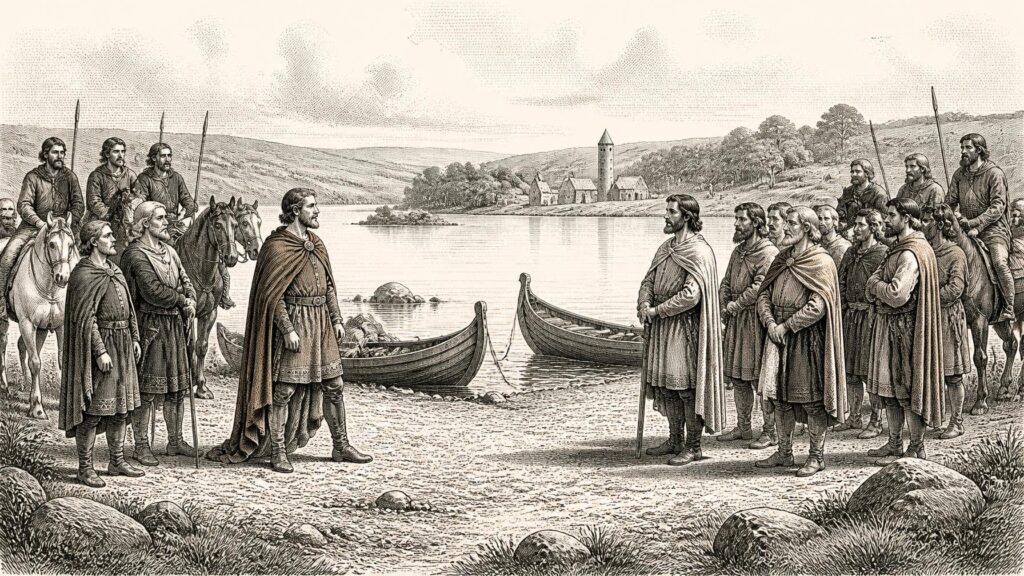
In 997, two men who had spent much of the previous two decades testing each other’s strength met at a waterside place named in the Annals of Inisfallen as Port Dá Chaineóc. Brian Bóruma, king of Munster, came with the leading men of Mumu; Máel Sechnaill mac Domnaill, king of Tara, represented the dominant Clann Cholmáin branch of the southern Uí Néill. Their agreement did not create a united Irish kingdom. Rather, it publicly recognised that neither could presently impose his will on the other. Yet it was an extraordinary acknowledgement of Brian’s ascent: the king of Tara conceded an effective southern sphere of authority to a ruler whose Dál gCais dynasty had only recently displaced Munster’s older political order.
A Carefully Dated Meeting
The principal contemporary-style notice is concise. Under 997, the Annals of Inisfallen state that Brian, the princes of Munster and Máel Sechnaill went to Port Dá Chaineóc and “divided Ireland between them into two”: Leth Cuinn went to Máel Sechnaill and Leth Moga to Brian. Modern discussion commonly connects the site with Bleanphuttoge, on Lough Ree in present-day Westmeath, though the annal itself supplies only its older name. The choice of a landing-place in the Shannon–Lough Ree corridor was politically apt. It lay at the meeting ground between Brian’s southern advance and Máel Sechnaill’s midland power, where water transport could bring royal retinues, supplies and prestige into view.
The date needs modest caution. Irish annals did not always begin their years at the same point, and their chronological systems sometimes drift against modern calendar reckoning. The Ulster annal heading conventionally labelled 997 is itself marked “AD 996 alias 997”; it does not record the Port Dá Chaineóc settlement. The agreement is nevertheless securely placed in 997 by the Annals of Inisfallen, and that is the date used here. Events listed under 997 in other annalistic compilations can illuminate the political atmosphere, but should not be treated as proof that every incident occurred after, or even in precisely the same calendar year as, the accord.
Two Halves, Not Two States
Leth Cuinn, the “half of Conn”, and Leth Moga, the “half of Mug”, were venerable geographical and genealogical formulas, not mapped states with surveyed frontiers. In broad terms, the former denoted the northern half of Ireland associated with Conn of the Hundred Battles and, in political practice, with Uí Néill supremacy; the latter denoted the south, associated with Mug Nuadat and particularly resonant in Munster. By invoking these names, the settlement clothed a hard contemporary calculation in the language of inherited order.
Its practical meaning was clearer than its neat division of the island might suggest. Máel Sechnaill retained pre-eminence in the northern and midland sphere centred on Tara and Mide. Brian’s authority in Munster and his leverage in Leinster were recognised as a political reality. Connacht, Osraige, smaller regional kingships and the Scandinavian-founded towns were not passive pieces on a chessboard. Their rulers, churchmen and communities had their own interests, and the agreement could operate only through submissions, alliances, tribute, hostages and the credible threat of force.
For Máel Sechnaill, compromise was not simple defeat. He had been king of Tara since 980, had broken Dublin’s power at the battle of Tara that year, and remained a formidable ruler with deep Uí Néill legitimacy. Brian, however, had built an unusually broad base from north Munster. He had brought competing Munster interests under his command, campaigned beyond the province, and exploited rivers as strategic roads. The settlement acknowledged that a king of Tara could no longer assume unquestioned superiority throughout Ireland. For Brian, it was a signal achievement, but not yet the kingship of Ireland later claimed for him. That would come only after further campaigns and changing alliances.
Hostages and Dublin’s Importance
The most revealing clause in the Inisfallen entry concerns hostages. Máel Sechnaill handed Brian the hostages he held from the Laigin of Leinster and from the Gall, the annals’ “foreigners”. Such hostages were normally high-status persons held as guarantees for obedience. Their transfer was therefore no ceremonial afterthought. It shifted real leverage: if a Leinster ruler or Dublin’s leadership defied Brian, people connected to them were now in Brian’s power. The agreement did not make Leinster or Dublin into Munster territory, but it made Brian’s overlordship there much harder to ignore.
The word Gall should not be allowed to flatten the society of Dublin into a simple opposition between “Irish” and “Vikings”. By the late tenth century the town was an established, fortified port with inhabitants of Scandinavian, Irish and mixed backgrounds, connected across the Irish Sea and beyond. Its rulers could make war, negotiate with Gaelic kings and profit from maritime trade. Dublin’s political value lay in its ships, accumulated silver, manpower, market connections and access to Leinster as much as in any ethnic label applied by an annalist.
Economic evidence makes the timing especially striking. Around 997 or 998, Sitric Silkbeard’s Dublin began producing the earliest coins struck in Ireland: silver pennies modelled on English issues and naming the king of Dublin. The start cannot be pinned to a single day, and the minting decision is not recorded as part of the Port Dá Chaineóc agreement. Even so, the near coincidence is meaningful context. At the very point when Brian received hostages from Dublin’s political world, that world was asserting its own royal authority through coinage. Dublin was not merely a target of royal ambition; it was a place whose trading wealth and urban institutions gave it unusual weight in Irish politics.
Violence Beyond the Accord
The agreement did not bring general peace. In the Ulster annals’ ambiguous 996/997 heading, the Uí Méith were defeated at Sruthair by the son of Donnchad Finn and the Fir Rois, with their king among those killed. The Uí Méith occupied territory around the modern south Ulster borderlands; the entry is a reminder that local kingship could be violently contested far from the Shannon meeting. The same annal records that Máel Sechnaill blinded Domnall son of Donnchad Finn. Blinding was a severe political punishment: bodily integrity mattered to eligibility for kingship, and mutilation could remove or diminish a rival without killing him.
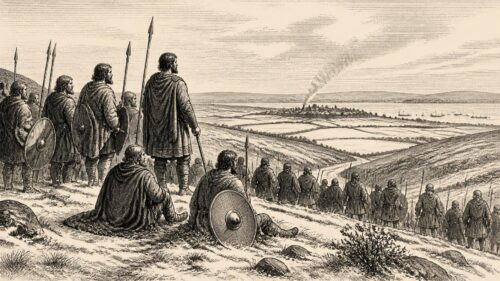
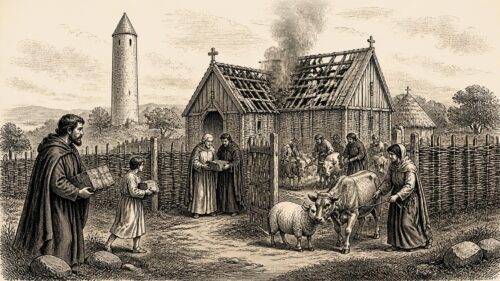
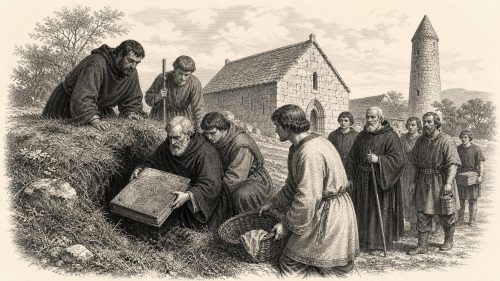
Also under that Ulster heading, “foreigners” plundered Clonard and Kells, two major ecclesiastical centres in the midlands. Whatever the precise calendar alignment, the notice shows how exposed wealthy churches remained in a landscape of mobile armed groups. Monasteries were places of worship and learning, but also landholders, employers, repositories of metalwork and manuscripts, and centres serving dispersed dependent communities. An attack could damage far more than a church building: it threatened food renders, livestock, labour, books, relics and the authority of the ecclesiastical family attached to the site.
Churches, Learning and Ordinary Continuity
The Inisfallen annalist recorded two religious deaths in 997: the “repose” of Colmán of Corcach, or Cork, and that of Máel Ísu son of Flannabra, successor of Senán. The second title identified Máel Ísu as comarba, heir or successor in office to St Senán of Inis Cathaig, Scattery Island. Such offices joined spiritual prestige to institutional resources. Their notice in a short annal is itself evidence of the importance of ecclesiastical succession in public life. Churches preserved learning and liturgical practice, but they were also embedded in dynastic politics and regional economies.
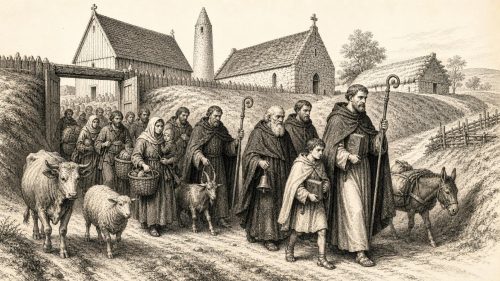
For most people, 997 was lived less through royal diplomacy than through the rhythms of mixed farming, herding, fishing, craftwork, seasonal travel and obligations to local lords or churches. The sources do not permit a village-by-village account of that particular year, and it would be false to invent one. Archaeology nevertheless shows a predominantly rural Ireland linked to growing ports. Rural households made and repaired textiles, leather goods, wooden vessels and iron tools; waterways carried people, animals and goods between inland settlements and coastal trading towns. Political agreements mattered to ordinary families when they altered demands for food, cattle, labour, ships or military service, or when a raid brought danger to a nearby church or lordship.
A Settlement with Limits
Port Dá Chaineóc was both a summit and a pause. In 998 Brian would take Connacht hostages at Athlone and hand them to Máel Sechnaill, an action that suggests the partners could still recognise each other’s standing. But their accommodation rested on ambition rather than equality. Dublin and Leinster would soon become the centre of renewed conflict; Brian’s victory at Glenn Máma belonged to 999, not to 997, and must not be read back into this year. In 997, the decisive fact was more restrained but no less important: Ireland’s leading Uí Néill king had met the Munster ruler as a counterpart and conceded him the southern half in name, hostages in hand, and authority in practice.
The accord therefore captures Ireland at a turning point. It did not abolish provincial kingship, establish fixed borders or end warfare. It did, however, reveal that political power could be rebalanced across the island through negotiation as well as battle. Brian Bóruma had not yet become the dominant king of Ireland. At Port Dá Chaineóc, he became impossible for its traditional leading dynasty to disregard.
Primary Sources
- Annals of Inisfallen: AI997
- Annals of Inisfallen, Irish text
- The Annals of Ulster: Year U997
- The Annals of Ulster, Irish and Latin text: Year U997
- Annals of Tigernach
- Annals of the Four Masters, Part 10
- Chronicon Scotorum
- Brian Bórama (Bóruma, Boru)
- Sitriuc Silkbeard (Sitric, Sigtryggr Ólafsson Silkiskeggi)
- The Leabhar Oiris
- Annals of Inisfallen to Go on Public Display in University College Cork
- Recording the Past: The Annals of Inisfallen and the Making of Irish History
- 950–1450: Vikings, Normans and Medieval Mints
- The Viking Age in Ireland
- Viking
- Early Medieval Ireland: Archaeological Excavations 1930–2009
- Archaeological Excavations at the Monastic Complex, Sevenchurches, Glendalough, Co. Wicklow, 2016 Stratigraphic Report
- Brian Boru: imperator Scotorum
- Three Kings and a Queen
- Queen Gormlaith, Brian Boru and The Northmen of Dublin Transcript
- The Making of Ireland
- Brian Boru and the Battle of Clontarf
- Logainmneacha Chill Chainnigh Thiar agus Chluain Lonáin – Ainmneacha na mBailte Fearainn
- What Kind of Irish Was Spoken in Westmeath? I