

Fire and Frontier1187 CE
In 1187, Ireland remained politically divided between Gaelic kingdoms and Anglo-Norman lordships, whose frontier was weakened after Hugh de Lacy’s death. Conchobar Máenmaige Ua Conchobair and Máel Sechlainn Bec destroyed Killare castle in western Meath, gaining arms and challenging colonial expansion. Northern dynastic warfare included Ruaidrí Ua Flaithbertaig’s death and reprisals after Drumcliff’s plunder by a mixed Gaelic-Norman force. Lightning or fire devastated the Rock of Lough Key, killing many inhabitants and straining Moylurg’s ruling family during succession. Churchmen, scholars and monastic foundations reflected reform and regional connections, while trade, agriculture and cross-cultural alliances shaped life amid conflict and recovery.
Dateline
The surviving chronicles make 1187 memorable for sudden destruction, contested frontiers and the continuing fragmentation of political power. Ireland had no single ruler able to command the whole island. Gaelic kings defended and enlarged regional lordships, while Anglo-Norman settlers held Dublin, much of Leinster and substantial parts of Meath and eastern Ulster. The year’s events are best understood not as stages in a simple national conquest, but as struggles involving shifting coalitions of Irish kings, newly arrived lords, local dynasties and church communities.
A Divided Political Landscape
John, the eighteen-year-old son of Henry II, remained lord of Ireland in title, but he was absent following his unsuccessful expedition of 1185. The English king therefore remained the ultimate source of authority claimed by the colonial administration. That authority was uneven. Hugh de Lacy, the principal architect of Anglo-Norman power in Meath, had been killed at Durrow on 25 July 1186. His Irish lands were subsequently withheld from his heir, leaving royal officers and local tenants to protect a lordship whose energetic founder had suddenly disappeared.
In Connacht, Conchobar Máenmaige Ua Conchobair ruled after forcing his father, the former high-king Ruaidrí Ua Conchobair, into retirement. Their earlier conflict had weakened the province, yet Conchobar was attempting to rebuild authority by rewarding supporters and accepting the submission of other kings. His ambitions extended beyond Connacht. The destruction of an English castle in western Meath became the clearest political and military success recorded for him in 1187.
The Fall of Killare
The Annals of the Four Masters report that Conchobar Máenmaige and Máel Sechlainn Bec Ua Máelshechlainn attacked the castle of Killare, near the Hill of Uisneach in present-day County Westmeath. Killare stood near an important route between the Shannon frontier and the central plain of Meath. Probably an earth-and-timber motte-and-bailey, it formed part of the chain of strongpoints through which Hugh de Lacy and his followers had tried to secure western Meath.
The attackers burned and demolished the castle. According to the annalists, none of its defenders escaped: some were killed and others suffocated in the burning works, including two knights. The victors carried away horses, shields, weapons, armour and other military equipment. Such details reveal why capturing a castle mattered beyond symbolism. Horses and mail were exceptionally valuable, while possession of the site controlled roads, tribute and access to surrounding farmland.
The report may magnify the completeness of the victory, as medieval annals often did, but the destruction itself is securely placed in 1187. It did not eliminate Anglo-Norman power in Meath, whose stronger eastern settlements remained intact. It did, however, expose the vulnerability of an advancing frontier after de Lacy’s death. For Conchobar, cooperation with the remaining Ua Máelshechlainn ruler of western Meath also strengthened his claim to leadership beyond Connacht.
Violence in the North-West
Further north, Ruaidrí Ua Flaithbertaig, briefly king of Cenél nEógain, entered Tír Conaill on a foray. He was killed by Flaithbertach Ua Máel Doraid, the powerful king of Cenél Conaill. The entry is terse, but it belongs to a wider contest between the two northern Uí Néill peoples. A predatory expedition could test a rival’s authority, seize cattle and compel submission; failure could destroy the reputation and following on which kingship depended. Ruaidrí’s death showed that Cenél nEógain could not simply impose its will west of the River Foyle.
Conflict also centred upon Drumcliff in modern County Sligo, an important church associated with Colum Cille. Aed Ua Ruairc, son of Máel Sechlainn Ua Ruairc and ruler among the Uí Briúin and Conmaicne, plundered Drumcliff with a son of Cathal Ua Ruairc and troops described as the Foreigners of Meath. This alliance is a warning against viewing the period as a straightforward struggle between Irish and English. Gaelic dynasts regularly used Anglo-Norman soldiers against Irish rivals, just as settlers relied upon Irish allies, guides and marriage connections.
The raid brought a fierce response. Aed was killed in Conmaicne within a fortnight, the son of Cathal Ua Ruairc was blinded by Ua Máel Doraid, and the annals claim that 120 of Aed’s followers died across Conmaicne and Cairbre Drumcliff. The chroniclers interpreted these reverses as miracles worked by Colum Cille in punishment for violating his church. Behind the devotional language lay practical realities: ecclesiastical centres possessed lands, livestock, stored food and valuable objects, but they also enjoyed sacred protection whose breach could legitimise retaliation.
Disaster at Lough Key
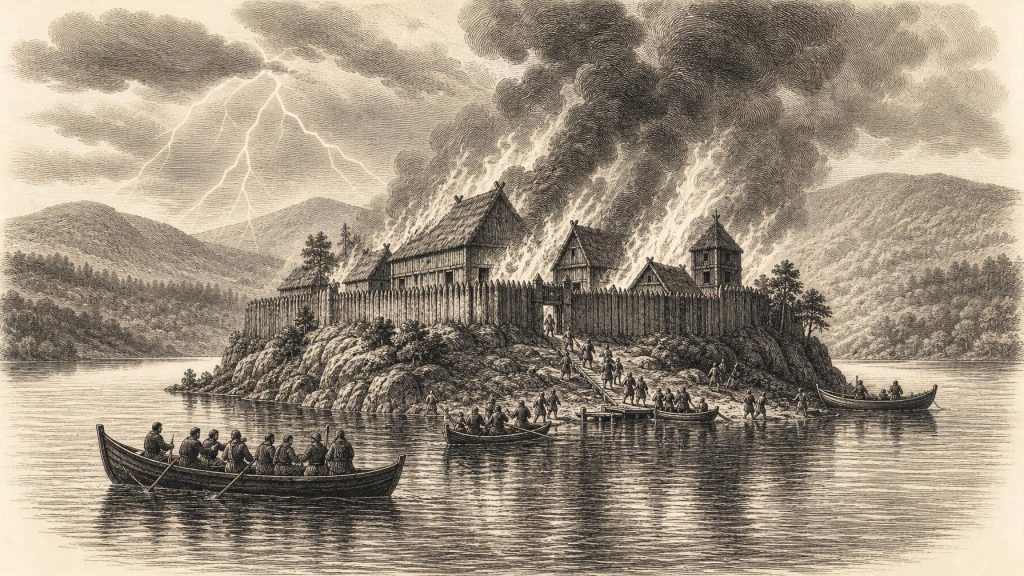
The year’s most dramatic non-military event occurred at the Rock of Lough Key in Moylurg, now County Roscommon. The Annals of Ulster say that the island stronghold burned at midday. The Four Masters identify lightning, or “fire from heaven”, as the cause. Duibhessa, daughter of Ua hEidhin and wife of Conchobar Mac Diarmata, was among those burned or drowned. The sources give variant totals, ranging from seven score to seven hundred or more men and women, so no precise death toll can be treated as certain. All agree, however, that the loss was catastrophic and occurred within about an hour.
The scale of the disaster indicates that the Rock was more than a private residence. It was a crowded political centre containing the household, dependants, visitors, craftspeople, servants and stores of a ruling family. Timber buildings, thatched roofs and closely packed enclosures could allow fire to spread with terrifying speed. On an island fortress, people driven towards a limited landing place or narrow approach faced drowning as well as flames. The tragedy offers a rare, if terrible, glimpse of the population gathered around a Gaelic court.
Muirgius son of Tadc, the long-ruling king of Moylurg, also died in 1187 at his residence at Claenloch. His death enabled Conchobar Mac Diarmata to emerge as ruler of Moylurg. The coincidence of dynastic succession with the destruction at Lough Key must have imposed a severe burden on the ruling kindred, which had to replace people, buildings, equipment and provisions while maintaining authority over its territory.
Churchmen and Learning
Several deaths recorded during the year illuminate the organisation of the Irish church. Muirchertach Ua Máel Uidir, associated with the bishoprics of Clonmacnoise and Clonfert, died after a long ecclesiastical career. Máel Ísu Ua Cerbaill, bishop of Airgialla or Clogher, also died. Their titles reflect the diocesan structure consolidated during the twelfth-century reform movement, although older monastic offices, hereditary church interests and local political relationships remained influential.
The death of Gilla Ísu, son of Ailill Ua Briain, deprived Uí Maine of a historian, scribe and poet who also held the office of secnab, a senior deputy or monastic official. His obituary shows that learning remained embedded in regional church communities and learned families. Historical memory, genealogy and praise poetry were not ornamental pursuits: they supported claims to land, ancestry and kingship, while scribes maintained the religious and chronological traditions from which much knowledge of 1187 ultimately derives.
A Latin annal assigns the foundation of the Abbey of Inch, near Downpatrick, to this year, although modern accounts commonly date its establishment more broadly within the 1180s. Founded under John de Courcy and linked with Furness Abbey in Lancashire, Inch represented both Cistercian expansion and the reorganisation of conquered territory in eastern Ulster. Its community connected County Down with religious, architectural and intellectual networks extending across the Irish Sea.
Work, Wealth and Settlement
For most people, daily life continued beyond the annalists’ narrow interest in rulers and disasters. Cattle remained central to rural wealth, food production and political tribute, which explains why raids so frequently sought herds. Sheep, pigs and cereals also mattered, while households depended upon dairying, tillage, woodland, fishing and seasonal labour. Lough Key and the Shannon waterways supported fishing and transport; Dublin, Waterford, Wexford, Cork and Limerick linked Irish produce and crafts to maritime commerce with Britain and continental Europe.
In territories under Anglo-Norman control, mottes, manors, mills, churches and market settlements were changing the organisation of land. Gaelic districts retained different legal and social structures, but the boundary between the two worlds was permeable. Trade, military service and diplomacy crossed it constantly. Killare’s destruction, the mixed force at Drumcliff and the English-linked monastery at Inch all demonstrate that regional change came through interaction as well as conquest.
Thus 1187 was neither a year of uninterrupted Anglo-Norman advance nor one of unified Gaelic recovery. Conchobar Máenmaige achieved a conspicuous frontier victory, while northern kings fought one another and enlisted outside troops. Church communities remained centres of wealth, sanctuary and scholarship, yet were vulnerable to war. Above all, the burning of the Rock of Lough Key reminds us that medieval history was shaped not only by political design, but by sudden calamity and the difficult work of rebuilding afterwards.
Primary Sources
- The Annals of Ulster: Year U1187
- Annals of the Four Masters, Volume 3: English Translation
- Annals of the Four Masters, Volume 3: Irish Text
- Annals of Loch Cé, Volume 1: English Translation
- Annals of Loch Cé, Volume 1: Irish Text
- Annales Hiberniae
- Ua Conchobair, Conchobar Máenmaige (‘of Máenmag’)
- Courcy, John de
- Lacy, Hugh de (I)
- Ua Conchobair, Ruaidrí
- John, Lord of Ireland, 1185–1216
- Medieval Ireland 1150–1550
- Three Medieval Settlements
- The Zooarchaeology of Medieval Ireland
- The Economy of Early Medieval Ireland
- From Boom to Bust: The Lordship of Ireland and the European ‘Commercial Revolution’
- Inch Abbey
- St Thomas’ Augustinian Abbey
- The Priory of Llanthony Prima and Secunda in Ireland, 1172–1541
- A Charter of Cristin, Bishop of Louth
- Henry II, the Council of Oxford and Angevin Overlordship in Leinster, 1177–85
- Irish Castles: 1180 to 1310
- Hugh de Lacy
- Cenél nEógain and the Donegal Kingdoms, AD 800–1200