Louth’s Broken Oratory987 CE
In the annalistic sequence around 987, Ireland experienced severe insecurity from disease, livestock mortality and storm damage. The Annals of Tigernach describes a deadly eastern illness interpreted through demonic imagery, alongside the onset of máelgarb, an unusual cattle murrain whose precise nature remains uncertain. A great wind destroyed many buildings, including Louth’s oratory, disrupting a significant ecclesiastical centre. Differing annal dates prevent precise modern chronology. These reports illuminate vulnerabilities affecting households, churches and political economies dependent on cattle, labour and resources. They occurred amid Máel Sechnaill’s overkingship and Brian Bóruma’s rise, but do not establish an event for that year.
Dateline
The most vivid Irish notice assigned to 987 is not a battle or a royal accession, but a storm. The Annals of Tigernach records that a great wind brought down many buildings, including the dertech, or oratory, at Louth (Lugmad) in present-day County Louth. The same annal also reports a frightening sickness in eastern Ireland and the onset of a major cattle disease. Together, the entries make 987 a year in which ordinary security—of bodies, herds, houses and sacred places—could not be taken for granted.
Yet the year must be handled with care. Medieval Irish annals did not use a modern, universally synchronised calendar, and their year headings can drift. The notices placed under 987 in the surviving Annals of Tigernach appear under 986 in the much later Annals of the Four Masters; the related sequence in the Annals of Ulster also carries an “alias” date. It is therefore responsible to regard the sickness, cattle mortality and destructive wind as events or conditions recorded in the annalistic sequence around 987, rather than to claim a precise modern date for any of them. The entry nevertheless provides an unusually revealing view of vulnerability in late tenth-century Ireland.
A Year of Sickness
The annalist first described an outbreak in the east of Ireland as a visible, devastating colic. In the language of the record, it was caused by demons, who were said to have appeared before people’s eyes. That explanation belongs to the religious and intellectual world of the chronicler, not to a diagnosis that can be accepted today. It should neither be dismissed as mere fantasy nor translated rashly into a named modern illness. The important historical point is that a severe and alarming disorder was remembered as causing extensive death among people.
Medieval writers often understood epidemic disease through a moral and spiritual as well as bodily framework. Prayer, penitence, saints’ cults and the protection of churches offered ways to comprehend and confront suffering when its physical causes were obscure. The entry’s emphasis on visible demons conveys the terror and apparent inexplicability of the outbreak. It does not prove that witnesses literally saw supernatural beings; it records how the calamity was interpreted and narrated.
The annal then marks “the beginning of a great murrain”, called máelgarb, a term the translator rendered as unknown or unprecedented. Modern discussion commonly treats máelgarb, literally something like “bald-rough”, as an epizootic affecting cattle, perhaps one involving the skin. Certainty is impossible: the medieval word is descriptive, not a clinical diagnosis. Still, the annalist’s decision to name it shows that the disease was considered distinctive and serious.
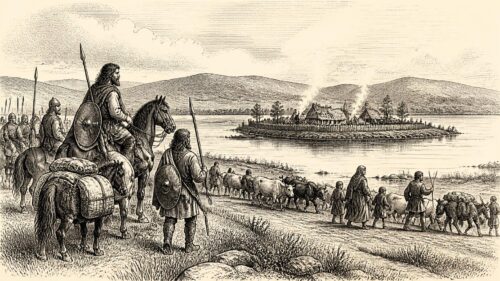
For rural households, a cattle epidemic could be as disruptive as human sickness. Cattle were food, dairy animals, draught power, breeding stock, stores of wealth and a medium in which obligations could be reckoned. They underpinned hospitality, lordship and compensation. A widespread mortality among them threatened milk and meat supplies, diminished a family’s capacity to meet dues, and reduced the resources with which a king could reward followers or sustain a travelling household. It would be unsafe to calculate losses, famine or prices for 987: the sources supply none. But the report of a “great” murrain deserves to be read as a major economic and social warning.
The Wind at Lugmad
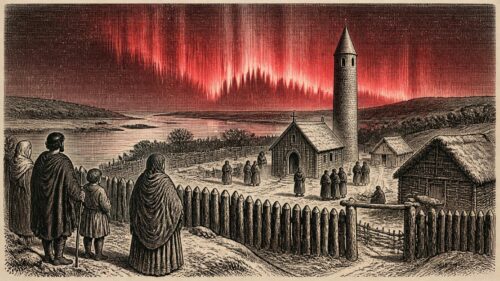
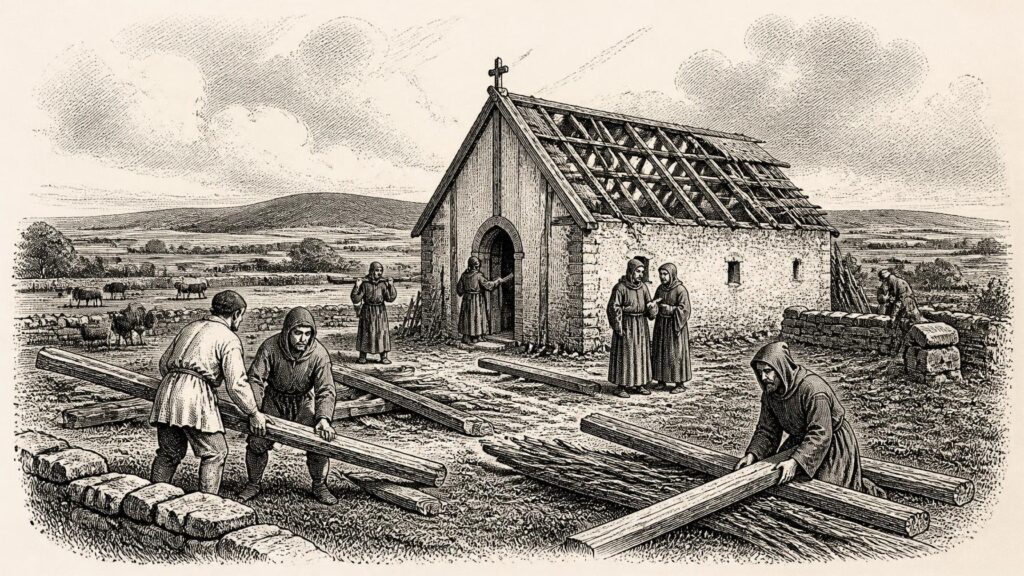
The storm notice is equally concise: a great wind felled many structures, among them the oratory of Louth. The wording does not tell us whether the damage was confined to the settlement, spread throughout a district, or occurred in one sudden gale rather than across a prolonged period of bad weather. Nor does it identify the building’s materials. Early Irish churches could combine timber, stone and thatch, while ecclesiastical sites included dwellings, storehouses, workshops, boundary features and guest accommodation as well as churches. A violent wind could thus interrupt worship and damage the practical infrastructure on which a religious community depended.
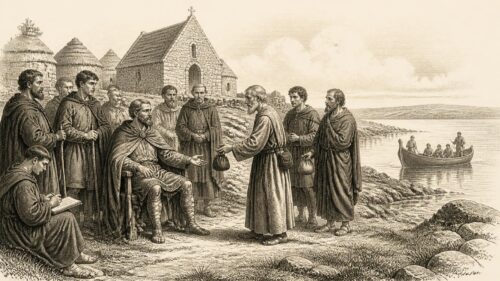
Louth was no isolated chapel. Its church was associated in tradition with Mochta, a fifth- or sixth-century saint linked to Patrick, though the surviving small stone oratory known as St Mochta’s House is usually dated much later, probably around the ninth century. It cannot simply be assumed to be the precise building struck in the annal. The record does, however, confirm that Lugmad possessed an oratory important enough for its loss to reach the annalist’s notice. In a landscape where churches were centres of worship, hospitality, landholding, literacy and local authority, rebuilding would have mattered to far more people than a resident clerical household.
The event also reminds us that the built environment of 987 was not static. Churches and monasteries were maintained, renewed and sometimes replaced. Their communities mobilised labour, commanded food renders and received patronage from local rulers. Wind damage exposed the fragility of buildings, but it also created a demand for timber, skilled construction and collective support. The annal says nothing about the reconstruction at Louth, so no particular patron or date of repair can be supplied.
Kingship Beyond the Entries
No securely dated campaign by Ireland’s leading rulers belongs in the surviving notices for this year. That silence is itself useful. Irish political life was not composed solely of the major battles later attached to Brian Bóruma or Máel Sechnaill mac Domnaill. Local communities continued to endure illness and weather while rulers competed for tribute, hostages, alliances and ecclesiastical recognition.
In 987 Máel Sechnaill, of Clann Cholmáin in Mide, had held the overkingship of Ireland since 980. His authority rested especially on the midlands and on the prestige of Tara, but it did not mean direct administration of a united country. Power was negotiated among provincial kings, lesser dynasties and influential churches. Brian Bóruma, king of the Dál Cais and dominant figure in Munster, was already an important rival, though he would not displace Máel Sechnaill as Ireland’s foremost king until 1002. Their famous accommodation dividing broad northern and southern spheres lay a decade in the future, in 997.
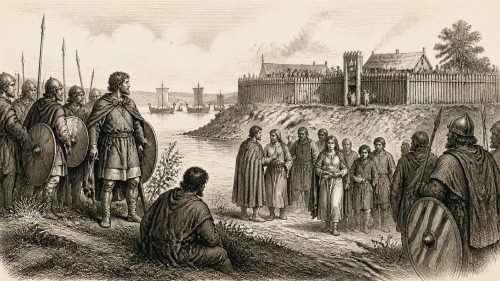
Nearby dates show the tense setting without being turned into events of 987. In the annalistic year before this sequence, Máel Sechnaill was reported to have led an expedition into Leinster and taken tribute. In the following years, conflict involved Munster, Connacht, Mide and the Scandinavian communities of the Irish Sea. Dublin, ruled in this period by Norse-Gaelic elites, was a prosperous trading town of international connections rather than a detached “Viking” enclave. Silver, slaves, textiles, weapons and other goods moved through maritime networks linking Ireland with Britain, the Isles and Scandinavia, while Irish kings and Hiberno-Scandinavian leaders repeatedly made and broke alliances.
The people affected by the máelgarb lived within this political economy. A king’s ability to collect cattle-render, feed a retinue or compensate allies depended on productive households. A monastic church’s capacity to host travellers, copy books, maintain its clergy and rebuild after a storm similarly depended on land and labour. Calamity therefore had political implications even where the annal does not name a king.
Churches, Memory and Evidence
The three notices for 987 reveal the priorities and limits of annalistic history. Annalists recorded exceptional calamities rather than the habitual labour of ploughing, dairying, fishing, craftwork and seasonal movement. They did not give the names of the sick, the herders who lost animals, or the builders whose work was blown down. Archaeology and later legal and literary material help recover the setting: a largely rural society organised through small kingdoms and estates, in which cattle remained fundamental but silver and urban trade had growing importance.
They also demonstrate how religion shaped public memory. A disease could be expressed in demonic terms; the collapse of an oratory merited preservation in writing; and a named cattle plague could become a marker in the historical record. The annals are not transparent reports from modern observers. They are carefully transmitted texts, copied and reordered across centuries. Their inconsistencies in dating are a reason for precision, not for abandoning them.
Accordingly, 987 should not be inflated into a turning point that the evidence cannot sustain. It was a year—or, more exactly, an annalistic year in a disputed chronological sequence—marked by reports of disease, cattle loss and destructive wind. At Louth, a sacred building fell. Across eastern Ireland, people faced an outbreak described with dread. In the countryside, the arrival of an unfamiliar murrain threatened the animals on which livelihoods and lordship alike depended. Those brief records offer a rare, humane glimpse of how insecurity was experienced beyond the courts of kings.
Primary Sources
- Part 15 of The Annals of Tigernach
- Part 15 of Annals of Tigernach
- The Annals of Ulster
- Part 558 of The Annals of Ulster
- Annals of the Four Masters
- CELT Project: Annals of the Four Masters
- Chronicon Scotorum
- Annals of Inisfallen
- CELT Project: Annals of Inisfallen, Pre-Patrician Section
- The Dating of the Irish Annals
- Facing Infectious Disease in Early Medieval Ireland
- Kingship, the Church, and Silver in Ireland
- Ireland’s Viking-Age Hoards: Sources and Contacts
- Animals and the Economy of Medieval Ireland: A Zooarchaeological Analysis of the Faunal Remains from Caherconnell Cashel, Co. Clare
- Land Tenure and Farming in Early Medieval Kerry: A Survey of Field Systems in the Lough Currane Basin
- Medieval Ireland: Territorial, Political and Economic Divisions
- Nation and Kingship
- Perception and Reality: Ireland c.980–1229
- St. Mochta’s House
- The Leabhar Oiris
- CELT Project: Cathréim Cellacháin Caisil
- Annals of Inisfallen to Go on Public Display in University College Cork