Brian’s Déisi Reprisal985 CE
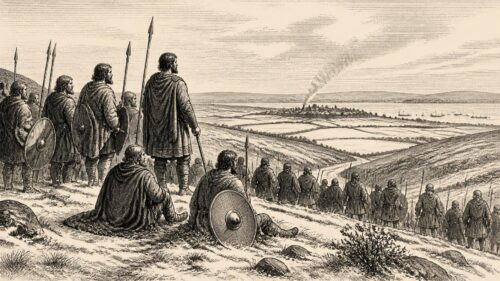
In 985, Ireland remained divided among competing regional kingships rather than united under a single state. Máel Sechnaill of Mide raided Connacht, destroying crannógs and killing chieftains, while internal conflict included the death of Fearghal of the Fiachra kindred. In Munster, Brian son of Cennétig retaliated after Déisi men stole three hundred cattle from his mercenaries, devastating the territory and pursuing Domnall son of Faelán to Waterford. An abundant mast crop aided rural livestock husbandry. Leinster’s king, Diarmait son of Uathmarán, died. Annals securely date these events to 985, illustrating warfare, resources, local authority and unstable political relationships across Ireland.
Dateline
The surviving record for 985 is brief, but it shows Ireland under pressure in several regions at once. In the south, Brian son of Cennétig—later remembered as Brian Bóruma or Brian Boru—answered a cattle raid with a destructive counter-campaign through the Déisi. In the west, Máel Sechnaill son of Domnall, overking of Mide and claimant to the kingship of Ireland, raided Connacht, destroying defended artificial islands and killing local rulers. Leinster also lost a king, Diarmait son of Uathmarán. These notices do not amount to a national narrative: tenth-century Ireland had no single state with a single political agenda. Yet together they expose how power worked—through mobile armed followings, livestock, control of strongholds, negotiated loyalties and the ability to inflict loss on rivals.
Care is needed with the evidence. The Annals of Inisfallen and Annals of Tigernach, whose chronological notices place their entries in 985, provide the firm basis for this year. The later Annals of the Four Masters attach further episodes to their entry for 985, but several correspond to material placed in 986 by other annalistic traditions and modern chronological work. They should not be silently transferred backwards. The securely placed events of 985 are few; their significance lies in what their unusually pointed wording reveals about warfare, food and authority.
Two Expanding Kingships
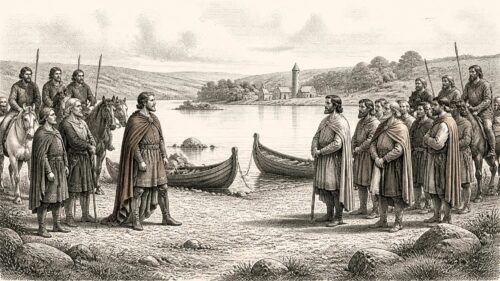
Ireland in 985 was divided among many kingdoms, lordships and ecclesiastical territories. A ruler called “king of Ireland” was not an unquestioned monarch in the modern sense. Máel Sechnaill’s position rested on his leadership of Clann Cholmáin of Mide, his control of the central plain, and his capacity to exact obedience or tribute beyond it. Brian’s authority rested farther south in the Dál Cais of north Munster. He had succeeded his brother Mathgamain in 976 and had spent the following years making himself the decisive force in Munster. Their rivalry would become one of the great contests of Irish history, but in 985 neither man yet commanded the whole island.
Their operations this year were geographically separate. Máel Sechnaill moved west into Connacht; Brian acted in the Déisi, the territory stretching across much of present-day County Waterford and adjoining districts. Neither expedition should be represented as a campaign for a modern national capital or a straightforward war of conquest. Raiding was a political language. It punished resistance, acquired livestock and captives, damaged a rival’s capacity to reward followers, and demonstrated that a king could carry war into another lord’s lands. A successful hosting could compel submission without permanent occupation.
Máel Sechnaill in Connacht
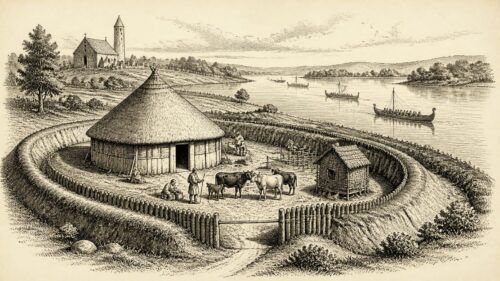
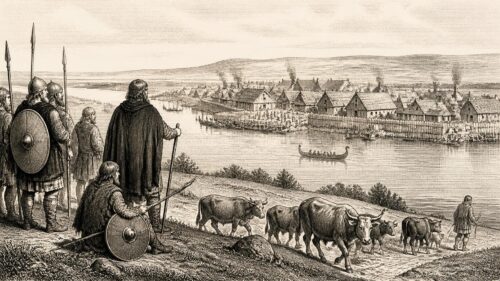
The Annals of Tigernach state that Máel Sechnaill “harried Connacht”, destroyed its artificial islands and killed its chieftains. The phrase is compact but exceptionally revealing. The artificial islands were crannógs: constructed or adapted islands in lakes and wetlands, often approached by a causeway or boat and sometimes protected by timber palisades. They could be residences, stores, workshops, places of refuge and symbols of local status. Destroying them was therefore more than incidental plunder. It struck at defended households and at the physical infrastructure through which regional dynasties held land, people and goods.
Connacht was not a passive frontier. Its politics consisted of competing Uí Briúin, Uí Fiachrach and other dynasties, while lakes, rivers and routes across the Shannon basin offered both obstacles and communications. The annal’s reference to several chieftains being killed does not identify each victim or prove a single set-piece battle. It does establish that Máel Sechnaill’s force inflicted serious losses. The attack also belonged to a wider pattern: powerful kings sought recognition from Connacht, while Connacht rulers resisted outside demands and exploited divisions among their neighbours. The results of the raid cannot be measured precisely. No surviving source says that Máel Sechnaill permanently subdued the province in 985, and it would be wrong to claim that he did.
A separate notice records the killing of Fearghal son of Lorcán, “king of the kindred of Fiachra”, by Connachtmen. The wording makes clear that Connacht’s political world was not united even in the face of external pressure. Fearghal’s death may reflect an internal struggle, a local response to the year’s disorder, or both; the annals do not supply enough detail to decide. What can be said is that the death of a ruler in a leading Connacht kindred made local power more unstable at precisely the time Máel Sechnaill was demonstrating his reach in the west.
Brian and the Three Hundred Cows
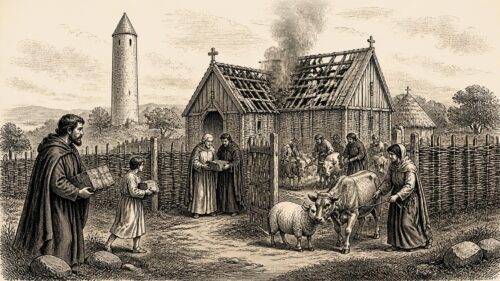
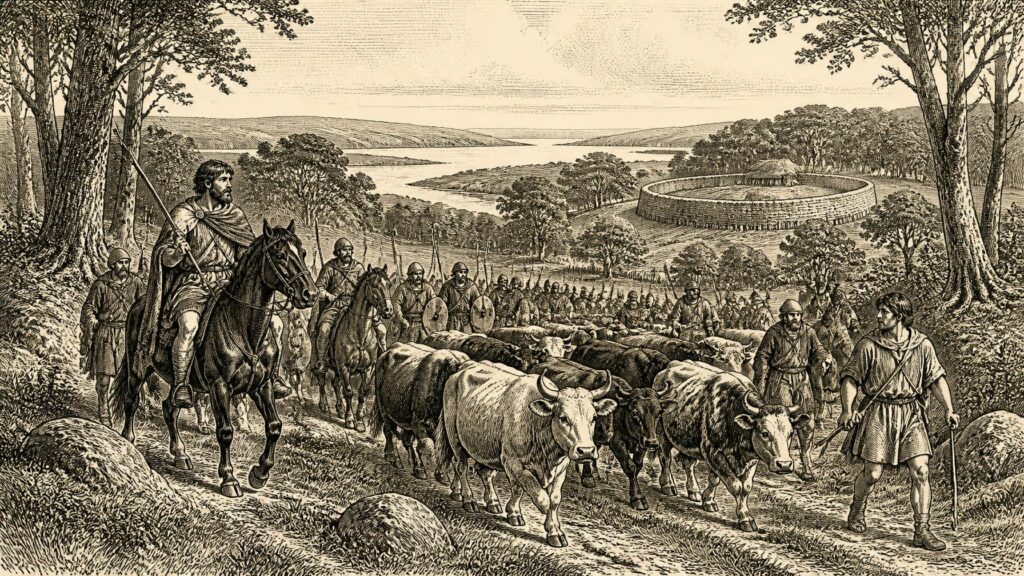
In Munster, the Annals of Inisfallen record an immediate cause and a severe reply. Men of the Déisi raided Brian’s mercenaries and carried off three hundred cows. Brian then harried the Déisi in vengeance, pursued Domnall son of Faelán as far as Port Láirge—Waterford—and devastated the whole territory. The annal’s sequence should be taken seriously: the cattle raid is presented as the trigger for Brian’s campaign, not simply as a colourful detail attached to an otherwise unexplained war.
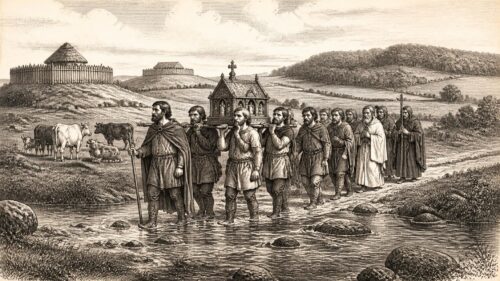
Three hundred cattle represented a large and valuable seizure. Cattle supplied dairy produce, meat, hides, traction and breeding stock; they were also a principal medium through which wealth, compensation, food-renders and political obligation were expressed. Their loss damaged a lord’s ability to feed a household and reward allies. The reference to Brian’s mercenaries is equally important. His forces were not merely an undifferentiated levy of farmers. A king’s military capacity depended on professional or semi-professional retainers, clients and allies, sustained through food, livestock, protection and prospects of plunder. An attack on those men challenged Brian’s prestige as well as his resources.
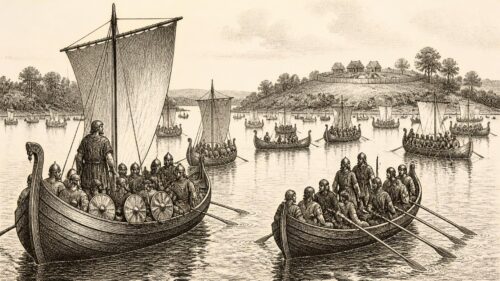
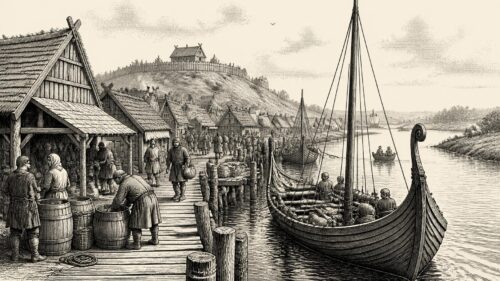
The pursuit to Port Láirge places the violence in a landscape connected to the Irish Sea. Waterford was a Scandinavian-founded port and a significant political centre, not an isolated Viking enclave detached from Irish affairs. Brian had already dealt with Scandinavian leaders and maritime forces in the region. In 985, however, the annal identifies his opponent as Domnall son of Faelán and frames the campaign as a struggle with the Déisi. “The whole of the Déisi was devastated” is annalistic language, not a survey of every settlement; it signals extensive raiding rather than literal destruction of every field and dwelling. Still, it conveys a campaign intended to make resistance painfully visible.
Mast, Pasture and Rural Life
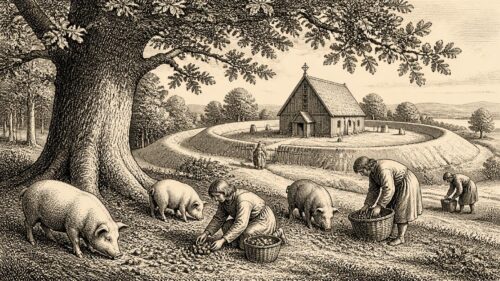
Alongside the violence, the Annals of Inisfallen preserve a striking environmental notice: there was an abundance of mast in 985, lasting until the end of the following year. Mast meant the seasonal crop of nuts and acorns produced by woodland trees, especially oak. Such a bumper crop mattered in a rural economy. It could provide valuable autumn and winter fodder for pigs, as well as food gathered by people; it also indicates that patches of productive woodland remained significant within a landscape of pasture, fields, wetlands and settlement.
The annal does not say that mast abundance ended hunger, enriched everyone equally or caused any particular political event. Those would be unwarranted conclusions. But the entry is a useful corrective to an account of 985 made only of kings and warriors. Most people lived in rural settlements and worked through the agricultural year: tending cattle, sheep and pigs; sowing and harvesting crops; processing milk; grinding grain; repairing houses, fences and trackways; and managing access to pasture and woodland. A plentiful mast season would have been noticed because it altered real choices in animal keeping and food supply.
That ordinary productivity underpinned the political events. A king’s cattle prey, a mercenary’s maintenance and a raided territory’s recovery all depended on labour by households whose names never reached the annals. Crannógs, raths and other farmsteads were not merely picturesque settings for warfare: they were centres of storage, production and kin-based authority. When Máel Sechnaill’s men destroyed artificial islands in Connacht, or when Brian’s force devastated the Déisi, the burden fell beyond elite rivals onto the people responsible for animals, crops and buildings.
A Leinster Succession
The final securely dated political notice is the death of Diarmait son of Uathmarán, described in the Annals of Tigernach as king of Leinster. The annal gives neither the manner of his death nor the succession that followed. It nevertheless marks another change in an important neighbouring province. Leinster’s rulers had to navigate the power of Dublin, the ambitions of Mide and the growing force of Munster. A royal death could open opportunities for competitors inside Leinster and for outside kings seeking allies or influence.
Thus 985 was not a year of one decisive battle or kingdom-wide settlement. It was a year in which the leading men of Mide and Munster applied force at opposite ends of the island, while Connacht and Leinster experienced their own losses and transitions. The annals’ spare notices preserve a country of local sovereignties and linked regions: lakeside strongholds in Connacht, cattle-rich territories in the south-east, a maritime port at Waterford, and the central kingship of Mide reaching outward. The more famous struggles of Máel Sechnaill and Brian still lay ahead. In 985, their separate campaigns already showed the methods by which that larger contest would be fought.
Primary Sources
- The Annals of Tigernach
- Part 15 of The Annals of Tigernach
- Annals of Inisfallen
- Part 54 of Annals of Inisfallen
- The Annals of Ulster
- Part 556 of The Annals of Ulster
- Annals of the Four Masters
- Part 9 of Annals of the Four Masters
- Annals Chronology and Synchronisms
- On Reconstructing Medieval Irish Chronicles
- Brian Bórama (Bóruma, Boru) | Dictionary of Irish Biography
- Church-Raiding And Subjugated Vikings, 980–1014
- Agriculture, Settlement and Society in Early Medieval Ireland
- The Archaeology of Livestock and Cereal Production in Early Medieval Ireland, AD 400-1100
- The Archaeology of Livestock and Cereal Production in Early Medieval Ireland, AD 400-1100
- Early Medieval Archaeology Project: Early Medieval Agriculture and Economy
- Early Medieval Ireland: Archaeological Excavations 1930–2009
- Ireland's Medieval Woodland: An Archaeological Approach to Understanding Long Term Patterns of Wood Use, Management and Exploitation
- Crannogs / Cránnoga
- Irish Field Monuments
- Loughnacrannoge
- Exploring the Irish Annals