Cashel in the Great Frost941 CE
In 941, exceptional frost froze waterways, allowing raiders to plunder Inis Mochta and disrupting ordinary travel and supplies. Muirchertach mac Néill, king of Ailech, campaigned through Mide, Uí Fhailge, Osraige and the Déisi, securing Cellachán of Cashel’s submission to Donnchad Donn of Tara. The campaign demonstrated northern power but did not establish lasting conquest. Cellachán had fought the Déisi, while Muirchertach also raided the Hebrides by fleet. Amlaíb mac Gofraid, Dublin-linked ruler of York and Mercia, died in Lothian. Brian Bóruma was notably also born. Later poetry magnified Muirchertach’s circuit, but contemporary annals depict a politically fragmented Irish Sea world.
Dateline
The winter that opened 941 was severe enough to enter the historical record before any king or battle did. The Annals of Ulster note a great frost that made lakes and rivers passable; Chronicon Scotorum adds a vivid local consequence: ‘foreigners’ crossed the ice to plunder Inis Mochta, the ecclesiastical island now known as Inishmot in Meath. This was not merely colourful weather reporting. Frozen waterways temporarily became roads, altering the reach of raiders, messengers and armed parties, while hard weather placed extra strain on livestock, fuel supplies and winter food stores.
In a year of movement and violence, Muirchertach mac Néill, king of Ailech, made the most imposing progress. His campaigning carried Northern Uí Néill power through the midlands and into the south-east; it ended with the submission and detention of Cellachán Caisil, overking of Munster. Yet 941 should not be treated as a straightforward march towards a unified Irish kingdom. Ireland remained a landscape of rival provincial rulers, powerful kindreds, church centres and Norse-Gaelic ports. Muirchertach’s achievement was to demonstrate how far a determined northern king could travel, exact obedience and turn submission into political theatre.
Ice, Islands and Exposure
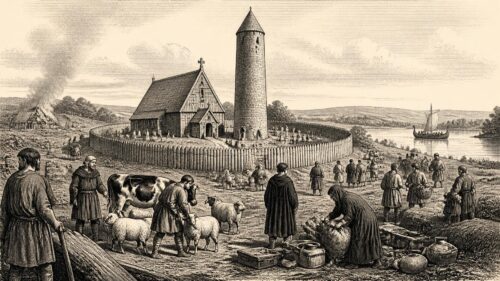
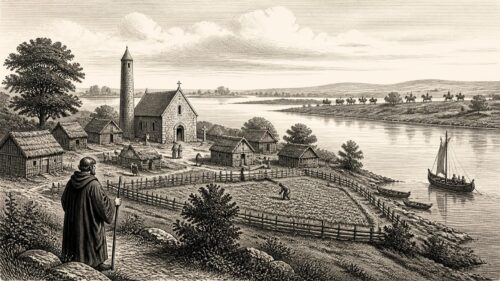
Inis Mochta was especially vulnerable in the freeze. Normally protected by water, its community could be reached over the ice. The terse annalistic notice does not say who these raiders were, how much was taken, or what happened to the inhabitants; it should not be enlarged into an unrecorded massacre. But the incident reveals a great deal. Religious sites held livestock, food, metalwork, books, tribute and skilled people; they were therefore valuable targets. Their spiritual standing did not make them secure in war. Inis Mochta’s plundering also shows how the cold temporarily overturned the defensive advantages of an island settlement.
For most people, however, the frost mattered without an annalist recording their names. Travel by water and land was central to exchange and lordship, but a frozen river could both ease passage and interrupt ordinary boating. Herds needed fodder; households needed timber or turf; food preservation and access to mills could become difficult. The annals do not permit a precise reconstruction of hardship in every district. They do allow a responsible conclusion: the climate was severe enough to be remembered as an exceptional condition affecting mobility across Ireland.
Muirchertach’s Southern Drive
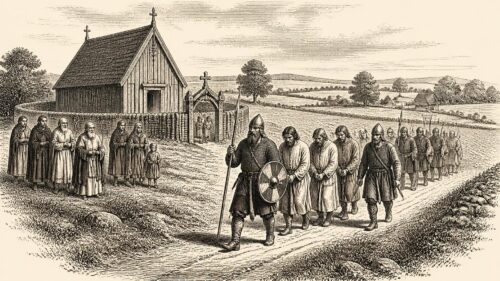
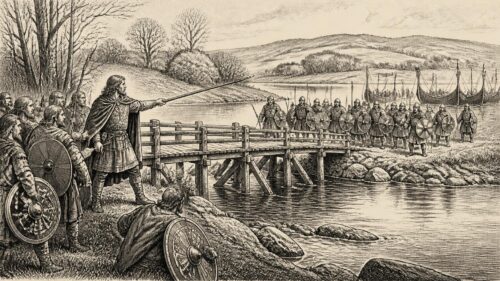
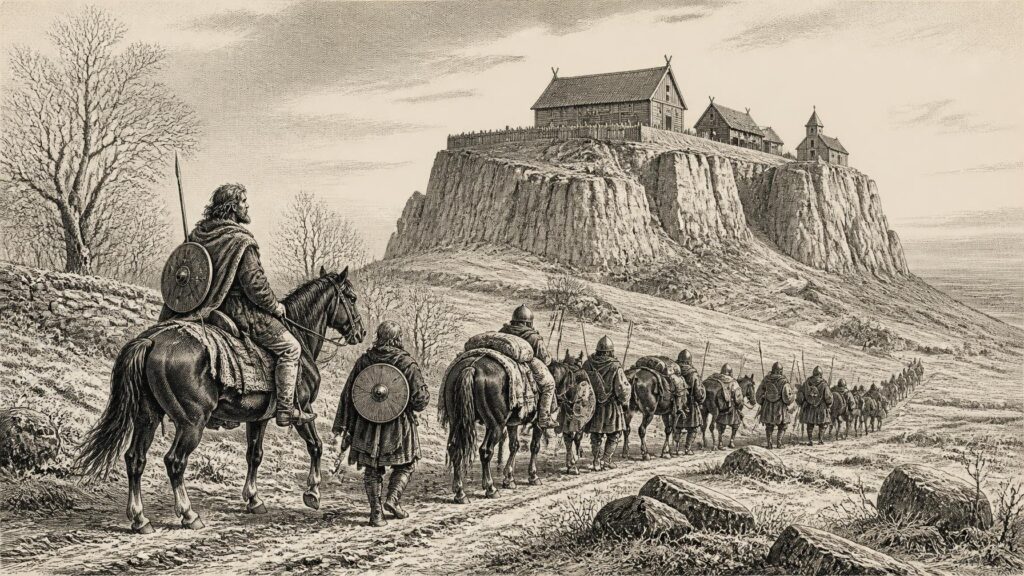
The central political development of the year was Muirchertach’s expedition. The Annals of Ulster place it in the great frost: he plundered Mide and Uí Fhailge, moved into Osraige, obtained submission there, ravaged the Déisi and brought Cellachán of Cashel into submission to Donnchad Donn, king of Tara. The language is important. Submission did not necessarily mean permanent conquest or direct administration. It usually meant that a king acknowledged superior force, rendered hostages or tribute, and accepted a temporary hierarchy under intense military pressure.
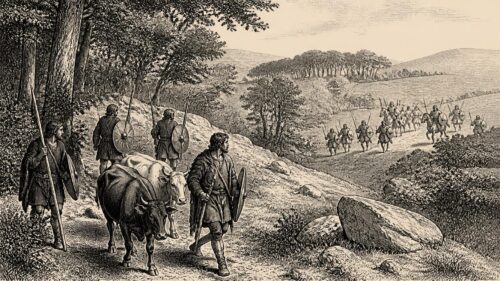
Muirchertach’s route joined together several contested zones. Mide was the heartland of Donnchad Donn’s Clann Cholmáin dynasty. Uí Fhailge lay west of Leinster, while Osraige occupied the strategic Barrow valley between Leinster and Munster. The Déisi, in south-eastern Munster, had their own political interests and did not simply act as passive subjects of Cashel. A northern army travelling through these territories displayed logistical capacity as well as aggression: it required food, guides, mounted men, foot soldiers and the ability to compel local communities to furnish provisions.
The campaign was also a partnership and a rivalry. Donnchad Donn held the kingship of Tara and was the senior figure to whom Cellachán was formally submitted. Muirchertach, descended from the Northern Uí Néill and ruler at Ailech, was the active commander whose reputation was growing across the island. The arrangement gave both men something. Donnchad could claim that Munster’s king had been brought under his authority; Muirchertach could prove that no southern frontier was beyond his reach. Their cooperation did not remove the underlying competition between northern and southern branches of the Uí Néill.
Cellachán, the Déisi and Cashel
Cellachán’s position helps explain why the expedition mattered. He was an ambitious Éoganacht ruler of Munster whose earlier actions had brought him into conflict with Uí Néill interests. In 941, however, his authority nearer home was under pressure. Chronicon Scotorum records a slaughter inflicted by Cellachán and the men of Munster upon the Déisi, giving a total of 2,000 dead. Medieval casualty figures can be rhetorical and cannot be accepted uncritically as a modern count. Nonetheless, the entry firmly conveys a major and bloody confrontation between Munster’s overking and a regional population that had aligned itself with Muirchertach.
The sequence should not be made more certain than the evidence permits. The annals and later compilations preserve related accounts with different emphases and chronologies. What can safely be said is that Cellachán fought the Déisi, that Muirchertach’s campaigning reached Osraige and the Déisi, and that Cellachán was reduced to submission and held for a time. Later historical writing speaks of a nine-month detention, but it derives its fuller narrative from traditions shaped after the event. The contemporary-style annalistic core is more restrained: the king of Cashel was compelled to acknowledge Donnchad.
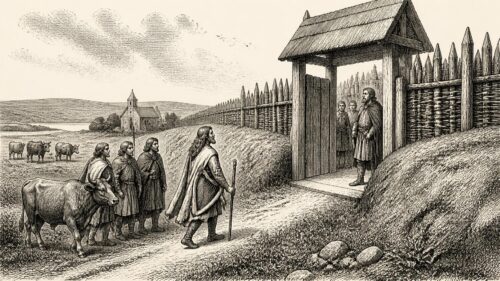
Cashel itself was more than a fortress on a rock. It was the principal royal centre associated with the Éoganacht kingship of Munster, a place where political legitimacy, ecclesiastical patronage and control of regional tribute met. To humble its king was therefore a statement aimed at every province. It did not erase Munster’s political identity. Indeed, Cellachán returned to rule and remained a significant figure until his death in 954. But in 941 his vulnerability exposed the limits of a provincial king’s authority when local resistance and a major external expedition converged.
A Fleet Beyond Ireland
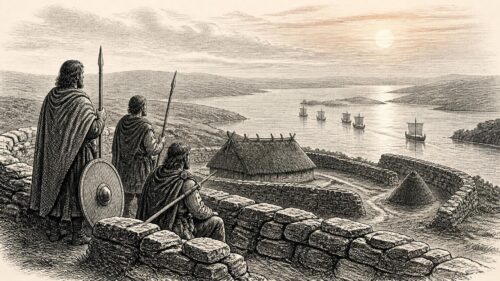
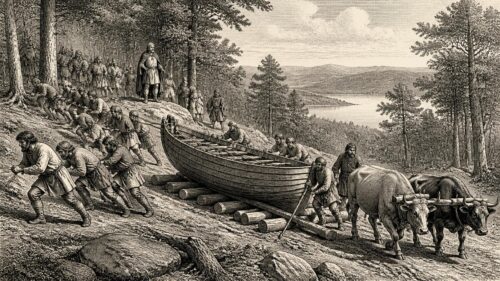
Muirchertach also projected power westwards. Chronicon Scotorum records that he brought a fleet and returned with plunder from the Hebrides, named in Irish as the Insi Gall, the ‘islands of the foreigners’. This was a maritime strike into the world of Norse and Norse-Gaelic communities across the sea, not an isolated Irish domestic raid. It demonstrates that the struggle around Dublin, Limerick and the northern coast belonged to a wider Irish Sea arena linking Ireland, western Scotland, the Isles and northern England.
Seafaring warfare required vessels, crews, coastal knowledge and places to assemble supplies. The entry does not identify every island attacked, nor does it prove lasting control of the Hebrides. Its significance lies in the raid itself: an Irish ruler could organise a fleet capable of crossing open water and returning with spoils. The same year’s frost and fleet thus offer contrasting images of movement. In one, ice enabled an opportunistic attack on an inland island church; in the other, ships carried royal violence into the sea-lanes beyond Ireland.
Dublin and the Death of Amlaíb
Another notice in Chronicon Scotorum reports the death of Amlaíb mac Gofraid, styled king of the fair and dark foreigners. Amlaíb had ruled Dublin while also becoming a major force in York and Danish Mercia. His death, apparently in Lothian during raiding, mattered directly to Ireland because Dublin was not a detached Scandinavian enclave: it was a Norse-Gaelic power whose rulers, ships and wealth moved through the Irish Sea.
The death did not immediately end Dublin’s importance. Amlaíb Cuarán succeeded in York, while Blacair was left to manage Dublin’s position. Yet the loss of Amlaíb removed a ruler whose authority had tied together an unusually broad political sphere. For Muirchertach, whose forces had pressed Dublin’s interests and raided overseas Norse bases, the moment offered opportunity. For communities around the Irish Sea, it foreshadowed renewed contest rather than peace.
Churches, Learning and a Future King
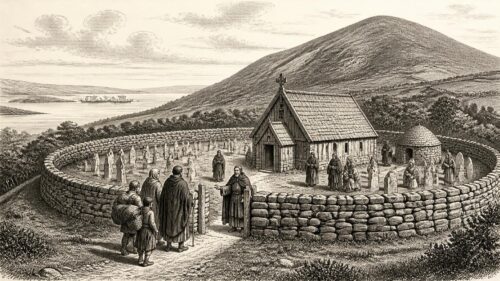
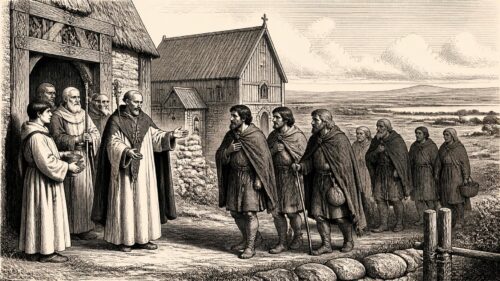
The year’s annals also mark quieter changes. Eochu son of Scannal, superior of Imlech Ibuir, and Aenacán, priest of Dún Lethglaise, died. Such brief obituaries are reminders that monasteries and churches were centres of worship, landholding, education, hospitality and record-keeping. Their leaders belonged to the political fabric of their regions. A raid on an island church or the death of a superior therefore had consequences beyond devotion alone.
The Annals of Ulster additionally record the birth of Brian son of Cennétig, the future Brian Bóruma. In 941 this was simply the birth of a boy in the Dál Cais of north Munster, not yet the beginning of an inevitable national story. Brian’s later career should not overshadow Cellachán, Muirchertach or the communities whose fortunes actually defined this year. Still, the entry is a striking chronological marker: while Cashel’s Éoganacht king was being brought low, a child was born in a rival Munster dynasty that would, decades later, transform the balance of power.
Remembering the Circuit
A later Irish poem, The Circuit of Ireland by Muirchertach mac Néill, turns the campaign into an expansive royal procession in which kings are taken, feasted and then delivered to Donnchad. It preserves valuable political memory, including the importance of hostages and ceremonial display. But its surviving form was created much later and is understood as propaganda for a twelfth-century ruler; it cannot be treated as a contemporary itinerary or a literal transcript of 941. Its richness is evidence for how Muirchertach’s achievement was remembered, rather than proof for every detail it supplies.
What is securely anchored in 941 is compelling enough: exceptional cold; a church island raided over ice; a northern king driving through the midlands and south; conflict within Munster; a fleet striking the Hebrides; and the death of a Dublin-linked ruler whose career reached across Britain and Ireland. The year reveals an island neither isolated nor politically simple, where winter weather, local loyalties and Irish Sea connections could all shape the reach of kings.
Primary Sources
- The Annals of Ulster
- Chronicon Scotorum, Annal CS941 (English translation)
- Chronicon Scotorum, Annal CS941 (Irish text)
- Annals of the Four Masters, Part 4
- CELT Project: Chronicon Scotorum
- CELT Project: The Annals of Ulster
- The Circuit of Ireland by Muircheartach mac Néill
- The Circuit of Ireland by Muircheartach mac Néill, Text
- Muirchertach na Cochall Craicinin
- Cellachán Caisil
- Donnchad Donn
- Amlaíb (Óláfr Godfridsson)
- Amlaíb (Óláfr) Cuarán
- Blacair (Blakkr)
- Vikings in Early Medieval Ireland
- The Vikings in Ninth-Century Ireland: Sources and Settlements
- Vikings in Ireland
- Nation and Kingship: Sources and Studies
- Getting to Know Dublin
- Irish Names of Places, Volume III