Condaire’s Fatal Raid962 CE
Dateline
For Ireland, 962 is a year best approached through a small cluster of annalistic notices rather than a single commanding narrative. Those notices are unusually revealing. They record a failed northern raid, the killing or death of several rulers across the island, and a parallel change in Alba. Together they show a political world made up not of a unitary state but of overlapping kingships, kin-groups, ecclesiastical interests and strategic routes. The clearest event was the death of Flaithbertach son of Conchobar, king of Ailech, after an expedition into Dál nAraide. It was a sharp reminder that even a ruler connected with the dominant Northern Uí Néill could be destroyed in a local war.
Dating a Sparse Year
Medieval Irish annals did not offer the kind of dated chronicle familiar from modern history. Entries are generally arranged beneath annual headings, but the transmission of texts, differing local records and occasional chronological displacement mean that individual dates require care. The Annals of Ulster place their relevant notice under a heading rendered “AD 961 alias 962”, whereas Chronicon Scotorum and the Annals of Inisfallen place closely related material in 962. Modern historical treatment can therefore connect the events securely with 962, but no source supplies a day, month or precise battlefield location.
This caution matters particularly because later compilations can preserve events in a different sequence. The year should not be burdened with later tenth-century raids, famines or ecclesiastical deaths merely because one chronicle places them near this point. What can responsibly be said is that three principal annalistic traditions associate 962 with the fall of Flaithbertach, while the southern annals also preserve the deaths of rulers in Uí Maine and Uí Fhidgeinte.
The Raid into Dál nAraide
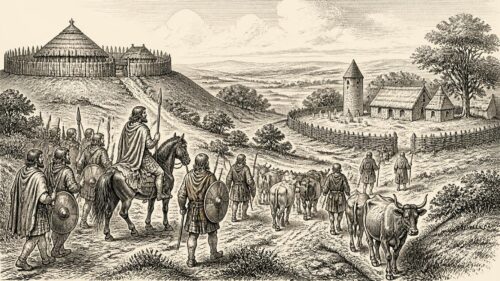
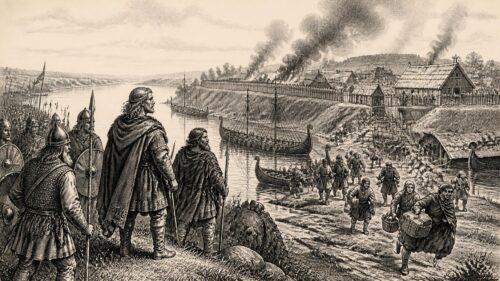
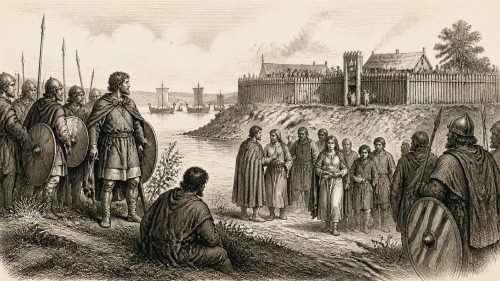
The fullest account comes from the northern annals. Flaithbertach son of Conchobar, styled king of Ailech, led a raid into Dál nAraide and plundered Condaire or Coindere. The Ulaid then caught the raiders. Flaithbertach was killed, along with Tadc and Conn, described in one source as his kinsmen and in another as his brothers, as well as many others. The disagreement over that relationship is a useful warning against overconfident reconstruction; the essentials, however, are firm. A royal force entered Dál nAraide, took plunder, and was overtaken by an Ulaid counter-attack in which its leader and close relatives died.
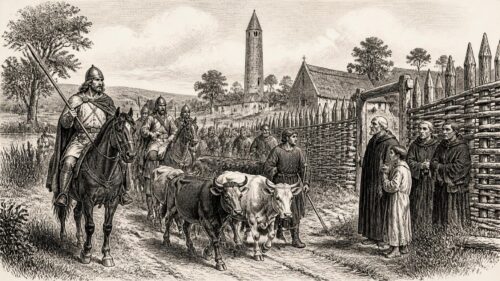
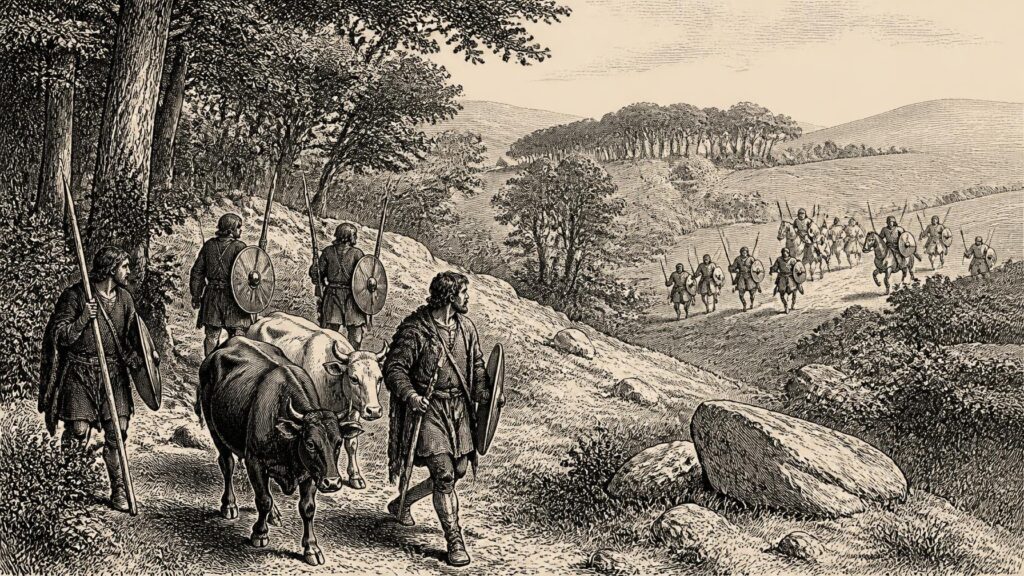
The raid belongs to the hard practical politics of early medieval Ireland. Plunder could mean cattle, food, valuables, captives and movable wealth, but it also proclaimed a ruler’s capacity to compel submission. An attacking king had to gather followers, secure provisions and lead them through contested country; a successful return enhanced status, while interception could be catastrophic. The annals’ brief wording does not identify the immediate cause of the expedition, tell how Condaire was defended, or preserve the name of the Ulaid commander. It nevertheless records a significant reversal: an Ailech king was not merely defeated but killed during withdrawal, the moment at which a raiding force was most vulnerable.
Dál nAraide lay within the wider province of Ulaid in the north-east. It was no passive borderland. Its rulers and fighting men could exploit local knowledge, short supply lines and the ability to assemble a response quickly. The outcome demonstrates that claims of superior rank did not erase the autonomy of neighbouring peoples. It also suggests why the chroniclers remembered the place-name Condaire: the attack and its reversal had become a notable episode in a continuing contest between northern powers.
Ailech and the Limits of Overkingship
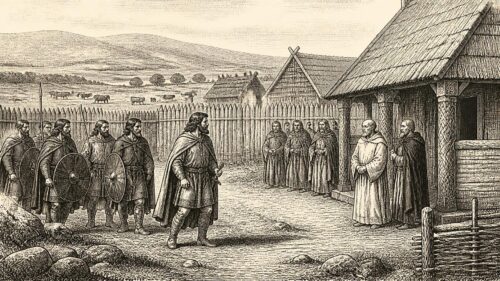
Flaithbertach’s title linked him to Ailech, the royal centre associated with Cenél nÉogain, a leading branch of the Northern Uí Néill. In 962, Domnall ua Néill, of the same wider dynasty, held the kingship of Tara and was attempting to sustain authority beyond his northern base. Modern scholarship identifies him as being at war in Munster and reasserting his position in Mide during this period. Yet Ireland was not governed through a central bureaucracy. The authority claimed by a king of Tara rested on alliances, hostages, tribute, marriage connections, military action and recognition by other rulers. It could be powerful, but it remained negotiated.
Flaithbertach’s death should not automatically be treated as a defeat for Domnall personally, or as proof that Domnall ordered the raid. The sources do not say either. It does, though, illuminate the pressure on the Northern Uí Néill world. Ailech’s local kings and royal kindred were expected to defend prestige and pursue resources; their losses could alter the balance within the dynasty. The killing of three closely connected men at once was especially serious in a political order where succession depended upon a broad royal kin-group rather than strict inheritance by eldest son.
Elsewhere, the same year’s notices expose the fragility of regional rule. The Annals of Ulster report that Eógan son of Muiredach, called a tributary king of Ireland, was killed by Uí Fhailgi. The phrase signals recognised status within a hierarchy, not a modern national office. Uí Fhailgi, in the central-east Midlands, retained the means to kill a king whose title invoked a wider political relationship. The killing was an act with consequences for tribute, lordship and local leadership, even though the annalist leaves its cause unstated.
Deaths Across the Island
Chronicon Scotorum adds that Óengus ua Máel Doraid, king of Cenél Conaill, was slain, while Mugrón ua Máelmuaid, king of Fir Cell, died. Cenél Conaill, based in the north-west, was a major rival within the Northern Uí Néill sphere; Fir Cell lay in the Midlands. These entries should not be woven into an invented island-wide campaign. No surviving notice connects their deaths to Condaire. Their importance lies instead in their accumulation. In a single annalistic year, kingship was disrupted in the north-east, north-west and central Ireland, whether through battle, killing or death.
The southern perspective is equally important. The Annals of Inisfallen record the deaths of Murchad, king of Uí Maine, and Scandlán grandson of Riacán, king of Uí Fhidgeinte. Uí Maine controlled an extensive Connacht kingdom centred on the lands around the Shannon and Suck river systems; Uí Fhidgeinte was an important Munster people in the region later associated especially with west Limerick. Neither entry names a successor, gives a cause of death or claims that the kingdoms changed hands. Still, the record shows that political transition was occurring in regions far from the fatal raid in Ulaid.
The same southern annal calls Eógan son of Muirecán a “royal official of Ireland”. The wording is tantalising but insufficient to define his precise duties. It does show that contemporaries could recognise offices and dignities operating across, or at least imagined across, a wider Irish political order. Such language coexisted with intensely local power. In 962, broad claims to authority and the reality of separate regional kingships were not opposites: they were the structure of politics.
Rural Wealth, Routes and Settlements
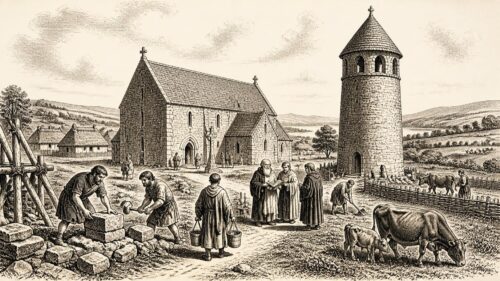
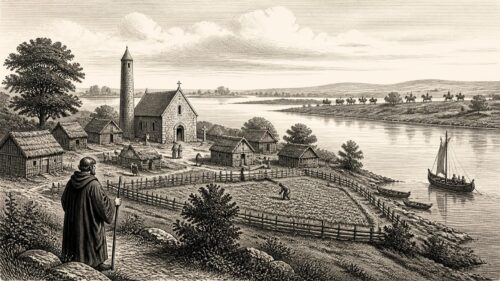
The people affected by these changes were overwhelmingly rural. Archaeology and early Irish evidence point to a landscape of farmsteads, ringforts, enclosed homesteads, small ecclesiastical settlements and dispersed agricultural communities. Cattle remained a primary store of wealth and a measure of rank, while cereals were increasingly important to subsistence and surplus. Grain drying, milling and animal husbandry supported households, lordly estates and religious communities. A raid such as that at Condaire was therefore an attack on the resources on which ordinary families, dependants and elites all relied.
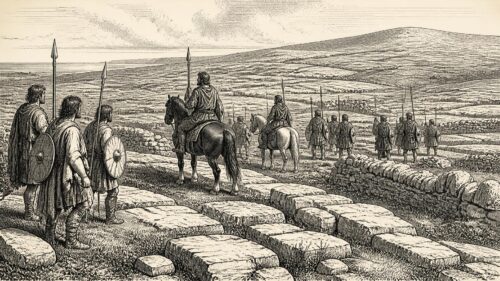
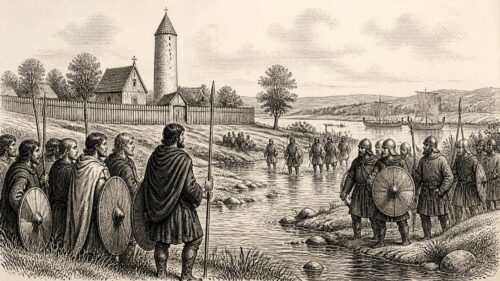
Travel and warfare followed waterways, ridges, trackways and passes rather than modern county boundaries. Rivers connected regions while also creating obstacles; lakes and bogs channelled movement; uplands could protect or expose a marching force. The northern raid reveals how geography shaped political risk. Flaithbertach’s men could reach Condaire and carry away plunder, but their route home placed them within reach of an Ulaid response. The annals do not record weather, harvest conditions or environmental disaster for 962, so none should be presumed. What is clear is that access to food, livestock and movement through the landscape was inseparable from lordship.
Monasteries were embedded in this same world. Major sites such as Armagh, Clonmacnoise and Kildare were centres of worship, learning, craftsmanship and exchange, with substantial lay populations and ties to kings. Their schools and scriptoria helped sustain the literate culture that eventually preserved notices of 962. But the sources do not report a new foundation, church building or synod for this particular year. The responsible conclusion is narrower: religious institutions remained influential landholders and centres of memory, while the year’s surviving record is dominated by secular political loss.
An Irish Sea Horizon
Chronicon Scotorum also notes the death of Illulb, king of Alba. This was not an event in Ireland, and the annal gives no Irish involvement. It is relevant nevertheless because Irish, Scottish and Norse-controlled lands formed an interconnected Irish Sea world. Dynastic exiles, mercenaries, traders, churchmen and raiders crossed its waters. Dublin, a Hiberno-Scandinavian port and political power, was already deeply involved in Irish Sea affairs and international trade. In 962, however, the central Irish annalistic story is not a Norse assault but conflict among Irish regional powers.
Condaire’s fatal raid thus captures the texture of the year. Its tragedy was local and immediate: a king, his close companions and many followers died after a plundering expedition. Its significance was wider. It reveals the limits of Ailech power, the resilience of Ulaid, the vulnerability of royal kindreds and the continuing importance of local control in an Ireland where ambitious overkingship never eliminated competing kingdoms.
Primary Sources
- The Annals of Ulster: Year U962
- CELT Project: The Annals of Ulster
- Chronicon Scotorum: Annal CS962
- CELT Project: Chronicon Scotorum
- Annals of Inisfallen: Annal AI962
- CELT Project: Annals of Inisfallen
- Annals of the Four Masters: Annal M962
- CELT Project: Annals of the Four Masters
- Ua Néill, Domnall
- Muirchertach na Cochall Craicinin
- Ua Néill, Áed
- Annals of Inisfallen to Go on Public Display in University College Cork
- Exploring the Irish Annals
- Agriculture, Settlement and Society in Early Medieval Ireland
- Irish Field Monuments
- Clonmacnoise
- Irish School of Illumination
- Ireland’s Viking-Age Hoards: Sources and Contacts
- The Vikings in Ninth-Century Ireland: Sources and Settlements
- The Vikings in Ulaid
- A Concise History of Ireland: Transformation: Early Medieval Ireland, c. 430–1169
- From Kingdom to Colony: Framing the English Conquest of Ireland
- Residence, Ritual and Rulership: A State-of-the-Art for Royal Places in Early Medieval Ireland