Cell Cuilinn’s Captives938 CE
In the annal-year conventionally dated 938, Ireland saw political upheaval around Dublin and Leinster. Amlaíb son of Gothfrith returned to the Norse kingdom after Brunanburh, while its power extended towards Áth Truisten. He raided Cell Cuilinn, probably Kilcullen, plundering the church and carrying off many captives, a thousand in later accounts. Donnchad Donn and Muirchertach son of Niall prepared for battle but made peace, then besieged Dublin and ravaged its hinterland without evident conquest. Fergal of Ailech died, enabling Muirchertach to succeed, while regional rulers and church leaders died. The sources reveal contested authority, warfare, captivity, ecclesiastical vulnerability, and destruction.
Dateline
The year conventionally labelled 938 in modern histories was a sharp, unsettled year in Ireland. Its surviving notices are brief, but they cluster around an unusually revealing sequence: a change of ruler in the northern kingdom of Ailech; an avoided war between two great Uí Néill rivals; the return of Amlaíb son of Gothfrith to Dublin; a devastating raid on Cell Cuilinn; and a joint expedition against the Dublin Norse. These were not isolated incidents. Together, they show how authority, religion, land and people could all become stakes in the struggle around Dublin and Leinster.
Dating a Difficult Year
Early Irish annals do not offer a modern diary of 938. Their entries were arranged beneath year-headings, copied and revised over centuries, and the same occurrence can appear under differing dates in later compilations. The Annals of Ulster place the principal events under U938, explicitly noting “AD 937 alias 938”. Chronicon Scotorum records several of them under 938, while the Annals of the Four Masters place a fuller version under 936. That discrepancy is a feature of annalistic chronology, not evidence for three separate episodes. What can responsibly be said is that the events belong to the annal-year conventionally treated as 938.
This caution matters especially for sequence. The annals state that Donnchad son of Flann and Muirchertach son of Niall prepared for battle, that peace followed, and that they subsequently acted together against Dublin. They do not provide days, months, meeting places or the terms of their settlement. Nor do they say precisely when Amlaíb returned, when Cell Cuilinn was attacked, or how long the siege of Dublin lasted. The year is therefore clear in broad outline, but not in the exact timetable that modern readers might expect.
Amlaíb Returns to Dublin
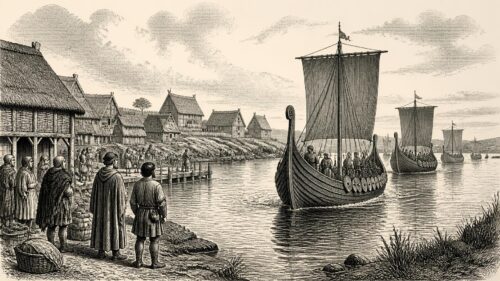
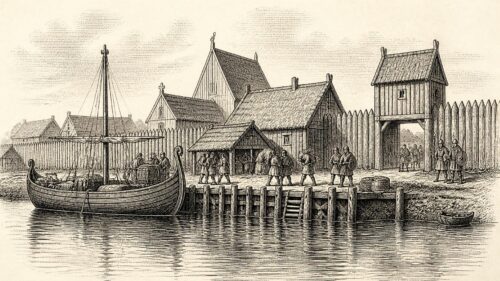
The annalist’s compact notice that “Amlaíb son of Gothfrith [was] in Áth Cliath again” is central to the year. Amlaíb, known in Scandinavian and English contexts as Óláfr Guthfrithson, belonged to the ruling dynasty of Viking Dublin. His return followed the great confrontation at Brunanburh in 937, where he had opposed King Æthelstan of the English. Irish and English evidence makes the wider Irish Sea dimension unmistakable: Dublin’s rulers could be involved in power struggles in northern Britain and England, then reappear in Ireland with their political position still intact.
That does not mean that Dublin was merely a foreign outpost. By 938 it was an established port-town and royal centre, tied to its hinterland as well as to seaborne networks. Archaeology from Dublin has revealed the commercial importance of silver, coin, ingots and imported goods in Viking-Age Ireland. The annal for this year adds a political measure of that importance. It describes territory extending from Dublin towards Áth Truisten, probably near Mullaghmast in County Kildare, as subject to the foreigners’ power. The exact limits of that lordship cannot be mapped from one sentence, but it was plainly more than control of the settlement at Dublin itself.
The Raid on Cell Cuilinn
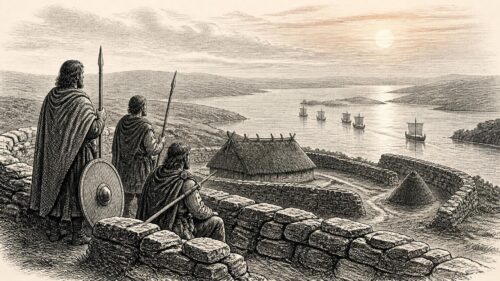
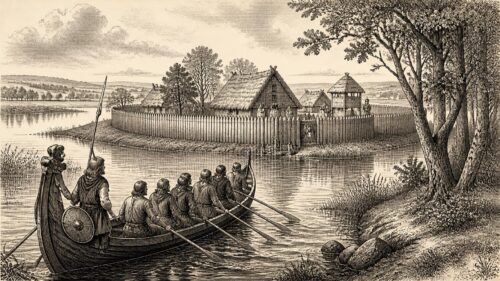
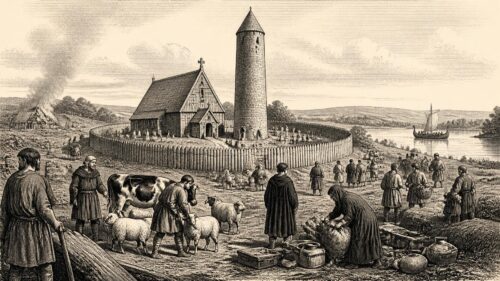
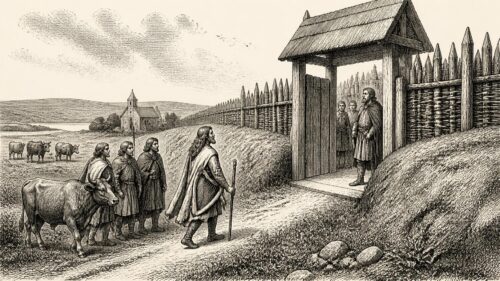
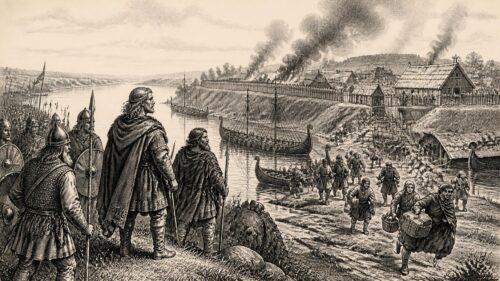
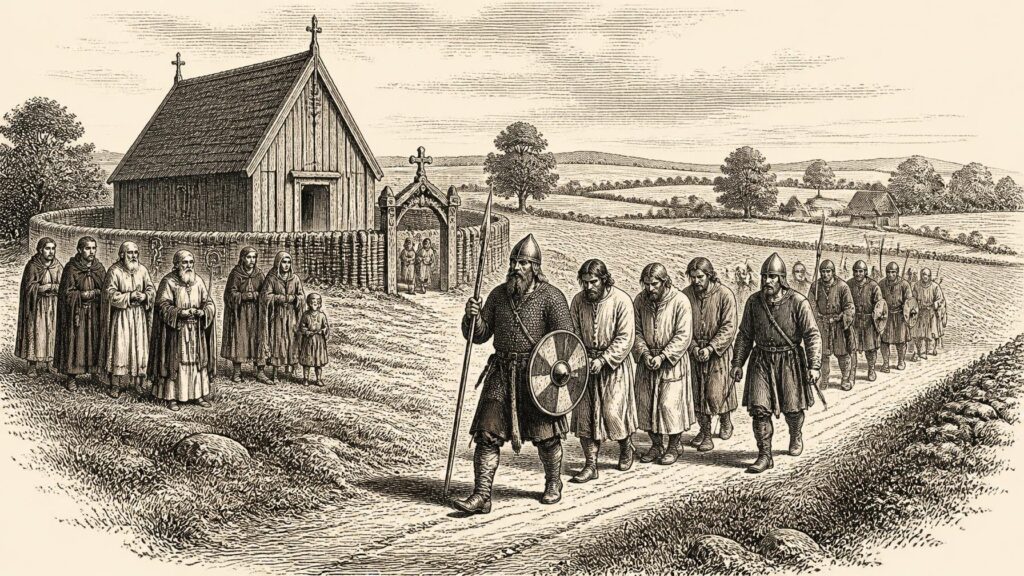
Amlaíb’s most painful recorded act of the year was the plundering of Cell Cuilinn, generally identified with the early ecclesiastical site at Kilcullen in County Kildare. The Annals of Ulster call the attack something that had not happened “from ancient times”, or, in another rendering, not often happened. The wording marks the raid as exceptional in the annalist’s judgement. Chronicon Scotorum and the later Annals of the Four Masters add that a thousand captives were taken.
That number must not be treated as a modern census. Round figures in annalistic writing can be rhetorical, and the earliest surviving version of the Ulster notice does not give a total. Yet there is no reason to soften the human meaning of the report. Captivity was a recognised consequence of warfare in early medieval Ireland and across the Viking world. Prisoners might be ransomed, retained within a household, exchanged, or sold onwards; their later fates are not recorded here. A raid capable of removing a very large body of people would have damaged households, farms, religious personnel and local networks of protection far beyond the buildings that were plundered.
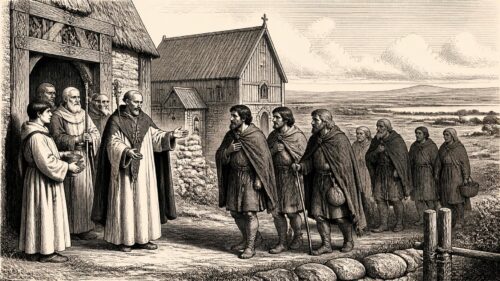
Cell Cuilinn was not simply a secluded place of worship. An Irish cell could be an ecclesiastical community embedded in a surrounding territory, sustained by land, food renders, clients and lay allies. Its loss therefore mattered both spiritually and materially. Church sites held sacred objects and learning, but they also concentrated movable wealth, food supplies and people. The annalist’s shocked language shows a religious response to the assault; the taking of captives reveals a more prosaic calculation of value and power.
Peace Between Rivals
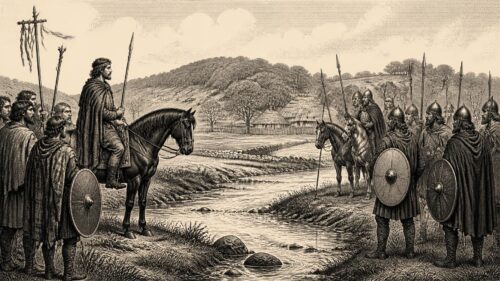
While Amlaíb was re-establishing himself at Dublin, the leading Irish powers were themselves close to conflict. Donnchad Donn, king of Tara and head of the southern Uí Néill dynasty of Clann Cholmáin, and Muirchertach son of Niall Glúndub, a leading figure of the northern Cenél nÉogain, “made preparations for a battle”. The annal then says that God brought them to peace. This is not proof that clerics personally negotiated the settlement, but it does show how a monastic writer understood peace: as a providential restraint on destructive rivalry.
The agreement was politically consequential. Donnchad and Muirchertach were connected by marriage, since Muirchertach had married Donnchad’s daughter Flann, but kinship did not remove competition. Their prospective battle reflects the divided character of Uí Néill supremacy. No single office automatically commanded all Ireland; kingship was exercised through armed followings, clientage, tribute, hostages and recognition by other rulers. In 938, diplomacy did not replace force. It redirected force towards a shared adversary.
The Siege of Áth Cliath
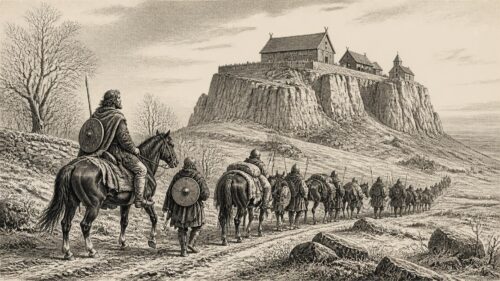
The two rulers then led an army to besiege “the foreigners of Áth Cliath”. The result recorded is not the capture of Dublin, the killing of Amlaíb, or the imposition of a treaty. Instead, the annals say that the allies ravaged from Dublin to Áth Truisten. That distinction is important. A siege could be a demonstration of strength, an attempt to compel submission, or cover for systematic devastation of an opponent’s dependent lands. In this case the surviving evidence supports the campaign and the destruction, but not an Irish conquest of Dublin.
The geography gives the expedition its significance. The route or zone from Dublin into south-west Leinster crossed productive lowland and important communications between the coast, the Liffey plain and the Barrow valley. To burn and plunder there was to strike at supplies, livestock, grain, prestige and the ability of Dublin’s rulers to reward followers. The later Four Masters preserve hostile verses attributed to Congalach of Brega, complaining that Muirchertach was burning corn while consuming the region’s bread. The verses cannot supply a verbatim contemporary speech, but they preserve the essential political complaint: a campaign against Dublin could impose heavy costs on Irish communities as well.
Death and Succession in the North
The death of Fergal son of Domnall, called king of Ailech in the Annals of Ulster and king of the North in Chronicon Scotorum, changed the northern balance of power. Fergal had been Muirchertach’s cousin and had held the kingship since the death of Niall Glúndub in 919. Muirchertach had already gained a formidable military reputation, but Fergal’s death removed the senior ruler above him. By the time of the expedition against Dublin, the Ulster annalist styles Muirchertach king of Ailech. The succession thus gave the alliance with Donnchad a new weight.
Elsewhere in the midlands, Conchobor son of Máel Cían, king of Uí Failge, was killed by the Laigin. Chronicon Scotorum names Lorcán son of Faelán as his killer. The variation is not necessarily contradictory: one source identifies a leading opponent, the other the wider Leinster force. What is certain is that the death occurred amid the same year of campaigning and exposed the fragility of local kingship in the territory west of Kildare. Regional rulers were not spectators in contests between Dublin, Tara and Ailech; they were vulnerable participants.
Churches, Memory and Limits
Religion appears in 938 not only through the trauma at Cell Cuilinn. The Annals of Ulster also record the deaths of Dubthach, successor of Columba and Adomnán, and Máel Cairnig, superior of Tulain. Chronicon Scotorum notes the death of Máel Pátraic, bishop of Lugmad, now Louth. Such notices remind us that ecclesiastical office formed part of the political landscape: churches were centres of authority, landholding, hospitality, writing and commemoration. But the records do not permit a detailed reconstruction of their communities’ daily life in this particular year.
No trustworthy source attached to 938 reports a harvest, epidemic, weather crisis, new settlement or specific trade voyage within Ireland. It would be wrong to invent them to make the year look complete. What the evidence does preserve is powerful enough: a king returned to Dublin after defeat overseas; an ecclesiastical community in Kildare was raided and its people carried away; rival Uí Néill rulers made peace rather than fight; and their combined army could punish, but not evidently overthrow, Dublin’s Norse kingdom. For contemporaries, the year’s defining reality was not a neat national contest between Irish and Viking. It was a shifting and costly struggle for control of people, food, land and allegiance.
Primary Sources
- The Annals of Ulster, Year U938
- The Annals of Ulster
- Chronicon Scotorum
- Chronicon Scotorum, Irish Text
- Annals of the Four Masters, Year M936
- Annals of the Four Masters
- The Annals of Tigernach
- Amlaíb (Óláfr Godfridsson)
- Muirchertach na Cochall Craicinin
- Donnchad Donn
- Tuathal
- Viking
- Early Medieval Ireland: Archaeological Excavations, 1930–2009
- The Vikings in Ninth-Century Ireland: Sources and Settlements
- Bound in Captivity: Intersections of Viking Raiding, Slaving, and Settlement in Western Europe During the Ninth Century CE
- The Slave Markets of the Viking World: Comparative Perspectives on an ‘Invisible Archaeology’
- Escaping from Brunanburh and John of Worcester
- Vikings in Ireland and Scotland
- Viking Activity in Ireland by County in the Annals
- Anglo-Saxon Chronicle, D-text (imperfect)
- Anglo-Saxon Chronicle, F-text
- Annals of the Kingdom of Ireland