Gofraid’s Painful Death934 CE
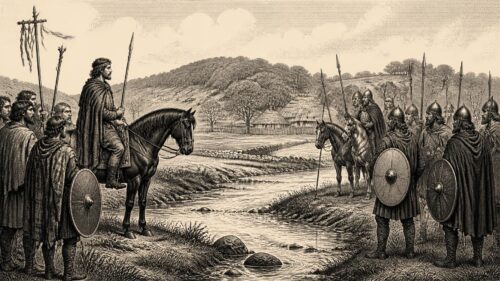
In 934, Gofraid, grandson of Ímar and Hiberno-Scandinavian king of Dublin, died painfully from illness, ending a rule connected with Dublin, York and the Irish Sea. The annals offer no details of his disease or succession, but his son Amlaíb succeeded him, inheriting a strategic trading and military centre. Elsewhere, Dubgilla son of Robacán, chief of Uí Chormaic, was killed in unexplained circumstances. Limerick’s foreigners raided deeply into Connacht, reaching Mag Luirg and Badhgna. Ireland remained politically fragmented: Dublin and Limerick pursued separate interests, while Irish dynasties, regional rulers and church institutions managed competing power, violence and succession across society.
Dateline
A Sparse but Consequential Record
The surviving Irish record for 934 is unusually brief, but it captures a meaningful change in the politics of the Irish Sea. The most securely dated development is the death from illness of Gofraid, grandson of Ímar, king of the foreigners. In modern historical terms, he was the Hiberno-Scandinavian ruler of Dublin and a leading member of the Uí Ímair dynasty, the kindred whose power linked Dublin to northern Britain, the Isles and, intermittently, York.
The Annals of Ulster, under its entry for 934, calls Gofraid “a most cruel king of the Norsemen” and says simply that he died of sickness. Chronicon Scotorum likewise records that “Gothfrith, king of the foreigners, died of a most painful disease”. Neither source provides a day, a place of death, an age, a burial site or a description of the illness. The moralising language of the annals should not be mistaken for a medical diagnosis, nor should it be read as a neutral modern character judgement. What is firm is that an established ruler died of disease in 934, rather than in battle or exile, and that his death created an immediate problem of succession at Dublin.
The same Annals of Ulster entry notes the killing of Dubgilla son of Robacán, chief of Uí Chormaic. It describes the death as wicked, but gives no location, motive or perpetrators. That small notice is a useful warning against treating 934 as a year wholly defined by Dublin. Ireland was still a landscape of many local lordships, whose conflicts could be deadly even when they left little trace beyond a single annalistic sentence.
The End of Gofraid’s Rule
Gofraid’s importance lay in more than his title. He belonged to a dynasty conventionally known as Uí Ímair, “the descendants of Ímar”. The exact family relationships within this kindred are not always recoverable from the sources, but Gofraid was identified as Ímar’s grandson and was part of a ruling network that operated across sea routes rather than within one fixed national territory. Dublin was its principal Irish base. From there, kings and war leaders could draw on ships, armed followings, tribute, captives, mercantile connections and alliances with rulers on both sides of the Irish Sea.
Gofraid had ruled Dublin since the early 920s. His career also touched Northumbria: after the death of his kinsman Sitric in 927, Gofraid crossed to York to press a claim there, though English royal power quickly checked his position. That episode matters for 934 because it shows that Dublin’s ruler was not merely a local king of a coastal settlement. His household and followers belonged to the political world of the Irish Sea, in which Dublin, York, the western seaways, Scottish kingdoms and the Isles could become connected theatres of rivalry.
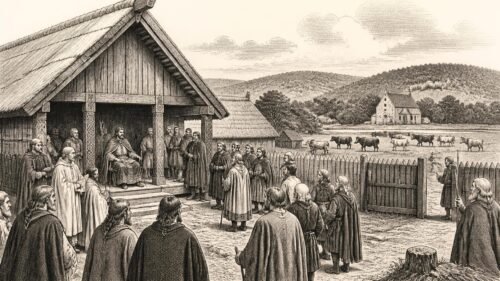
Yet this was not an empire administered from Dublin in a modern sense. Authority depended on personal lordship, ships, kinship, negotiated loyalties and the capacity to reward followers. Gofraid’s death therefore mattered not only because a king had died, but because the relationships assembled around him had to be renewed. His son Amlaíb, known in Old Norse as Óláfr Guthfrithson, is identified by later historical reconstruction and biographical scholarship as his successor in Dublin. The annals do not preserve the ceremony or date by which Amlaíb assumed power. It is safer to say that the succession belongs to 934, while the manner in which it was secured remains unrecorded.
Dublin at a Moment of Succession
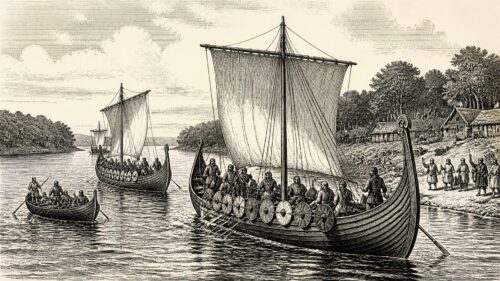
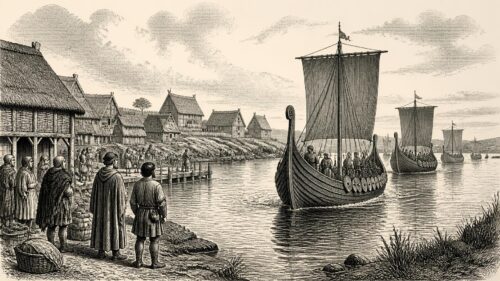
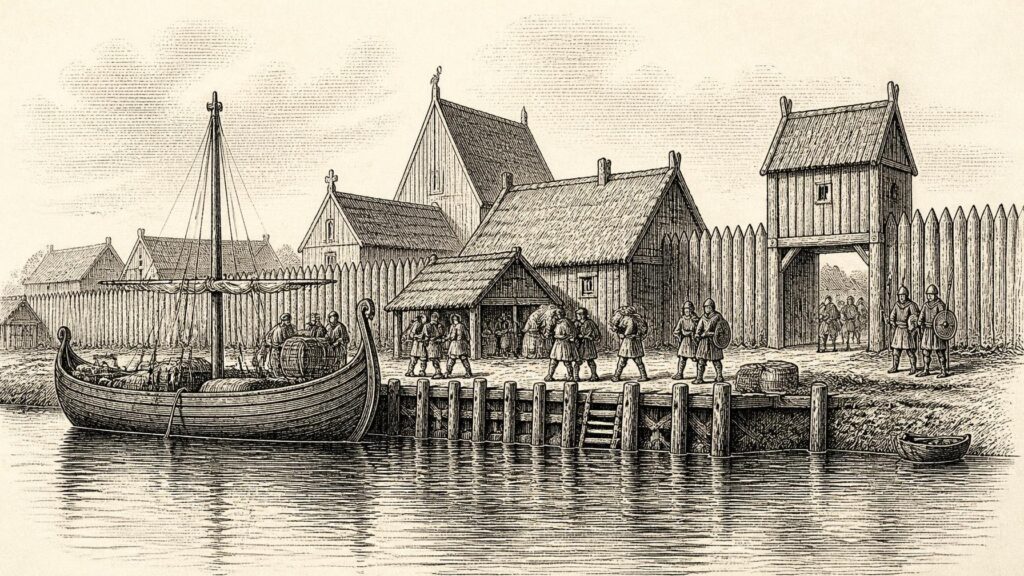
In 934 Dublin was already a permanent Hiberno-Scandinavian settlement, not a temporary raiders’ camp. Its growth rested on the strategic advantages of the Liffey estuary and access to the Irish Sea. Archaeology and wider historical evidence show that Viking-age Dublin had developed into an urban centre with waterfront activity, craft production, exchange and overseas connections. Its inhabitants cannot responsibly be reduced to a single ethnic bloc. Scandinavians, people of mixed Scandinavian and Irish background, Gaelic speakers, captives, traders and visitors all moved through such a port.
For ordinary people, a royal death might have been felt in practical ways: uncertainty over obligations, the security of trade, demands for food and transport, or the risk that armed men would seek reward during a disputed succession. These consequences are plausible features of early medieval lordship, but the sources do not report a disturbance in Dublin during 934. There is no surviving notice of a battle for the town, a burning, a treaty or an assembly. The absence of such a record does not prove that the transition was peaceful; it means only that peace or violence cannot be asserted as fact.
Dublin’s political value rested partly on wealth. Silver, slaves, livestock, imported goods and ecclesiastical valuables all figure in the broader evidence for the Viking age in Ireland. The town’s rulers could use maritime force to raid, but its prosperity also depended on continuing commercial contacts. This double character—armed lordship combined with trade—helps explain why control of Dublin was worth competing for. In 934, the death of Gofraid put that resource-rich settlement into new hands.
Limerick’s Raid into Connacht
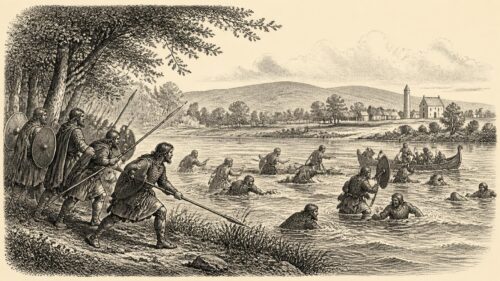
The other major event assigned to 934 by Chronicon Scotorum occurred far from Dublin. It records that the “foreigners of Limerick” raided Connacht as far north as Mag Luirg and as far east as Badhgna. The same raid appears, with a chronological offset, in the later Annals of the Four Masters. The agreement that a Limerick-based force penetrated Connacht lends weight to the event, although neither source supplies a date within the year, the commander’s name, the size of the force, casualties or a list of settlements attacked.
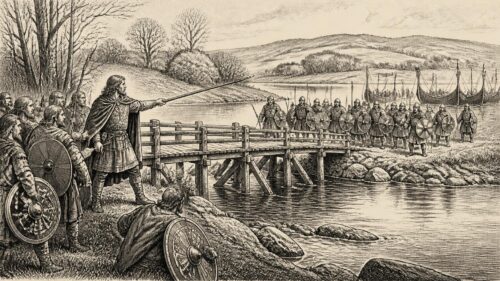
The geography conveys the scale of the incursion. Mag Luirg lay in what is now northern County Roscommon, while Badhgna was a Connacht territory associated with the uplands and plains to the east. Reaching these districts meant more than a quick coastal strike. Limerick’s seaborne warriors and their allies could use the Shannon system and connected waterways as avenues into the island’s interior, then operate across land. The annal’s paired limits—north to Mag Luirg and east to Badhgna—are best understood as a statement of the raid’s reach, not as a complete itinerary.
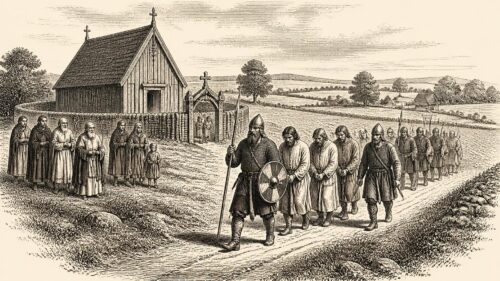
For Connacht communities, raiding was not an abstract political event. A successful force could seize cattle, provisions, valuables and people, damage farms and churches, and compel local rulers to divert warriors from cultivation and other obligations. The sources do not permit a precise account of what was taken in 934, so it would be wrong to attach invented burnings or massacres to the raid. Nevertheless, its inclusion in a terse chronicle indicates that contemporaries judged the expedition notable. It also demonstrates that the Hiberno-Scandinavian towns were not politically united simply because their inhabitants were called “foreigners” by Irish annalists.
The Limerick raiders were a separate force from the Dublin kingship whose succession was unfolding after Gofraid’s death. Rivalry, alliance and temporary co-operation among Dublin, Limerick, Waterford, the northern lough settlements and Irish dynasties were all possible. The evidence for 934 records movement and violence by the Limerick group, but it does not prove that the raid was ordered by, opposed by or even directly connected to Amlaíb’s new authority in Dublin.
Irish Kingship Beyond the Ports
The wider political setting was fragmented. Donnchad Donn of Clann Cholmáin was king of Tara and the foremost Southern Uí Néill ruler. His position gave him considerable standing in the midlands, but it did not make Ireland a centrally governed kingdom. Provincial and local kings retained their own interests, while major dynasties competed for precedence, hostages and military advantage.
In the north, Muirchertach of the Cenél nÉogain was already a formidable military figure, although he did not become king of Ailech until 938. The year before Gofraid’s death had been difficult for him: annalistic evidence records his defeat by Fergal son of Domnall and Sicfrith son of Uathmarán. Thus 934 should not be portrayed as a simple contest between a united Irish polity and foreign settlers. Irish rulers contested one another, while Dublin and Limerick pursued their own ambitions and could ally with Irish kings when advantage required.
In Munster, established Éoganacht power remained important, but other lineages were gaining ground. The death in 934 of Rebachán son of Mothla, king of Dál Cais and abbot of Tuamgraney, is associated by later scholarship with the opening of a period in which Cennétig’s family consolidated its position in Thomond. This was a regional development rather than a sudden island-wide transformation. It is relevant because it shows the political variety of Ireland in Gofraid’s final year: alongside maritime kingships, inland dynasties and ecclesiastical communities were adjusting to their own successions.
Churches, Memory and the Limits of the Evidence
Church institutions remained essential to Irish society. Monasteries and churches were centres of worship, learning, landholding, hospitality and record-keeping; they were also vulnerable repositories of portable wealth. The annals that preserve 934 were written and recopied in ecclesiastical settings, which helps explain their close attention to deaths of rulers, clerics and churchmen, as well as raids. But no surviving annal for this calendar year provides a detailed account of a synod, a new church, a major manuscript or a religious reform.
Nor is there securely dated evidence for a notable harvest failure, flood, frost or epidemic affecting Ireland in 934. Gofraid’s illness cannot be expanded into a general outbreak. The honest historical picture is consequently narrow but significant: a Limerick force raided deep into Connacht; a local chief was killed; and the king who had held Dublin within the Uí Ímair maritime network died painfully of disease. Gofraid’s death did not settle the politics of Ireland. It transferred a strategic town and its sea-facing connections to a new ruler, setting the conditions for conflicts that would become clearer in the years ahead.
Primary Sources
- The Annals of Ulster: Year U934
- The Annals of Ulster
- Chronicon Scotorum: Annals CS930–CS934
- Chronicon Scotorum
- Annals of the Four Masters: Annals M933–M934
- CELT Project: Annals of the Four Masters
- Annals of Inisfallen: Annals AI923–AI929
- Annals of Inisfallen
- Amlaíb (Óláfr Godfridsson)
- Blacair (Blakkr)
- Donnchad Donn
- Muirchertach na Cochall Craicinin
- Cennétig
- The Vikings in Ninth-Century Ireland: Sources and Settlements
- The Vikings in Ninth-Century Ireland: Sources and Settlements (full text)
- Viking Ireland: Afterthoughts
- Kerry’s Viking-Age Silver: A Legacy of Antiquarians, Collectors and Dealers
- Hoards: Viking Age Gold and Silver from Ireland
- Viking Age Gold and Silver from Irish Crannogs and Other Watery Places
- The Vikings in Ulaid