Conaing’s Empty Heirship937 CE
Dateline
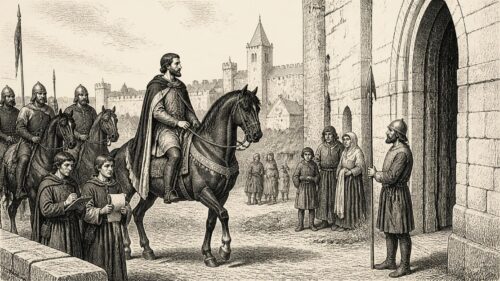
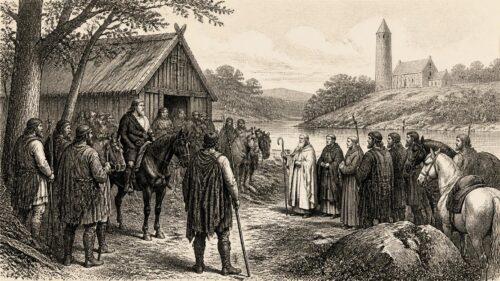
For Ireland, 937 is best understood through a small but unusually revealing cluster of annalistic notices. The record does not offer a single national narrative: it reports deaths, killings and a storm in several provinces, while also preserving Ireland’s connection to one of the most consequential battles of tenth-century Britain. Its most striking Irish political notice is the death of Conaing son of Niall, described in the Annals of Ulster as rígdamna Érenn, ‘heir designate of Ireland’. The phrase did not mean that a settled succession would automatically follow. Rather, it signalled that Conaing stood within the narrow, competitive circle from which an overking might plausibly emerge. His death removed a significant claimant at a moment when power was divided among strong regional dynasties, the rulers of Dublin and Limerick, and the king of Mide, Donnchad son of Flann.
An Heir Dies
The notice of Conaing’s death is securely placed in the annalistic year conventionally treated as 937, although the Annals of Ulster itself labels the heading ‘AD 936 alias 937’. Such qualifications matter. Medieval Irish annals were compiled and copied over centuries; their year-numbers can drift by one or more years between texts. The death itself is not in doubt, since it is also registered by the Annals of Inisfallen, but the precise date within the modern calendar cannot be recovered.
Conaing belonged to the northern Uí Néill world associated with Ailech and Cenél nEógain. His father Niall had been a dominant northern king, and Conaing’s standing placed him beside, and potentially in rivalry with, the more famous Muirchertach son of Niall. The title ‘heir designate of Ireland’ therefore exposes the character of kingship in this period. Ireland did not possess a unitary monarchy in the modern sense. The claim to be king of Ireland rested on military capacity, dynastic pedigree, clientage, church connections and the ability to take hostages or tribute. A recognised heir could still be displaced by illness, violence or the calculations of more powerful kin.
The same year’s entries make the vulnerability of lordship plain. Bruatur son of Duibgilla, king of Uí Chennselaig in south Leinster, was killed. Gairbíth son of Máel Étig, king of Fir Rois in the north-east, was killed by his own kinsmen. Cróngilla son of Cuilennán, king of Conaille Muirthemne around the Cooley–Dundalk region, died of sickness. Mac Étig son of Ainnsemain, king of Mugdorna Maigen, also died. These were not minor footnotes to a stable political map: each death could alter obligations, landholding, marriage alliances and the readiness of a people to follow a successor into war.
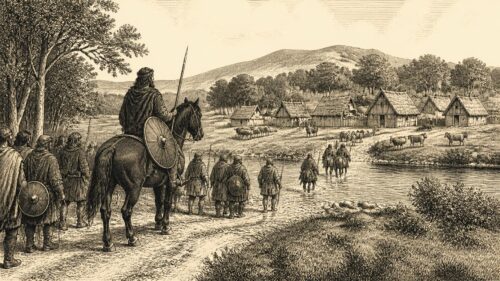
The annals rarely tell us how ordinary households experienced such transitions. Yet a change of ruler had practical consequences. Kings and their followers expected food-renders, livestock, hospitality and fighting men; ecclesiastical communities negotiated with them for protection and privileges. When a king was killed by kinsmen, as Gairbíth was, the conflict was likely to be felt well beyond the immediate killing, in contested succession and local extraction. The short notices consequently preserve the outlines of a society in which political authority was personal, mobile and continually renegotiated.
Dublin’s King at Brunanburh
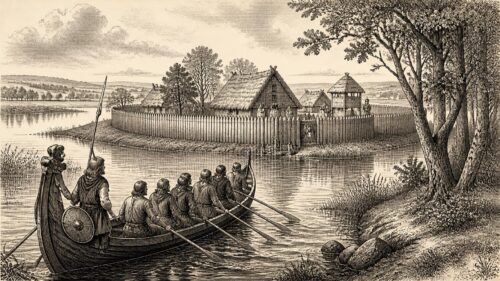
Ireland’s most important connection to events beyond the island came at Brunanburh, fought in 937 somewhere in northern or north-western England, although its exact location remains disputed. Athelstan, king of the English, defeated a coalition led by Amlaíb Guthfrithson, the Norse ruler of Dublin, together with Constantine of Alba and forces from Strathclyde. The Irish annalist called it a great, grievous and terrible battle, stating that vast numbers of Norsemen fell, that Amlaíb escaped with only a few followers, and that Athelstan won a major victory. The wording is emotive and the casualty figure cannot be treated as a modern count, but defeat and Amlaíb’s survival are firm elements of the tradition.
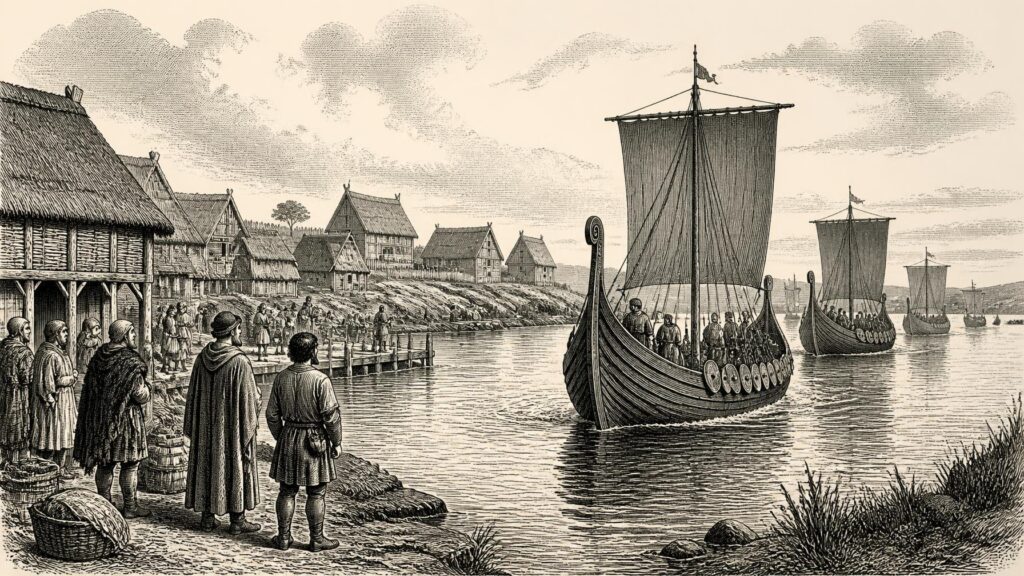
For Irish history, Brunanburh was not merely an English or Scottish affair. Amlaíb was a king based at Dublin, a port-polity embedded in Irish politics and connected by sea to western Britain, northern England, the Isles and Scandinavia. His expedition demonstrates that Dublin’s rulers could project force across the Irish Sea while maintaining interests in Ireland. The battle also shows why it is misleading to imagine a simple opposition between ‘Irish’ and ‘Vikings’. Dublin’s population and political networks had long included people of Scandinavian and Gaelic background; alliances crossed linguistic, religious and regional boundaries when advantage required it.
The English poetic account of the battle says that Amlaíb fled by ship towards Dublin. This broad picture accords with the Irish annal’s statement that he escaped. It does not, however, permit certainty about the number of ships, the route taken, or the experience of every survivor. What can responsibly be said is that news, men and political consequences crossed the sea quickly. Dublin’s position at the mouth of the Liffey made it both a local Irish power and a maritime hinge between Ireland and Britain. The failure at Brunanburh checked Amlaíb’s immediate ambitions in England, but it did not end Dublin’s political significance.
Churches, Offices and Memory
Ecclesiastical entries are equally prominent. Diarmait son of Ailill, superior of Cell Chuilinn, died in old age, and Fedach, superior of Sláine, also died. These notices remind us that a church office was far more than a devotional role. Major Irish churches were landed institutions, centres of worship, burial, literacy and local authority. Their superiors managed estates and dependants, dealt with secular rulers, and helped preserve the learning through which the annals themselves were eventually transmitted.
Later annalistic compilations add further deaths for this year: Máel Domnaig, abbot of Tallaght; Cellach son of Caellaide, prior of Saigir; Finnachta son of Cellach, successor of Doire and a bishop learned in Bérla Féne, the legal language; and Laigén, successor of both Ferns and Tallaght. These entries should be used cautiously. The Annals of the Four Masters was compiled in the seventeenth century from earlier materials, and its chronology does not always align exactly with the Annals of Ulster. Nonetheless, its record is valuable evidence for the interconnectedness of Irish ecclesiastical offices, especially the striking possibility that one churchman could be associated with more than one important foundation.
The reference to Finnachta’s legal learning offers a rare glimpse of specialist knowledge. Law, genealogy, Latin learning, liturgy and vernacular writing circulated through church-based intellectual networks. This was not an age in which every monastery was secluded from the world. Churches could be patrons of scholars, repositories of books and places where kings sought legitimacy; they could also be exposed to seizure, plunder and hostage-taking. The previous year had seen the Dubliners raid Cell Chuilinn, an episode that makes Diarmait’s death in 937 a reminder of a community living under real pressure rather than in monastic isolation.
The Four Masters also records that Donnchad son of Flann, described as king of Ireland, ‘covered’ Cánóin Phádraig. The concise wording does not securely identify the building work or object involved, so it should not be expanded into an invented architectural programme. At minimum, it records royal intervention in a Patrician ecclesiastical setting. Such acts could express piety, prestige and a ruler’s relationship with the church of Patrick, whose authority reached far beyond any single settlement.
Raiding Claims and Chronological Caution
A later account assigns a large Munster expedition to 937. Cellachán, king of Cashel, accompanied by Munster forces and the ‘foreigners’ of Waterford under Macca Cuinn, is said to have entered Mide, taken cattle, plunder and captives, raided churches at Clonard and Killeigh, and carried off two abbots. The same narrative says that men of Uí Fothad and others were left in the hands of Aimergin, king of Uí Fhailge. It is an important illustration of the coalition-building possible between an Irish king and the Scandinavian-associated population of Waterford, as well as the centrality of churches to the landscape of wealth and power.
But this campaign requires careful handling. It is placed under 937 in the Four Masters, not independently confirmed in the surviving 937 entry of the Annals of Ulster, and may reflect chronological displacement in the compilation’s source tradition. It is therefore responsible to treat it as an event attributed to 937 by a later annalistic witness, not as securely dated in the same way as Brunanburh or Conaing’s death. The claim that the foreigners abandoned Dublin in the same Four Masters year should be approached with still greater restraint: other evidence shows continued Scandinavian kingship and activity connected with Dublin. It cannot bear the weight of a claim that the town was permanently deserted.
Wind Over Ailech
The Annals of Inisfallen closes its 937 notices with a ‘mighty wind’. It gives no location, damage assessment or explanation. The observation cannot be turned into proof of a nationwide climatic disaster. It does, however, preserve a glimpse of environmental experience within a year otherwise dominated by political deaths and warfare. For people dependent on crops, livestock, roofs, boats and exposed coastal travel, severe wind could be disruptive even when it did not enter the annals as a catastrophe.
Thus 937 was not a year of a single Irish battle or coronation. Its surviving evidence instead reveals an island tied together by rival dynasties, churches, ports and sea-routes. Conaing’s death left an acknowledged succession claim unfulfilled; regional rulers died violently or from illness; clerical offices changed hands; and Dublin’s king returned from a defeat that reshaped politics across the Irish Sea. The fragmentary record is enough to show a connected, unsettled Ireland, in which power could be proclaimed in an annal but never safely assumed.
Primary Sources
- The Annals of Ulster: Year U937
- Annals of the Four Masters: Annal M937
- Chronicon Scotorum
- Chronicon Scotorum: Text and Translation
- Annals of Inisfallen: Annal AI937
- Annals of the Four Masters
- The Battle of Brunanburh
- The Battlefield of Brunanburh
- On Brytene: Late Old English Poetry and Nation
- 937: Brunanburh and English Triumph at Lanchester, County Durham
- Cambridge, Corpus Christi College, Parker Library MS 173
- Parker Library
- The Collections: Parker Library
- The Anglo-Saxon Chronicle (MS A)
- The Anglo-Saxon Chronicle AD 937
- Exploring the Irish Annals
- Annals of the Kingdom of Ireland: Table of Contents
- Irish School of Illumination, c. 650–1100
- High Crosses
- Clonmacnoise Monastic Site: Highlights
- Monasterboice Monastic Site
- Monasteries and Abbeys
- Rock of Cashel Social Guide