Amlaíb’s Week of Raids935 CE
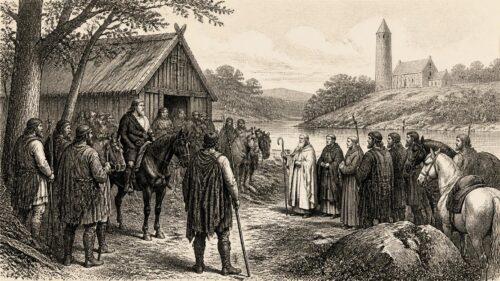
In 935, Amlaíb mac Gofraid, king of Dublin, demonstrated Scandinavian power by sacking Lagore and Knowth in Brega during one week, threatening inland centres. He sought dominance among Irish Scandinavian settlements, reportedly capturing a Limerick rival and installing Haraldr there. Norsemen killed Cinaed mac Cairpre, chief of Uí Chennselaig, with many followers in Leinster. Annals record deaths of abbots and church leaders, underlining monasteries’ political and economic roles, while a notice of abundant oak mast reflects dependence on woodland resources and pig forage. Differing annalistic chronologies complicate dating, but collectively these events reveal interconnected violence, lordship, ecclesiastical succession, and subsistence.
Dateline
The clearest contemporary Irish annalistic dossier for 935 is short, but it is unusually revealing. It records a concentrated assault by Amlaíb, son of Gofraid and grandson of Ímar, on two important places in the Boyne valley; the killing of a Leinster ruler by Norsemen; several notable ecclesiastical deaths; and an exceptional abundance of oak mast. Read together, these notices show an Ireland in which violence, rulership, monastic organisation and the seasonal economy were inseparable. They also require care. Irish annals do not always align their year-numbers: the Annals of Ulster place this dossier under 935 while noting an alternative reckoning, whereas the corresponding material in the later Annals of the Four Masters appears under 933. The events are securely connected with the calendar year conventionally called 935, but no precise day or sequence can be claimed.
A Dublin King Strikes Inland
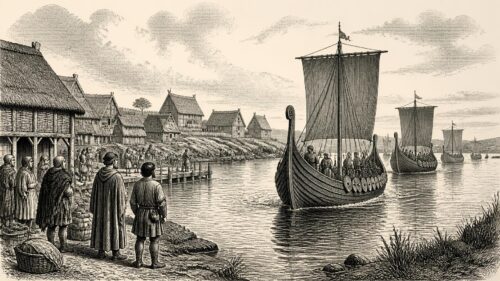
The year’s dominant figure was Amlaíb mac Gofraid, king of Dublin. His father Gofraid had died in 934, leaving him heir to a powerful but contested Irish Sea kingship. The Annals of Ulster state that Amlaíb sacked the island of Loch Gabor and, in the same week, the cave of Cnogba. Loch Gabor is Lagore, near modern Dunshaughlin in County Meath; Cnogba is Knowth, the great ancient ceremonial landscape in the Boyne valley. The wording is spare, but its pairing of targets is eloquent: both lay in Brega, the politically valuable region north of the Liffey and east of the Shannon routeways, near the heartlands of Uí Néill power.
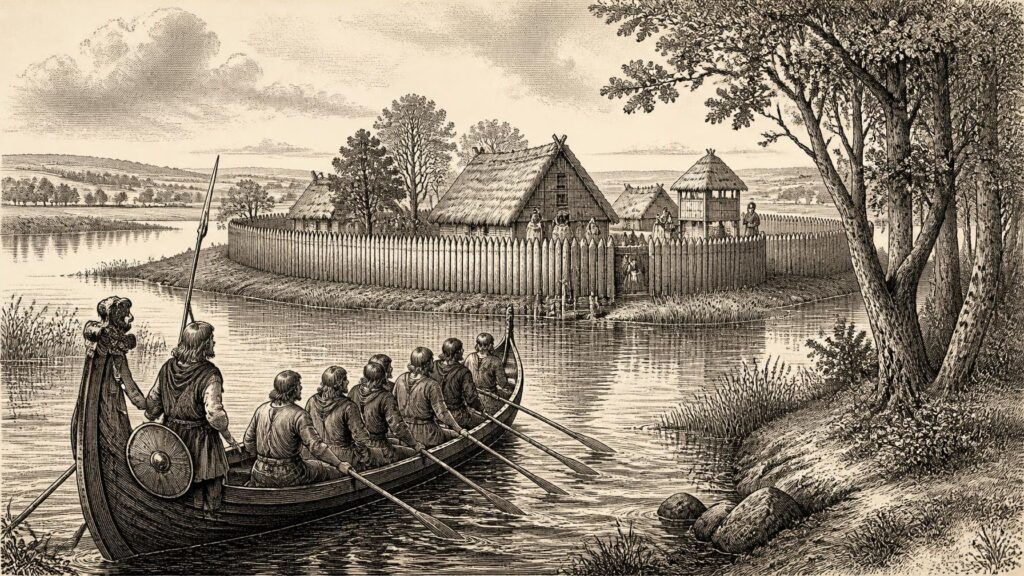
Lagore was no anonymous lake island. Archaeology identifies it as a long-lived, high-status settlement, constructed and rebuilt in the lake shallows with substantial timberwork. It has traditionally been treated as a royal residence of the kings of southern Brega, although recent scholarship rightly cautions that the excavated evidence cannot simply be equated with every claim made by later historical interpretation. Even so, the annals repeatedly associate Loch Gabor with kingship. To sack it was to strike a place of lordly authority, stored wealth, hospitality and political assembly, rather than merely a vulnerable farmstead.
Knowth, meanwhile, was a prominent place in the Boyne landscape long before the tenth century. The annal calls the target its cave, not a church or a royal fort. That prevents any confident reconstruction of what, exactly, was plundered there in 935: the record does not say whether people were killed, enslaved or captured, nor what goods were taken. Yet an attack on Cnogba in the same week as Lagore demonstrates purposeful movement through Brega. Amlaíb’s force had ships, local intelligence and the capacity to operate beyond Dublin’s immediate hinterland.
This was not an old-fashioned raid carried out by strangers who happened to reach Ireland’s coast. Amlaíb belonged to the dynasty that ruled Dublin, and Dublin was by this date a defended settlement, maritime base and increasingly important centre of craft production and exchange. Archaeology from the city reveals houses, workshops, boundaries, walkways, tools, weights, scales and imported materials. Its inhabitants and rulers could trade, make alliances and recruit fighting men, while also launching expeditions for plunder and captives. The same fleets that connected Dublin to Britain, Scandinavia and the wider Irish Sea made its king dangerous to inland communities.
Consolidating Scandinavian Power
Modern biographical reconstruction places another important episode in 935: Amlaíb travelled west to Lough Ree, captured the rival Scandinavian leader Amlaíb Cennchairech of Limerick and destroyed his ships. He then installed his cousin Haraldr in Limerick. The detail belongs to a wider synthesis of difficult annalistic evidence rather than to the brief Ulster entry about Lagore, so it should not be imagined as a tightly dated continuation of the Boyne raids. Nevertheless, it fits the political direction of the year. Amlaíb was not simply gathering booty. He was trying to make Dublin paramount among the Scandinavian centres of Ireland and to command routes from the east coast into the Shannon basin.
Such an ambition had consequences far beyond the Norse-speaking towns. Dublin’s commercial life depended partly on links to Irish districts that supplied foodstuffs, animal products, timber and people. Inland lordships, for their part, faced a neighbour able to exchange goods and silver across the sea yet willing to use armed force against Irish rulers. The distinction between “Viking” and “Irish” therefore cannot explain every political action in 935. Scandinavian forces could ally with Irish dynasties, and Irish kings could exploit them against domestic rivals. What the surviving record does show is that the Dublin kingship had become a major Irish political power, not an external nuisance at the edge of the island.
The raids also foreshadow Amlaíb’s larger Irish Sea career. His later involvement in Northumbrian politics should not be projected backwards as though it were already inevitable in every detail. But control of men, ships and rival ports in 935 would have increased his capacity to pursue power across the water. Ireland’s eastern coast was not peripheral to those ambitions; it was one of their principal foundations.
A Leinster Lord Killed
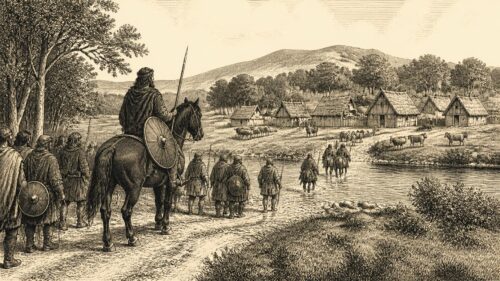
The violence of 935 reached Leinster as well. The Annals of Ulster record that Cinaed, son of Cairpre, chief of Uí Chennselaig, was killed with many others by Norsemen. Uí Chennselaig was a leading dynasty of south-eastern Leinster, rooted in territory broadly associated with parts of modern Counties Wexford and Carlow. The notice offers no battle-name, no motive and no casualty total beyond the significant phrase “many others”. It is safest to understand it as a serious armed killing, not to supply an invented campaign narrative.
The later Annals of the Four Masters, whose relevant entry is chronologically offset, adds that Cinaed died in a nocturnal attack by foreigners of Loch Garman, the Wexford area. That detail is plausible and geographically coherent, but it comes from a much later compilation and should be treated as supplementary rather than as a contemporary certainty. Whether the attackers were directly commanded by Amlaíb is likewise unproved. The important point is secure: Norse military activity cost the Uí Chennselaig their chief and other men in the same year that Brega was raided. Leinster’s coast and river approaches remained exposed to seaborne power, while the death of a dynastic head could alter local alliances, tribute claims and succession calculations.
Churches, Communities and Succession
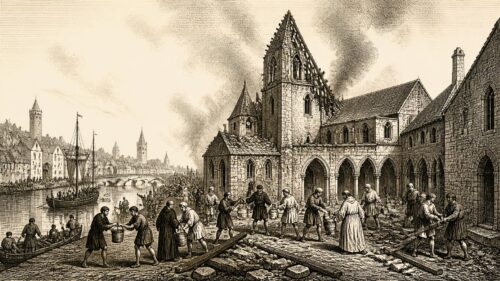
Monastic Ireland also experienced loss. The Ulster annalist notes the death of Cormac, fosterling of Maenach and superior of Achad Bó; of Máel Brigte, superior of Mainister; and of Muiredach, Máel Brigte’s son, superior of Dam Liac, who died young. These were not minor occupational labels. A superior or abbot oversaw a religious community but could also manage land, tenants, rents, hospitality, learning, ecclesiastical clients and relationships with neighbouring rulers. Their passing mattered to institutions embedded in regional society and economy.
The sources complicate the picture. The Annals of Inisfallen place the repose of Mac Lenna, abbot of Imlech Ibuir, in 935. The Annals of the Four Masters, in its differently numbered corresponding annal, says that Cormac and Mac Lenna were slain, while it records the deaths of Máel Brigte and Muiredach. These variations warn against treating any one medieval compilation as a transparent report. They do, however, agree on the wider reality: prominent churchmen and ecclesiastical heads were dying or being remembered across Ireland, from Achad Bó and Damliag in the north-east to Imlech Ibuir in Munster.
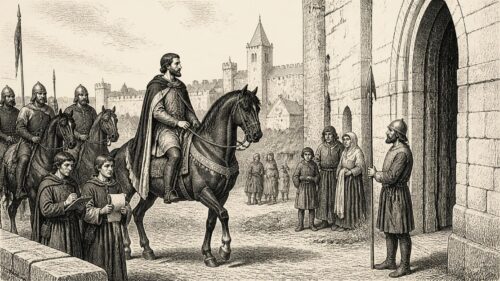
A further Ulster notice, set in parentheses in the modern edition, says that Conchobor son of Domnall, heir designate of Ailech, died and was buried in the cemetery of kings at Ard Macha. Because of its editorial presentation and the complexities of annalistic transmission, it is prudent not to build a detailed northern succession crisis upon it. Even so, the notice preserves something important about political culture: royal heirs were identified before accession, and Armagh’s royal cemetery offered a setting of exceptional dynastic prestige. Church and kingship were not separate worlds. Burial at Armagh publicly joined lineage, territory and sacred authority.
Oak Mast and Ordinary Provision
Among the deaths and attacks, the annalist inserted a brief environmental observation: an abundance of oak mast. Mast means the crop of acorns and other tree-fruits, here specifically acorns. This is one of the few direct glimpses of seasonal conditions in 935. It should not be inflated into proof of island-wide prosperity, nor can it tell us exactly which woods produced most heavily. But an annalist thought the crop notable enough to record, and that itself indicates how closely communities watched woodland resources.
For rural households, a heavy acorn crop had practical value. Oaks formed part of managed and contested landscapes, providing timber, fuel and forage; acorns could support pigs, an important source of meat and fat. A mast year may therefore have eased autumn feeding in some places, while also attracting animals and people to woods whose use was regulated by local lordship. The juxtaposition is striking rather than contradictory. In 935, a favourable natural abundance could be recorded in the same annal as raids, killings and the deaths of church leaders. Security and sustenance varied sharply by locality.
A Year of Reach and Vulnerability
Nothing in the evidence permits a grand claim that 935 transformed Ireland in a single stroke. Its surviving notices are fragmentary, and the date of several entries must be handled through the differing chronologies of the annals. Yet the year captures a real pattern. Amlaíb of Dublin could project force into Brega and, probably through related campaigning, assert influence across Scandinavian Ireland. A leading Leinster dynasty lost its chief to Norse violence. Monastic communities marked changes in leadership. Rural observers noticed the abundance of acorns.
These are not separate stories. Political power rested upon control of people, food, land, waterways, religious institutions and the ability to take or protect movable wealth. The raids on Lagore and Knowth exposed the vulnerability even of prestigious inland places; the record of oak mast recalls the productive landscapes on which every lordship depended. In that tension between maritime raiding power and local resilience lies the historical significance of Ireland in 935.
Primary Sources
- The Annals of Ulster, Year U935
- The Annals of Ulster
- Annals of the Four Masters, Part 4
- Annala Rioghachta Eireann: Annals of the Kingdom of Ireland by the Four Masters
- Annals of Inisfallen, Part 49
- Annals of Inisfallen
- Chronicon Scotorum
- Amlaíb (Óláfr Godfridsson), Dictionary of Irish Biography
- Congalach Cnogba, Dictionary of Irish Biography
- Viking, National Museum of Ireland
- Early Medieval Ireland: Archaeological Excavations, 1930–2009
- Early Medieval Ireland: Archaeological Excavations 1930–2009 – Text for Royal Irish Academy
- Residence, Ritual and Rulership: A State-of-the-Art for Royal Places in Early Medieval Ireland
- The Archaeology of Ireland’s Viking-Age Towns
- The Vikings in Ninth-Century Ireland: Sources and Settlements
- The Vikings in Ninth-Century Ireland: Sources and Settlements – Full Text
- Viking Dublin Was a Town of Merchants and Craftsmen
- Dublin’s Foundations: A Viking Legacy
- Irish Historic Towns Atlas
- Vikings in Early Medieval Ireland: Church-Raiding, Politics and Kingship
- Vikings in Early Medieval Ireland: Church-Raiding, Politics and Kingship – Review
- AD 930 ‘Foreigners on Loch Bethrach in Osraige.’ (A.U. 930.3)
- What Is a Mast Year?
- Guide to the National Museum of Ireland