Tomrair’s Shannon Offensive922 CE
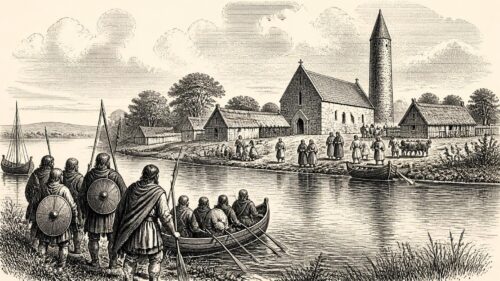
In 922, despite differing annalistic dates, Tomrair son of Elgi led a Limerick-based Scandinavian fleet up the Shannon. The force plundered Inis Cealtra, Muicinis, Clonmacnoise and Lough Ree’s islands, burned Clonmacnoise, and ravaged Mide, carrying away gold, silver and other wealth. The campaign demonstrated the Shannon’s strategic importance and exposed the vulnerability of major ecclesiastical and political networks. Clonmacnoise was a populous, wealthy religious and economic centre, not an isolated monastery. The expedition indicates Limerick’s capacity as a naval base, though not proven urban foundation. Meanwhile, Donnchadh of Tara suffered defeat near Athlone, highlighting Ireland’s fragmented authority and raiders’ opportunities.
Dateline
What Can Be Dated
The year conventionally labelled 922 is unusually revealing, but it demands care. Ireland’s surviving annals do not always align their year-numbers exactly: the Annals of Ulster head their relevant notice “921 alias 922”, while the Annals of Inisfallen place the principal campaign under 922. The broad sequence is nevertheless secure. A fleet based at Luimnech, or Limerick, penetrated the Shannon system, attacked major ecclesiastical communities and carried its operations into the midlands. This was not a single isolated robbery. It showed how a well-led Scandinavian force could use Ireland’s waterways to turn western access into a threat to the island’s political and religious heartlands.
The leader is called Tomrair son of Elgi in the Annals of Inisfallen. The Annals of Ulster, describing the same Lough Ree expedition, calls the force the fleet of Limerick, “that is, of Ailche’s son”. The forms are generally understood as referring to the same commander, though the evidence does not permit a confident reconstruction of his Scandinavian name, family or earlier career. It is safest to retain the annalists’ testimony: in 922 Tomrair headed a Limerick-based force of formidable reach.
Up the River Highway
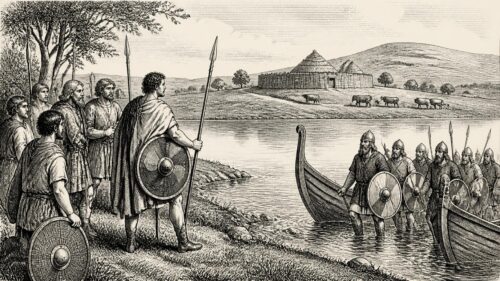
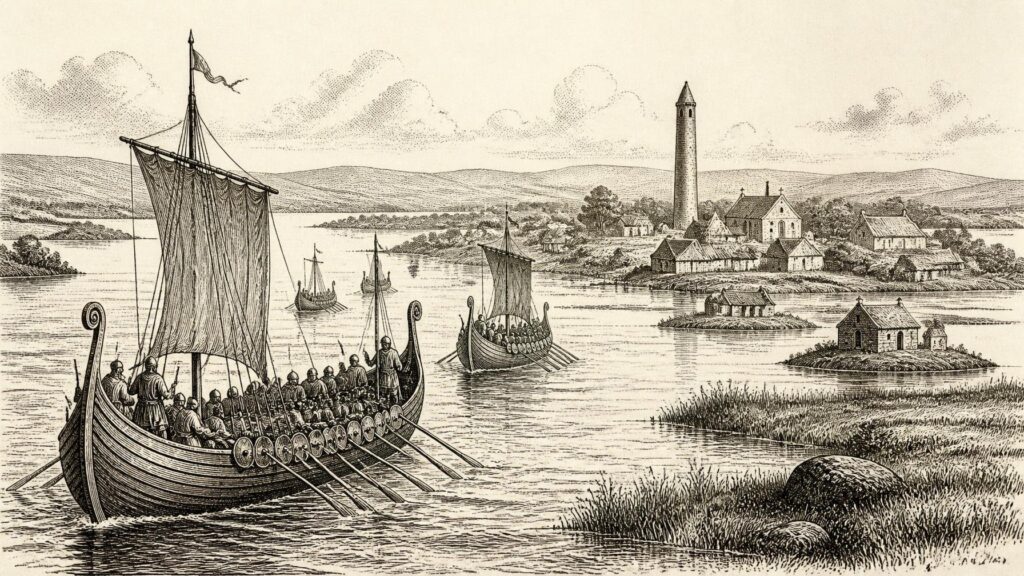
The route recorded by Inisfallen conveys the scale of the operation. Tomrair first plundered Inis Cealtra and Muicinis, communities on or beside the Shannon’s upper estuarine and lake-linked route. He then burned Clonmacnoise, proceeded on to Lough Ree, plundered all its islands, and ravaged Mide. Ulster independently confirms the decisive central portion: the Limerick fleet came onto Lough Ree, plundered Clonmacnoise and the lake islands, and took substantial booty in gold, silver and other treasure.
For contemporaries, this geography mattered as much as the violence. The Shannon was not a distant frontier but one of Ireland’s great corridors of movement. A force entering from the west could travel through its estuary and lakes, choose landing places, strike communities distributed along the water, and threaten territories connected to the road and river crossings of the midlands. Lough Ree, broad and island-strewn, offered both targets and temporary operating space. The campaign demonstrated that a fleet did not need to besiege a royal centre in order to exert political pressure: it could disrupt the people, resources and institutions on which kingship depended.
The annals’ language should not be softened. Clonmacnoise was burned; its islands and neighbouring communities were plundered; Mide was ravaged. Yet neither should it be reduced to a picturesque tale of ships attacking helpless monks. These were organised armed expeditions operating in a landscape of kings, local rulers, lay dependants, clergy, artisans, tenants, cattle-herders and travellers. The raiders’ mobility was formidable, but their campaign also depended on knowledge of navigable waters, landing places, food supplies and rich targets. The phrase “great booty in gold, silver and much treasure” points to a material world in which portable wealth could be concentrated, seized and carried away.
Clonmacnoise in the Line of Fire
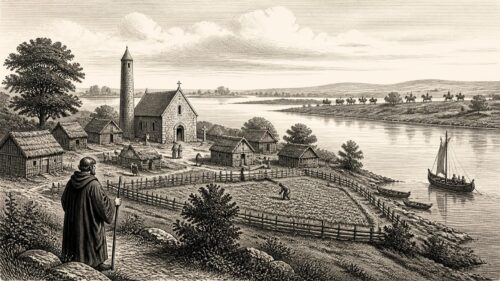
Clonmacnoise was a particularly consequential target. Situated beside the Shannon near the central crossing routes of Ireland, it was more than a secluded religious house. By the early tenth century it was a large ecclesiastical settlement with a substantial lay population, estates, craftsmen and learned personnel, as well as religious buildings and burial grounds. Its religious prestige, economic resources and location made it valuable in several senses at once. To strike it was to acquire wealth, but also to announce that no celebrated church community was beyond the reach of a river fleet.
Several deaths placed by annalistic tradition in this year underline the human and institutional density surrounding the raid. Ulster records the deaths of Ferdálach, bishop of Clonmacnoise, and Rumán, bishop of Clonard, alongside Colgú, abbot of Slane, Loingsech, household steward of Duleek, and other churchmen. The entries do not say that these people died in Tomrair’s attack, and it would be wrong to imply that they did. Their juxtaposition in a yearly record is nevertheless a useful reminder of the network endangered by disruption: monasteries were linked by office, patronage, learning, estate management and travel, not isolated islands of prayer.
Clonmacnoise’s resources included more than precious objects. A major church centre accumulated books, liturgical equipment, food renders, livestock, skilled labour and political connections. Its inhabitants also maintained the routines from which these resources arose: cultivation and herding on dependent lands, boat traffic, hospitality, teaching, manuscript work and the care of visitors and pilgrims. The burning recorded for 922 would therefore have affected a community whose daily life extended well beyond the clergy named in the annals. The sources do not describe the recovery, so its immediate human cost cannot be calculated.
Limerick’s Emerging Power
The expedition also illuminates a change around Limerick. Scandinavian activity had long touched the lower Shannon, and a Viking ship-camp or longphort is attested there in the ninth century. Modern historians often treat 922 as a key moment in the refoundation or consolidation of a more durable Limerick settlement, sometimes associated with King’s Island. That interpretation is plausible, but the annals themselves do not say, “a town was founded in 922”. They record a leader and fleet at Limerick, not the laying-out of streets or the building of a permanent settlement. Archaeological evidence for Viking-age Limerick remains much thinner than that for Dublin and Waterford.
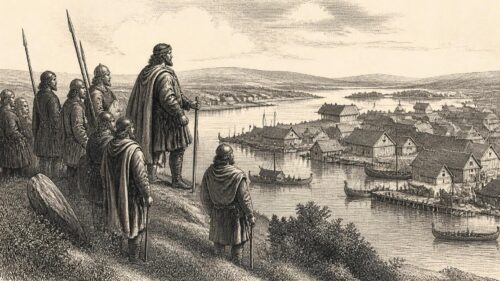
What can responsibly be said is that the campaign reveals Limerick as an effective operational base. It could furnish ships, men and supplies for a sustained movement far up the Shannon. Such capacity suggests more than a fleeting landing party, whether its exact base was a fortified camp, a developing settlement or a combination of harbour, stronghold and allied territories. The raids brought wealth towards the lower Shannon and probably helped advertise Tomrair’s authority among both Scandinavian followers and Irish neighbours. At the same time, success created enemies and rivals. Limerick’s later tenth-century history would be shaped by competition with Dublin’s rulers and by shifting alliances with Irish dynasties; 922 belongs to the opening phase of that contest, not to its conclusion.
Kingship Beyond the Fleet
The same annalistic year records the limits of authority on land. Chronicon Scotorum says that Donnchadh, king of Tara, led an army into Connacht and that a great number of his followers were slain in the wilderness of Áth Luain, including Cináed son of Conchobor, king of Uí Fhailge. This was a serious reverse for a ruler whose standing rested on military leadership as well as tribute and alliances. Donnchadh had become the leading claimant to the kingship of Tara after the death of his brother Domnall in the previous year; his position did not make the west obedient.
That entry is significant beside Tomrair’s river campaign. Ireland in 922 was not governed by a central state able to direct a unified response to every threat. The kingship of Tara carried exceptional prestige, but practical power was negotiated through provincial kings, lesser dynasties, church communities, clientage and hostage relationships. A defeat near Athlone, on the approaches to the Shannon corridor, exposed the risks of campaigning across such a landscape. It also helps explain why mobile raiders could exploit political fragmentation without needing to conquer Ireland.
Other recorded deaths show regional politics continuing amid the wider crisis. Tadc son of Faelán, king of Uí Chennselaig in south Leinster, died; so too did Cernach son of Flann, superior of Lann Léire and steward of Armagh’s community over a wide stretch of Brega. Their deaths were not necessarily caused by violence. But each removed a person whose office tied locality to a larger political or ecclesiastical order. In early medieval Ireland, succession was rarely a merely private matter: a king’s death could alter alliances, while the loss of an ecclesiastical steward could affect the management of tribute, hospitality and church lands.
A Year of Connected Vulnerability
922 is remembered chiefly because Tomrair’s ships reached deep into Ireland. The raid’s importance lies not simply in destruction at named sites, but in what it exposed. Rivers joined Limerick to Lough Ree, Mide and the great monastery of Clonmacnoise; church wealth and influence drew raiders as surely as royal cattle and tribute did; and political authority remained dispersed enough that neither Tara nor any local lord could guarantee security across the waterways.
The year should not be made into a simple confrontation between “Irish” and “Viking” worlds. The annals distinguish foreigners from Irish communities, but the political landscape already included trading, raiding, settlement and negotiation across the Irish Sea. Nor should the Limerick force be imagined as an inevitable future city in embryonic form. Its campaign is firmer evidence for naval power than for urban form. Even so, the events recorded in 922 make one point unmistakable: the lower Shannon had become the launching place for a new and dangerous centre of power, and the midlands felt its reach.
Primary Sources
- The Annals of Inisfallen, Annal AI922
- The Annals of Ulster, Year U922
- Chronicon Scotorum, Annals CS920–CS924
- Annals of the Four Masters
- Annals of the Four Masters, Part 2
- The Annals of Ulster
- Annals of Inisfallen
- Chronicon Scotorum
- Irish Texts at CELT
- Exploring the Irish Annals
- The Vikings in Ninth-Century Ireland: Sources and Settlements
- Limerick: Irish Historic Towns Atlas, no. 21
- Limerick
- The Viking Age in Ireland
- Clonmacnoise Monastic Site
- Clonmacnoise Visitor Guide
- Irish School of Illumination, c. 650–1100
- Limerick: Irish Historic Towns Atlas, no. 21 – Royal Irish Academy
- The Archaeology of Ireland’s Viking-Age Towns
- The Vikings