Gofraid’s Armagh Foray921 CE
In 921, amid uncertain annalistic dating, Ragnall grandson of Ímar died and Gofraid assumed control of Dublin, reshaping Irish Sea politics alongside Sitriuc’s succession in York. Donnchad Donn strengthened his precarious position through the deceitful killing of his brother Domnall, while another heir died. Scandinavian fleets operated in the north-west, but Fergal’s forces destroyed one vessel. On 10 November Gofraid raided Armagh’s hinterland, sparing its principal religious community yet inflicting serious disruption; Muirchertach later defeated part of his force. Ecclesiastical leaders died, one source recorded plague, and warfare threatened rural livelihoods across politically fragmented Ireland and its interconnected maritime world.
Dateline
The events conventionally placed in 921 reveal an Ireland in which political authority, religious prestige and sea power were tightly entangled. The year is unusually well illuminated by the Irish annals, but it also demonstrates why their dates must be handled carefully. The Annals of Ulster labels its section “920 alias 921”, while the related annalistic traditions sometimes distribute the same events under neighbouring years. This article therefore treats the sequence as belonging to 921 in modern historical convention, while avoiding claims for exact dates except where an annal itself supplies one.
A New Ruler in Dublin
At the centre of the year stood a change in the Scandinavian leadership of Dublin. Ragnall grandson of Ímar, whom the Annals of Ulster calls king of both the “fair foreigners” and “dark foreigners”, died. Those labels were Irish annalists’ customary, and not always consistent, terms for Scandinavian groups; they should not be mistaken for precise ethnic descriptions. Ragnall’s death mattered in Ireland because his power had stretched across the Irish Sea world, linking Scandinavian interests in Ireland, northern Britain and York.
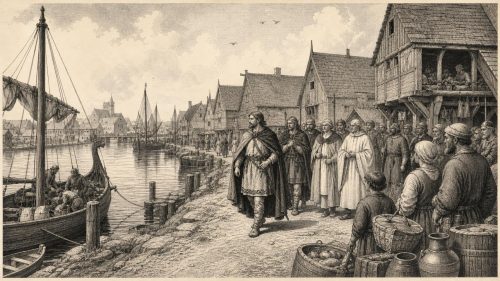
Gofraid grandson of Ímar then “entered Áth Cliath”, the settlement at Dublin. The Annals of Inisfallen similarly says that he took Dublin. This was not the foundation of a new town: Scandinavian power had been restored there in 917 after an earlier expulsion, and Dublin was already a defended riverside settlement, harbour and political base. But Gofraid’s arrival marked a significant redistribution of authority within the Uí Ímair, the dynasty associated with Ímar. Ragnall’s death also cleared the way for Sitriuc Cáech, another member of that kindred, to succeed in York. Thus the political shift at Dublin belongs to a wider Irish Sea realignment, rather than an event confined to the mouth of the Liffey.
It would be misleading, however, to picture Gofraid as ruler of an isolated foreign colony facing a united Irish kingdom. Dublin depended upon ships, mobile warbands, alliances and access to food, labour and commodities from its hinterland. Gaelic rulers likewise negotiated, fought and sometimes competed with one another while responding to Scandinavian power. The annals’ language of “foreigners” records a real cultural and political distinction, but the workings of power in 921 were more complicated than a simple Irish-versus-Viking frontier.
Violence Within the Southern Uí Néill
The year also exposed the fragility of Donnchad Donn’s authority in the midlands. Donnchad, son of Flann Sinna, had become overking after the death of Niall Glúndub in battle against the Dublin Scandinavians in 919. Yet the kingship of Tara was never an automatic national monarchy. It rested on kinship, military followings, tribute, hostages and the ability to dominate rival branches of the Uí Néill.
In 921, Donnchad’s brother Domnall was killed by him. The Chronicon Scotorum places the killing at Bruiden Dá Choca and calls Domnall royal heir of Tara and king of Mide; the Annals of Ulster also portrays the death as a deceitful fratricide. Such wording preserves a moral judgement as well as political news. It tells us that contemporaries considered the manner of the killing reprehensible, even in an aristocratic world where violent succession disputes were familiar.
Another dynastic loss followed: Máel Sechnaill, grandson of Flann and heir-designate of Tara, died while still young. The death of an heir was more than a private bereavement. A ruler’s household was the machinery through which claims, alliances and future leadership were secured. In one year Donnchad’s immediate kin group lost both a potential rival and a prospective successor. The result was not peace, but a reminder that the apparent supremacy of Tara rested on unstable foundations.
Fleets in the North-West
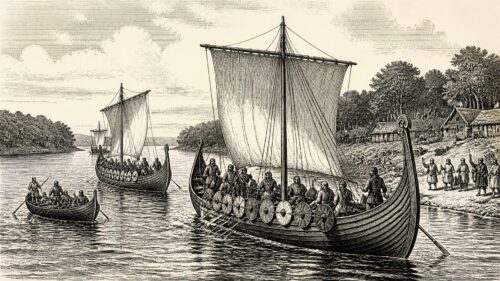
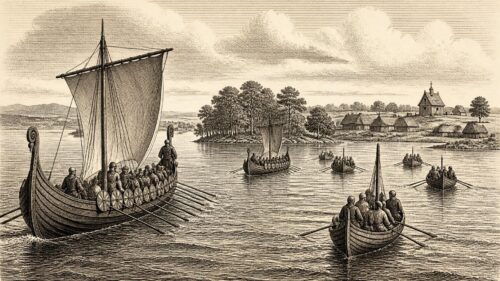
Sea routes brought danger to a different part of Ireland. The Annals of Ulster records a force under Acolb entering Loch Foyle with thirty-two ships. It also reports a second naval group of twenty ships at Cenn Magair, on the coast of Tír Chonaill, led by a son of Uathmarán son of Bárid. The figures may reflect annalistic reporting rather than an exact naval muster, but they nonetheless indicate operations on a scale far beyond a single raiding boat.
The first force abandoned Cennrig almost entirely, leaving only a few behind. Fergal son of Domnall, king in the north, opposed the raiders: his men killed the crew of one ship, wrecked it and took its booty. This compact notice is valuable. It shows that naval warfare was not solely a matter of Scandinavian attackers striking helpless coasts. Local rulers could assemble resistance, attack vessels and recover movable wealth. Ships were instruments of mobility, but also vulnerable assets whose loss meant dead crews, diminished striking power and forfeited goods.
The place-names show why control of waters mattered. Loch Foyle and the Tír Chonaill coast connected north-western Ireland with the Hebrides, western Scotland, Man and the wider Irish Sea. These were not peripheral waters. They were channels along which people, livestock, slaves, military equipment, prestige goods, news and ecclesiastical travellers could move. The annal does not tell us the raiders’ intended destination or the social composition of their crews, so neither should be invented; its clear evidence is of substantial maritime pressure and an effective northern counterstroke.
Armagh on 10 November
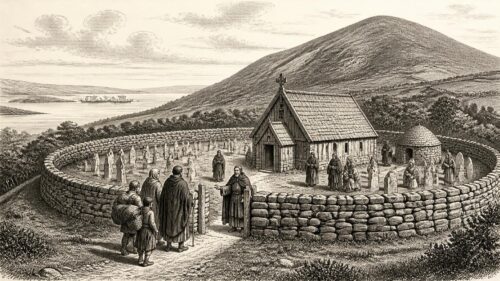
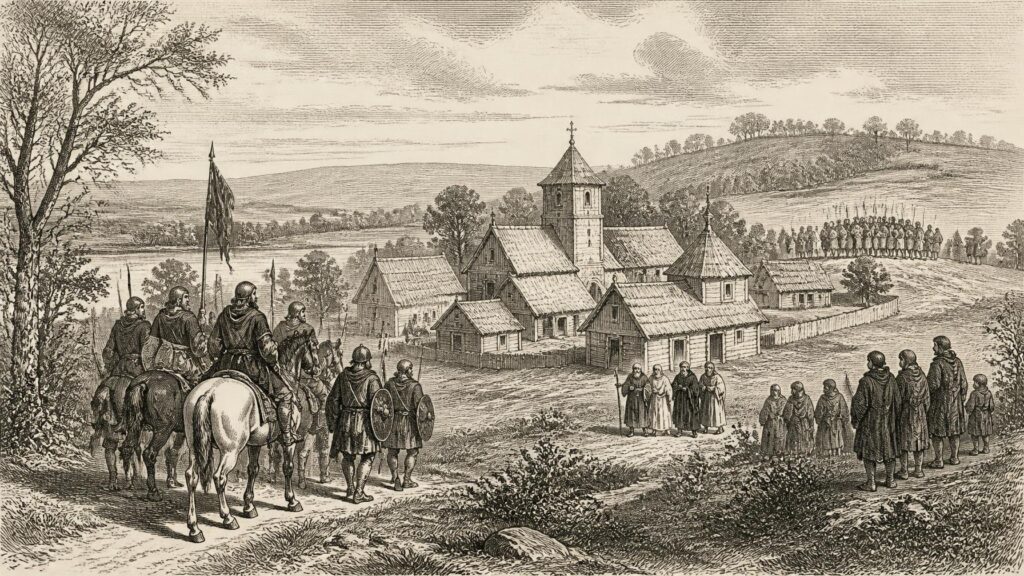
The firmest date in the record comes late in the year. On Saturday, 10 November, the Saturday before Martinmas, Gofraid led the Dublin force into Armagh. Armagh was no ordinary monastery. Its association with St Patrick gave it exceptional religious authority, while its churches, learned community, landed interests and networks of dependent churches made it a major institutional power in northern Ireland.
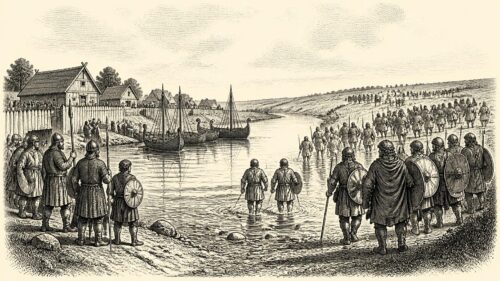
The annalist’s description is unusually discriminating. Gofraid spared the prayer-houses, their céle Dé communities and the sick, and also spared the monastery itself, apart from a few dwellings said to have caught fire through carelessness. The force nevertheless harried a wide surrounding zone: west to Inis Ua Labrada, east to the Bann, and north to Mag Ilesen. This was grave violence even without a reported destruction of Armagh’s principal church buildings. Raiding could mean the seizure of food, animals, valuables and captives, the burning of smaller settlements, and the disruption of the agricultural and pastoral resources on which an ecclesiastical centre depended.
The sparing of particular sacred and vulnerable groups should not be romanticised as a general act of mercy. It may reflect calculation, the need to manage relations with a prestigious church, customary restraints, or a combination of such motives. Yet it matters that the annal records the distinction. The Dublin leadership had the capacity to threaten Armagh directly, but did not reduce its religious core indiscriminately. Violence and diplomacy could operate together.
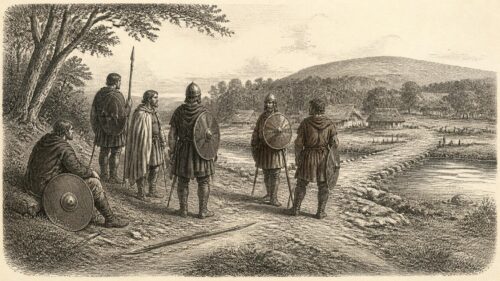
Gofraid’s northern detachment did not escape unchallenged. Muirchertach son of Niall, a leading representative of the northern Uí Néill and son of the slain Niall Glúndub, joined Aignert son of Murchad in catching the party that had travelled north. They defeated it, leaving many dead; only a few escaped as dusk fell. The entry supplies neither a precise battlefield nor a casualty total, but its political meaning is plain. Muirchertach could present himself as defender of northern interests and as an active opponent of Dublin at a moment when Donnchad’s southern kingship was compromised by internal bloodshed.
Churches, Learning and Loss
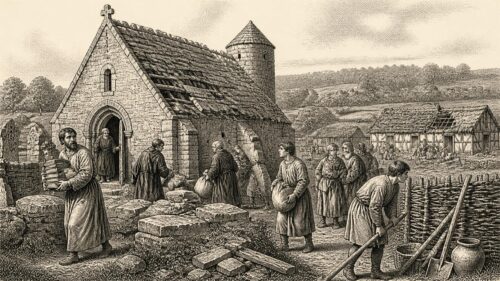
War dominates the surviving narrative, but 921 was also marked by losses in ecclesiastical and learned institutions. Máenach son of Siadal, successor of Comgall—therefore head of the community associated with Bangor—died. The Annals of Ulster styles him “chief master of erudition in the island of Ireland”. Such a title is evidence of esteem, not a measurable national office, but it confirms the importance attached to teaching, textual learning and scholarly reputation in Irish church communities.
Ciarán, abbot of Daiminis, also died, as did Cinaed son of Domnall, superior of Daire Calgaig and Druim Tuama and chief counsellor of Cenél Conaill. These notices reveal the close connections between churches and regional politics. An abbot or superior could be a spiritual leader, manager of property and hospitality, guardian of learning, and adviser to a ruling people. Their deaths altered local balances of influence even where no conflict is reported.
Chronicon Scotorum alone places “a great plague in Ireland” in this year. The entry should be taken seriously, but cautiously. It gives no disease, locality, duration or mortality figure, and the corresponding notice is absent from the Annals of Ulster. It is responsible to record that one important annalistic tradition remembered a major outbreak; it is not responsible to reconstruct its medical character or claim that it transformed every region of Ireland.
Life Beyond the Annals
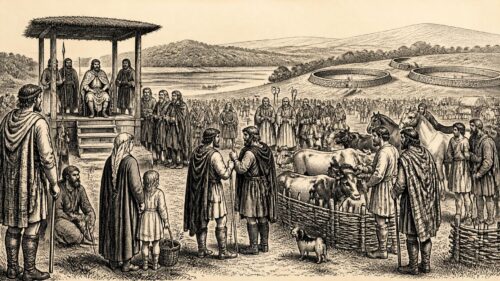
The annals focus on rulers, fleets, churchmen and calamities because these were the matters their compilers considered worth recording. Most people in 921 lived beyond that narrow beam of light. Ireland remained predominantly rural, organised through many small kingdoms and local lordships. Cattle were a principal store of wealth and social standing, while cereal cultivation, dairying, herding, milling, craftwork and household production sustained communities. Ringforts, crannogs, dispersed farmsteads and ecclesiastical settlements structured much of the inhabited landscape; Dublin was an important exception, increasingly shaped by maritime exchange and settlement.
For ordinary households, the year’s conflicts had immediate material consequences: a fleet in a lough, an army ranging through a district, or a raid around an ecclesiastical centre could threaten stores, stock, seasonal labour and personal safety. But evidence does not permit a day-by-day reconstruction of their experience. What can be said is that 921 joined political succession, coastal warfare and ecclesiastical vulnerability in a single pattern. Gofraid’s assault on Armagh was its sharpest episode: a Dublin ruler demonstrated formidable reach, while northern Irish leaders showed that such power could still be resisted.
Primary Sources
- The Annals of Ulster, Year U921
- Annals of Inisfallen, Annals AI920–AI922
- Chronicon Scotorum
- Annals of the Four Masters
- The Annals of Ulster, Year U920
- The Annals of Ulster, Year U918
- Annala Uladh: Annals of Ulster Otherwise Annala Senait, Annals of Senat
- Chronological Synchronisation of the Irish Annals
- The Chronology and Sources of the Early Irish Annals
- The ‘Annals of Ulster’, 912–1100
- Ragnall
- The Vikings in Ninth-Century Ireland: Sources and Settlements
- Vikings in Early Medieval Ireland
- Agriculture, Settlement and Society in Early Medieval Ireland
- The Archaeology of Livestock and Cereal Production in Early Medieval Ireland, AD 400–1100
- The Vikings in Ireland
- Annals of Inisfallen
- Fragmentary Annals of Ireland
- The Annals of Tigernach
- Irish Annals Edition Directory