Cell Mo-Chellóc’s Viking Battle927 CE
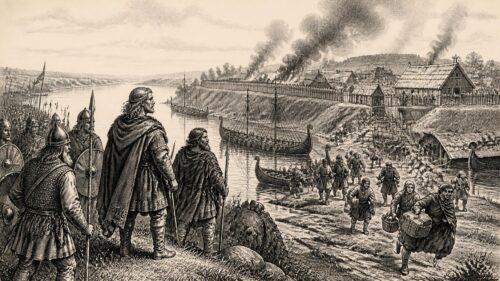
In 927, the Annals of Inisfallen record a Munster and Limerick Scandinavian victory over Waterford’s foreigners at Cell Mo-Chellóc, probably Kilmallock, demonstrating shifting alliances among Irish kingdoms and Viking settlements. They also note the death of Máel Brigte, abbot of Armagh and Iona, whose dual leadership united ecclesiastical federations. Other annals, chronologically offset, describe Dublin’s instability under Gofraid, Sitriuc’s death, and a bloodless confrontation at Tailtiu, reflecting contested Uí Néill authority. Later sources report churchmen, pilgrimage and raids, but their dating is uncertain. Together, the evidence depicts interconnected warfare, religious prestige, travel and political rivalry across Ireland and Irish Sea.
Dateline
For Ireland, 927 is best approached as a carefully bounded annalistic year rather than as a neatly documented twelve-month story. The surviving chronicles do record significant events under this date, but they do not always agree on placement. The Annals of Inisfallen, compiled within a Munster-centred tradition, place two matters firmly beneath 927: the death of Máel Brigte son of Tornán, abbot of Armagh and of Í Coluim Chille, and a victory at Cell Mo-Chellóc over the foreigners of Waterford. Other annals attach related political news to headings whose year-counts can differ by one year. The differences are not a licence to move events casually between dates; they are part of the evidence. What can securely be said is that 927 found Ireland’s regional kings, churches and Scandinavian towns bound together by warfare, travel and competition for authority.
A Munster Victory at Cell Mo-Chellóc
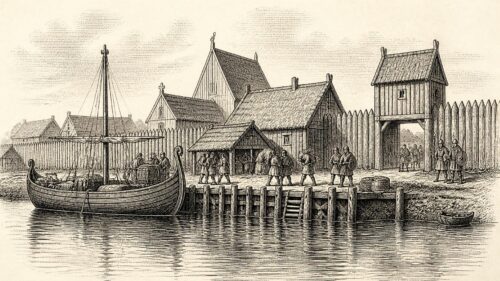
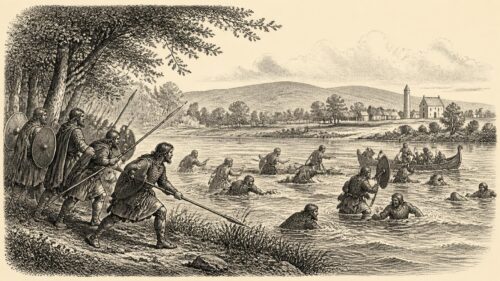
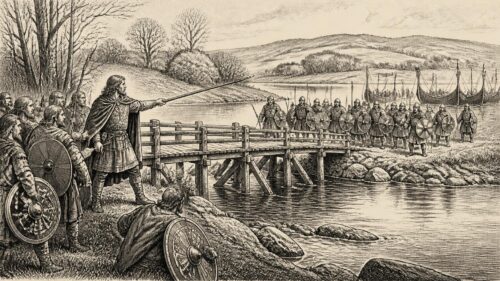
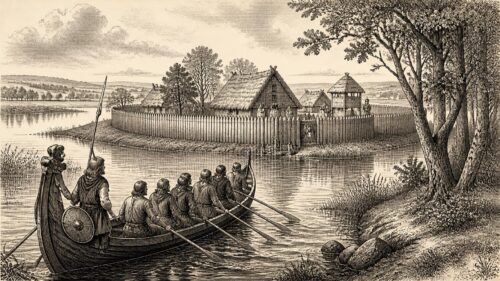
The most striking incident securely entered for 927 in the Annals of Inisfallen was “a slaughter” of the foreigners of Port Láirge, Waterford, at Cell Mo-Chellóc, inflicted jointly by the men of Mumu, Munster, and the foreigners of Luimnech, Limerick. Cell Mo-Chellóc is generally identified with Kilmallock in modern County Limerick. The wording is compressed, as annalistic notices commonly are: it gives neither numbers nor the immediate cause, and it does not identify commanders. It nevertheless preserves an important fact. Scandinavian forces based at Limerick fought on the same side as a Munster army against a Scandinavian force associated with Waterford.
This is a useful corrective to the crude picture of an Ireland divided simply between “Irish” and “Vikings”. By the early tenth century, the maritime settlements at Dublin, Waterford and Limerick were political centres with their own interests and rivalries. Their rulers and armed followings might attack Irish churches and kingdoms, but they also made situational alliances with Irish dynasties against competing Scandinavian groups. At Cell Mo-Chellóc, ethnic labels did not determine the sides. Local advantage did.
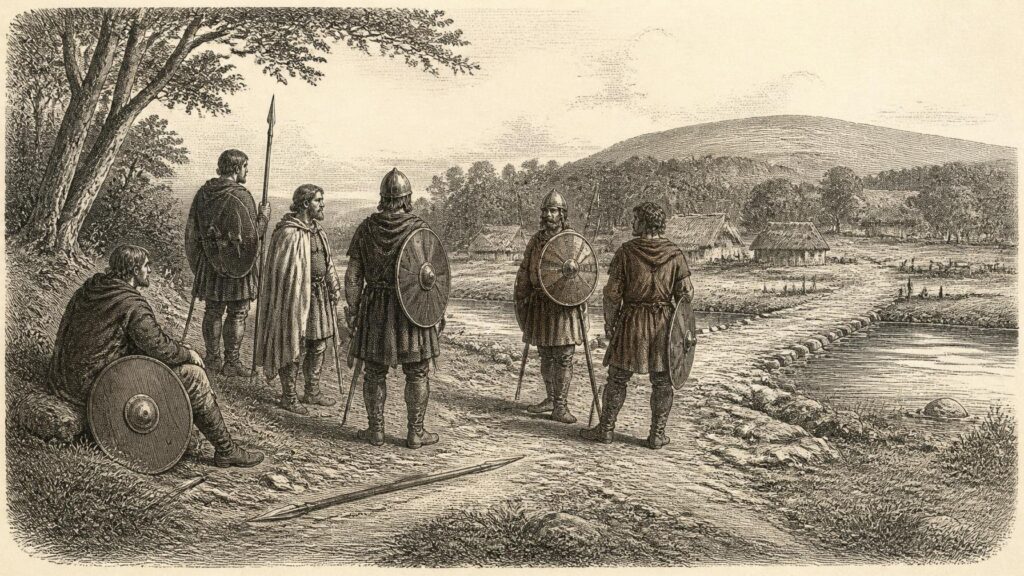
The encounter also points to the strategic importance of routes across Munster. Kilmallock lay in a landscape of roads, river crossings, livestock movement and connections towards the Shannon basin and southern coast. An armed force did not appear there by accident. It required ships or overland movement, intelligence, food, animals and a chain of dependent communities able—or compelled—to supply them. The annal does not permit a reconstruction of the battle itself: there is no warrant for imagining shield walls, a siege, or a particular battlefield. Yet its bare notice reveals that inland Munster was exposed to the rivalry of coastal powers and that Limerick’s Scandinavian community could project force beyond its immediate harbour.
The choice of the word “slaughter” signals a decisive defeat, but not necessarily the destruction of Waterford’s settlement or fleet. Waterford remained an important Scandinavian base. The outcome should therefore be read as a local and perhaps temporary advantage for the Munster–Limerick coalition, not as the end of a rival polity. That limitation matters. Ireland in 927 was not being shaped by a single campaign with one final winner; it was shaped by repeated contests whose settlements could be revised quickly.
Dublin’s Uncertain Moment
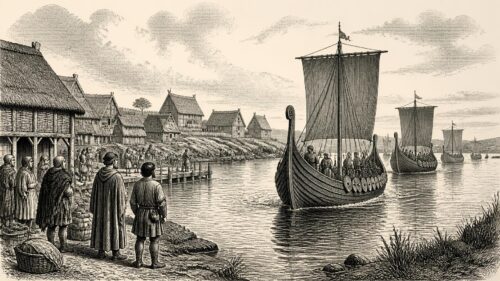
The wider Irish Sea setting helps explain why such rivalries mattered. Dublin was ruled by Gofraid grandson of Ímar, a member of the Uí Ímair dynasty whose kindred had power on both sides of the sea. The Annals of Ulster, under its entry labelled U927 but explicitly calibrated “AD 926 alias 927”, records the departure of the fleet of Linn Duachaill, Gofraid’s abandonment of Dublin, and his return within six months. Chronicon Scotorum similarly says that the foreigners of Dublin left Ireland. These notices are closely connected to the political world of calendar year 927, but their internal chronological offset means they should not be presented as securely dated within that calendar year.
Even with that caution, the episode illuminates the volatility surrounding Dublin. A ruler who could leave the settlement and return within half a year operated across sea-lanes rather than within a fixed territorial state. Dublin’s wealth rested on its harbour, trade, tribute, raiding and its links with western Britain and Northumbria. Its political security, however, depended on maintaining ships, followers and agreements with nearby Irish rulers. A temporary withdrawal was therefore no minor administrative detail: it exposed the fragility of urban control and the speed with which authority could shift in the Irish Sea zone.
The death of Sitriuc grandson of Ímar, described in the Ulster annals as king of both the dark and fair foreigners, belongs to the same U927 annal heading. His death affected the wider dynasty from which Gofraid drew standing and allies. But because of the dating issue, it is sounder to treat it as immediate chronological context for 927 rather than to claim an exact Irish calendar date without qualification. The contrast with the Inisfallen entry is instructive: southern annalists chose to record a Munster victory over Waterford’s foreigners, while northern and midland traditions preserved news of dynastic movement around Dublin and the Irish Sea.
Tailtiu and Contested Overlordship
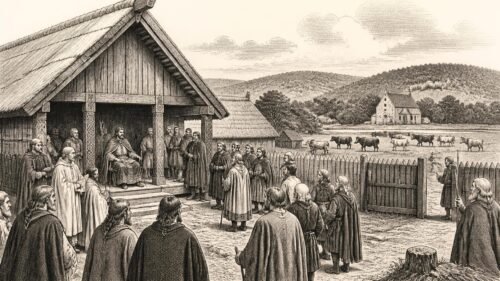
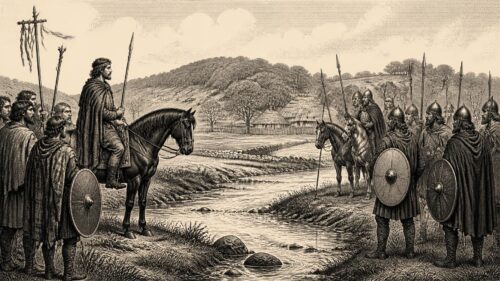
The U927 material also records a disturbance at the fair of Tailtiu, the great assembly-place in what is now County Meath. The conflict involved a son of Niall son of Áed and Donnchad son of Flann, king of Tara in the southern Uí Néill dynasty. The annalist’s conclusion is unusually restrained: God separated the opposing parties without loss of life. Again, the notice stands in the chronologically offset Ulster entry, so it cannot be assigned without reservation to calendar year 927. It does, however, belong directly to the political tension framing the year.
Tailtiu was more than a market. It was a recurring assembly associated with the Uí Néill political world, where legal business, display, exchange, entertainment and the negotiation of status could converge. That should not be turned into a modern parliament or a national government. Early Irish kingship was layered and personal, exercised through kin groups, clientship, hostages, ecclesiastical alliances and armed following. But a public disturbance at Tailtiu mattered precisely because it threatened an arena where hierarchy was enacted before a large gathering.
The avoidance of bloodshed was itself a political result. Donnchad’s kingship did not mean uncontested command over every Uí Néill branch, while Muirchertach son of Niall and the northern Cenél nEógain were formidable rivals. A confrontation that ended without killing may have reflected mediation, calculation or the practical difficulty of escalating violence at a major fair. The annals preserve no treaty terms. They do show that peace in this period was not the absence of tension; it was often a temporary success in containing it.
The Passing of Máel Brigte
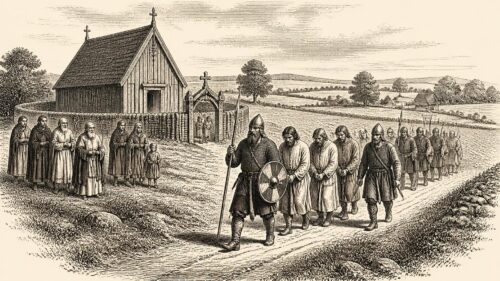
The death of Máel Brigte son of Tornán provides 927 with its clearest ecclesiastical turning point. Inisfallen calls him abbot of Ard Macha, Armagh, and abbot of Í Coluim Chille, Iona; Ulster styles him successor of Patrick and Colum Cille and says that he died in happy old age. He had held together the leadership of two exceptionally prestigious religious federations: the Patrician church centred on Armagh and the Columban familia whose inheritance extended from Iona through important Irish houses.
His title did not mean that he governed every church in Ireland as a bishop might govern a modern diocese. Monastic communities retained their own interests, lands and patrons, and ecclesiastical office was deeply entwined with secular kinship. Still, Máel Brigte’s dual succession was an exceptional concentration of prestige. His death ended that personal union: the Patrician and Columban successorships thereafter resumed separate heads. It is a reminder that institutions which appear enduring in hindsight could depend heavily on the position, lineage and relationships of a single office-holder.
Máel Brigte was also associated with learned culture. He is linked with the production of the richly illuminated Gospels of Mac Durnan, a manuscript that demonstrates the continuing resources of elite ecclesiastical book culture in a period often portrayed only through raiding and war. Scriptoria, churches and households of learned clergy required skilled labour, vellum, pigments, Latin learning and patronage. The manuscript tradition does not prove that such work was made in 927, but his death that year brings into view a career spanning scholarship, church government and high politics.
Faith, Travel and the Limits of the Record
A later annalistic compilation, the Annals of the Four Masters, places further ecclesiastical deaths under 927, including Céledabhaill son of Scannall, successor of Comgall of Bangor, said to have died while on pilgrimage in Rome on 14 September. It also records Tuathal of Damliag and Lusk, Caencomrac of Derry, and other clerics. These notices reveal long-distance religious travel and the dense network of Irish churches. Yet the Four Masters was compiled in the seventeenth century from earlier materials, and its chronology does not align consistently with the near-contemporary annals. Its exact date for Céledabhaill is valuable testimony, but should remain attributed to that source rather than treated as independently secured calendar fact.
That distinction is especially important for reports in the same compilation of Limerick fleets on Lough Corrib and Lough Ree, a battle at Liathdruim, and the plundering of Kildare. Parallel annals place comparable events under different years. They belong to the late 920s environment of waterborne raiding, dynastic rivalry and pressure on wealthy churches, but they cannot responsibly be made into a sequence of events for 927 alone.
What emerges from the securely dated evidence is not a silent interval between greater battles. In Munster, Scandinavian groups and an Irish provincial force combined to defeat rivals at Cell Mo-Chellóc. Across the island, the death of Máel Brigte altered the balance of ecclesiastical prestige between Armagh and the Columban churches. Around Dublin, uncertain and differently dated annalistic reports point to a political order in motion, while the threatened gathering at Tailtiu shows that kingship was negotiated as much at public assemblies as on battlefields. Ireland in 927 was a land of competing centres—harbours, monasteries, royal meeting-places and local kingdoms—whose connections were as consequential as their conflicts.
Primary Sources
- Annals of Inisfallen
- Annals of Inisfallen (English Translation)
- Annals of Inisfallen (Irish Text)
- Annals of Inisfallen: Textual and Manuscript Description
- The Annals of Ulster
- The Annals of Ulster, Year U927
- The Annals of Ulster, Year U927 (Irish and Latin Text)
- Chronicon Scotorum
- Chronicon Scotorum, Annals CS925–CS929
- Chronicon Scotorum, Annals CS924–CS928 (Irish and Latin Text)
- Annals of the Four Masters, Volume 2
- Annals of the Four Masters, Annals M923–M929
- Annals of the Four Masters, Annals M923–M929 (Irish Text)
- Máel-Brigte
- Irish Texts at CELT
- List of Published Texts at CELT
- The Fair of Tailtiu and the Feast of Tara
- The Metrical Dindshenchas
- Continuity, Cult and Contest
- Early Medieval Ireland – Edward Worth Library
- Early Medieval Ireland, AD 400–1100: The Evidence from Archaeological Excavations
- Vikings in Ireland and Scotland
- The Circuit of Ireland by Muircheartach mac Néill