Ailche’s Fleet on Lough Neagh928 CE
Annals conventionally assigned to 928 describe Ailche’s son leading Scandinavian or Hiberno-Scandinavian forces across Lough Neagh, ravaging islands and adjacent territories, demonstrating inland waterways’ strategic importance. Chronological uncertainties complicate the dating of related notices. Norsemen killed Donnchad, northern heir-designate, while Donnchad Donn of Mide killed his nephew Máel Ruanaid; rivalry with Muirchertach also limited Tara’s authority. Diarmait of Osraige died. Ecclesiastical leaders at Birr, Aghaboe and Cork died, and Bangor’s Céile began a Roman pilgrimage. Records also note elite women’s deaths and a disputedly dated raid on Kildare, revealing interconnected dynastic, church and Scandinavian power networks across Ireland and Europe.
Dateline
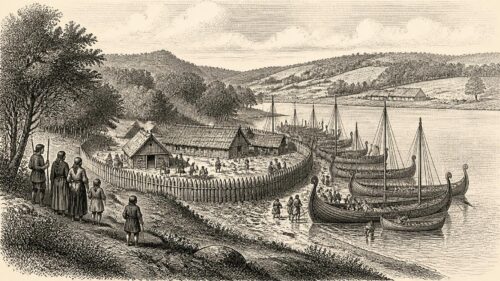
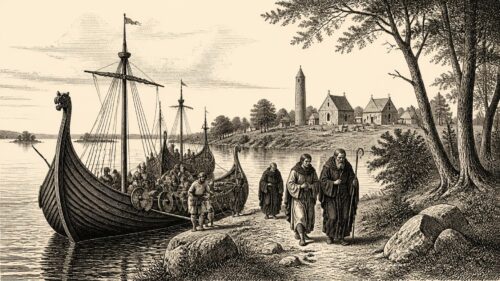
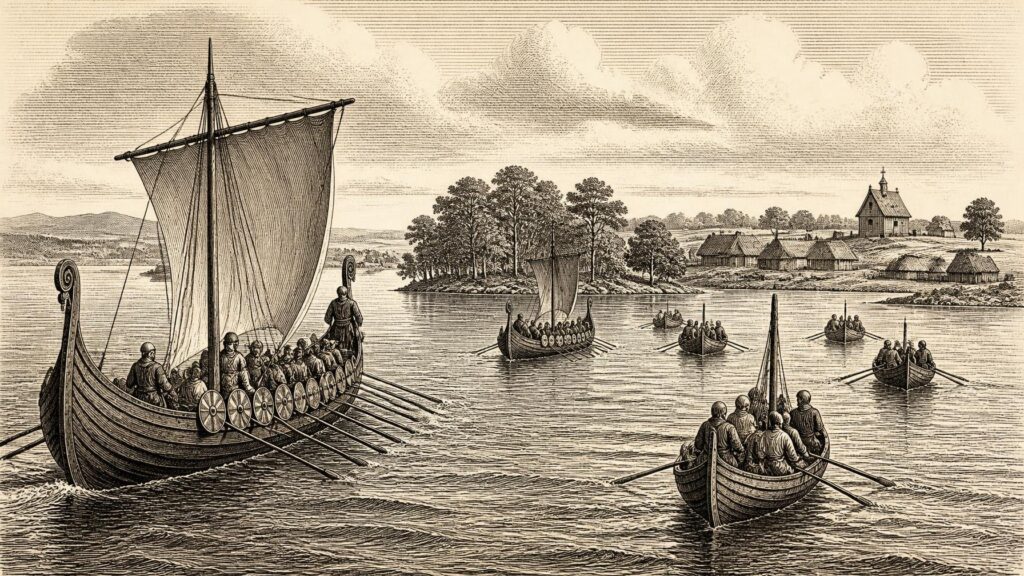
In the annalistic record conventionally assigned to 928, the most vivid Irish event is neither a pitched battle nor an inauguration, but a fleet moving across Lough Neagh. The Annals of Ulster report that “Ailche’s son” entered the lake with a force of Gall, or foreigners, and ravaged its islands and surrounding territories. The brief notice gives no tally of ships, casualties or booty. Yet it reveals how a large inland waterway could become a route of attack, joining the military politics of the Irish Sea to communities in the northern interior.
The year also records royal deaths, dynastic killing, ecclesiastical successions and an arduous pilgrimage towards Rome. Taken together, these notices show an Ireland in which local lordship, monastic authority and Scandinavian-led military forces overlapped. No single ruler commanded the whole island in a modern sense. Power was exercised through kindreds, client peoples, churches, tribute, hostage-taking, alliances and the ability to move armed men along roads, rivers and lakes.
Dating a Difficult Year
Any account of 928 must begin with a warning about chronology. Irish annals were copied, revised and synchronised over centuries, and their year-headings do not always correspond exactly with the modern calendar. The relevant section of the Annals of Ulster is headed “AD 927 alias 928”; Chronicon Scotorum and the later Annals of the Four Masters distribute several related notices differently. This does not make the events unreal. It means that historians should distinguish an event securely preserved in the annalistic sequence from a claim that it happened on a particular modern day or even, in some cases, an unqualified calendar year.
The Lough Neagh raid, the killing of Donnchad son of Domnall, and the death of Diarmait son of Cerball appear in the Ulster annal assigned here to 928. Other notices, especially those concerning churchmen and Kildare, are preserved by Chronicon Scotorum under 928 but occur in neighbouring years elsewhere. They belong to the immediate historical horizon of this year, but their placement should be read with that limitation in mind.
A Fleet on the Inland Sea
Lough Neagh lay at the centre of northern communication. Its shores and islands connected territories of Ulaid, Airgialla and the northern Uí Néill, while its rivers offered approaches deep into the interior. A force able to bring vessels onto the lake could strike settlements that were not coastal at all. The annalist’s wording is emphatic: Ailche’s son ravaged both the islands and the lands adjoining the lake. This was a campaign across a whole waterscape, not simply a landing at one shore.
“Foreigners” was an Irish annalistic label, not a precise statement of nationality. In this context it normally denotes Scandinavian or Hiberno-Scandinavian fighting men. The leader is not named personally in the entry, only by his father. Earlier notices connect Ailche’s son with the Scandinavian force at Limerick, and modern scholars have proposed an identification with a leader known in later discussion as Tomrair mac Ailchi. That identification is plausible rather than certain; the safest conclusion is that the raid belonged to the mobile Scandinavian-led military networks then active between Limerick, Dublin, the Irish Sea and northern lakes.
The raid should not be imagined as an encounter between two wholly separate peoples. Scandinavian groups had been present in Ireland for generations, and their leaders made enemies, allies and followers among Irish dynasties. Nevertheless, a fleet entering Lough Neagh was a serious threat. Islands could contain farms, ecclesiastical sites, stores, livestock and people seeking temporary security. The annal does not say what was seized or destroyed, so it would be wrong to supply a precise narrative of burning, killing or enslavement. It does show that control of waterborne mobility remained a decisive political resource.
Rival Claims in the North and Midlands
The same annal records the killing by Norsemen of Donnchad son of Domnall son of Áed, described in Chronicon Scotorum as heir-designate of the North. The title marks him as a man with a credible claim within the northern Uí Néill world, rather than merely a local casualty. His death therefore mattered beyond his immediate family: succession was a continuing contest, and the presence of Scandinavian forces could alter its balance.
Another killing is more plainly internal. Máel Ruanaid son of Conchobor was killed by Donnchad Donn, the Clann Cholmáin ruler of Mide who claimed the kingship of Tara. Modern biographical study identifies Máel Ruanaid as Donnchad’s nephew. The notice offers a stark illustration of early medieval dynastic politics. Kinship created claims to power and obligations of support, but it also created dangerous rivals. Eliminating a close relative could be a calculated act of kingship.
Donnchad Donn’s position was not secure simply because he was called king of Tara. His principal northern competitor was Muirchertach, son of Niall Glúndub, of Cenél nÉogain. A confrontation at the assembly site of Tailtiu is generally placed in 928, though the associated annal is transmitted under a neighbouring heading. It ended without recorded loss of life. Even so, the fact that rival Uí Néill leaders could confront one another at such a politically charged place demonstrates the limits of Donnchad’s authority. Ireland’s leading kings competed for precedence, tribute and recognition rather than ruling through a settled national administration.
The death of Diarmait son of Cerball, king of Osraige, is placed by the Annals of Ulster in this year, although Chronicon Scotorum places it in its next annal. Osraige, between Munster and Leinster, was strategically important precisely because it stood between larger overkingdoms. The loss of a king there would have opened a fresh struggle over allegiance and succession, even if the surviving notices say nothing of its immediate outcome.
Churches, Households and Pilgrimage
The annals preserve a striking cluster of ecclesiastical notices. Baíthéne, successor of Brénainn of Birr, died; so did Ciarán, successor of Cainnech, probably attached to the Columban foundation at Aghaboe. Such titles were not merely devotional honours. A successor, or comarba, held the inheritance of a saint: an institution’s landed resources, dependants, prestige, liturgical responsibilities and political connections. The deaths of senior churchmen could therefore matter to kings and local communities alike.
Muirgel, a daughter of Máel Sechnaill, died in old age, according to the Ulster annalist. Chronicon Scotorum places her death at Clonmacnoise and identifies her more fully as daughter of Flann son of Máel Sechnaill. Cainech daughter of Canadán, styled queen of the king of Tara, also died in its 928 entry. These notices are unusually valuable because women generally appear less often than male rulers and churchmen in the annals. They show elite women being remembered through both descent and royal status, even where the record does not reveal their own actions.
Chronicon Scotorum also records the death of Fínnachta, abbot of Corcach, while the Annals of Inisfallen preserve the same obituary. Cork was not yet a town in the later medieval sense, but its monastery was a significant religious and economic centre at the head of a navigable harbour. Its abbot’s death belongs to the same pattern: ecclesiastical offices were institutions of regional consequence.
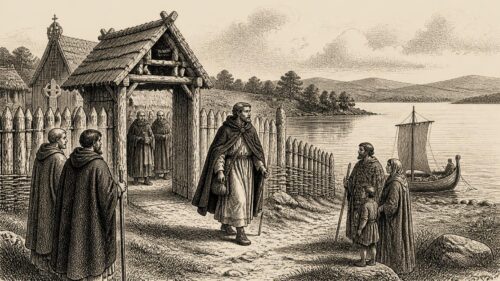
One notice points far beyond Ireland. Céile, successor of Comgall at Bangor, scribe, anchorite and “apostolic doctor of all Ireland”, set out on pilgrimage. His death at Rome is securely recorded only in the following annalistic year, on 14 September, so it should not be brought back into 928. But the departure itself belongs here. It reminds us that Irish religious life was connected to a wider Christian world through travel, learning, relics, patronage and the ideal of pilgrimage. A journey to Rome was exceptional, demanding resources, contacts and endurance; it was also a public statement of spiritual authority.
Kildare and the Reach of Violence
Chronicon Scotorum places the plundering of Kildare by a son of Gothfrith, arriving from Waterford, in 928. Other annalistic traditions position the episode differently, so its exact calendar placement cannot be treated as firm. Its association with this year is nevertheless revealing. Kildare was among Ireland’s most prestigious churches, linked to Brigit and embedded in the politics of Leinster. An attack on it was not simply an assault on a religious building. It struck an endowed community, its stores, dependants, movable wealth and symbolic standing.
By the late 920s, Scandinavian settlements and fleets had become part of the island’s political landscape. Dublin, Waterford and Limerick were developing as durable coastal bases and centres of exchange, though Ireland remained overwhelmingly rural and dependent on mixed farming. Warfare disrupted that countryside, but it also moved people, silver, goods and information between regions. The annals’ compact notices cannot reconstruct ordinary lives in detail. They do, however, preserve the pressures under which those lives were lived: the vulnerability of shoreline communities, the demands of kingship, the wealth concentrated in churches, and the importance of boats on both sea and lake.
The record for 928 is therefore fragmentary but coherent. A foreign fleet penetrated Lough Neagh; rival dynasties remained dangerous to one another; a king of Osraige died; major churches lost leaders; and a renowned Bangor cleric began a pilgrimage that would end in Rome. Far from being a peripheral episode, the year shows Ireland connected internally by waterways and institutions, and externally by Scandinavian sea power and the long road to the Christian centre of the Mediterranean world.
Primary Sources
- The Annals of Ulster, Year U928
- The Annals of Ulster, Year U924
- The Annals of Ulster, Year U929
- The Annals of Ulster, AD 431–1201
- Chronicon Scotorum, Annal CS928
- Chronicon Scotorum
- Chronicon Scotorum: Introduction
- The Annals of Inisfallen, Part 48
- The Annals of Inisfallen
- Annals of the Four Masters, Volume 2
- Donnchad Donn
- Muirchertach na Cochall Craicinin
- Niall Glúndub
- The Viking Age in Ireland
- The Vikings in Ulaid
- Vikings in Early Medieval Ireland
- Historical Truth or Literary Embellishment? Uncovering the Voices of Historical Queens in Medieval Irish Sources
- Residence, Ritual and Rulership: A State-of-the-Art for Royal Places in Early Medieval Ireland
- Remembering the Vikings: Violence, Institutional Memory and the Instruments of History
- Kings of Aileach and the Vikings, AD 800–1060
- Exploring the Irish Annals
- CELT: List of Published Texts