Mochta and Patrick’s Honour893 CE
In 893, surviving annals depict Ireland as a landscape of ecclesiastical, dynastic and Scandinavian power. Mochta, bishop, anchorite and scribe of Armagh, died, emphasising the church’s learned authority. At Whitsun, Cenél nEógain and Ulaid forces fought at Armagh; Máel Brigte imposed settlement under Patrick’s honour through compensation, hostages and executions. Dublin’s Scandinavian leadership split between a son of Ímar and the jarl Sigfrith, prompting departures but not ending Viking activity. Congalach, heir designate of Brega, also died, exposing uncertain succession. These fragmentary records reveal sacred centres enforcing political claims amid interconnected Irish Sea conflict and the burdens borne by communities.
Dateline
A Year Seen Through Sparse Records
The surviving evidence for 893 is unusually concentrated. Rather than a single island-wide campaign or royal assembly, the year is illuminated by a sequence of short annalistic notices: the death of an Armagh churchman, a bloody confrontation at the same ecclesiastical centre, a split among Dublin’s Scandinavian leaders, and the death of an expected ruler in Brega. Together they show that power in Ireland rested not simply with kings, but with churches, kindreds, military followings and communities able to enforce claims to honour and compensation.
There is an important chronological caution. The Annals of Ulster head the material as “AD 892, alias 893”, reflecting the complications of medieval Irish annalistic dating. Modern scholarship normally treats this cluster as belonging to 893. The Annals of Inisfallen and Chronicon Scotorum also preserve notices under 893. By contrast, the much later compilation known as the Annals of the Four Masters assigns further raids and killings to its own entry for 893. Those notices cannot safely be merged with the better-correlated events below as though every source used an identical calendar.
Mochta of Armagh
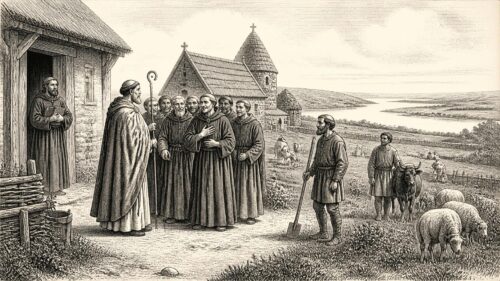
The year opened, or at least was recorded, with the death of Mochta, fosterling of Féthgna. The Annals of Ulster call him bishop, anchorite and an excellent scribe of Ard Macha, Armagh. The description is unusually rich for an obituary and reveals the several kinds of authority that could reside in a senior churchman. Mochta was a bishop, associated with pastoral and sacramental office; an anchorite, a title of religious distinction; and a trained writer, an accomplishment central to the preservation of Latin learning, legal memory and institutional claims.
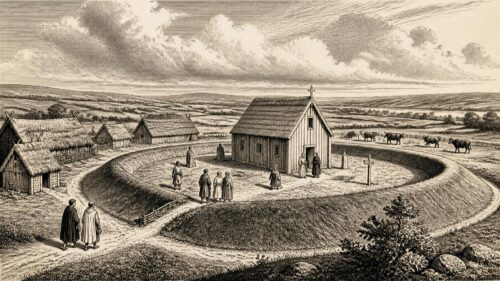
His death mattered because Armagh was far more than a place of worship. It was the chief church associated with Patrick, whose prestige was asserted across Ireland through clerics, client communities, dues, relics and legal protections. The settlement was an ecclesiastical complex with churches, dwellings and working areas, not a silent monastic retreat. Archaeology confirms that early medieval Armagh contained domestic and industrial activity within its broad ecclesiastical landscape. A bishop and scribe such as Mochta belonged to the skilled personnel through whom this great institution maintained its standing.
Nothing allows us to identify Mochta’s manuscripts or reconstruct his daily routine. Yet the annalist’s decision to call him an “excellent scribe” is evidence enough that literacy was understood as a public virtue. In a society where charters were not the ordinary currency of government, learned churchmen still copied texts, composed records, calculated the church calendar and safeguarded the accumulated authority of saints and churches.
Violence at Whitsun
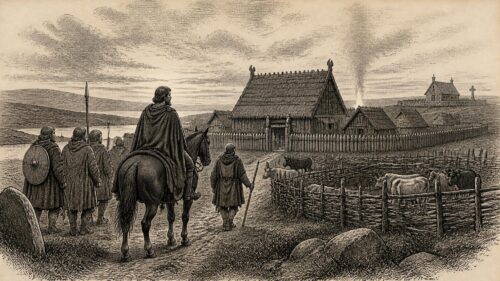
The most substantial Irish event securely placed in 893 occurred at Armagh during Whitsun, the Christian feast of Pentecost. The Annals of Ulster tersely report a disturbance between the Cenél nEógain and the Ulaid in which many people fell. Chronicon Scotorum offers a fuller version: the conflict involved Aidíth son of Laigne and Flaithbertach son of Murchad, and Máel Brigte separated the combatants.
Even this expanded notice does not tell us why the fighting began. It should not be presented as a battle for the kingship of Ireland, nor as a simple attack upon the church. Cenél nEógain, a leading northern Uí Néill dynasty, and the Ulaid were neighbouring political groupings with their own rival kings and client territories. Armagh stood close to the zones in which their interests met. A great church could offer a setting for negotiation, a venue for public assembly and an arena in which political antagonists sought moral legitimacy. Those advantages also made it a dangerous place when armed entourages arrived.
The choice of Whitsun gives the disturbance additional force. Feast days drew clergy and lay people together, while their sacred character heightened the offence of violence. The record does not say that fighting occurred inside a church, so that must not be imagined. But deaths at Armagh during a major festival could not be treated as an ordinary private feud. The subsequent settlement, as recorded in Chronicon Scotorum, was framed in terms of Patrick’s honour.
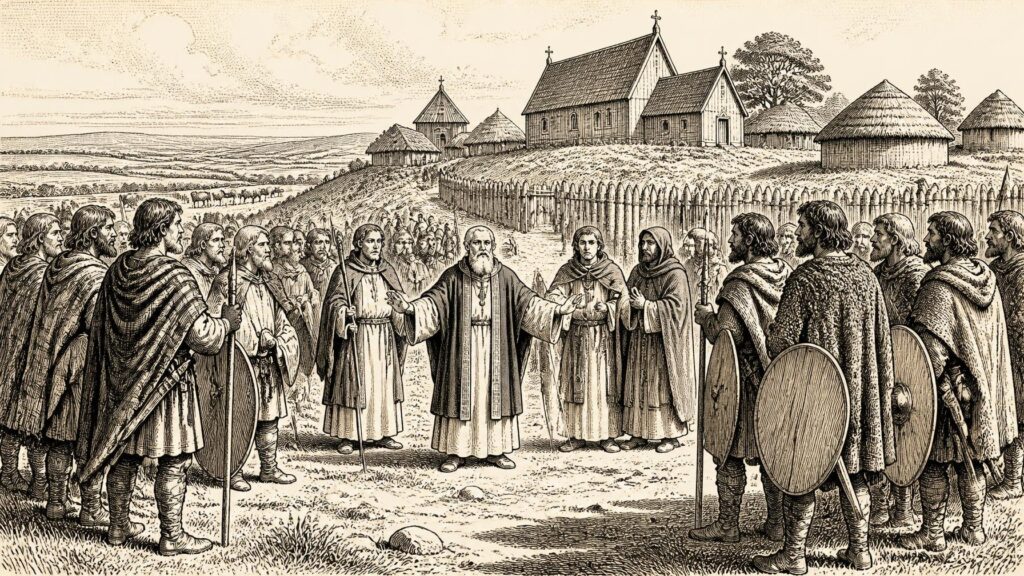
Máel Brigte’s intervention ended the immediate clash, but settlement had a hard edge. The chronicle says that Patrick’s law and honour were enforced throughout Ireland; hostages were taken, thirty-seven cumala were exacted, and four men of Ulaid were hanged, in addition to liabilities involving churches and monastic dependants. The compressed wording leaves uncertainties about the exact sequence and the identity of every beneficiary. Nevertheless, the essential point is clear: compensation was demanded in the name of the Patrician church, and punishment included execution.
A cumal was a recognised unit of value, originally associated with a female slave and later used as a conventional measure in legal and economic assessment. Its modern monetary equivalent cannot be calculated with confidence. The reference does, however, show that redress could be expressed in formal, countable obligations rather than in vague promises. Hostages were likewise a practical political instrument: their delivery bound families and rulers to an agreement because a breach endangered people of high value to their kin.
The entry offers a rare view of how religious and secular power worked together. Armagh’s claim was not enforced by prayer alone. It rested on negotiation, compensation, the taking of hostages and, in this case, lethal coercion. At the same time, rulers sought the standing conferred by acting under Patrick’s protection. Church honour was therefore both a religious principle and a political resource.
Dublin’s Divided Foreigners
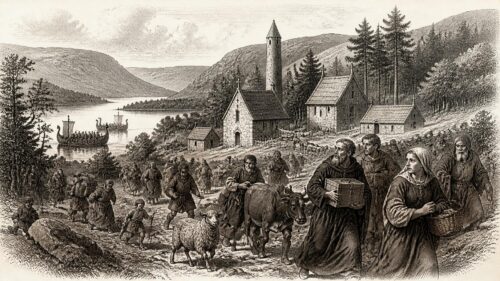
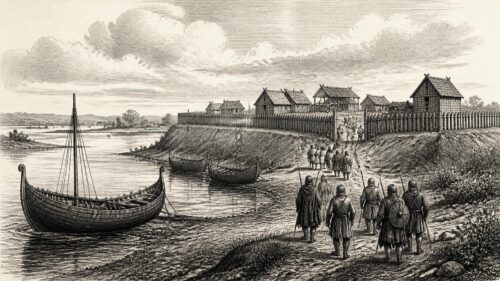
While Armagh confronted violence among Irish powers, Áth Cliath, Viking Dublin, was shaken from within. The Annals of Ulster record “a great dissension” among its foreigners. They dispersed into two sections, one following a son of Ímar and the other Sigfrith, described as a jarl. The annalist does not name Ímar’s son, state what sparked the quarrel, or say which faction controlled the settlement afterwards. Those silences matter. It is safer to recognise a division of leadership and followers than to manufacture a neat succession dispute.
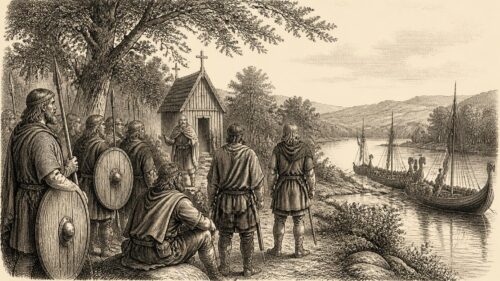
Still, the break was consequential. Dublin had been a durable Scandinavian base since the mid-ninth century, connecting Ireland with the western seaways, Britain and the wider North Atlantic world. Its rulers could raid, levy tribute, make alliances and traffic in people and goods. But the annal shows that the settlement’s military capacity depended upon cohesion among competing leaders. A divided Dublin was less able to project force consistently into Irish politics, even though individual groups remained formidable.
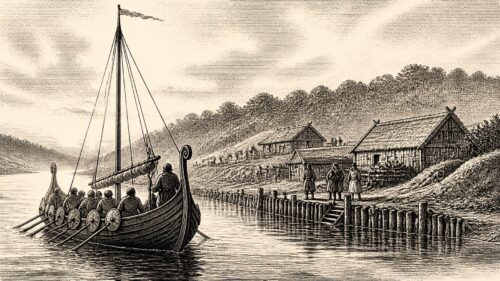
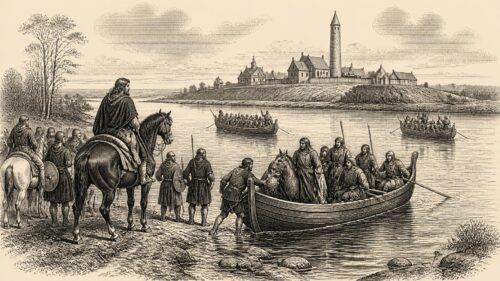
The Annals of Inisfallen make the same year sound more sweeping: “the heathens departed from Ireland”. This should not be read as proof that every Scandinavian inhabitant sailed away or that Dublin vanished overnight. Set beside the Ulster report, it more plausibly reflects the departure of important raiding forces amid the dissension. Indeed, the Annals of Ulster record a son of Ímar coming to Ireland again under the following annal heading. The wording points to movement across the Irish Sea, not to a clean and permanent end of Scandinavian involvement.
An external notice helps explain why these sea routes mattered. The Ulster annalist also reports a victory by “the Saxons” over dark foreigners, with innumerable dead. It probably refers to fighting in Britain, often linked by historians to the campaign ending at Buttington in 893, but the Irish annal does not name the battlefield. Its inclusion nevertheless shows that events in England and Wales were considered relevant in Ireland. Viking fleets, leaders and displaced fighters moved within an interconnected Irish Sea world; a serious reverse across the water could reshape the choices available at Dublin.
Brega and the Limits of Succession
The final Ulster notice for the year records the death of Congalach son of Flannacán, heir designate of Brega. Brega, extending across much of the rich country north of the River Liffey and Boyne, was politically significant both in its own right and because of its proximity to the Uí Néill heartlands. An heir designate was not a king in possession; his death demonstrates the fragility of succession in a system where royal eligibility was spread among powerful kin-groups rather than fixed by automatic primogeniture.
Flann Sinna, king of Tara and dominant figure among the southern Uí Néill, remained active in this period, but the records for 893 do not describe a new all-Ireland settlement directed by him. The more responsible picture is regional and contingent. Armagh’s clergy and patrons imposed a costly settlement in the north; Dublin’s foreign leadership fractured; and Brega lost a prospective ruler. These were not isolated local incidents. Each affected networks of allegiance, tribute, military manpower and ecclesiastical prestige.
What 893 Reveals
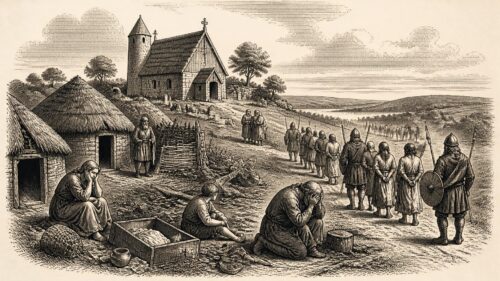
For most people, the annals are silent. They do not describe the spring sowing, livestock, craft production, market exchange or family life of 893. Nor can they tell us how far the Whitsun violence disrupted ordinary households around Armagh. Yet their silences should not conceal the realities behind their brief notices. Compensation measured in cumala, liabilities owed by church dependants, hostages and the dispersal of maritime warbands all affected communities who supplied food, labour, transport and fighters.
893 was therefore not an empty interval between better-known Viking episodes. It was a year in which Armagh’s Patrician authority was defended after bloodshed, Dublin’s political unity fractured, and succession narrowed in Brega. The record is fragmentary, but it captures an Ireland in which sacred places were centres of learning and power, where legal settlement could entail severe violence, and where Irish and Scandinavian politics were inseparable from the wider Irish Sea.
Primary Sources
- The Annals of Ulster
- CELT Project: The Annals of Ulster
- Annals of Inisfallen, Part 45
- CELT Project: Annals of Inisfallen
- Chronicon Scotorum, Part 93
- CELT Project: Chronicon Scotorum
- Annals of the Four Masters, Part 72
- CELT Project: Annals of the Four Masters
- Vikings in Irish Chronicles, 794–902: Data
- Vikings in Ireland
- Vikings in Ireland and Scotland
- Early Medieval Ireland: Archaeological Excavations, 1930–2009
- Early Medieval Archaeology Project: The Early Medieval Church
- Early Medieval Archaeology Project: Early Medieval Burials and Cemeteries
- Early Medieval Ireland: Archaeological Excavations 1930–2009, Report 4.5
- Irish Society c. 700: I. Communities
- The Idea of the Three Orders of Society and Social Stratification in Early Medieval Ireland
- Religion and Society in Ireland
- Dispute Settlement in Medieval Ireland: A Preliminary Inquiry
- Derbforgaill: Twelfth-Century Abductee, Patron and Wife
- Vikings in Early Medieval Ireland
- 893: Vikings Liquidated at Buttington, Powys
- Saga-Book of the Viking Society, Volume XIX