Tailtiu Without a Fair889 CE
In 889, unevenly dated annals record political strain across Ireland. Domnall, son of Áed Findliath, led northern Uí Néill forces and a foreign contingent against the southern Uí Néill, though no battle or outcome is described. The royal assembly at Tailtiu was not held, signalling impaired authority in the midlands. Dub Lachtna became king of Cashel and Tadc king of Connacht, while Tuadcar, bishop of Clonmacnoise, died. These notices demonstrate contested power, fragile public institutions and significant succession, but do not establish a coordinated crisis or provide evidence for wider conditions such as famine, weather, or economic disruption in Ireland.
Dateline
A Year Recorded Unevenly
The surviving evidence for 889 is brief, but unusually revealing. Its central notices concern a military demonstration against the southern Uí Néill, the failure to hold the great assembly at Tailtiu in modern County Meath, and changes of rulers in Cashel and Connacht. Taken together, they show an Ireland in which political authority depended not simply on who possessed a kingship, but on the ability to assemble followers, attract allies and make the public rituals of rule happen.
A warning about dates is necessary. Chronicon Scotorum places the expedition, the unheld fair, the accession at Cashel and the death of the Clonmacnoise bishop under 889. The Annals of Inisfallen likewise date the accessions of Dub Lachtna at Cashel and Tadc in Connacht to 889. The Annals of Ulster preserve the expedition and the missed fair under their annal numbered U889, although the modern CELT edition correlates that heading with AD 888. Such discrepancies are normal in medieval annals, whose year-counts were copied and recalculated over centuries. The events discussed here are therefore securely attached to the annalistic year called 889 in two traditions, but no exact day, month or sequence within the calendar year can responsibly be supplied.
Domnall’s Armed Progress
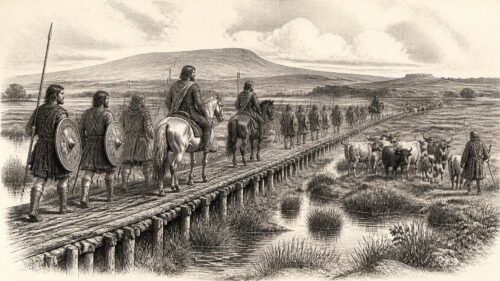
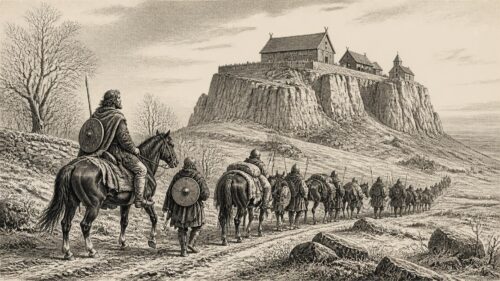
The most important political entry says that Domnall, son of Áed, led a sluaiged, or hosting, with “the men of the north of Ireland” and with Gallaib—foreigners—against the southern Uí Néill. The entry is economical to the point of frustration. It provides neither battlefield nor casualty list, says nothing of a siege, and does not identify a decisive winner. It should be read as evidence for an armed expedition, not as proof of a battle whose details have been lost.
Yet the composition of Domnall’s force is striking. He was a son of Áed Findliath, the northern Uí Néill ruler whose death in 879 had opened a renewed contest for pre-eminence. The southern Uí Néill, centred on the rich midlands and led by Flann Sinna of Clann Cholmáin, held the leading overkingship. “Northern” and “southern” Uí Néill were not modern national factions: they were powerful, related dynastic groupings, rooted respectively in northern and midland territories, whose claims to wider authority competed and overlapped. Domnall’s march towards the south was thus an intervention in the politics of the island’s central zone, where control of people, tribute, church connections and assembly places mattered enormously.
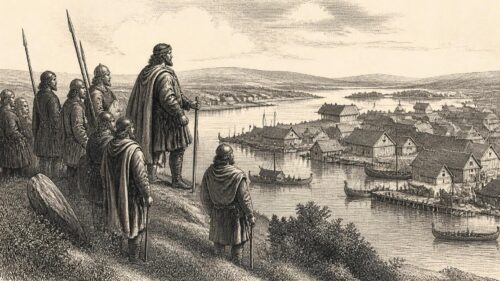
The reference to foreigners is equally important, but must not be overstated. In ninth-century Irish sources, Gall usually denotes Scandinavian incomers and their forces, though it does not identify their language, homeland, commander or base in this particular case. The annal does not say that Dublin’s rulers commanded Domnall’s allies, nor that they were mercenaries paid by him. What it does establish is that a northern Irish leader could campaign against southern Uí Néill rivals in association with a foreign contingent. Viking groups were no longer merely raiders arriving from overseas; some were participants in Irish political calculations, capable of fighting beside Irish forces as well as against them.
This was a volatile setting. The preceding annalistic material records a defeat inflicted on Flann son of Máel Sechnaill by the foreigners, in which Áed son of Conchobor, king of Connacht, and prominent churchmen died. It also records the deceitful killing of Sigfrith son of Ímar, described as king of the Northmen. These events belong to the immediate political background rather than to 889 itself. They nevertheless help explain why alliances with foreign warbands could appear useful, and why no ruler could assume that the Dublin-based Scandinavian world was united or predictable.
The Silence at Tailtiu
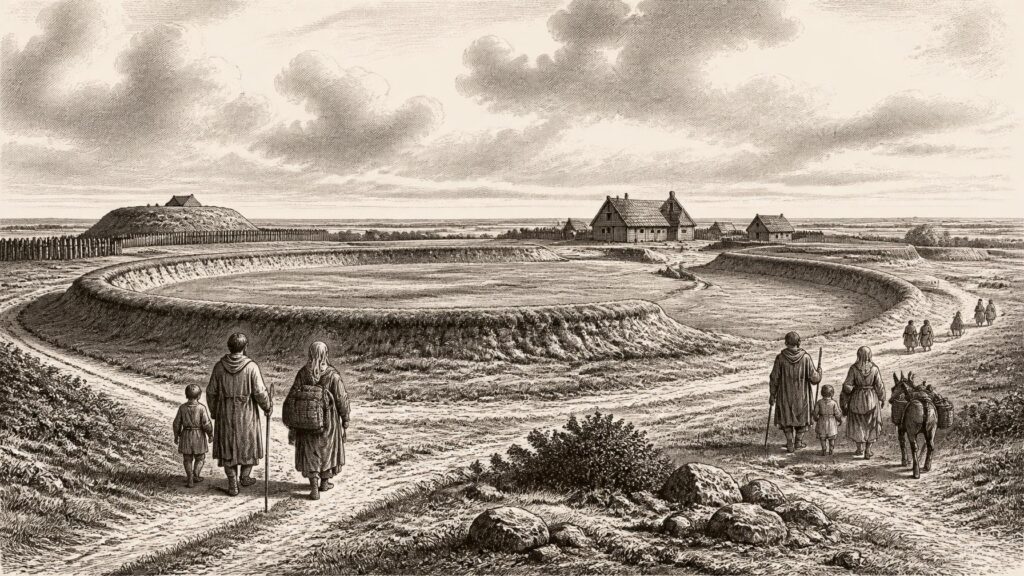
The second great notice is more restrained but perhaps more eloquent: the fair, or assembly, of Tailtiu was not held. Tailtiu, near modern Teltown in County Meath, stood within the principal territory of the southern Uí Néill. It was a royal gathering-place, associated with the authority of Tara and with an annual assembly remembered in both historical and literary sources. For an annalist to record its non-occurrence was to mark a public failure of order and kingship, not a minor cancellation in a local calendar.
We should be cautious about reconstructing exactly what failed to occur. A much later poem about Tailtiu imagines an ideal fair of gold and silver, games, music, learning, orderly seating, legal restraint and an island-wide truce. That is literary commemoration, not a timetable for 889. Still, it preserves the scale of meaning attached to the place. An óenach was a venue for exchange, adjudication, display, negotiation and royal recognition as well as for entertainment. Its absence may have reduced opportunities for traders, craftsmen, poets, litigants and visitors, but the annals do not permit a calculation of economic loss or a claim that ordinary people went hungry because of it.
Nor was this the first interruption. The annalistic record notes earlier occasions in the 870s when Tailtiu was not held, making clear that this was an institution under pressure rather than a single, pristine custom abruptly broken in 889. Conversely, it was held by Flann son of Máel Sechnaill in 891, according to Chronicon Scotorum. That later restoration does not tell us why it failed in 889, but it demonstrates that convening the fair remained a meaningful assertion of authority. The cancellation therefore belongs beside Domnall’s hosting: both point to a struggle over who could make the midlands acknowledge their power.
New Kings at Cashel and Connacht
While the Uí Néill heartlands faced military tension, the south and west saw changes at the top. The Annals of Inisfallen record that Dub Lachtna son of Máel Guala entered the kingship of Caisel, while Tadc son of Conchobar entered the kingship of Connacht. These are accessions, not evidence that either man conquered an entire province in a single campaign. Early medieval Irish kingship was layered: a king’s effective authority rested on his own dynasty, subordinate lordships, hostages, church alliances and the willingness—or inability—of rivals to resist.
Dub Lachtna’s accession mattered because Cashel was the principal royal centre of the Eóganachta of Munster. His appearance in the record signals continuity in a kingdom whose internal divisions were substantial and whose rulers had to manage relationships extending beyond the limestone outcrop of Cashel itself. The annals later place his death in 895, indicating a reign of several years; that later endpoint should not be read back as proof that his position was secure in 889. In this year, the firm fact is simply that he took the kingship.
Tadc’s entry into the Connacht kingship is similarly significant but spare. Connacht was not politically empty territory waiting for direction from Tara or Cashel. Its local dynasties had their own rivalries, and its rulers could be drawn into wider Irish affairs, as the death of a Connacht king in the fighting reported immediately before this year illustrates. Tadc’s accession suggests a rapid reconstitution of kingship after that loss, but the surviving notices do not say whether he gained office through inheritance, agreement, force or some combination of all three.
Church Leadership and Continuity
Chronicon Scotorum also records the death of Tuadcar, bishop of Cluain Moccu Nóis, or Clonmacnoise. Situated on the Shannon, Clonmacnoise was more than a secluded monastery. It was a major ecclesiastical community with landed interests, learned personnel and connections across the Irish midlands. The death of a bishop there was a local institutional event of consequence, even though the annal gives no account of his successor, burial or achievements.
Church communities were embedded in secular society. They held resources, fostered scholarship, maintained cults of saints and supplied figures who could appear in political conflict as victims, negotiators or allies. This does not mean that every monastery was controlled by a king, or that every cleric was a political agent. It does mean that changes in Clonmacnoise, Cashel, Connacht and the Uí Néill world were interconnected through networks of patronage, land and prestige. The compact notices of 889 show that royal succession and ecclesiastical succession were both considered worth recording.
What the Record Cannot Say
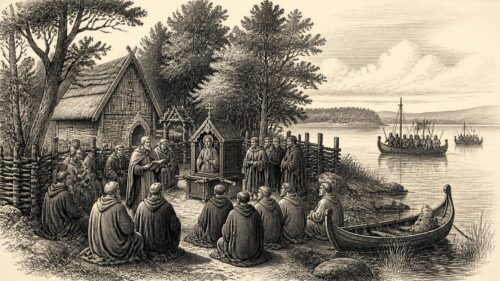
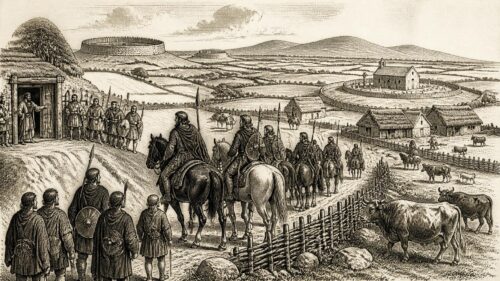
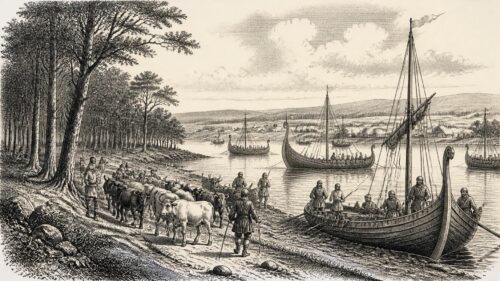
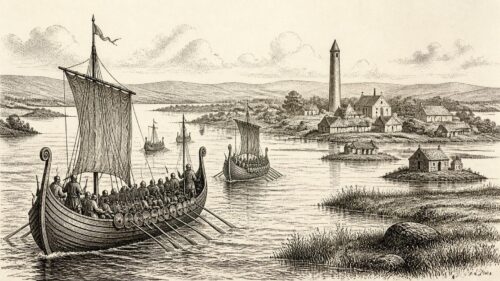
There is no securely dated annalistic report for 889 of weather, harvest, epidemic, famine, shipbuilding, settlement foundation or artistic production. It would be tempting to fill those silences with a generic picture of farms, ringforts, monasteries and Viking longships, but that would turn context into false evidence. Most people in Ireland continued to live through agricultural routines, local obligations and religious observance that rarely reached the annals; none of that can be described as a distinctive development of this year.
What 889 does reveal is a political landscape in which public institutions were vulnerable. Domnall’s armed movement, joined by foreigners, challenged the southern Uí Néill. The fair at Tailtiu did not take place. Elsewhere, new rulers entered the kingships of Cashel and Connacht, while Clonmacnoise lost a bishop. These were not necessarily parts of one coordinated crisis; the sources do not say so. But together they make 889 a year of contested authority, interrupted ceremony and carefully watched succession across Ireland.
Primary Sources
- The Annals of Ulster, Year U887
- The Annals of Ulster, Year U888
- The Annals of Ulster, Year U889
- The Annals of Ulster, Year U890
- Chronicon Scotorum: Introduction
- Chronicon Scotorum, Annals CS888–CS892
- Chronicon Scotorum, Annals CS890–CS894
- Chronicon Scotorum, Annals CS895–CS897
- Annals of Inisfallen, Annals AI880–AI889
- Annals of Inisfallen, Annals AI890–AI899
- Annals of Inisfallen, Annals AI900–AI907
- Annals of the Four Masters, Annals M889–M894
- Annals of the Four Masters
- Vikings in Irish Chronicles, 794–902: Data
- Medieval Ireland
- Early Christian Ireland: A Sample Chapter
- The Metrical Dindshenchas
- The Church and the World in Early Christian Ireland
- The Practice of Irish Kingship in the Central Middle Ages
- The Annals of Tigernach