Frost Roads to Cashel856 CE
In 856, Ireland experienced severe frost, political coercion and dispersed conflict. Frozen lakes and rivers altered travel across the island. Máel Sechnaill mac Máele Ruanaid visited Cashel and took Munster hostages, demonstrating temporary dominance rather than permanent conquest. He also fought heathen forces with Gall-Goídil allies, reflecting fluid Irish Sea loyalties. Áed son of Niall routed Norse-Irish troops at Glenn Foichle. Norse violence struck ecclesiastical centres, including Lusk’s oratory and Slane’s bishop Sodomna, while Lismore and other churches recorded clerical deaths. Horm, a Scandinavian leader, was killed in Wales, underscoring the wider maritime political world. Annalistic dating remains chronologically uncertain.
Dateline
856 CE was a year of hard winter, royal pressure and fragmented warfare in Ireland. The surviving Irish annals do not offer a continuous narrative, nor do they permit every conflict to be mapped or every participant to be confidently identified. They do, however, preserve unusually vivid notices: lakes and rivers frozen hard enough for people and horses; Máel Sechnaill mac Máele Ruanaid at Cashel taking Munster hostages; a war in which he was assisted by Gall-Goídil; an attack on Lusk; a northern victory over Norse-Irish forces; and the deaths of churchmen at Lismore, Slane and elsewhere. Taken together, these entries show an island where political authority, ecclesiastical wealth and seaborne violence were closely entangled.
A Caution on Dating
The year needs a preliminary warning. Irish annalistic manuscripts contain chronological difficulties, and the heading U856 in the Annals of Ulster is accompanied in the surviving text by an AD 855 label. Chronicon Scotorum and the Fragmentary Annals, however, place several of the same notices under 856. This article therefore treats the events as belonging to 856 CE in the conventional chronological sense, while avoiding invented days, months or sequences. The exceptional frost itself crossed two calendar years: it began on 23 November and lasted until 7 January. Thus, the annal records both the severe closing weeks of 855 and the opening days of 856 as one connected winter episode.
Winter Highways
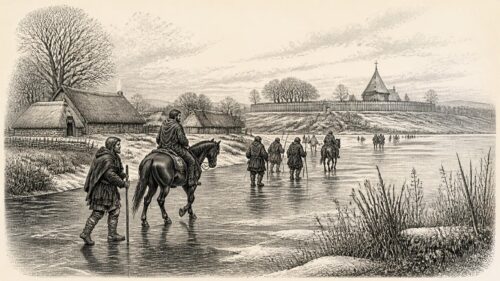
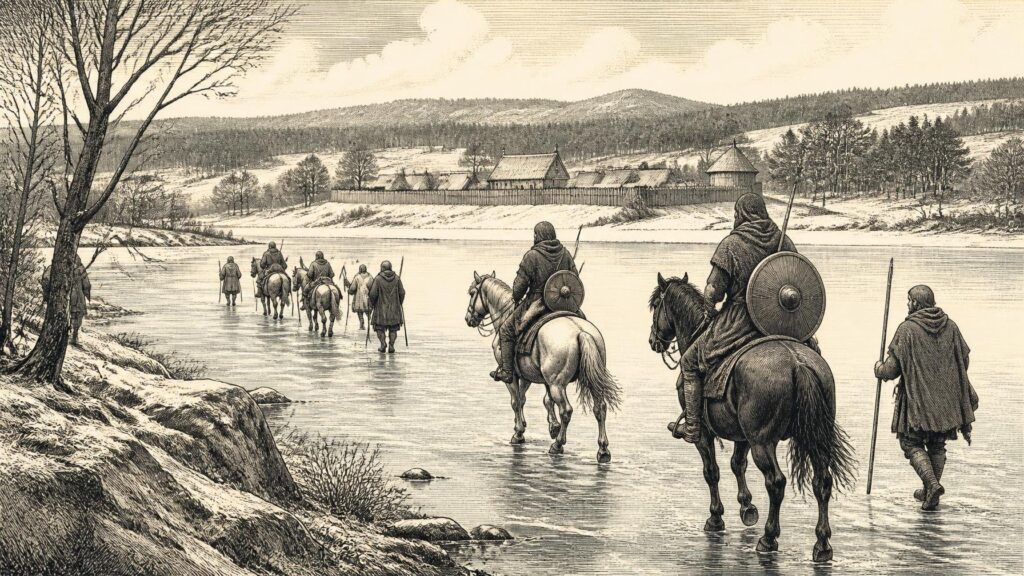
The annalists described an intense frost in which Ireland’s principal lakes and rivers could be crossed on foot and on horseback. This was not merely picturesque weather reporting. Inland water was normally a barrier, a route for boats, and a boundary between territories; when it froze, ordinary movement, herding, communications and military calculation all changed. The sources do not tell us which parties crossed which waters or whether a particular raid depended on the ice. It would be unsafe to turn the notice into a story of armies marching across a named lough. Yet the record makes clear that communities throughout the island experienced an extraordinary environmental condition, sufficiently memorable to enter more than one annalistic tradition. Chronicon Scotorum also calls it a stormy year, a reminder that weather could be registered alongside kings, battles and church affairs as a matter of public consequence.
Máel Sechnaill at Cashel
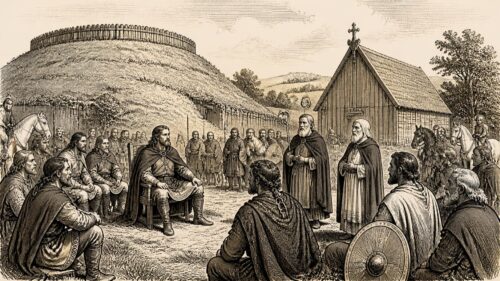
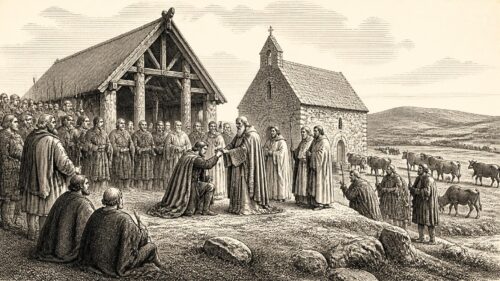
Against this wintry background, Máel Sechnaill mac Máele Ruanaid was recorded as being at Cashel and taking hostages from Mumu, or Munster. He was the dominant ruler of the southern Uí Néill and king of Tara; his career shows repeated attempts to compel recognition from Munster’s competing political interests. The terse entry does not say that he conquered Munster, deposed its rulers, or permanently occupied Cashel. It does say something very important: he was able to appear at the province’s principal royal centre and exact hostages. In early medieval politics, hostages were not a ceremonial afterthought. Their delivery made an agreement enforceable and marked an unequal relationship between the receiving king and those who submitted persons of standing to his custody.
The event belongs to a wider, but carefully bounded, pattern. Máel Sechnaill had already intervened in Munster in 854, and further campaigning and hostage-taking are recorded in 858. Those surrounding expeditions should not be collapsed into 856, but they show that the Cashel visit was neither accidental nor evidence of settled all-Ireland government. It was one episode in a continuing effort to turn military reach into political obedience. Cashel mattered because it was a centre through which a king could make a claim upon Munster; hostages mattered because they gave that claim practical force after an army had gone home.
War and the Gall-Goídil
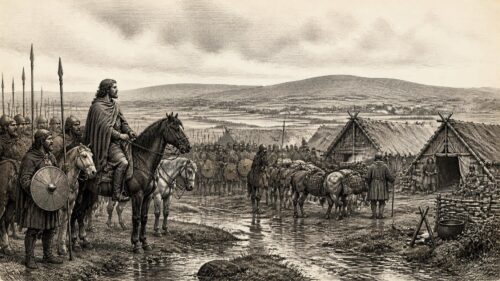
The same annal year reports “great warfare” between the genti, conventionally translated as heathens or pagans, and Máel Sechnaill, “with Gall-Goídil” on his side. The report is consequential but frustratingly spare. It supplies neither battlefield nor victor, and it does not name the opposing Scandinavian leaders. Later entries name Ímar and Amlaíb in fighting in Munster in 857; that does not licence placing either man, with certainty, in the undated war notice for 856. The prudent conclusion is that Máel Sechnaill fought a major conflict against a force the annalist designated as heathen, aided by a group called Gall-Goídil.
The Gall-Goídil are particularly revealing. The name is often rendered “Foreign-Gaels” or “Norse-Irish”, but the annal does not define ancestry, language, place of origin or religious practice. It should not be treated as a neat ethnic category. A later, much more expansive literary account portrays Gall-Goídil in hostile terms as people who had abandoned baptism and adopted Scandinavian ways; that is valuable evidence for later attitudes, not a neutral description that can simply be inserted into the record for 856. What the contemporary-style annal securely demonstrates is political permeability. Men identified neither simply as Irish nor simply as foreign could fight alongside the king of Tara against other overseas-connected forces. The conflict was therefore not a straightforward contest between an Irish population and external invaders, but part of a shifting Irish Sea world of alliances, rival warbands and regional kingship.
Fighting in the North
In the north, Áed son of Niall inflicted a great rout on Norse-Irish forces at Glenn Foichle, with, in the annalist’s emphatic wording, a vast number killed. Áed was a leading member of the northern Uí Néill and a future king of Tara, though that later prominence should not be projected backwards as though he already ruled Ireland in 856. The place is generally associated with Glenelly in modern County Tyrone, far from the coastal image often attached to Viking-age conflict. If that identification is correct, the notice indicates that Scandinavian-connected armed groups could operate well inland, and that local dynastic leaders could meet them there with effective force. Beyond the fact of a major defeat, however, the annal tells us neither why the force was in the valley nor what followed immediately afterwards.
Lusk and Slane
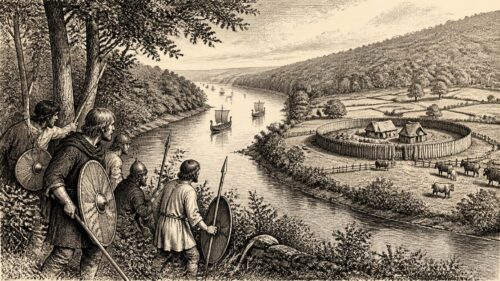
Violence also reached ecclesiastical communities. Norsemen burned the oratory of Lusca, modern Lusk in north County Dublin. The word translated “oratory” should not conjure the present round tower: Lusk’s surviving tower is later, dating to the late tenth century. The 856 entry instead preserves the loss of a church building within an older monastic settlement, probably a vulnerable structure of timber or other perishable materials. Such a burning represented more than damage to a place of worship. Monasteries were centres of landholding, food production, craft, hospitality, literacy and local authority, and their churches could contain portable wealth and sacred objects.
The bishop Sodomna of Slane suffered a violent death, which Chronicon Scotorum and the Fragmentary Annals explicitly attribute to Norsemen. Slane stood in the Boyne landscape, within reach of routes connecting the Irish Sea, Brega and the midlands. The sources do not describe the killing, identify a raiding party, or state whether the monastic settlement itself was destroyed in 856. Nonetheless, Sodomna’s death and the Lusk burning show why ecclesiastical institutions were caught up in the same instability that shaped royal campaigning: churches were spiritually important, but they were also conspicuous nodes of people, resources, learning and patronage.
Writing, Prayer and an Irish Sea Horizon
Not all the year’s church notices were violent. The Annals of Ulster mark the peaceful deaths of Suibne, described as scribe, anchorite and abbot of Lismore, and Cormac of Lathrach Briúin, a scribe and bishop. These compressed titles reveal the overlapping religious and intellectual roles expected in major ecclesiastical networks. A scribe was part of the labour that copied texts and preserved records; an anchorite signalled a life of ascetic devotion; an abbot or bishop exercised institutional authority. Their deaths cannot tell us what books they wrote or which schools they directed, but they properly belong beside the military notices. Ireland in 856 was not defined only by raiding: it retained communities capable of sustaining learning, worship and disciplined religious life.
Finally, the annals note that Horm, leader of the Dubgaill or “dark foreigners”, was killed by Rhodri son of Merfyn, king of Wales. The event occurred outside Ireland, but it belongs to Irish history’s immediate horizon. Irish, Welsh and Scandinavian leaders moved through a shared maritime zone in which fleets, raiders, refugees and political news crossed the sea. The year’s record is thus local and international at once: frozen inland waters, a royal appearance at Cashel, attacks on churches near Dublin and the Boyne, conflict in Tyrone, and warfare across the Irish Sea.
856 does not yield a single decisive battle or a simple tale of national unity. Its importance lies in the pattern it exposes. Máel Sechnaill could demand Munster hostages, but faced major warfare; Áed could win a northern rout, while Lusk and Slane remained exposed; religious houses endured as centres of authority and learning, yet paid heavily for their visibility. Above all, the Gall-Goídil show that identities and loyalties were being remade within, rather than merely imposed upon, Ireland. The frost gave the year its unforgettable image: roads where water should have been. The politics of 856 were similarly unstable, opening temporary paths of power across an island still divided among many rulers and communities.
Primary Sources
- The Annals of Ulster: Year U856
- The Annals of Ulster
- Chronicon Scotorum: Annal CS856
- Chronicon Scotorum: Annal CS856 (Irish text)
- Chronicon Scotorum
- Fragmentary Annals of Ireland
- Annals of Inisfallen
- Annals of the Four Masters
- Vikings in Irish Chronicles, 794–902: Data
- Máel-Sechnaill
- Vikings in Ireland and Scotland
- Viking Ireland: Afterthoughts
- The Vikings in Ninth-Century Ireland: Sources and Settlements
- Irish Chronicles and Their Chronology
- The Chronology and Sources of the Early Irish Annals
- The Dating of the Irish Annals
- Lusk Round Tower and Belfry
- Hill of Slane
- Early Medieval Dwellings and Settlements in Ireland, AD 400–1100: Vol. 1 Text
- Early Medieval Ireland: Archaeological Excavations, 1930–2009
- Patrician and Early Christian Architecture
- Early Christian Monasteries
- The Archaeology of Early Christianity in the North of Ireland, Volume 1
- The Triads of Ireland