Linn Duachaill’s Counterstroke851 CE
In 851, rival Viking groups contested Ireland’s eastern seaways. The Dubgenti attacked Dublin’s Finngenti, killing many and plundering their longphort, but suffered heavy losses when attacking the defended base at Linn Duachaill near Annagassan. These events reveal competition for ships, wealth, captives and strategic ports rather than a unified Viking campaign. Meanwhile, Máel Sechnaill mac Máele Ruanaid, king of Tara, convened rulers and churchmen at Armagh, strengthening northern alliances and authority. He also helped kill Cináed of Cianachta, a rebellious regional rival, despite guarantees. Foreign violence killed Eochu of Fir Rois. The year illustrates contested military, political and ecclesiastical power.
Dateline
The clearest record of 851 CE in Ireland is not a single war between Irish and Scandinavian forces, but a sharp collision within the Viking world and an equally revealing act of Irish political theatre. At Dublin, a force called the Dubgenti, usually rendered ‘dark foreigners’ or ‘dark heathens’, struck at the Finngenti, the ‘fair foreigners’, killing many and plundering their fortified ship-camp. The attackers then turned north towards Linn Duachaill, the Viking longphort near modern Annagassan in County Louth, where the annals report a severe reverse. In the same year Máel Sechnaill mac Máele Ruanaid, king of Tara, gathered rulers and churchmen at Armagh. The two developments belonged to the same unsettled Irish Sea world: military groups competed for ports and plunder, while an ambitious Irish overking sought acknowledged authority across provincial boundaries.
A Year with Difficult Dates
Dating ninth-century Irish events requires care. Chronicon Scotorum places the Dublin attack, the fighting at Linn Duachaill, the Armagh assembly and the killing of Cináed son of Conaing under 851. The relevant section of the Annals of Ulster is numbered U851 but carries a calendrical heading equivalent to AD 850, an effect of a known chronological displacement in that compilation. The later Annals of the Four Masters also rearrange some events by more than a year. For this reason, 851 is the conventional and defensible date for the main sequence, but claims about particular days or the exact order of every episode would exceed the evidence. The annals are terse records, not a continuous diary.
One firmly associated event was the death of Cináed son of Conaing, king of Cianachta in Brega. The annalists say that Máel Sechnaill and Tigernach, king of Brega, had him drowned cruelly in a lake, despite guarantees given by leading men of Ireland and, especially, by the successor of Patrick. A later, highly literary account in the Fragmentary Annals expands the episode into a tale of summons, deception and calculated political killing. Its details should not be accepted uncritically, but the agreement of the annalistic tradition on Cináed’s violent removal is important. He had recently rebelled against Máel Sechnaill with foreign support and ravaged Uí Néill lands, churches and secular settlements. His death removed a formidable regional challenger from the king of Tara’s eastern neighbourhood.
Fighting for Dublin
The attack on Áth Cliath, Viking Dublin, demonstrates that ‘the Vikings’ were no single army or people acting with one purpose. The Irish annals distinguish the combatants as dark and fair foreigners. Older scholarship commonly treated these labels as Danes and Norwegians, and that remains a useful shorthand for the episode; yet the terms were labels used by Irish writers, not reliable descriptions of hair colour, nationality or a fixed political identity. The people involved could have come from varied Scandinavian, insular and mixed backgrounds. What matters most is that rival maritime groups were fighting for control of resources and bases in Ireland.
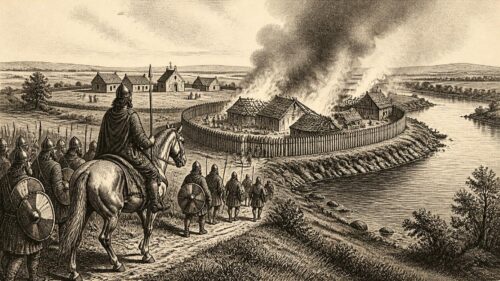
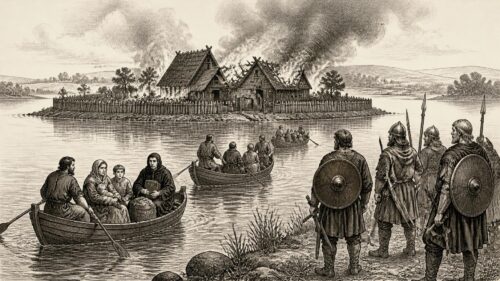
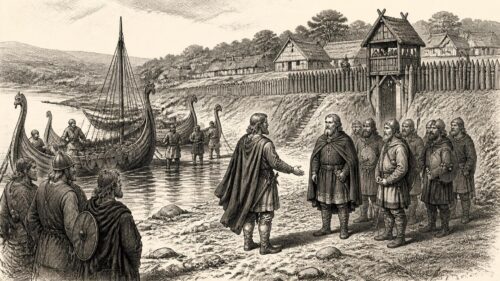
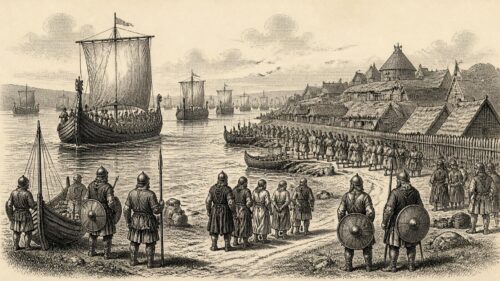
The Dublin camp was a longphort, literally a ship-place: a defended waterside encampment where vessels, crews, captives, food, weapons and portable wealth could be concentrated. It was not yet the fully developed Hiberno-Norse town familiar from later centuries. Nevertheless, it was already a strategically important node at the mouth of the Liffey, linking the Irish Sea to inland routes and to the densely populated kingdoms of Leinster, Brega and Mide. When the dark foreigners entered the camp in 851, they killed many of the fair foreigners and plundered both people and property. That wording is stark. It points not merely to a clash at sea but to the seizure of ships, goods and persons within an established base.
The struggle was therefore also economic. Armed fleets required supplies, repair materials, crews and secure anchorages; their leaders profited from raiding, tribute, ransom and captive-taking. A fortified camp offered a place to store such gains, but it also became an attractive prize for competitors. The annal does not permit an exact reconstruction of numbers, tactics or commanders at Dublin. It does, however, show that the raiders’ success depended on holding infrastructure as well as winning encounters. For communities along the east coast, the consequences of rivalry between Viking groups could be as dangerous as a raid launched against Irish rulers.
The Blow at Linn Duachaill
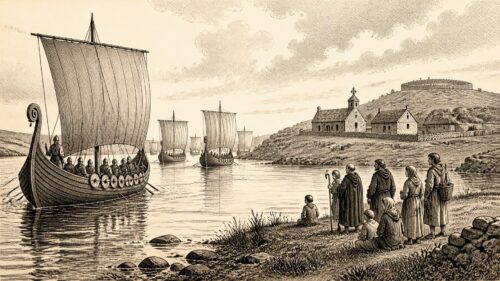
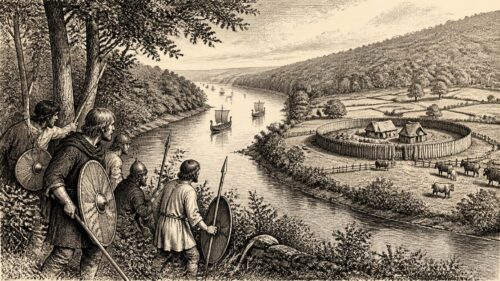
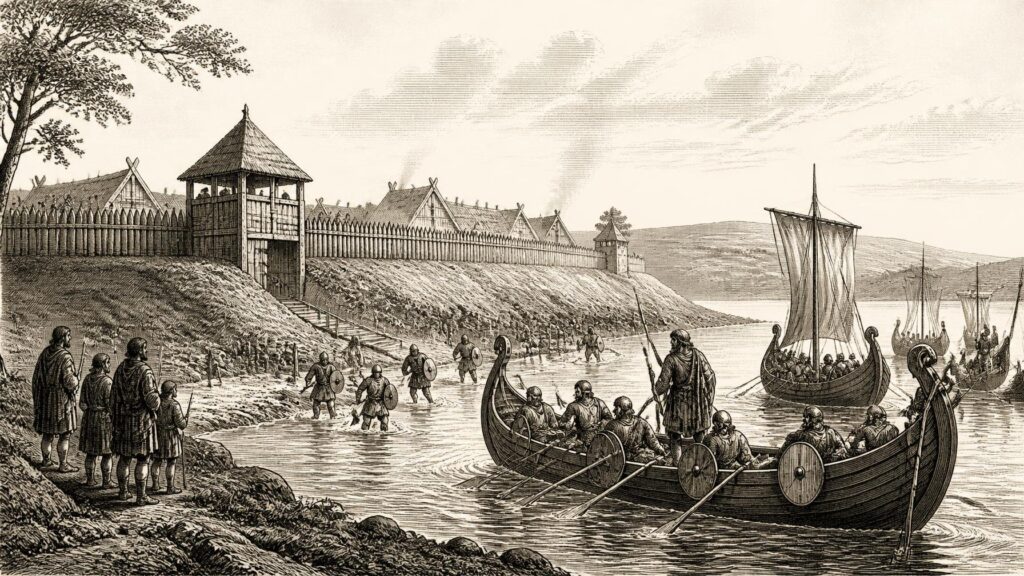
After Dublin, the dark foreigners made an attack on Linn Duachaill. The annal adds that a great slaughter was inflicted on them there. This is the year’s decisive reversal: the force which had successfully plundered Dublin did not simply carry its advantage northward. Linn Duachaill, at the confluence of the Glyde and Dee near the modern village of Annagassan, had been established as a longphort a decade earlier. Archaeological survey and excavation have identified substantial defensive earthworks cutting across the peninsula, alongside evidence of burning and Viking-period activity. The physical setting explains its attraction: access to the sea, sheltered water, and river routes running inland through north-east Ireland.
That defensive landscape helps make sense of the annal, without allowing archaeology to invent details of the battle. The evidence does not identify a battlefield, nor does it reveal how many people fought in 851. It does establish that Linn Duachaill was a large, defended maritime base rather than a fleeting beach landing. Its occupants could protect ships and accumulated goods, and could also draw upon local knowledge and alliances. The failed attack suggests that the northern longphort was able to resist a hostile fleet, at least on this occasion. In a single campaigning season, Dublin was plundered and Linn Duachaill held: control of Ireland’s eastern seaways was contested rather than settled.
Máel Sechnaill at Armagh
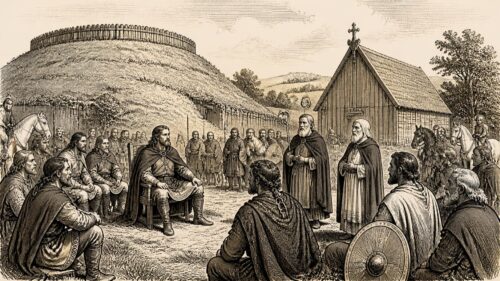
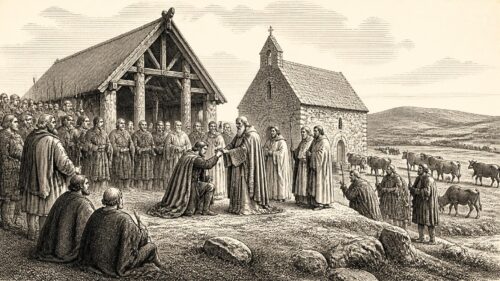
While these conflicts reshaped the coast, Máel Sechnaill pursued authority by assembly. The annals record a rígdál, or royal meeting, at Armagh between him and the nobles of Leth Cuinn, the northern half of Ireland in traditional political language; Matudán, overking of Ulaid, with the nobles of his province; Diarmait and Fethgna with Patrick’s congregation; and Suairlech with the clergy of Mide. The list is significant because it carefully sets secular magnates beside ecclesiastical communities. Armagh was not simply a convenient meeting place. Its claim to stand in Patrick’s succession gave proceedings there a moral and institutional weight that could strengthen agreements between kings.
The exact terms of the settlement are not preserved. Modern biographical scholarship plausibly sees the meeting as an acknowledgement of Máel Sechnaill’s superiority by Matudán of Ulaid, but the annal itself merely records the gathering. It is safer to say that the conference displayed Máel Sechnaill’s capacity to convene major northern rulers and to work through the church of Armagh. That alone was a political achievement. Irish overkingship was not a centralised monarchy. It depended on personal alliances, military capacity, hostages, tribute, legal guarantees and public recognition. A meeting attended by the king of Tara, an overking of Ulaid, the Patrician clergy and the churchmen of Mide was one means by which those relationships could be negotiated and made visible.
Diarmait, the leading ecclesiastic named at the assembly, had emerged from a long dispute for the abbacy of Armagh. He was accompanied by Fethgna, who would succeed him after his death in 852. Their presence illustrates the importance of learned churchmen in high politics. The community of Patrick could preserve agreements, supply religious legitimacy and connect Armagh’s interests to rulers across Ireland. Suairlech, associated with Ind Eidnén and linked to the church of Clonard, represented the clerical world of Mide, Máel Sechnaill’s own power-base. In 851, then, religious institutions were neither detached spectators nor merely victims of warfare: they were active participants in diplomacy.
Violence, Sanctuary and Daily Security
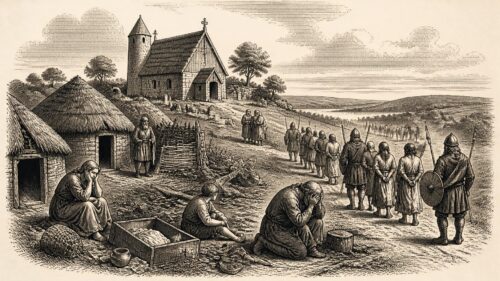
The year also exposes the limits of that authority. Cináed’s drowning, said to have violated solemn guarantees, showed how quickly political necessity could override the protection offered by elite pledges and church backing. Elsewhere, Eochu son of Cernach, king of Fir Rois in the kingdom later associated with south Armagh and Monaghan, was killed by heathens. The notice is brief, but it confirms that foreign military activity continued to affect local kings beyond the great camps at Dublin and Linn Duachaill. For farmers, church tenants, traders and households in these districts, insecurity was likely experienced through demands for food, cattle, transport, labour and protection as much as through the rare large encounter preserved in a chronicle.
Nothing in the evidence permits a confident account of harvests, weather or ordinary domestic routines in 851. Nor should the Scandinavian conflicts eclipse the wider Irish population. Most people lived in dispersed rural communities, worked mixed agricultural landscapes and were governed through local lordships and church estates. Yet the recorded events show why coastal waterways and ecclesiastical centres mattered so much. Ships made violence mobile; longphuirt turned temporary raiding forces into durable strategic presences; and Armagh’s religious prestige gave an overking a forum in which to answer fragmentation with alliance.
By the close of 851, neither side had established a lasting settlement of Ireland’s political future. Dublin had proved vulnerable, Linn Duachaill had proved resilient, and Máel Sechnaill had demonstrated an ability to punish rivals and summon leading powers to Armagh. The year is best understood as a moment of contested control: of ports and ships, of Brega and the northern provinces, and of the public language through which power could be recognised in Christian Ireland.
Primary Sources
- The Annals of Ulster: U851
- The Annals of Ulster: U852
- The Annals of Ulster
- Chronicon Scotorum: Annal CS851
- Chronicon Scotorum
- Fragmentary Annals of Ireland
- Fragmentary Annals of Ireland: Annals FA233–FA240
- Fragmentary Annals of Ireland: Annals FA241–FA247
- Annals of the Four Masters
- Vikings in Irish Chronicles, 794–902: Data
- Vikings in Ireland and Scotland
- Máel-Sechnaill
- Diarmait
- Fethgna
- Suairlech ind Eidnén
- Forannán
- Patrick (Patricius, Pátraic, Pádraig)
- The Viking Longphort of Linn Duachaill, Co. Louth, 2010
- Annagassan – Lisnarann
- The Winter Camp of the Viking Great Army, AD 872–3, Torksey, Lincolnshire
- Dublin as a Longphort
- Early Medieval Ireland: Archaeological Excavations, 1930–2009
- Annals of Inisfallen