Tomrair at Scíath Nechtain848 CE
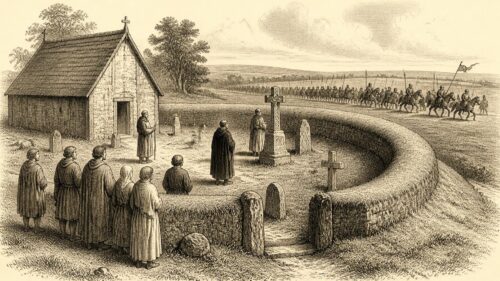
In 848, Irish annals recorded a cluster of victories over Viking forces, although later compilations and exaggerated casualty figures require caution. Máel Sechnaill of Tara defeated raiders at Forach, while Ólchobar of Munster and Lorcán of Leinster killed Tomrair, a prominent Scandinavian jarl and deputy, at Scíath Nechtain. Tigernach of Lagore and the Eóganacht of Cashel won further successes. Ólchobar also campaigned against the Viking fort at Cork, though its outcome is unknown. These actions demonstrated regional resistance, not national unity, amid disruption to communities and churches. Viking bases and activity endured, but victory enhanced Irish confidence and standing abroad.
Dateline
A Year of Counterstroke
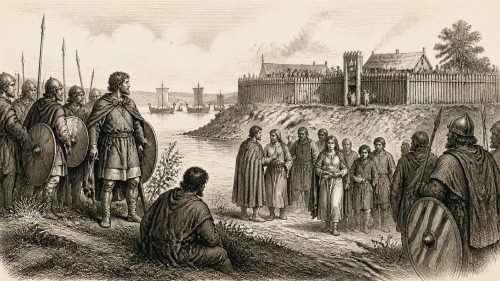
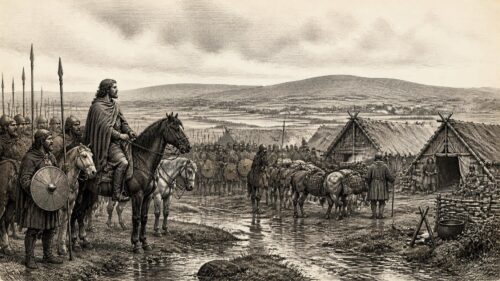
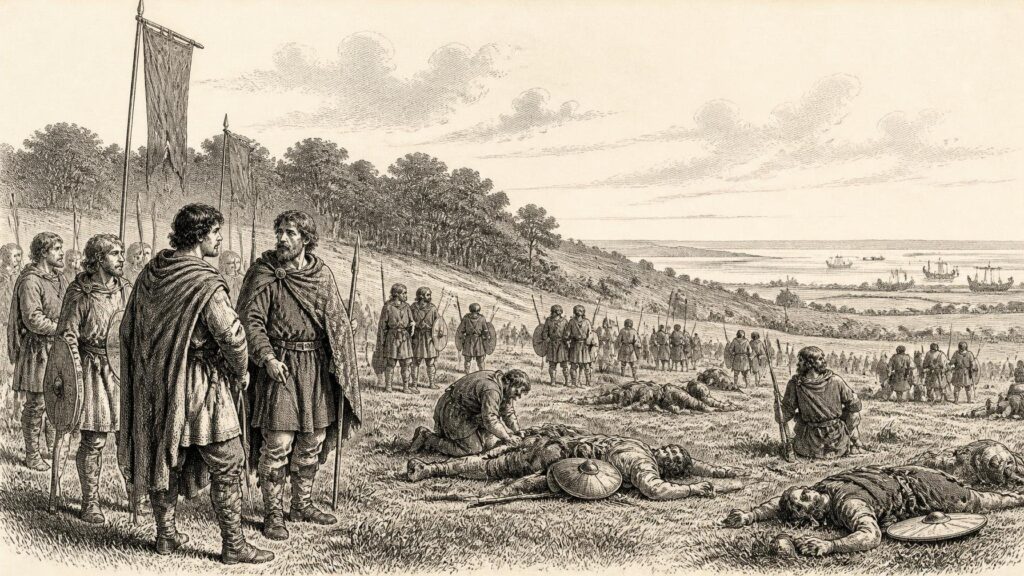
In 848, Irish annalists recorded an exceptional sequence of victories over Viking forces. The entries are terse, and their casualty totals cannot be accepted literally, yet their combined message is unmistakable: powerful Irish rulers had mounted co-ordinated resistance in several regions after years in which raiders had pushed inland, seized waterways and established defended bases. The most consequential encounter was fought at Scíath Nechtain in Leinster, probably near modern Castledermot, County Kildare. There Ólchobar mac Cináeda of Munster and Lorcán mac Cellaig, leading the Leinstermen, defeated a force commanded by Tomrair, described as an erell or jarl and as tanist—heir-designate or deputy—of the king of Lochlann.
The year must nevertheless be handled carefully. The surviving annals were compiled later from earlier records, and their year-numbering does not always align perfectly: the Annals of Ulster places this campaign in an entry whose internal AD label is one year out of step, while the Annals of Inisfallen, Chronicon Scotorum and modern historical treatment connect the battle firmly with 848. The sources also disagree over some details, especially numbers killed. What can responsibly be said is that 848 was remembered across more than one annalistic tradition as a year of major Irish successes against overseas raiders.
Four Victories, One Campaign Season
Máel Sechnaill mac Máele Ruanaid, king of Tara and ruler of the southern Uí Néill, won a battle at Forach, where the Annals of Ulster says 700 “heathens” fell. In annalistic usage, that term normally denotes the Scandinavian raiders rather than providing a detailed account of their beliefs or identities. Forach is generally associated with the Skreen area of modern County Meath, though the precise battlefield is not securely identified. The report matters because it places the king of Tara himself at the head of a successful response in the central-eastern region, close to the Irish Sea routes on which raiding fleets moved.
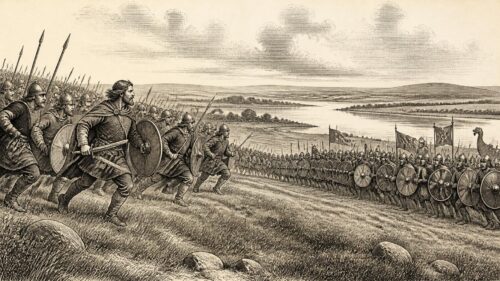
Farther south, the battle of Scíath Nechtain brought together rulers whose territories faced one another across the Munster–Leinster frontier. Ólchobar, identified by the annals as king of Mumu or Munster, and Lorcán, ruler of Leinster, defeated Tomrair’s force with the men of Leinster. The Annals of Inisfallen gives the battle special prominence and names Tomrair alone among the defeated. Its companion entry associates 848 with Ólchobar’s assumption of the kingship of Cashel, making the victory an emphatic opening statement for a Munster ruler whose authority was still new.
Tomrair’s title is as significant as his death. A jarl was not simply an anonymous raider, while tanist of the king of Lochlann implies a man standing near the summit of a wider Scandinavian political order. It does not establish the identity of that king, and Lochlann in ninth-century Irish sources should not automatically be translated as Norway. Scholars have variously connected it with Scandinavian power in Scotland and the western seaways. The wording does, however, show that the Irish annalist believed Tomrair commanded more than a casual ship-crew. His loss was therefore remembered as a blow against an organised external leadership.
How costly was the defeat? Here the sources warn against false precision. One version of the Ulster entry gives 200 men falling with Tomrair; Chronicon Scotorum and the later Annals of the Four Masters give 1,200. Such totals often functioned as conventional signs of a vast slaughter and victory rather than audited counts. The defensible conclusion is not that exactly 200 or 1,200 men died, but that the battle was regarded as a very large and decisive Irish success.
Other victories were reported in the same annalistic sequence. Tigernach, lord of Loch Gabor—Lagore in County Meath—routed raiders in the oakwood of Dísert Do-Chonna. The Annals of Ulster gives 1,200 dead, whereas related traditions offer a smaller figure of twelve score. The Eóganacht of Cashel then defeated another force at Dún Máile Tuile, with 500 said to have fallen. These notices should not be forced into a single centrally directed national campaign: early medieval Ireland had no unitary state or standing army. Yet they reveal a striking concentration of successful actions by the king of Tara, Munster’s ruler and dynasty, Leinster’s ruler, and a lord in southern Brega. In 848, local kingship and provincial authority could meet maritime violence with effective armed levies.
Ólchobar and the Cork Fort
Chronicon Scotorum adds a further development that the Annals of Ulster does not preserve: Ólchobar established an encampment to destroy the foreigner-held fort of Corcach, Cork. The later Annals of the Four Masters likewise records a military expedition by him against the foreigners at Cork. Neither account supplies a clear outcome, so it would be wrong to claim that Cork was captured or its settlement destroyed in 848. Even so, the notice is important. It shows that the conflict was not confined to chance encounters in open country; Irish rulers could turn against fortified Viking positions linked to coastal movement and raiding.
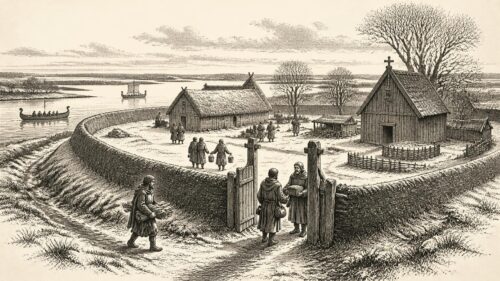
Such sites were not yet towns in the later medieval sense. The Scandinavian newcomers had created defended ship-camps, commonly called longphuirt in Irish sources, at strategic river and coastal locations. Dublin, established as a Viking base in 841–42, remained particularly important in the Irish Sea world. Cork’s fort likewise belonged to a landscape in which vessels could bring people, weapons, captives and portable wealth between river mouths and overseas routes. The 848 victories checked particular forces; they did not end Viking activity, erase those bases, or remove Scandinavian people from Ireland.
War, Lordship and Everyday Vulnerability
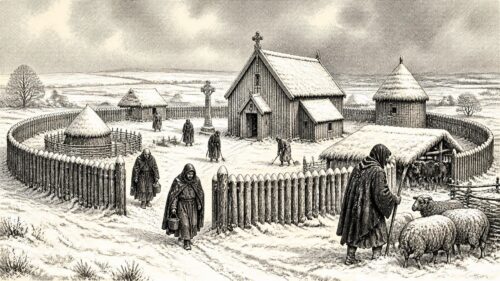
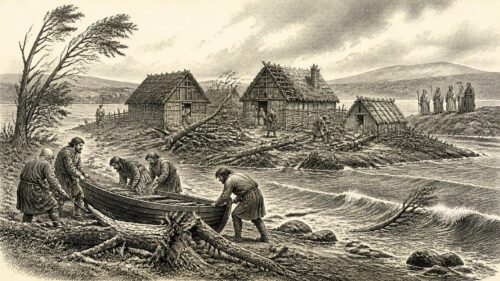
The campaign was fought within a society whose political building blocks were kingdoms, dynasties, clientships and ecclesiastical communities. Kings gathered followers through landholding, tribute, protection and personal alliance; warfare could involve professional retainers but depended heavily on local levies. The annals name rulers and battlefields, not the farmers, herders, craftworkers, women, children and enslaved people whose lives sustained those forces. Nevertheless, military movement would have affected them directly. Armies consumed food, took cattle and required transport. A raid or counter-raid could interrupt sowing, harvesting, travel, fishing and the tending of animals, particularly in districts near waterways and contested routes.
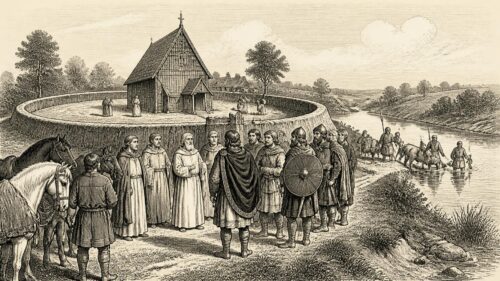
Numbers in the annals should not be converted into population statistics, but they point to the scale of fear created by raiding. Scandinavian forces had been active in Ireland for more than half a century, and by the 840s they could travel up major rivers and overwinter in defended bases. Religious settlements were vulnerable because they held livestock, food renders, metalwork, manuscripts and skilled people, but they were also political centres connected to kings and kin-groups. The sharp distinction often made between peaceful monasteries and violent secular society is misleading: church communities had dependants, estates and alliances, and clerics could participate in local defence.
Churches and Changing Authority
The annals also preserve quieter changes. Fínnechta of Luibnech died; he is described as an anchorite and a former king of Connacht. His career illustrates how religious life and aristocratic status overlapped. Withdrawal into an ascetic vocation did not remove a person from the memory of secular rank, and a former ruler’s death was worth recording alongside battles. Tuathchar son of Cobthach, king of the Luigni, also died, a reminder that lordship was continually reshaped by mortality and succession.
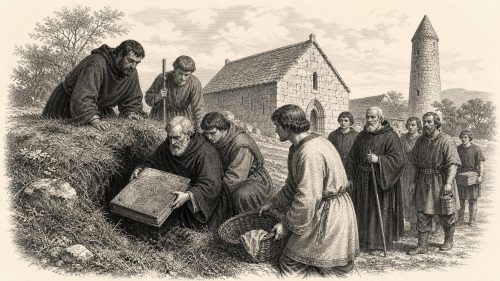
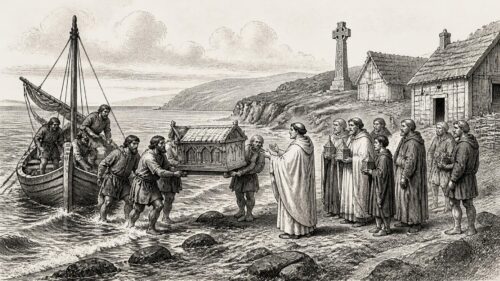
At Armagh, Diarmait replaced Forannán as abbot. This was more than an internal appointment. Armagh was the principal church of Patrick and an institution with extensive religious and political claims across Ireland. Forannán had been seized by raiders only a few years earlier, in 845, when the shrine of Patrick was also carried off. The change of abbot in the aftermath of those attacks indicates both disruption and continuity: the community endured, its leadership was renewed, and ecclesiastical authority remained a central part of Irish public life.
News Beyond Ireland
The victories of 848 resonated beyond the island. The Frankish Annals of St-Bertin report that the Irish had overcome the Vikings with divine help and that envoys came with gifts to Charles the Bald, seeking passage through his realm for a pilgrimage to Rome. The Frankish wording exaggerates matters by suggesting that the Vikings had been driven from Ireland altogether; they had not. Yet the embassy is valuable evidence of diplomatic reach. Irish rulers and churchmen could use victory against raiders to present themselves at a Carolingian court as Christian allies, linked by travel, gift-giving and pilgrimage to continental politics.
Thus 848 was not a final expulsion but a turning point in confidence and capability. Tomrair’s death at Scíath Nechtain, the victories at Forach, Dísert Do-Chonna and Dún Máile Tuile, and Ólchobar’s move against Cork together showed that Viking groups in Ireland could be defeated by Irish coalitions and regional powers. The sea-borne threat survived, as did the settlements from which it operated. But for one campaign season, the annals record the balance tilting sharply towards Ireland’s kings.
Primary Sources
- The Annals of Ulster
- The Annals of Ulster, Year U848
- Chronicon Scotorum
- Chronicon Scotorum, Part 84
- Annals of Inisfallen
- Annals of Inisfallen, Part 40
- Annals of the Four Masters
- Annals of the Four Masters, Part 67
- Vikings in Irish Chronicles, 794–902: Data
- Vikings in Ireland
- Vikings in Scotland and Ireland in the Ninth Century
- The Vikings in Ninth-Century Ireland: Sources and Settlements
- The Vikings in Ninth-Century Ireland: Sources and Settlements (PDF)
- The Viking World
- Three Welsh Kings and Rome: Royal Pilgrimage, Overlordship, and Anglo-Welsh Relations in the Early Middle Ages
- Annales Bertiniani
- Annales Bertiniani, Pars Prima
- Early Medieval Ireland
- Carraig Aille, Lough Gur
- Carron Ringfort
- Dún Eoghanachta (The Fort of Eoghanacht)
- Errigal Ringfort
- Grangefertagh Round Tower and Church
- Annals of Inisfallen: Bibliographic and Manuscript Information